Register For Our Mailing List

Register to receive our free weekly newsletter including editorials.

Home / 373

Retirement adequacy: COVID means we need to work longer

As has been well canvassed, those who withdraw money from superannuation under the COVID-19 early access scheme will reduce the savings available to them and hence weaken their prospects of an adequate retirement.

But what of the other, broader, impacts of the COVID-19 pandemic on retirement savings?

Four factors drive retirement income variations

To demonstrate the possible impacts, Willis Towers Watson created 12 examples of people (we'll call them 'cameos') aged between 30 and 60 years and with various earning levels. We assume all 'cameos' work to age 67 with no career breaks, receive contributions at the legislated superannuation guarantee (SG) rates, invest in a balanced investment option throughout their working lifetime and retirement, and are married with a superannuation account balance equal to their spouse throughout retirement (for the purpose of Government Age Pension).

We consider four factors to show how retirement outcomes might be affected by the pandemic:

1. Investment returns

2. Switching behaviour

3. Early release payments

4. Periods of unemployment.

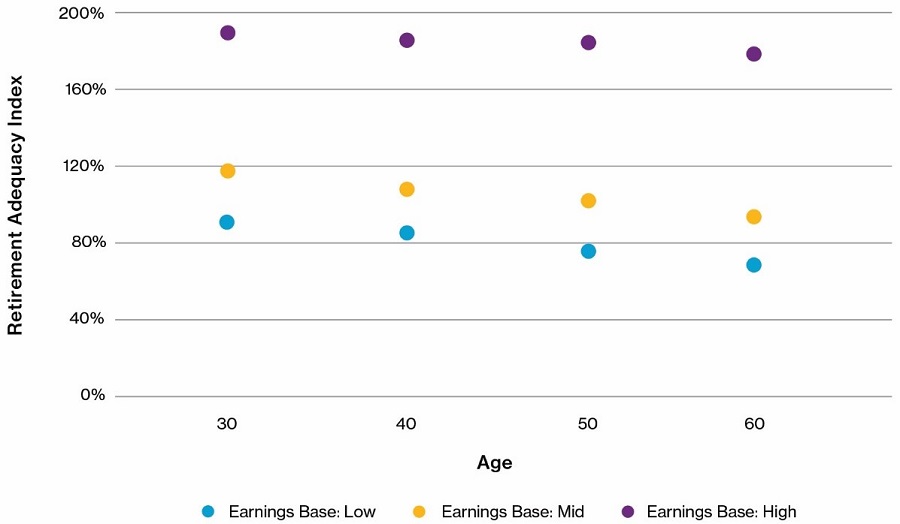
Before we can quantify the pandemic’s impact, we need to establish a baseline. We have determined the retirement adequacy for the 12 cameos on a pre-COVID-19 outlook as at 31 December 2019. We measure retirement adequacy using an index calculated as the ratio of prospective retirement income (including age pension) to the ASFA Comfortable Standard.

As expected, younger members benefiting from a full working lifetime of SG contributions are projected to achieve a higher Retirement Adequacy Index (RAI) than older members.

For each cameo, the RAI has been redetermined after allowing for each of the pandemic-related stresses.

Pre COVID-19 Retirement Adequacy
1. Investment returns

COVID-19 saw markets tumble globally in the March 2020 quarter. While markets partially recovered over the ensuing months, Balanced options still recorded losses for the six months ending 30 June 2020, with a median return (SuperRatings) of -4.9%.

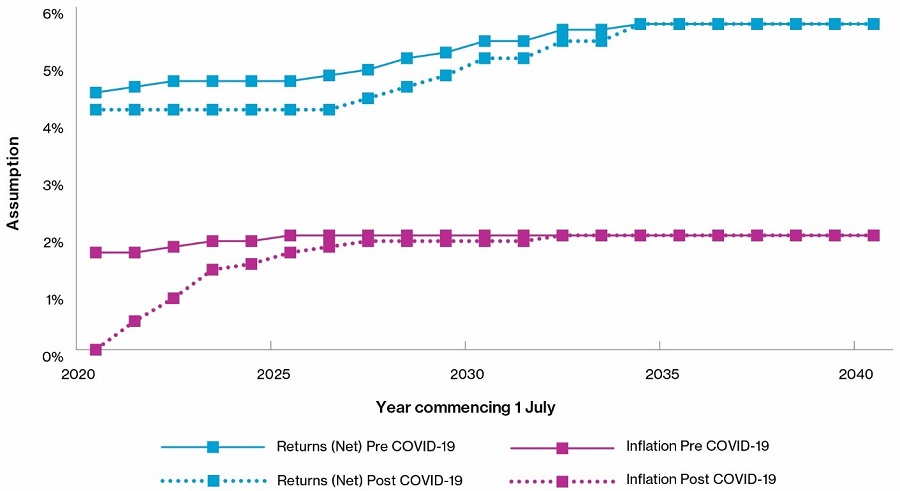
While acknowledging the unpredictability of markets, the investment return stress comprises both the impact of the (lower than anticipated) returns to 30 June 2020 and assumptions reflecting lower expected inflation and investment returns in the medium term due to the ongoing effects of the pandemic.

Key Financial Assumptions
2. Switching behaviour

Throughout March and April 2020, many funds reported members shifting to cash and low growth investment options in response to the market downturn. Similar patterns were observed during the GFC in 2008-09, after which many members did not return to their previous investment options for some time, if at all.

The ‘switching’ stress assumes a switch to cash at 31 March 2020, following the most significant COVID-19 related investment losses, returning to a Balanced investment option after 10 years, to illustrate the impact of a long delay before reinvesting.

3. Early release

The special provision allowing the release of up to $20,000 (two payments tranches of up to $10,000) from superannuation accounts was introduced as a pandemic stimulus measure. Over $30 billion had been released by 16 August by over a million individuals.

Our ‘early release’ stress allows for two early release payments of $10,000, up to the value of the current account balance. We have allowed for the timing of many tranche one payments, which occurred immediately following the poor investment returns of the first quarter of the year, and hence reduced the exposure to the subsequent market recovery.

4. Periods of unemployment

The shutdown imposed to restrict the spread of COVID-19 in Australia has resulted in a significant spike in unemployment, with Treasury forecasting an unemployment rate of up to 9.25% in the December quarter 2020. Large numbers of Australians will see little to no contributions coming into their superannuation accounts over the next few years.

Our ‘unemployment’ stress allows for a three-year period of unemployment to illustrate the potential impact of a period of sustained unemployment, after which time the individual is assumed to return to their previous level of earnings.

Impact of COVID-19 on retirement adequacy

The reduction in Retirement Adequacy as a result of each stress, both in isolation and collectively, is shown below.
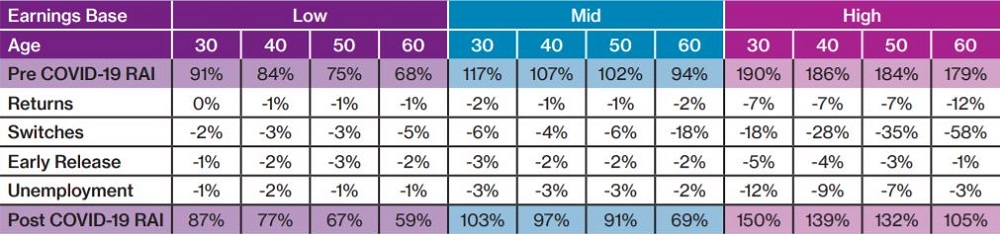
Those in the low earnings band incur the smallest reduction in adequacy across the board, due to retirement income being buttressed by the age pension.

The greatest adverse impact comes from switching. While the proportion of members that switch to cash is still reasonably small across the industry, the analysis demonstrates that it can be very damaging and is particularly acute for older members, reflecting the importance of investment returns in the ‘retirement risk zone’ (the years immediately preceding and after retirement date).

The impact of early release is greater for younger members. The exception is those with a low earnings base and account balance, where withdrawals are significantly less than the maximum $20,000. And younger members are most affected by periods of unemployment, with lost income in the early years leading to the largest impact at retirement through the power of compound interest.

So, what can individuals do to offset these impacts? Some, particularly higher earners, may choose to retire with a slightly lower retirement income if they are able to maintain their desired lifestyle with the funds available.

For others, the most obvious action is to contribute more by way of voluntary member contributions. However, at a time where unemployment is projected to reach its highest since the great depression, many will not have the ability or inclination to do this.

Those unable or unwilling to make additional contributions may be forced to work past their preferred retirement age – if such an option is available to them. The below table illustrates the additional number of years an individual would need to work to achieve their pre COVID-19 adequacy. Clearly, for those approaching retirement for whom additional work for up to eight years is required, this approach may not be feasible.

Additional working years required to restore Pre COVID-19 Retirement Adequacy

By using this analysis to understand how different cohorts have been affected by the pandemic, investors and service providers can better understand the impact of policies, unemployment and investment returns and how to respond sensibly.

The full report is available here.


Nick Callil is the Head of Retirement Solutions and Erinn Cullinane is Associate Director, Retirement at Willis Towers Watson Australia.


  •   2 September 2020
  • 8
  •      
  •   
8 Comments
George
September 02, 2020

Most investors are unrealistic about future return expectations based on the past. Bonds and term deposits will give nothing, and future equity returns will be subdued in the face of a global recession and decline in global trade.

Aaron
September 03, 2020

Exactly. In 30 years government will be stunned that the average super fund balance is actually lower than it was in 2020.

Dudley.
September 05, 2020

"Bonds and term deposits will give nothing, and future equity returns will be subdued in the face of a global recession and decline in global trade.":

The consistent response of governments to recession has been to repress interest rates.

Governments repressing interest rates results in money bidding up the price of assets - without increasing the earnings from the assets - which results in decreasing rate of return from the bid up assets.

Recession reduces the earnings from the assets - which also results in decreased rate of return.

Assets prices are influenced by the combination of repressed interest rates and reduced earnings the overall result being reduced interest rates and reduced rate of return.

John J
September 02, 2020

People who sit behind desks for 40 years make lovely statements about 'working longer'. Spend 40 years on a building site and see if you've got another five years in you at age 60.

David Bell
September 02, 2020

Thanks for unpacking the different drivers Erinn and Nick - not an easy exercise.
Cheers, David

Jo
September 06, 2020

The liberal government do not like compulsory Super, much of which goes to Industry Funds who historically have the lowest cost / best return ratio, giving financial power to the unions with the Super bank of influencing wealth.

John
September 08, 2020

By working longer to build the nest egg, we block new job entrants for longer, making unemployment even worse in a world where the need for human labour is declining in advanced economies, due to AI, automation, robots etc. A more likely scenario is governments obliging earlier retirement in some job sectors, simply to get out of the way of the next generation. Better to start paying the "aged" pension earlier for those with modest resources, than to keep paying unemployment benefits like JobSeeker to a larger cohort.

SMSF Trustee
September 08, 2020

I'd need to see evidence that a job held by someone over 60 years of age is taking a job from someone trying to enter the workforce before accepting this line of argument, John. From my observations of the workforce, that simply isn't the case.
the need for human labour isn't diminishing, it's changing. As it always has. The workforce's skill set changes, people retrain, the next generation learns how to do things that the older generation doesn't do. If that didn't happen, then how come everyone isn't unemployed? Because there are very few jobs being done today that are the same as they were 50 years ago, or even 20 years ago.


Leave a Comment:

RELATED ARTICLES

Uncomfortable truths: The real cost of living in retirement

Putting off that retirement speech

The Division 296 tax is still a quasi-wealth tax

banner

Most viewed in recent weeks

Building a lazy ETF portfolio in 2026

What are the best ways to build a simple portfolio from scratch? I’ve addressed this issue before but think it’s worth revisiting given markets and the world have since changed, throwing up new challenges and things to consider.

Get set for a bumpy 2026

At this time last year, I forecast that 2025 would likely be a positive year given strong economic prospects and disinflation. The outlook for this year is less clear cut and here is what investors should do.

Meg on SMSFs: First glimpse of revised Division 296 tax

Treasury has released draft legislation for a new version of the controversial $3 million super tax. It's a significant improvement on the original proposal but there are some stings in the tail.

Ray Dalio on 2025’s real story, Trump, and what’s next

The renowned investor says 2025’s real story wasn’t AI or US stocks but the shift away from American assets and a collapse in the value of money. And he outlines how to best position portfolios for what’s ahead.

10 fearless forecasts for 2026

The predictions include dividends will outstrip growth as a source of Australian equity returns, US market performance will be underwhelming, while US government bonds will beat gold.

13 million spare bedrooms: Rethinking Australia’s housing shortfall

We don’t have a housing shortage; we have housing misallocation. This explores why so many bedrooms go unused, what’s been tried before, and five things to unlock housing capacity – no new building required.

Latest Updates

3 ways to fix Australia’s affordability crisis

Our cost-of-living pressures go beyond the RBA: surging house prices, excessive migration, and expanding government programs, including the NDIS, are fuelling inflation, demanding bold, structural solutions.

Superannuation

The Division 296 tax is still a quasi-wealth tax

The latest draft legislation may be an improvement but it still has the whiff of a wealth tax about it. The question remains whether a golden opportunity for simpler and fairer super tax reform has been missed.

Superannuation

Is it really ‘your’ super fund?

Your super isn’t a bank account you own; it’s a trust you merely benefit from. So why would the Division 296 tax you personally on assets, income and gains you legally don’t own?

Shares

Inflation is the biggest destroyer of wealth

Inflation consistently undermines wealth, even in low-inflation environments. Whether or not it returns to target, investors must protect portfolios from its compounding impact on future living standards.

Shares

Picking the next sector winner

Global equity markets have experienced stellar returns in 2024 and 2025 led, in large part, by the boom in AI. Which sector could be the next star in global markets? This names three future winners.

Infrastructure

What investors should expect when investing in infrastructure: yield

The case for listed infrastructure is built on stable earnings and cash flows, which have sustained 4% dividend yields across cycles and supported consistent, inflation-linked long-term returns.

Investment strategies

Valuing AI: Extreme bubble, new golden era, or both

The US stock market sits in prolonged bubble territory, driven by AI enthusiasm. History suggests eventual mean reversion, reminding investors to weigh potential risks against current market optimism.

Sponsors

Alliances

© 2026 Morningstar, Inc. All rights reserved.

Disclaimer
The data, research and opinions provided here are for information purposes; are not an offer to buy or sell a security; and are not warranted to be correct, complete or accurate. Morningstar, its affiliates, and third-party content providers are not responsible for any investment decisions, damages or losses resulting from, or related to, the data and analyses or their use. To the extent any content is general advice, it has been prepared for clients of Morningstar Australasia Pty Ltd (ABN: 95 090 665 544, AFSL: 240892), without reference to your financial objectives, situation or needs. For more information refer to our Financial Services Guide. You should consider the advice in light of these matters and if applicable, the relevant Product Disclosure Statement before making any decision to invest. Past performance does not necessarily indicate a financial product’s future performance. To obtain advice tailored to your situation, contact a professional financial adviser. Articles are current as at date of publication.
This website contains information and opinions provided by third parties. Inclusion of this information does not necessarily represent Morningstar’s positions, strategies or opinions and should not be considered an endorsement by Morningstar.