Stay committed to your decisions, but stay flexible in your approach.
- Tony Robbins
Last week I proposed a scorecard for retirement where readers could self-assess their retirement prospects using four criteria:
- Understanding the maths of retirement
- Knowing how much you will spend
- Estimating how much you need to support annual spending
- Defining an asset allocation strategy
I received several questions about the maths of retirement. In essence, I was asked if I committed an informal fallacy by using the 4% rule as the basis for creating the personalised withdrawal rate.
These are valid questions. The 4% rule was designed for the American retirement system. There are several core differences in the Australian system which call into question the 4% rule’s relevance to our local market.
As an American who moved to Australia 12 years ago, I’ve had to adapt my thinking to an entirely new retirement system. Is my outside perspective useful? Or am I too influenced by the framework I grew up with? That is the question I set out to answer.
Difference one: Minimum pension drawdown rates
Once you move your super to an account-based pension the government requires you to withdraw a minimum percentage of your balance each financial year.
The minimum pension drawdown rate is based on your age. The following table outlines the withdrawal rates:
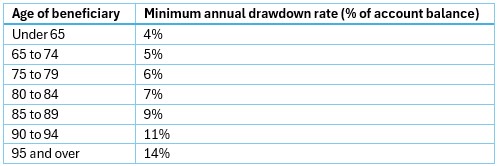
For anyone with an account-based pension who is older than 65, the minimum annual drawdown rate exceeds 4%. On the surface this presents an issue as the government is requiring you to take out more from your super than the 4% rule would suggest is sustainable.
Prior to identifying the disconnect between the two withdrawal rates it is worth looking at the intention of the 4% and the minimum pension drawdown rate.
The 4% rule is intended to represent a sustainable withdrawal rate given a variety of market return and inflation environments over 30 years. Specifically, it is supposed to protect against a bear market and high inflation early in retirement.
The minimum pension drawdown rate is not designed with the sustainability of a portfolio in mind. There are generous tax breaks for account-based pensions. Investors pay no tax on capital gains or income.
The minimum pension drawdown rate is designed to get assets out of this generous tax environment so the funds can be taxed or spent. This isn’t some conspiracy theory. Politicians from various political parties have repeatedly said the purpose of super is not tax minimisation or estate planning – it is to pay for retirement.
How do various withdrawal rates impact retirement outcomes?
Retirement outcomes are dependent upon market and economic conditions. Most academic studies use a Monte Carlo simulation which tests different combinations of inflation and market returns.
The 1998 Trinity Study by finance professors Cooley, Hubbard and Walz tested every scenario between 1926 and 1995 at different withdrawal rates. A scenario was deemed a failure if a retiree ran out of money in less than 30 years.
For a 4% withdrawal there was a 0% failure rate for a 75% growth / 25% defensive asset allocation. For a 5% withdrawal rate the failure rate jumped to 22%.
That is a stark difference, but it is worth noting that the failures for the 5% withdrawal rate occur if someone has the bad luck of retiring at the wrong time. The wrong time is during a high inflation environment when markets immediately plummet.
The first five years of retirement are the danger zone. The initial withdrawal rate you pick is tested during this period.
A simple example demonstrates the importance of getting through this danger zone. If you retired five years ago you’ve made it through this perilous period in decent shape. Inflation was relatively high, but returns were strong.
The following chart shows the returns of various AustralianSuper funds in pension mode and inflation for the previous five financial years.
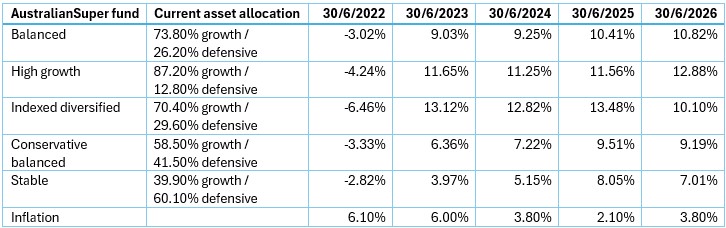
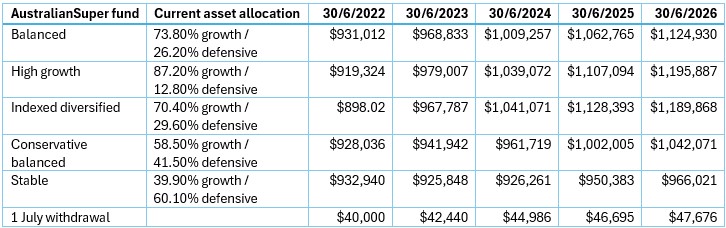
Assume a retiree began retirement with a $1,000,000 portfolio, withdrew their expenses each year on 1 July starting in 2021, and then earned the applicable financial year returns.
The following is the annual ending balance with a 4% initial withdrawal rate subsequently increased by inflation.
Next is the annual ending balance with a 5% initial withdrawal rate subsequently increased by inflation.
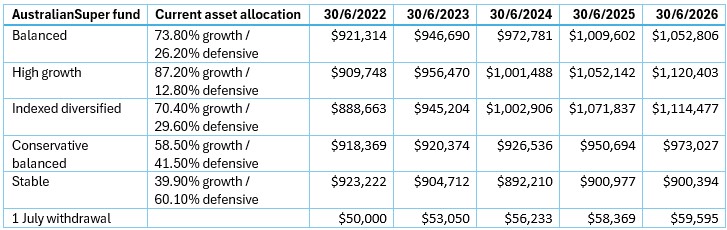
In both cases the hypothetical retiree’s portfolio has held up well. In the 4% withdrawal scenario an investor would have a larger portfolio than when they started in four out of five AustralianSuper investment options. The most conservative portfolio balance is only ~$34,000 lower despite supporting spending of ~$221,000.
The 5% withdrawal impacted the portfolio balance, but three out of five portfolios invested in AustralianSuper investment options have risen in value. In this case all five portfolios have supported ~$277,000 of spending.
What if returns were lower?
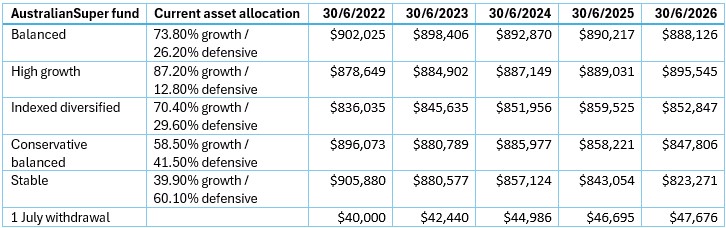
Another scenario shows what happens if someone retires in a less advantageous environment. Unlike the Monte Carlo simulation I’m not modeling out the worst possible situation. I used the same inflation figures from the last five years and simply adjusted the returns.
I reduced the positive returns by half and doubled the drawdown in the financial year ending 30 June 2022 when an AustralianSuper investor experienced negative returns.
Below is the 4% withdrawal scenario:
And the 5% withdrawal scenario:
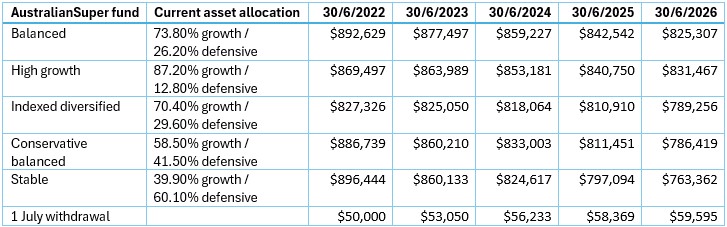
This is far from a doomsday scenario but the outcomes are very different. The ending balances at the 4% withdrawal rate were 14.77% to 28.32% higher under the actual market return scenarios. In the 5% withdrawal scenario they were 15.22% to 29.18% higher.
These are arbitrary examples, but they are illustrative of both the dangers of sequencing risk during the first years of retirement and the limitations of assuming retirees won’t adjust their behaviour in response to changing conditions.
In all of these examples and any Monte Carlo simulation the underlying assumption is no action is taken by the retiree based on returns or inflation. No adjustments are made to spending levels and no thought is put into which positions are sold and which are retained.
The core lesson from all these studies on withdrawal rates is that there is a danger zone during the first five years of retirement. That is when investment mistakes matter more, the overall return environment is more consequential and increasing spending is more impactful.
My advice remains consistent. Set a withdrawal rate that is appropriate for your own situation. Use your personalised withdrawal rate and take the minimum pension drawdown rate at face value – the intention of the policy makers in Canberra wasn’t to set retiree spending levels. You may have to take the money out of super but you don’t have to spend it.
Difference two: Do the distinctions between social security in the US and the age pension mean the 4% rule doesn’t apply in Australia?
This is a very good question. Unlike the age pension there is no means test for social security in the US. If someone is employed for around ten years in the US they are eligible for social security.
Lifetime earnings impact the amount of the social security payment as well as when someone elects to start receiving benefits. A reduced benefit is available at 62 years old, the full benefit at 67 and a larger benefit is paid to people who delay until 70 years old.
Social security provides a baseline level of financial support in retirement with a current average benefit of around US$2,000 or $2,900 per month.
The age pension operates differently. For some retirees the age pension makes up all or a portion of spending from the start of retirement. But for all retirees it acts as a fallback plan. The current maximum age pension for a single person is $1,237.70 per fortnight.
For both retirees eligible for social security in the US and Australian retirees ‘running out of money’ isn’t technically possible. But if you begin retirement with enough assets to exclude you from the age pension the means test should factor into your decision making.
This is highly dependent on your personal circumstances. The age pension eligibility criteria can be ignored if your wealth far exceeds the cutoff. In that case, focus on the sustainability of the lifestyle that level of wealth enables.
However, if you are not eligible for the age pension at retirement but are relatively close to qualifying make sure you factor that into how you think about your initial withdrawal rate, asset allocation and housing situation.
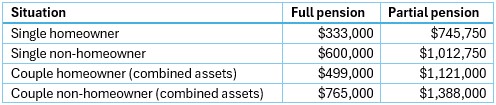
The following table shows the current cut-off for full and partial age pension eligibility. Assets exclude the value of your primary place of residence.
Reconsidering your withdrawal rate
If there was no age pension fallback you need to pick an initial withdrawal rate that makes it unlikely you will run out of money if you go through a challenging market environment early in retirement.
With an age pension fallback, it makes sense to set a higher initial withdrawal rate to support spending early in retirement when you are active. If returns are high, you will be fine. If returns are poor and your portfolio drops in value you will be eligible for the partial or full age pension.
Factor the age pension into your asset allocation
The same logic applies to asset allocation. Allocating more of your portfolio to growth assets increases your expected long-term returns.
This benefit is offset by the increased volatility of growth assets. But if your portfolio falls in value you could become eligible for the age pension. You get all the upside of growth assets while the age pension partially offsets the consequences of poor returns.
Addressing housing in retirement
The value of your primary place of residence is not included in the age pension means test. More Australians are retiring with a mortgage and housing is generally the largest item in a household budget.
If you retire with a mortgage there is an incentive to pay it off using any other funds you’ve accumulated. That eliminates a large expense and might make you eligible for the age pension.
Final thoughts
Differences between retirement systems do matter. The current rules and tax policies should influence your retirement strategy and decision making. As should your personal circumstances.
Remember, the rules and tax policies are not set in stone. We’ve seen profound changes in the last two years and changes will continue.
The wealth you accumulate is not the defining feature of your life. It is an enabler of getting to define your life on your own terms.
That isn’t easy to do. It involves building knowledge. It requires discipline and patience over decades. It takes a bit of luck.
In my last column I challenged readers to complete a self-assessment to identify areas that might need some further attention. In this column I’ve challenged my outside perspective. I think the principles of retirement planning apply to any system.
If you don’t understand the maths of retirement, I would encourage you to put in some work to increase your knowledge.
Australian retirees shouldn’t blindly follow any rule of thumb – especially one designed for another retirement system.
But nor should they ignore the underlying principles. The maths of retirement doesn’t change just because rules are different.
Questions, comments or restaurant recommendations? I can be reached at [email protected].
Mark LaMonica, CFA, is Director of Personal Finance at Morningstar Australia.