Planning is bringing the future into the present so that you can do something about it.
- Alan Lakein
The 2026 Epic Retirement Tick rated industry and retail super funds against a set of twenty criteria designed to measure how well they supported their members in retirement.
I’m supportive of any effort that helps Australians improve their retirement outcomes. But I also have a different worldview. Advice and support play a key role in outcomes. But ultimately my retirement comes down to me.
A super fund – like any investment – is a tool. My retirement outcome depends on the person wielding the tool. No organisation is going to hand me the life I want.
The agency you have over your outcome is both the promise and challenge of investing. For anyone who wants a great retirement I’ve come up with my own tick test. I’ve immodestly named it the 2026 Legendary Self-directed Investor Scorecard.
2026 Legendary Self-directed Investor Scorecard
A legendary retirement doesn’t happen by chance. You need a framework to guide your decision making and help you follow the pathway to achieving your goals. Use this scorecard to self-assess where you stand.
Do you understand the maths of retirement?
Financial literacy is the foundation for a great retirement. You don’t need advanced maths or to dedicate your life to financial planning. Understanding the high-level mechanics of retirement will do – that starts with the 4% rule.
There are several legitimate criticisms of the 4% rule. I’m an advocate for everyone to create a personalised retirement roadmap. But to do that means understanding the different factors that impact the sustainability of a withdrawal rate.
The baseline goal for every retiree is the same…don’t run out of money. How quickly you run out of money depends on the interplay between several factors including your withdrawal rate, inflation and the order and magnitude of returns.
For instance, in a recent article I ran a Monte Carlo simulation to figure out the probability of not running out of money in retirement. I put in assumptions for withdrawal rates, inflation, returns and asset allocation.
The simulation gave a 78.37% chance of not running out of money in thirty years. But the simulation also showed that starting out with $1m you have a 10% probability of ending up with more than $8.5 million in thirty years. The middle 50% of scenarios between the 25th percentile and the 75th percentile shows outcomes between $248k and $4.53m. These are meaningfully different outcomes and to have a great retirement you need to understand why.
Gaining this foundational knowledge allows you to incorporate your individual circumstances into a personalised plan. Your plan will help you spend confidently by knowing you’re not spending too much or too little.
If you can answer the following questions it is a good sign you understand the maths of retirement:
- What is the most challenging market environment to navigate as a retiree?
- What are the assumptions around spending embedded in the 4% rule?
- What are the assumptions about taxes embedded in the 4% rule?
- How long is the 4% rule designed to last?
- Why can two retirees with the same average return experience very different outcomes?
Give yourself a score between 1 to 5. 5 indicates you can easily answer the questions while 1 means you have some work to do. Scored low? Start with understanding the assumptions behind the 4% rule.
Do you have an estimate of how much you will spend each year?
Everybody will have a different vision of retirement. But in every case it won’t be free so you need to estimate how much you will spend each year.
The precision of your estimate is largely dependent on how long you have until retirement. I still have my estimate from my twenties in a spreadsheet. Looking at it now makes me want to go back in time and shake young, naïve Mark… don’t you know how much nice hotels and flights cost?
My ambitions and perspective have changed but that doesn’t mean it wasn’t worth going through the exercise.
An evolving goal is better than no goal at all.
Start with a goal and then develop a plan. Adjust accordingly. There are several factors to consider when making an informed estimate.
Typically, retirees spend a lot early in retirement when they are active and less once they’ve grown older. Spending can also spike at the end of life as medical and care costs come into play.
If you put these typical spending patterns on a chart it looks like a smile – hence, it is known as the smile effect. A study by a former Morningstar researcher found that spending typically drops in real terms by approximately 1% a year for retirees between the ages of 60 and 90.
This may not seem meaningful but it compounds over time. A retiree with $100,000 in spending at age 60 would hit a spending trough around age 84 when spending is $74,146 or 26% lower. Not accounting for this tendency may mean underspending early in retirement.
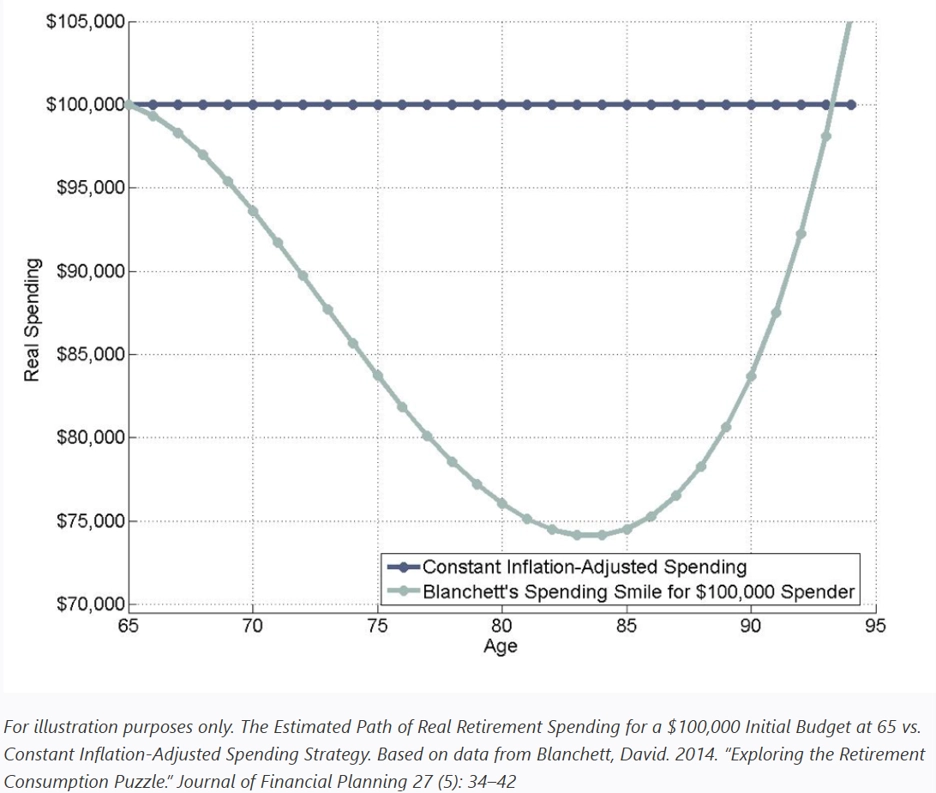
Source: What is the retirement spending smile?
When coming up with your estimate concentrate your efforts on the big categories of spending. Housing and day-to-day expenses are universal factors. Other categories will be dependent on your individual goals.
When estimating your retirement spending there are several questions to ask:
- Will your expenses change significantly in retirement? Examples include paying off your mortgage, relocating to a cheaper location or a desire for more recreation and travel.
- How vulnerable are your expected expense categories to inflation?
- Given your planned retirement age and / or health how long do you believe you will be active?
Give yourself a score between 1 to 5. 5 indicates you can easily answer the questions while 1 means you have some work to do. Scored low? My four-step process for estimating retirement spending should help.
Do you know how much money you need to retire?
I’m not a big believer in rules of thumb. You aren’t going to be successful without interrogating the conventional wisdom of retirement. Examples include the 4% rule / rule of 25 and the ASFA retirement standard.
A rule of thumb is a rough estimate that broadly applies to most people without precisely applying to any individual.
You are unique – your goals, financial circumstances and philosophy about money are all distinct. Estimating your annual retirement spending is only half the battle. Your withdrawal rate needs to be personalised as well.
The withdrawal rate is the next step in your retirement roadmap as it mathematically transforms your annual spending into the lump sum you need to retire. Small changes make a big difference. Increasing your withdrawal rate from 4% to 4.50% increases annual spending by 12.50%.
One reason hard and fast rules don’t work is because everyone’s circumstances are different. One example is the flexibility of retirement spending.
If most of your projected spending is on ‘needs’ there may be little flexibility and a requirement to increase spending by inflation.
If most of your spending is on ‘wants’ you may be able to adjust your spending based on market conditions and inflation.
Spending flexibility is just one example. Others include the length of your retirement, the return environment, your asset allocation, your investment flexibility. All these factors should influence your personalised withdrawal rate.
Once you’ve got an estimated withdrawal rate you can calculate the lump sum you need to retire. Just divide your annual spending needs by the withdrawal rate.
Now you have your target for a legendary retirement based on your personal circumstances rather than somebody else’s assumptions.
To estimate your personalised withdrawal rate consider the following:
- Do you have flexibility around your spending so you can adjust it based on market conditions?
- What percentage of your total expected spending is ‘needs’?
- Do you plan to retire prior to your preservation age and have you factored it into your plan?
Give yourself a score between 1 to 5. 5 indicates you can easily answer the questions while 1 means you have some work to do. Scored low? Get tips on creating a personalised retirement plan.
Do you have an asset allocation target?
For all the attention that security selection receives from investors, asset allocation plays the biggest role in investor outcomes.
Asset allocation impacts the long-term returns of portfolios. It impacts the volatility of a portfolio and the drawdowns faced by investors in bear markets.
Asset allocation decisions dictate how a portfolio will respond to the twin risks of retirement – sequencing risk and longevity risk. These are the two risks the 4% rule is designed to mitigate.
Sequencing risk refers to how the order – or sequence – of returns impacts how long a portfolio can support your spending in retirement. If you retire into a bear market and need to sell when prices are low to fund spending, you will run out of money faster.
Outliving your retirement savings is the other key risk faced by retirees. This is longevity risk which becomes more of a challenge as life spans increase.
The order of returns may not seem important. But if you retired in the year 2000 with a $1m portfolio and withdrew $40,000 annually you would be left with approximately $330,000 twenty years later if you invested your entire portfolio in the S&P 500.
If you reversed the order of S&P 500 returns over those twenty years you would end up with approximately $1.564m. The average return is the same but the outcomes are very different.
The simplistic response to sequencing risk is to invest in more defensive assets which will fall less in a bear market. The problem with defensive assets is that they have lower long-term returns.
Those lower returns are a problem because of longevity risk. To avoid outliving your savings means investing in growth assets with higher expected long-term returns.
The seemingly contradictory approaches to addressing these twin risks underpins the dilemma for retirees when choosing the right asset allocation. But this high-level view ignores the nuance involved in crafting a plan for retirement.
Retirees have many tools at their disposal including using cash as part of a bucket approach, holding income generating assets, annuities and positioning within a high-level asset class.
Asset allocation decisions in retirement aren’t about perfection. They are about resilience under a variety of scenarios.
Come up with a plan to address the underlying risks of retirement which addresses the following questions:
- How will you respond if the market plunges early in retirement?
- How will you respond if returns are different from your expectations over the course of your retirement?
- How long can your portfolio last in retirement and what medical and care scenarios can it support?
Give yourself a score between 1 to 5. 5 indicates you can easily answer the questions while 1 means you have some work to do. Scored low? Learn how asset allocation can help you survive the worst year of retirement.
Final thoughts
Are you feeling more confident about retirement? Are there areas you need to focus on? Were you so confused by what I wrote that it might as well have been in Latin?
The good news is this wasn’t a test. The point of the scorecard was to help you identify areas that might need some further attention.
A legendary retirement doesn’t happen by chance. You are in control of your outcomes.
You can develop a baseline of financial literacy.
And you can use your knowledge to make the trade-offs needed to create a plan and adapt as circumstances change.
The future is unknown. That doesn’t mean you can’t take steps today to make it better.
Questions, comments or restaurant recommendations? I can be reached at [email protected]
Mark LaMonica, CFA, is Director of Personal Finance at Morningstar Australia.