Register For Our Mailing List

Register to receive our free weekly newsletter including editorials.

Home / 685

Does an American retirement rule work for Australians?

Stay committed to your decisions, but stay flexible in your approach.
- Tony Robbins

Last week I proposed a scorecard for retirement where readers could self-assess their retirement prospects using four criteria:

  • Understanding the maths of retirement
  • Knowing how much you will spend
  • Estimating how much you need to support annual spending
  • Defining an asset allocation strategy

I received several questions about the maths of retirement. In essence, I was asked if I committed an informal fallacy by using the 4% rule as the basis for creating the personalised withdrawal rate.

These are valid questions. The 4% rule was designed for the American retirement system. There are several core differences in the Australian system which call into question the 4% rule’s relevance to our local market.

As an American who moved to Australia 12 years ago, I’ve had to adapt my thinking to an entirely new retirement system. Is my outside perspective useful? Or am I too influenced by the framework I grew up with? That is the question I set out to answer.

Difference one: Minimum pension drawdown rates

Once you move your super to an account-based pension the government requires you to withdraw a minimum percentage of your balance each financial year.

The minimum pension drawdown rate is based on your age. The following table outlines the withdrawal rates:
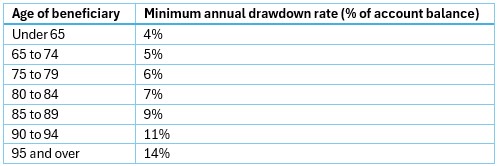
For anyone with an account-based pension who is older than 65, the minimum annual drawdown rate exceeds 4%. On the surface this presents an issue as the government is requiring you to take out more from your super than the 4% rule would suggest is sustainable.

Prior to identifying the disconnect between the two withdrawal rates it is worth looking at the intention of the 4% and the minimum pension drawdown rate.

The 4% rule is intended to represent a sustainable withdrawal rate given a variety of market return and inflation environments over 30 years. Specifically, it is supposed to protect against a bear market and high inflation early in retirement.

The minimum pension drawdown rate is not designed with the sustainability of a portfolio in mind. There are generous tax breaks for account-based pensions. Investors pay no tax on capital gains or income.

The minimum pension drawdown rate is designed to get assets out of this generous tax environment so the funds can be taxed or spent. This isn’t some conspiracy theory. Politicians from various political parties have repeatedly said the purpose of super is not tax minimisation or estate planning – it is to pay for retirement.

How do various withdrawal rates impact retirement outcomes?

Retirement outcomes are dependent upon market and economic conditions. Most academic studies use a Monte Carlo simulation which tests different combinations of inflation and market returns.

The 1998 Trinity Study by finance professors Cooley, Hubbard and Walz tested every scenario between 1926 and 1995 at different withdrawal rates. A scenario was deemed a failure if a retiree ran out of money in less than 30 years.

For a 4% withdrawal there was a 0% failure rate for a 75% growth / 25% defensive asset allocation. For a 5% withdrawal rate the failure rate jumped to 22%.

That is a stark difference, but it is worth noting that the failures for the 5% withdrawal rate occur if someone has the bad luck of retiring at the wrong time. The wrong time is during a high inflation environment when markets immediately plummet.

The first five years of retirement are the danger zone. The initial withdrawal rate you pick is tested during this period.

A simple example demonstrates the importance of getting through this danger zone. If you retired five years ago you’ve made it through this perilous period in decent shape. Inflation was relatively high, but returns were strong.

The following chart shows the returns of various AustralianSuper funds in pension mode and inflation for the previous five financial years.
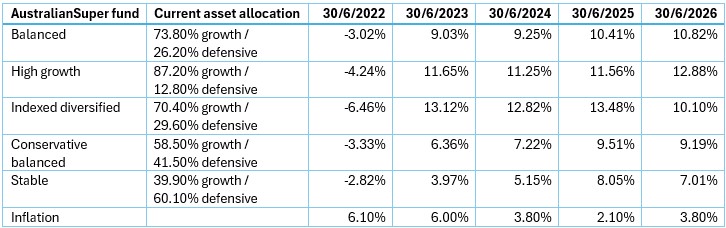
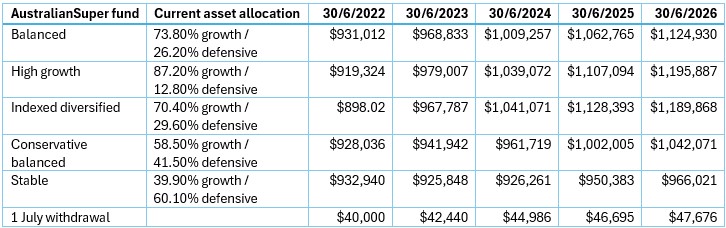
Assume a retiree began retirement with a $1,000,000 portfolio, withdrew their expenses each year on 1 July starting in 2021, and then earned the applicable financial year returns.

The following is the annual ending balance with a 4% initial withdrawal rate subsequently increased by inflation.
Next is the annual ending balance with a 5% initial withdrawal rate subsequently increased by inflation.
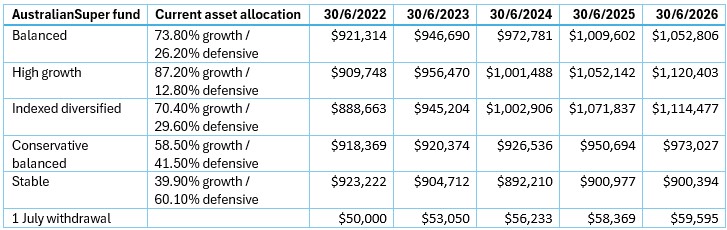
In both cases the hypothetical retiree’s portfolio has held up well. In the 4% withdrawal scenario an investor would have a larger portfolio than when they started in four out of five AustralianSuper investment options. The most conservative portfolio balance is only ~$34,000 lower despite supporting spending of ~$221,000.

The 5% withdrawal impacted the portfolio balance, but three out of five portfolios invested in AustralianSuper investment options have risen in value. In this case all five portfolios have supported ~$277,000 of spending.

What if returns were lower?

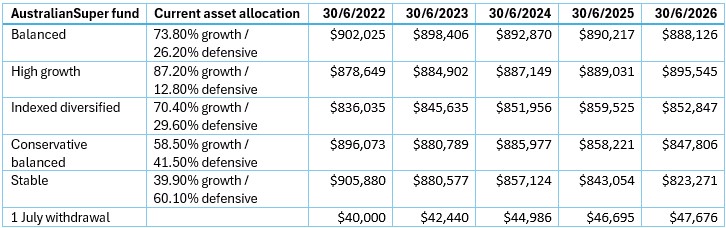
Another scenario shows what happens if someone retires in a less advantageous environment. Unlike the Monte Carlo simulation I’m not modeling out the worst possible situation. I used the same inflation figures from the last five years and simply adjusted the returns.

I reduced the positive returns by half and doubled the drawdown in the financial year ending 30 June 2022 when an AustralianSuper investor experienced negative returns.

Below is the 4% withdrawal scenario:
And the 5% withdrawal scenario:
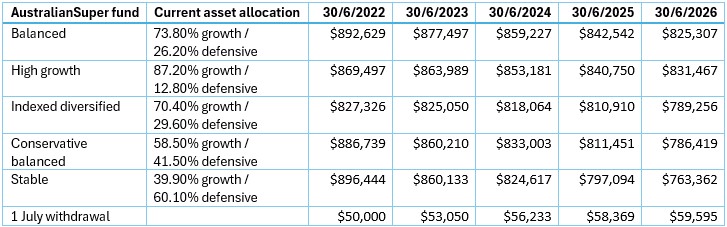
This is far from a doomsday scenario but the outcomes are very different. The ending balances at the 4% withdrawal rate were 14.77% to 28.32% higher under the actual market return scenarios. In the 5% withdrawal scenario they were 15.22% to 29.18% higher.

These are arbitrary examples, but they are illustrative of both the dangers of sequencing risk during the first years of retirement and the limitations of assuming retirees won’t adjust their behaviour in response to changing conditions.

In all of these examples and any Monte Carlo simulation the underlying assumption is no action is taken by the retiree based on returns or inflation. No adjustments are made to spending levels and no thought is put into which positions are sold and which are retained.

The core lesson from all these studies on withdrawal rates is that there is a danger zone during the first five years of retirement. That is when investment mistakes matter more, the overall return environment is more consequential and increasing spending is more impactful.

My advice remains consistent. Set a withdrawal rate that is appropriate for your own situation. Use your personalised withdrawal rate and take the minimum pension drawdown rate at face value – the intention of the policy makers in Canberra wasn’t to set retiree spending levels. You may have to take the money out of super but you don’t have to spend it.

Difference two: Do the distinctions between social security in the US and the age pension mean the 4% rule doesn’t apply in Australia?

This is a very good question. Unlike the age pension there is no means test for social security in the US. If someone is employed for around ten years in the US they are eligible for social security.

Lifetime earnings impact the amount of the social security payment as well as when someone elects to start receiving benefits. A reduced benefit is available at 62 years old, the full benefit at 67 and a larger benefit is paid to people who delay until 70 years old.

Social security provides a baseline level of financial support in retirement with a current average benefit of around US$2,000 or $2,900 per month.

The age pension operates differently. For some retirees the age pension makes up all or a portion of spending from the start of retirement. But for all retirees it acts as a fallback plan. The current maximum age pension for a single person is $1,237.70 per fortnight.

For both retirees eligible for social security in the US and Australian retirees ‘running out of money’ isn’t technically possible. But if you begin retirement with enough assets to exclude you from the age pension the means test should factor into your decision making.

This is highly dependent on your personal circumstances. The age pension eligibility criteria can be ignored if your wealth far exceeds the cutoff. In that case, focus on the sustainability of the lifestyle that level of wealth enables.

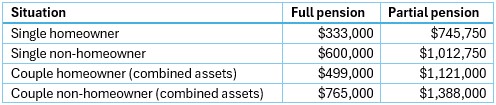
However, if you are not eligible for the age pension at retirement but are relatively close to qualifying make sure you factor that into how you think about your initial withdrawal rate, asset allocation and housing situation.

The following table shows the current cut-off for full and partial age pension eligibility. Assets exclude the value of your primary place of residence.
Reconsidering your withdrawal rate

If there was no age pension fallback you need to pick an initial withdrawal rate that makes it unlikely you will run out of money if you go through a challenging market environment early in retirement.

With an age pension fallback, it makes sense to set a higher initial withdrawal rate to support spending early in retirement when you are active. If returns are high, you will be fine. If returns are poor and your portfolio drops in value you will be eligible for the partial or full age pension.

Factor the age pension into your asset allocation

The same logic applies to asset allocation. Allocating more of your portfolio to growth assets increases your expected long-term returns.

This benefit is offset by the increased volatility of growth assets. But if your portfolio falls in value you could become eligible for the age pension. You get all the upside of growth assets while the age pension partially offsets the consequences of poor returns.

Addressing housing in retirement

The value of your primary place of residence is not included in the age pension means test. More Australians are retiring with a mortgage and housing is generally the largest item in a household budget.

If you retire with a mortgage there is an incentive to pay it off using any other funds you’ve accumulated. That eliminates a large expense and might make you eligible for the age pension.

Final thoughts

Differences between retirement systems do matter. The current rules and tax policies should influence your retirement strategy and decision making. As should your personal circumstances.

Remember, the rules and tax policies are not set in stone. We’ve seen profound changes in the last two years and changes will continue.

The wealth you accumulate is not the defining feature of your life. It is an enabler of getting to define your life on your own terms.

That isn’t easy to do. It involves building knowledge. It requires discipline and patience over decades. It takes a bit of luck.

In my last column I challenged readers to complete a self-assessment to identify areas that might need some further attention. In this column I’ve challenged my outside perspective. I think the principles of retirement planning apply to any system.

If you don’t understand the maths of retirement, I would encourage you to put in some work to increase your knowledge.

Australian retirees shouldn’t blindly follow any rule of thumb – especially one designed for another retirement system.

But nor should they ignore the underlying principles. The maths of retirement doesn’t change just because rules are different.

Questions, comments or restaurant recommendations? I can be reached at [email protected].


Mark LaMonica, CFA, is Director of Personal Finance at Morningstar Australia.


  •   21 October 2026
  • 11
  •      
  •   
11 Comments
Jon Kalkman
October 22, 2026

The 4% rule is based on an assumption. The assumption is that the investment portfolio produces insufficient income to sustain a retiree’s living expenses and that assets need to be progressively sold to generate their income. And selling assets for income immediately exposes investors to market risk and sequencing risk. That problem is particularly acute when market prices are low over an extended period because more and more assets then need to be sold to generate the same level of cash.

Market risk can be managed by diversification across different asset classes whose prices are more stable and have lower price volatility, but such diversification also provides lower growth and therefore offers less protection against inflation risk or longevity risk. In the US, growth assets produce very little income. That has prompted the 4% rule of thumb which is seen as the best compromise between market risk and longevity risk, for retirement savings to last 30 years.
 
In Australia, the impact of market volatility has particular relevance to retirees who draw their pension income from an Australian industry super fund. In accumulation phase, with each contribution, workers purchase units from their industry super fund at the prevailing price. In retirement phase, the cash for each pension payment comes from the sale of some of those units back to the fund, again at prevailing prices. Such a pension is at the mercy of market price volatility. Thus, unit sales continue until pension payments stop, hopefully not before the retiree expires. Inflation and increasing mandatory pension withdrawals simply accelerate that asset depletion. It explains why governments try to reduce the damage to these funds by easing the mandatory pension requirements at a time of low prices such as the GFC and COVID.

2
Jimmy
October 22, 2026

You don’t have to spend the whole 9% withdrawals, like spend 4% and keep 5% which can be invested outside super (without the super tax benefits unfortunately).

1
Steve
October 23, 2026

The old saying, just worry about what you can control, not what you cannot. Even if our investments have done well for many years this is more due to being invested in assets that appreciate over time. Can't really take any credit for that if we are being honest. What we do control is how much we spend. A system that is inflexible with regard to spending seems a poor starting proposition. If we cut spending in down markets it decreases the capital draw down, obviously. Of course everyone is different, some get by content on the age pension, others have to travel regularly and have higher expectations. You control these choices. But a system that cuts spending in down markets and maybe adds to a cash buffer in good times would be interesting to see modelled yo see if it makes much difference. Even just a simple 4% of balance model would be interesting. Avoids locking in a spend amount based somewhat arbitrarily on a particular starting balance and locking in a nominal inflation increase every year. Let's face it if you started with $1M you would start at $40000, but if you started with $0.9M you would start with $36000. If the starting amount is not fixed but a proportion of the initial balance why not apply this "rule" every year, with the actual balance as the starting point?

1
Rob
October 22, 2026

Only half the "equation"

Superannuation is designed to "cover" your cost of living with some dignity. 4% may or may not do that in which case you drawdown faster, tap other income sources or "ultimately", visit Centrelink. My personal plan is multi faceted:

- Starts with a fund growth estimate of +7.5% pa
- Estimates our Cost of Living, projected at +3% pa
- Compares that with Minimum drawdown - Surplus or Deficit?
- If Surplus, relax, if Deficit, how is gap bridged?
- Tests the whole model with a 20% drop in Financial markets

As you age, reality bites and death tax looms. 85 you are "forced" to drawdown 9%, tough to earn that, so fund is likely running off. Time to pull or substantially cut super? Quite probably!!

Nadal
October 22, 2026

"If you retire with a mortgage there is an incentive to pay it off using any other funds you’ve accumulated."

An alternative thought: if my mortgage interest rate is 6-7% (nominal, after tax) and the account-based pension rate of return is greater than 6-7%, than surely the incentive is NOT to pay the mortgage off (assuming that the source of funds for the mortgage discharge is the ABP). The AustSuper rates of return in the table above over the last 5 years are all generally higher than that 6-7% rate.

Dudley
October 22, 2026


"mortgage interest rate is 6-7% (nominal, after tax) and the account-based pension rate of return is greater than 6-7%, than surely the incentive is NOT to pay the mortgage off (assuming that the source of funds for the mortgage discharge is the ABP)":

If in the Age Pension Assets Taper Zone, where converting Assessable Assets (in Disbursement Account = "ABP") to Non-Assessable Assets (home equity), Age Pension increases by 7.8% / y of money so converted; Commonwealth Government Guaranteed. Whereas returns from Disbursement Account are not.

3
Dave
October 22, 2026

Hi Nadal, my plan is to withdraw my mortgage balance and leave in offset account, I get to keep the funds available but it would reduce with mortgage repayments. This means not having to pay interest on the mortgage is a defacto interest earning. Whilst the returns my be less then holding in super, it may also be better returns during downtime and would hopefully even itself out.

5
Nit picker
October 22, 2026

Bill Bengen recently updated his work. The 4% “rule” is now 4.7%

Jim Bonham
October 22, 2026

I think that this sort of exercise is useful, but it should be accompanied by a couple of important caveats:

The real problem is not "running out of money" but facing an expense that you can't cover. In that case, the usual (often the only possible) response is simply not to take the action associated with the expense, but that can have very significant lifestyle or health implications.

At a relatively low level, this might include proper maintenance of house, car, appliances, clothing. On a much bigger scale, your house sale might fall through just before you are due to settle on a downsizer or buy your way into aged care (happened to a friend of mine in her mid-90s).

The notion that you must spend down your assets throughout retirement militates against building resilience against this sort of problem. The age pension can only cover routine living expenses at best.

Dave Roberts
October 22, 2026

I was watching a U S cable news show this week. They were saying the Social Security Fund over there will run out of money within 10 years.


Leave a Comment:

RELATED ARTICLES

The Bengen 4% Rule: Lost in translation

Sequencing risk resurfaces for retirees

Can you manage sequencing risk in retirement?

banner

Most viewed in recent weeks

It’s time for LICs to die

A high-profile dividend cut and a prominent fund manager’s apology have reignited a long-running debate. If investors can access similar exposures more cheaply and efficiently elsewhere, what exactly is keeping LICs alive?

Division 296: the initial moves to make before the windows close

What if the best superannuation strategy isn't about earning more, but acting before your options disappear? Several overlooked planning windows are narrowing, with consequences that can last for decades.

The retirement scorecard: how many of these questions can you answer?

From the maths of retirement, estimating spending and picking the right asset allocation to survive a poor decade, here are the questions every retiree – current or future – should be able to answer for themselves.

Testamentary trusts: Treasury has picked the wrong reading

A decades-old estate planning tool has survived one tax crackdown only to be caught by another. The surprise isn't who the reform is targeting, but who could end up paying the price for drafting choices made years ago.

Superannuation’s structural failings

Politicians are fighting over access to super, but they may be arguing about the wrong thing. The system’s three fundamental flaws have been hiding in plain sight for decades, costing Australians far more than they realise.

Avoid unnecessary CGT with this estate planning clause

A simple estate plan can create a ticking time bomb. One overlooked clause can pit spouses against children, delay inheritances, and potentially leave a family facing an unexpected tax bill worth hundreds of thousands of dollars.

Latest Updates

Superannuation

Superannuation’s structural failings

Politicians are fighting over access to super, but they may be arguing about the wrong thing. The system’s three fundamental flaws have been hiding in plain sight for decades, costing Australians far more than they realise.

Planning

The great wealth transfer myth

Why do some families preserve wealth for generations while others struggle to? As the great wealth transfer unfolds, the determining factor is often not the structure of the estate, but the preparation of those who will inherit it.

Investment strategies

What comes after bank hybrids?

For years, bank hybrids have been a cornerstone of portfolio income. With tens of billions of dollars now disappearing from the market, investors face a critical question: what comes next, and are the obvious replacements enough?

Investment insights from the US

What happens when knowledge becomes a commodity? The latest themes emerging from the US tech sector suggest AI could reshape company moats, disrupt incumbents and create winners and losers in unexpected places.

Investing

Can Berkshire thrive without Buffett?

Warren Buffett's departure marks the end of an era. But the more important question for investors is whether Berkshire's culture, discipline and capital allocation framework can survive without the man who built them.

Retirement

The Bengen 4% Rule: Lost in translation

For years, retirees have been told to focus on withdrawal rates. But the real question is far simpler: how many dollars can you safely spend? The answer may be very different from what conventional retirement wisdom suggests.

Interest rates

Super low interest rates came with side effects

For more than a decade, investors lived through an era of near-zero interest rates. With bond yields now surging, it's worth asking whether cheap money solved economic problems, or introduced a much larger set of risks.

Sponsors

Alliances

  • ASA-Logo-RGB-ActiveGreen-web.png

© 2026 Morningstar, Inc. All rights reserved.

Disclaimer
The data, research and opinions provided here are for information purposes; are not an offer to buy or sell a security; and are not warranted to be correct, complete or accurate. Morningstar, its affiliates, and third-party content providers are not responsible for any investment decisions, damages or losses resulting from, or related to, the data and analyses or their use. To the extent any content is general advice, it has been prepared for clients of Morningstar Australasia Pty Ltd (ABN: 95 090 665 544, AFSL: 240892), without reference to your financial objectives, situation or needs. For more information refer to our Financial Services Guide. You should consider the advice in light of these matters and if applicable, the relevant Product Disclosure Statement before making any decision to invest. Past performance does not necessarily indicate a financial product’s future performance. To obtain advice tailored to your situation, contact a professional financial adviser. Articles are current as at date of publication.
This website contains information and opinions provided by third parties. Inclusion of this information does not necessarily represent Morningstar’s positions, strategies or opinions and should not be considered an endorsement by Morningstar.