Nothing gets a contestant on The Price is Right going quite like the announcer yelling “it’s a new car!”
In investing, nothing gets an investment bank or the financial press going like the sound of “it’s a new IPO!” The difference is that unlike winning a new car, shareholders may have to wait a long time to find out whether they’ve acquired something worth celebrating.
A case in point is SpaceX’s IPO from earlier this year, which attracted an eye-watering valuation and even spurred the listing of two space ETFs on the ASX.
But Anthropic, the company behind Claude, has managed to surpass that. It sold 980 million shares at US$83 a pop. This makes it the largest IPO in American history, dethroning the record SpaceX had for five months.
Claude has changed how businesses operate and helped make scientific discoveries possible that would once have taken years. But the product is just one part of the story. Investors also need to assess the company’s financial commitments, earnings prospects and the hype that has been built into its valuation. And as on The Price Is Right, getting carried away with the showcase can lead to losing it.
335 pages that could change markets
The opening to Anthropic’s S-1 filing with the US financial markets regulator (the SEC) reads “we believe that AI is one of the most consequential technologies in human history.”
There’s no doubt that AI is already changing the way humans work. Scientists can use AI to accelerate drug discovery, analysts are now able to crunch complex data points much faster and investors use it as a tool to research and make decisions about where they allocate their money. AI has been fundamentally changing the way white collar workers do their jobs and it is expected to accelerate.
The 2026 ASX Australian Investor Study found that 24% of investors aged 18–29 use AI tools for investment advice. It’s also helping professional investors assess what an optimal portfolio looks like. The VanEck Dynamic International Equity ETF (GOAT) is the prime example of this. GOAT uses an AI-driven model to evaluate and select companies.
But investors can underestimate visionary businesses by focusing on what they sell today rather than what they could become. Amazon developed far beyond its origins as an online bookstore, while Google built a business around a search engine that transformed digital advertising.
In our view, Anthropic’s ambitions deserve consideration. After all, any investor is, by their nature, in the business of optimism because they hope to see their investments do well. As the uses of Claude expand, so could the market that Anthropic serves. But as we have also explored, there is a gap between recognising that potential and realising it.
Every IPO creates an opportunity to buy, but it also allows investors who were in long before there was ever chatter of going public to lock in their gains. That means the challenge for new investors is two-fold: assessing the quality of the company on offer and determining why it is being offered now.
Show me the money
Anthropic closed its first day of trading with a market capitalisation of US$1.75 trillion. The following day, its shares fell 8.5% amid a broader selloff in big tech stocks. As of publishing, the company’s share price remains above its IPO price.
Two days of trading do not make a trend, nor do they tell investors much about the share price’s long-term prospects. However, in a widespread selloff sparked by concerns over the cost of this megatrend, Anthropic’s financials will be brought into much sharper focus.
Anthropic generated US$33.2 billion in revenue over the first nine months of 2026, including nearly US$17 billion in the September quarter. Enterprise adoption is a sizeable part of this.
However, the September quarter produced an operating loss of US$567 million, reversing June’s US$974 million operating profit. Expenses included a US$1.96 billion non-cash charitable contribution, which helps explain the change. Its US$23.3 billion net loss was again dominated by accounting charges linked to financing arrangements.
Table 1: Anthropic’s quarterly financial results (US$ million; three months ended)
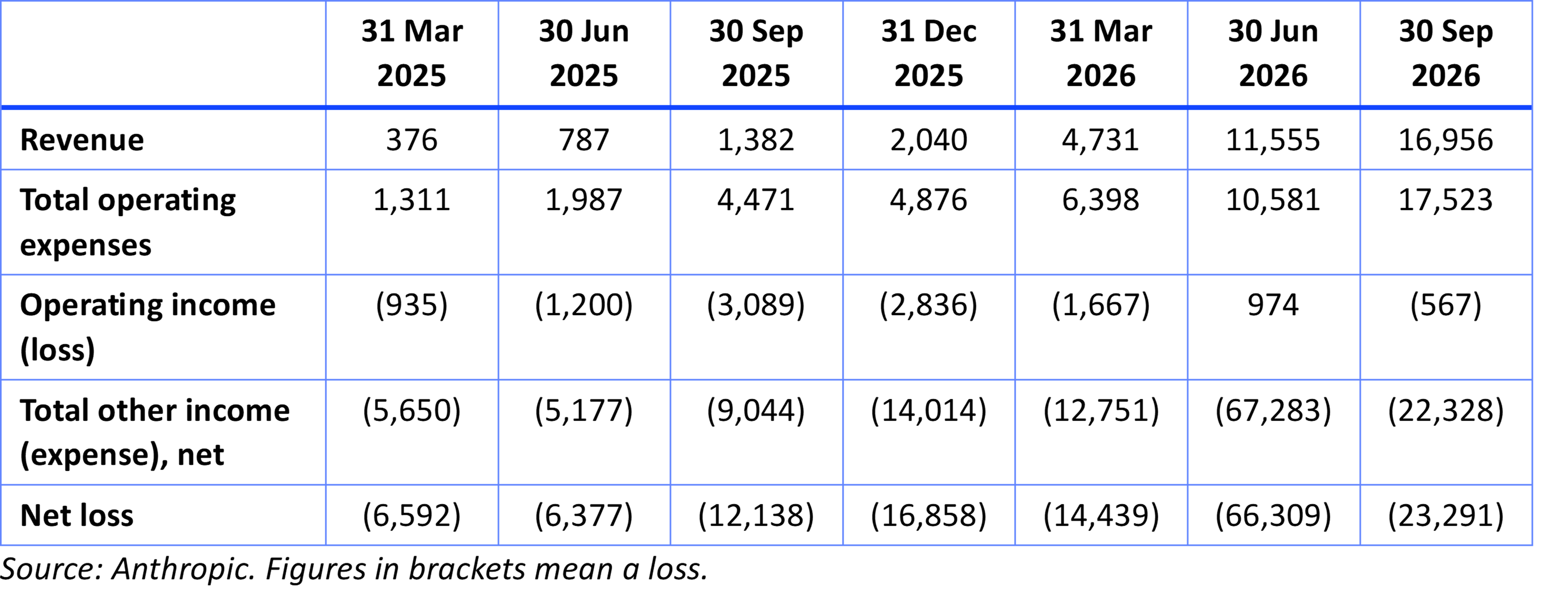
These figures show why Anthropic may attract growth investors and traders on short time horizons, but they offer less reassurance to those looking for a record of stable profits. Rapid revenue growth gives investors a reason to pay attention, but it may not tell them what the shares should be worth.
90+ pages of risks
As the disclaimers say, every investment involves risk. Few, we are sure, come with more than 90 pages of them.
The risks include maintaining its technological lead, funding its infrastructure commitments, dependence on major customers and distribution channels and what it calls “catastrophic or existential risks to humanity” as a result of unregulated AI.
For comparison, SpaceX’s risks section was 38 pages while Reddit’s was 54.
A big debut does not guarantee inclusion
There is another risk that wasn’t mentioned in Anthropic’s SEC filing – index inclusion. That’s because index inclusion for any company, even one as big as Anthropic, is not guaranteed.
Many indices require a minimum trading history before a company becomes eligible. Some also have published fast-entry rules for large IPOs, allowing qualifying companies to enter sooner, but these are assessed on a case-by-case basis.
The S&P 500 has requirements for trading history, liquidity and shares available to the public, as well as company size. It also requires a profit under US accounting standards in the latest quarter and across the latest four quarters combined.
Tesla was large enough years before it joined. In January 2013, its market capitalisation was about US$4.3 billion, above the US$4 billion minimum at the time. But it only cleared the earnings requirement with its June 2020 results. S&P announced its selection that November, and Tesla joined on 21 December. Even after meeting the requirements, a company still needs to be selected.
Anthropic will have to meet those requirements too. In June 2026, S&P rejected proposals to waive the profitability test and shorten the post-IPO waiting period for very large companies. The rules still apply, however much investors are prepared to pay for the shares.
Another consideration for index providers is the amount of shares available for trading. About 12% of the company’s shares are available. This means that considering its end of day one valuation of US$1.75 trillion, the index would only take 12% of this value in its calculation. This has the impact of making the size of the company in an index much smaller than expected.
MSCI has already announced that Anthropic is being included in the MSCI World Index at the rebalance at the end of November, but it is only expected to have a small weight.
Coming to a portfolio near you
Anthropic followed SpaceX in opening its IPO to Australian retail investors. Three retail brokerage services and several wholesale and institutional brokers were all appointed to the Anthropic pre-debut process.
And while you may not own any Anthropic shares, you could still be exposed via superannuation or international equity funds.
Enter the index
Anthropic could attract substantial buying from funds if and when it is admitted to other major indices. That demand may support its shares, but it will still tell investors little about the return they can expect over the years ahead.
In our view, a large market capitalisation does not establish the reliability of its earnings or how much shareholders will benefit from its growth. That’s not to say that Anthropic’s potential doesn’t deserve serious consideration. After all, the technology it operates is changing how the world works. However, a company can achieve extraordinary things while delivering disappointing returns to shareholders who paid too much.
Jamie Hannah is Deputy Head of Investments & Capital Markets at VanEck, a sponsor of Firstlinks. Jamie is an expert in all ETF, index, delta one and passive investments across a range of asset classes. With over 25 years’ experience in financial markets gained in Sydney, London and New York, Jamie provides portfolio management and capital market trading across the full range of VanEck’s passive solutions.
For more articles and papers from VanEck, please click here.
Any views expressed are opinions of the author at the time of writing and is not a recommendation to act.
VanEck Investments Limited (ACN 146 596 116 AFSL 416755) (‘VanEck’) is the issuer and responsible entity of all VanEck exchange traded funds (Funds) listed on the ASX. This is general advice only and does not take into account any person’s financial objectives, situation or needs. The product disclosure statement (PDS) and the target market determination (TMD) for all Funds are available at vaneck.com.au. You should consider whether or not an investment in any Fund is appropriate for you. Investments in a Fund involve risks associated with financial markets. These risks vary depending on a Fund’s investment objective. Refer to the applicable PDS and TMD for more details on risks. Investment returns and capital are not guaranteed.