Register For Our Mailing List

Register to receive our free weekly newsletter including editorials.

Home / 662

Survival is the only success

In 2015, Tai Lopez started running his now famous “Here in my garage” ad on YouTube as a way to promote his 67 Steps self-help course. The ad featured Lopez standing in front of a brand-new Lamborghini before panning over to seven bookshelves he had installed to fit 2,000 books he had recently purchased.

Following the release of the ad, Lopez became an overnight sensation. Despite being widely ridiculed, “Here in my garage” was a massive success that, according to some sources, generated over $50 million in revenue for Lopez. Based on this success, Lopez founded a marketing business that did well as his YouTube following grew.

However, by 2019, Lopez shifted his focus and created a holding company, Retail Ecommerce Ventures LLC (“REV”), to invest in distressed brick-and-mortar stores. REV raised $112 million from investors to buy companies like Radio Shack, Pier 1 Imports, and Linens N Things.

Unfortunately, this is where things went south. As these distressed investments failed to pan out, REV allegedly started missing payments to investors, and everything came undone. In September 2025, Lopez was charged with fraud and running a Ponzi scheme by the SEC.

I’ve been thinking about Lopez’s story a lot over the last six months. How does someone who’s won the game end up losing so badly? I don’t mean to pick on Lopez either, because it’s happened with so many others. Sam Bankman-Fried went from the world’s richest person under 30 to a 25-year prison sentence. Elizabeth Holmes went from the cover of Forbes to 11 years in prison.

All of these falls from grace illustrate a deeper truth—survival is the only success. It doesn’t matter what you do in life if you can’t sustain it. You could make $100 million, but if you end up in a prison cell or broke, who cares? That’s not success. In fact, it’s the opposite.

Using this definition, you are more successful than Tai Lopez, Sam Bankman-Fried, and Elizabeth Holmes. I am too. If you don’t believe me, ask yourself one question: Would you trade places with any of them?

I know I wouldn’t. I bet you wouldn’t either. There’s no amount of money and fame that is worth the loss of reputation and freedom.

Here’s the funny part though—Lopez, Bankman-Fried, and Holmes all could’ve enjoyed their success if they had just stopped earlier. Lopez and Bankman-Fried had real, profitable businesses. They didn’t need to chase after more. Holmes could’ve failed with Theranos (without the fraud) and I guarantee she’d get funding for her next venture.

But they didn’t stop. Why? Because greed is a hell of a drug. Greed drives people to behave in absolutely irrational ways. It drives some people to risk everything for just a little bit more. It’s the most negatively asymmetric payoff you could imagine—the upside is capped, but the downside is unlimited.

And yet people still make this trade all the time. There are people out there doing it right now. They may look successful today, but they won’t hold onto their success.

I was reminded of this after recently re-reading Fooled by Randomness by Nassim Taleb. Taleb tells a story of a trader who is rewarded with larger and larger bonuses each year by pursuing a high risk, levered strategy. The trader outperforms all of his peers, further affirming that his approach is best. All is well until something happens in the market that the trader wasn’t expecting. Their strategy blows up and they lose everything.

Taleb’s story demonstrates why survival is the ultimate financial goal. Because it doesn’t matter how you perform for a month, a year, or even a decade. All that matters is what you can keep in the long run. Whether you can make it to the end game.

This is why I’m not a fan of those who “generate income by selling options.” These people are trading immediate rewards for future risks. And when those future risks inevitably arrive, many of them get wiped out. As Taleb writes:

Options sellers, it is said, eat like chickens and go to the bathroom like elephants.

Unfortunately, option sellers are the opposite of investors. They collect rewards now for risk later. Investors take risks now for rewards later. So which do you want to be?

You don’t have to sell options or run a Ponzi scheme to fall victim to this either. There are plenty of ways that retail investors do this on a much smaller scale. They put most of their money into a single stock because it’s surging upward. They juice their returns with leverage or chase the latest trend.

All of these work great…until they don’t. Unfortunately, when they stop working, you can lose more than just your capital. You can lose your confidence too. That’s where the psychological cost of investing shows up. You start to question whether you know how to invest or whether you’re just lucky.

This is why survival matters far more than short-term performance. Because survival allows you to compound your money for a longer period of time. And it’s this compounding that builds true wealth.

There’s a great irony in this though. Because the people who compound their money for decades aren’t the ones you typically read about. There’s no headline for someone who invested consistently for 40 years and retired comfortably. There’s no documentary about someone who built a small fortune while working a 9-5 job. But these are the real financial success stories. Everything else is just noise.

It reminds me of this interaction I saw not too long ago about index investors:
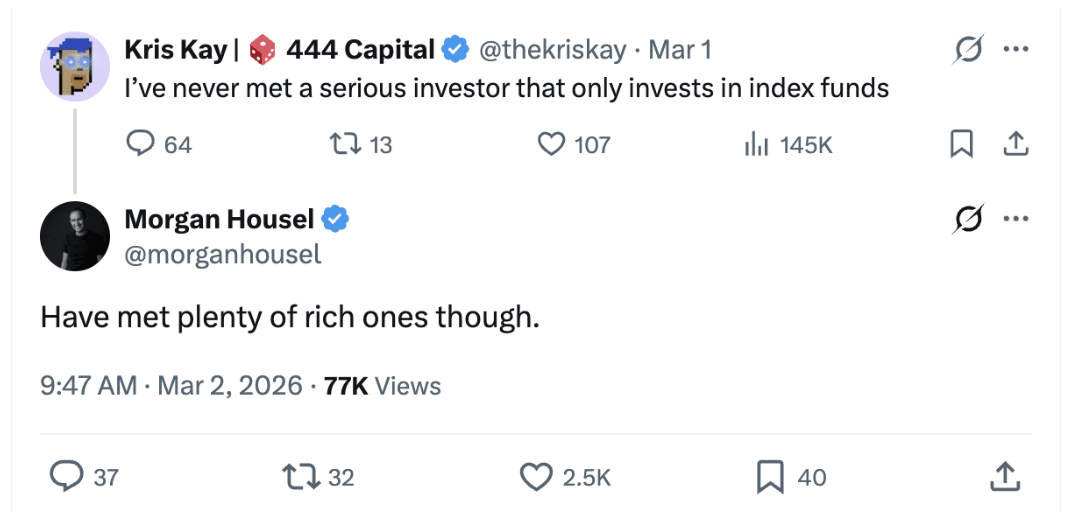
So, if you want to be financially successful—just survive.


Nick Maggiulli is the creator of personal finance blog Of Dollars And Data and the Chief Operating Officer at Ritholtz Wealth Management. For disclosure information please see here. This article was originally published on the Of Dollars and Data blog and is reproduced with permission. If you liked this article, consider signing up for Nick’s newsletter.


  •   13 May 2026
  • 3
  •      
  •   
3 Comments
Mark
May 18, 2026

If there is a secret to (financial) success, it is to get rich slowly. Patience is your best asset and friend.
Diversify to mitigate at least some of the risks. Occasionally, sell losers and match with winners to rebalance. Then put those funds in a secure place.
This method works very well for me and provides necessary liquidity. If you want fast money, go to the casino. If you value intelligent investing and the power of compounding, use sensible guidelines such as these and completely avoid get rich quick gambles that will likely end in tears.

2
Geoff
May 14, 2026

If survival is the only success, then we're all destined for failure...

1
 

Leave a Comment:

RELATED ARTICLES

Shaky markets, steady mind

Winning by not losing: The silver rule of investing

The BIG picture: portfolios perform for the passive and patient

banner

Most viewed in recent weeks

Division 296: the initial moves to make before the windows close

What if the best superannuation strategy isn't about earning more, but acting before your options disappear? Several overlooked planning windows are narrowing, with consequences that can last for decades.

The retirement scorecard: how many of these questions can you answer?

From the maths of retirement, estimating spending and picking the right asset allocation to survive a poor decade, here are the questions every retiree – current or future – should be able to answer for themselves.

Testamentary trusts: Treasury has picked the wrong reading

A decades-old estate planning tool has survived one tax crackdown only to be caught by another. The surprise isn't who the reform is targeting, but who could end up paying the price for drafting choices made years ago.

Superannuation’s structural failings

Politicians are fighting over access to super, but they may be arguing about the wrong thing. The system’s three fundamental flaws have been hiding in plain sight for decades, costing Australians far more than they realise.

Avoid unnecessary CGT with this estate planning clause

A simple estate plan can create a ticking time bomb. One overlooked clause can pit spouses against children, delay inheritances, and potentially leave a family facing an unexpected tax bill worth hundreds of thousands of dollars.

Higher yields are creating opportunities in global bonds

Bond markets are adjusting to a new reality, but not in the ways investors expect. With markets repricing and capital competing for attention, investors may need to rethink where resilience and opportunity lie. 

Latest Updates

Retirement

The retirement account that Australia should have

Our retirement system asks one account to do two very different jobs. A dedicated "rainy day" account separating income from emergency savings could deliver better outcomes and greater peace of mind for retirees.

Investing

What the US midterm results mean for investors

Democrats have regained control of Congress, changing the equation in Washington. Whether that proves positive for investors will depend less on the result itself and more on what happens next for growth and markets.

Taxation

Should the capital gains tax reward risk?

A reader query on the recent CGT reforms has revealed a bigger issue. One overlooked feature of the old system may have done more than compensate for inflation. As we move to indexation, are we forgetting to reward risk?

Investment strategies

Bonds: The income and diversification trade-off

Rising yields have made bonds attractive again, but that does not mean they will behave as expected. As inflation, fiscal pressures and geopolitical risks reshape markets, the role of bonds may be more complicated than it appears.

Investment strategies

Why high-dividend investing deserves another look

Income investors have endured several lean years, but signs of a recovery are emerging. As opportunities improve, investors face an important choice between chasing headline yields and building a reliable source of income.

Investment strategies

Why 'overvalued' has been such an expensive word

Investors love simple rules, especially when markets appear stretched. Yet some of the strongest returns have arrived when the outlook seemed least attractive. This leaves an important question that history struggles to answer.

Investment strategies

AI – A good kind of bubble or just a bubble?

Investor obsession with AI is attracting unprecedented amounts of capital and confidence. But beneath the excitement lies uncertainties about returns, funding and risks that enthusiasts may not be paying enough attention to.

Sponsors

Alliances

  • ASA-Logo-RGB-ActiveGreen-web.png

© 2026 Morningstar, Inc. All rights reserved.

Disclaimer
The data, research and opinions provided here are for information purposes; are not an offer to buy or sell a security; and are not warranted to be correct, complete or accurate. Morningstar, its affiliates, and third-party content providers are not responsible for any investment decisions, damages or losses resulting from, or related to, the data and analyses or their use. To the extent any content is general advice, it has been prepared for clients of Morningstar Australasia Pty Ltd (ABN: 95 090 665 544, AFSL: 240892), without reference to your financial objectives, situation or needs. For more information refer to our Financial Services Guide. You should consider the advice in light of these matters and if applicable, the relevant Product Disclosure Statement before making any decision to invest. Past performance does not necessarily indicate a financial product’s future performance. To obtain advice tailored to your situation, contact a professional financial adviser. Articles are current as at date of publication.
This website contains information and opinions provided by third parties. Inclusion of this information does not necessarily represent Morningstar’s positions, strategies or opinions and should not be considered an endorsement by Morningstar.