Tax is one of the few subjects capable of producing near-universal dissatisfaction.
For all the heat generated by ongoing debates, Australians actually appear relatively united on the outcomes they value, though considerably less on how those outcomes should be funded.
Per Capita's Tax Survey tracks community attitudes towards taxation and public spending over time. One important caveat is that these results were collated before the May 2026 Federal Budget, so they shouldn't be interpreted as a verdict on the latest reforms, but rather, a snapshot of the period immediately beforehand.
A nation in the mirror
One of the more enduring findings in the survey relates to self-perception. Nearly half of the respondents continue to describe Australia as a high-tax, big-government country and this has remained relatively stable for over a decade. The consistency of this view is arguably more interesting than the result itself.
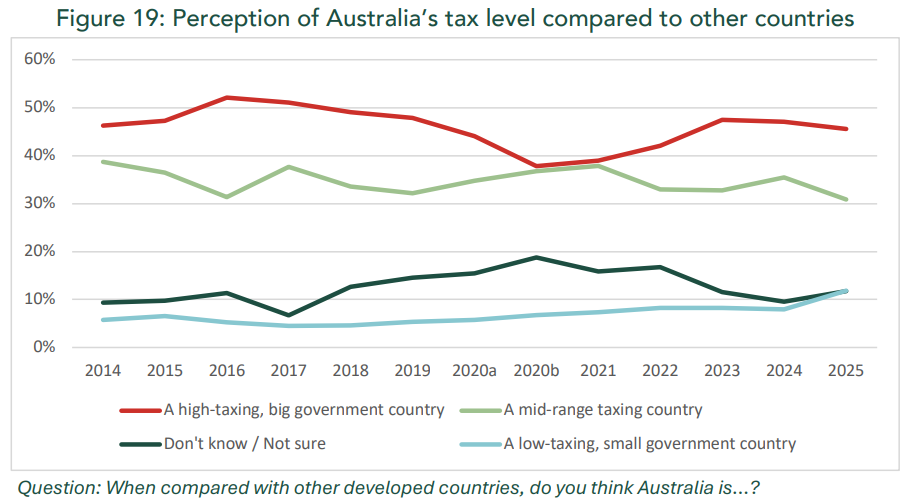
Multiple governments have come and gone during the survey period, while tax rates and fiscal settings having repeatedly shifted. Yet our perception of Australia as a heavily taxed nation has barely moved.
Though the proportion of respondents identifying Australia as a middle-of-the-road tax country has fallen, both the low-tax and ‘unsure’ categories have modestly grown. Instead of converging towards a common understanding, it seems there is a broader range of competing narratives at play.
At the same time, the survey paints a far more positive picture of attitudes towards public services than one might expect. Australians continue to report reasonably high levels of confidence in the quality, accessibility, value for money and usefulness of public services. These ratings have eased from their pandemic-era peak, but remain stronger than they were a decade ago.
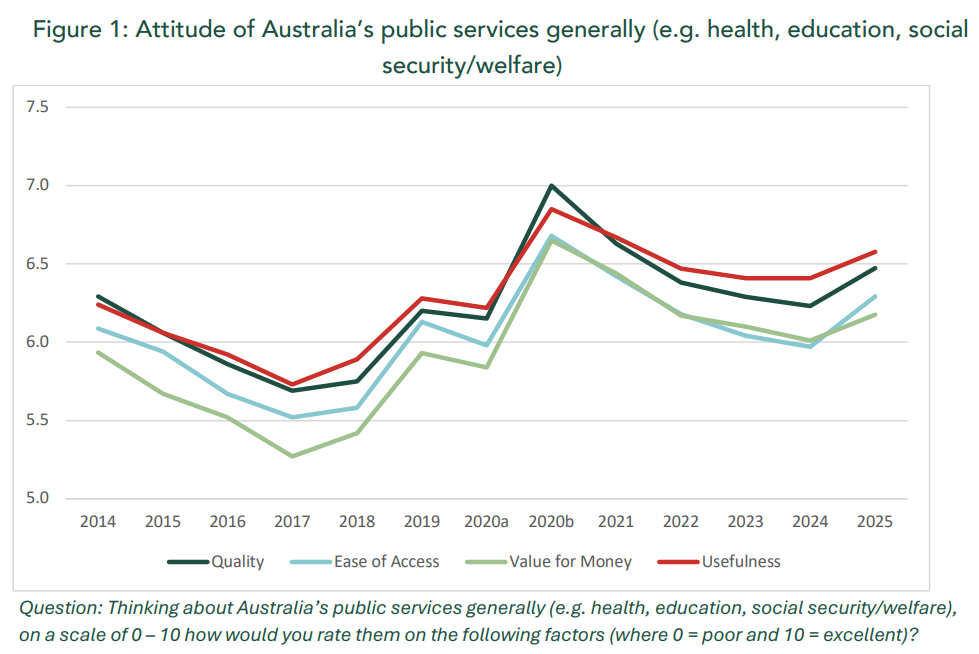
Given public debate often operates on the assumption that confidence in institutions has collapsed, this finding surprised me. It also perhaps explains another seemingly paradoxical result. Most respondents believe governments should spend more on public services, particularly health and education.
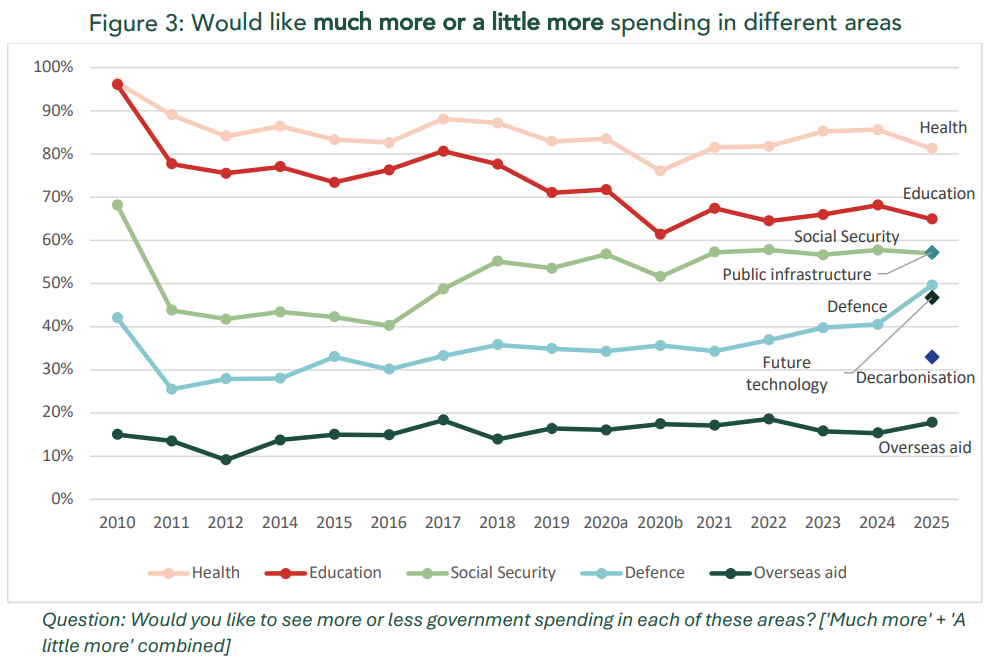
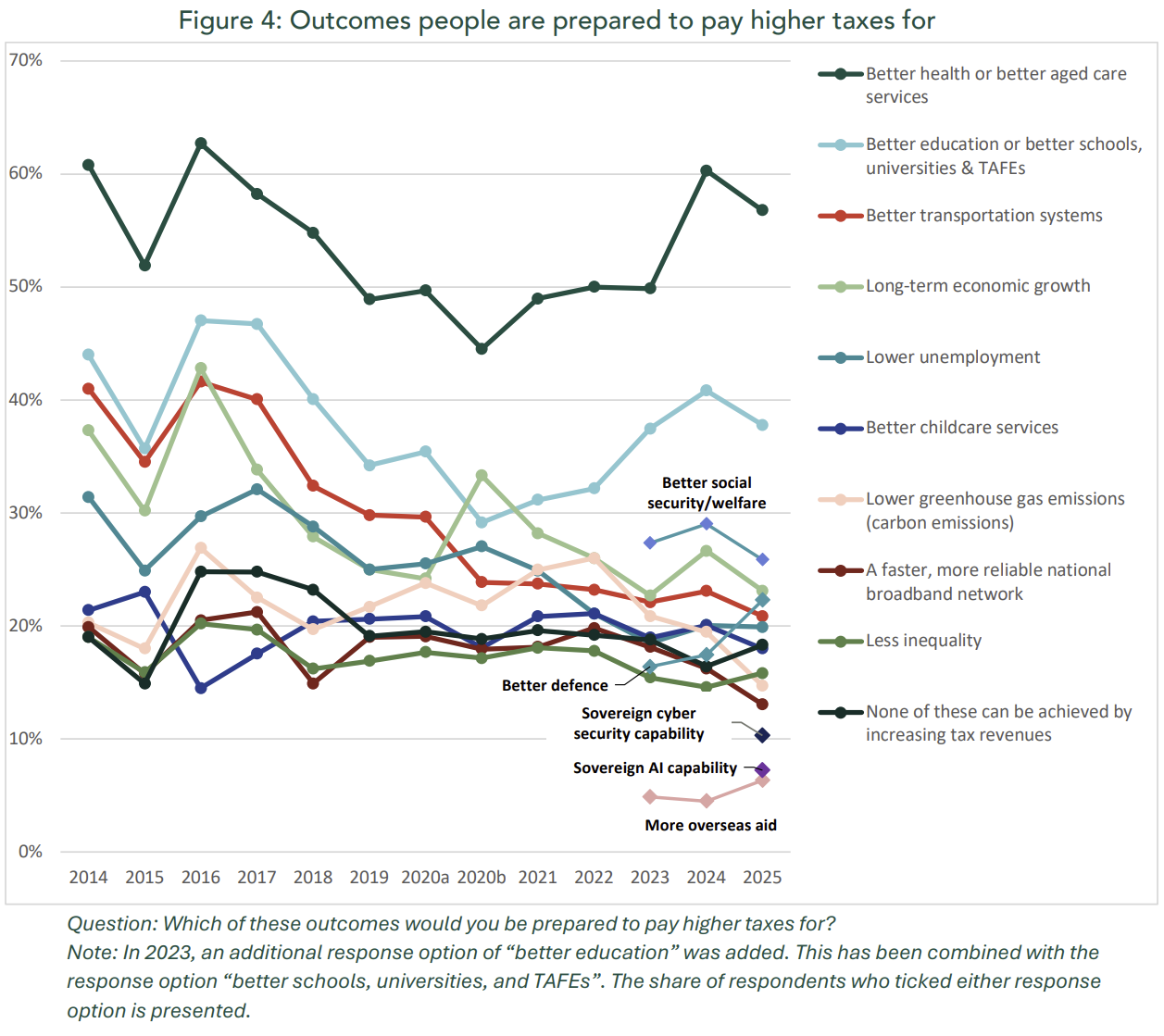
However, when the question shifts from spending in the abstract to individual contributions, people's enthusiasm naturally becomes selective.
On the surface, it seems that we're willing to pay more when the outcome is tangible and immediate. Health services, aged care and education continue to attract the strongest support. By contrast, the willingness to pay more for decarbonisation, sovereign AI capability and other less direct outcomes remains comparatively low.
I'll play devil's advocate and suggest that doesn't necessarily reflect a reluctance to contribute. Rather, there is a strong desire to see clearer connection between the cost and its outcome. The further an expense or objective moves from the everyday experience, the harder it becomes to persuade people to pay for it.
Who should foot the bill?
This willingness to support public spending while remaining cautious also appears in the survey's findings on revenue raising.
A crackdown on corporate tax avoidance remains the most popular option. Higher tax rates on top income earners also continues to attract support. Measures such as negative gearing and capital gains tax reforms, which have since moved from debate to policy, attracted only moderate support in the survey.
There is an old tendency in public policy for agreement to diminish in proportion to specificity. Agreement is often easiest at the level of principle, but once pen is put to paper, that consensus is difficult to sustain.
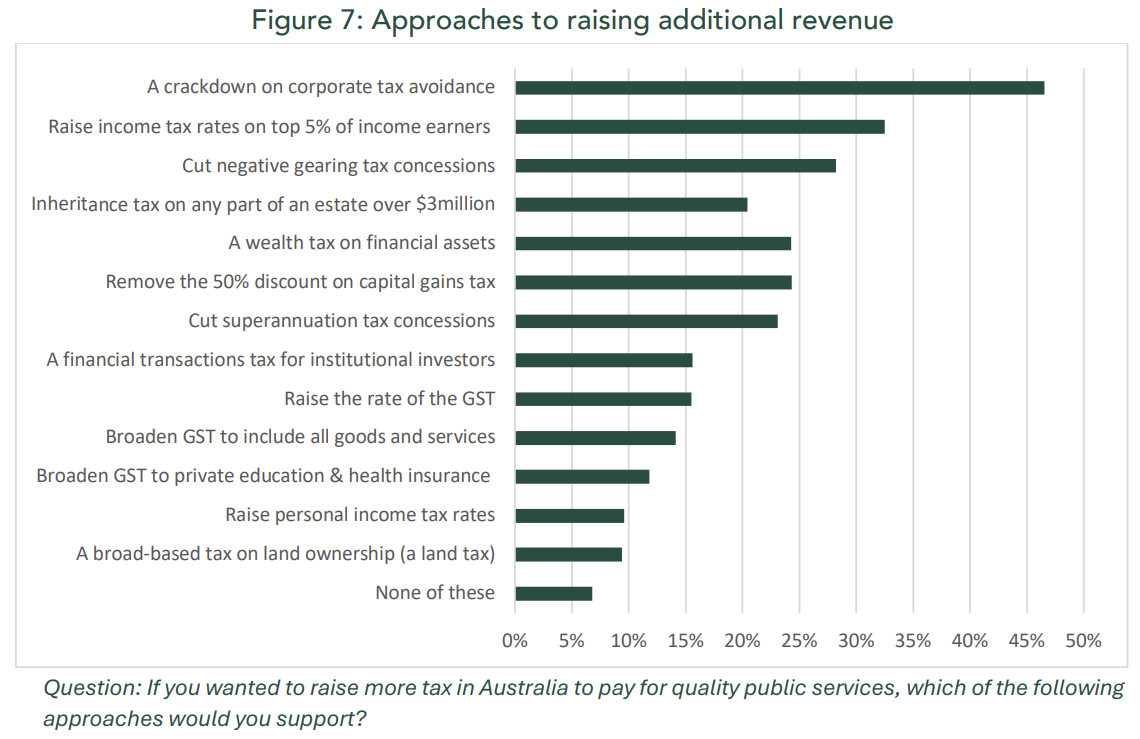
Whether one agrees with these policy positions or not, they suggest many Australians place considerable weight on perceived fairness. The survey indicates a preference for targeted measures aimed at those seen as better placed to contribute, rather than approaches that distribute the burden more evenly across the population.
Retirement income funding
Australia is often described as one of the world's great compulsory savings systems. The Super Guarantee now sits at 12%, but debate continues about whether the system will ultimately provide adequate income for retirees.
Some believe individuals should aspire to save more, while a similar number argue that the Age Pension should play a larger role. Others see the answer in further strengthening superannuation itself through concessions.
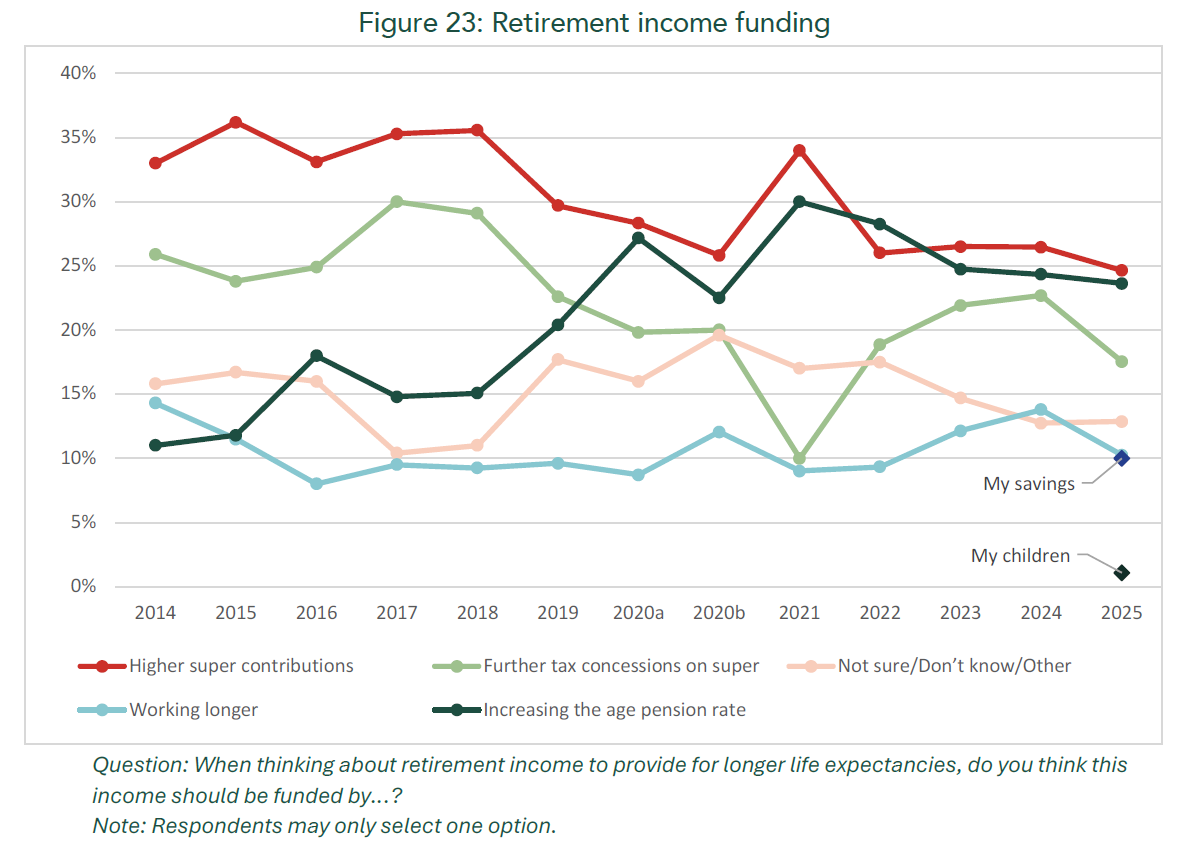
Despite decades of discussion about self-reliance, retirement continues to be viewed as a collective challenge.
We may disagree on the mechanism, but there remains a broad expectation that longevity risk and income security should not rest solely on the shoulders of individuals. That is perhaps unsurprising. If an increasing number of people reach retirement age without adequate resources, the consequences are ultimately endured more broadly through taxation. In that sense, retirement policy occupies an unusual space where we must balance personal responsibility with the recognition that the consequences rarely stop at the individual.
Simonelle Mody
***
Weekend Market Update
From Shane Oliver, AMP
US shares fell sharply over the last week as the Democrat wins in the midterm elections renewed fears about tighter regulation of AI adding to worries about an AI bubble and leading to a sharp rout in AI related tech shares leaving the US share market on track for 2.7% fall. This also dragged Japanese and other Asian share markets down sharply. Eurozone shares managed a small rise though. Australian shares also rose managing a gain of around 0.8% helped by its relatively low exposure to AI related shares and less hawkishness from the RBA after its latest rate hike. While energy shares fell on the back of lower oil prices this was offset on the ASX 200 by gains in tech, consumer and property shares. While gold and iron ore rose over the last week, Bitcoin fell along with metal prices. The $A fell on the back of the risk off trade but the $US also fell slightly.
Oil prices plunged on hopes that the move to a Democrat Congress will help bring an end to the Iran War with Republicans seeing that as a cause of their midterm losses. The risk around this remains high though as Trump could still decide to ramp up the attacks again.
Bond yields fell further again over the last week on hopes that US political gridlock will stop the blowout in the US budget deficit and on safe haven demand. The longer term risks for bond yields remain on the upside though thanks to a combination of: the oil shock; expectations for more central bank rate hikes; stronger US economic data adding to concerns that maybe the neutral short term rate has moved up; worries about big budget deficits in the US, UK, France, Brazil and elsewhere; corporate borrowing to fund data centre investment; and a rising trend in Japanese bond yields leading to a reversal of the so-called carry trade.
The US midterms saw a resounding rebuke of Trump’s policies, with a blue wave seeing Democrats retake control of both the House and the Senate and various governorships in red states. Naturally though Trump tried to deflect - arguing if “I was on [the ballot] we would have won in a landslide” ironically ignoring the fact that he had asked people to assume he was on the ballot. Maybe they did! But, as always “it’s the economy stupid”. Trump won in 2024 largely because of “cost of living” pressures turned people against the Democrats, but his crazy tariff and War policies made them even worse causing those who swung to him then to swinging back to the Democrats. Of course, this wasn’t helped by things like the ICE raids (turning Hispanics and other immigrant groups against him), the Epstein files and perceptions of graft and corruption. Of course, there is a danger in reading too much into it in terms of what it means for the 2028 elections as given Trump’s low approval rating the seat gains by the Democrats are consistent with the experience in past midterm elections.
However, the blue wave does have significant implications particularly given Trump’s sensitive character and the unusual nature of the Trump Administration. In particular:
- Congress will now be a check on Trump’s actions at least domestically and in particular there are now likely to be significant inquiries into his actions including a possible attempt at impeachment. Democrat control off the Senate also means Fed independence will be protected. At a high level this once again highlights that US governance and democracy remains strong – a slide into strong man dictatorship is not going to happen as voters won’t permit it.
- More regulation around tech and AI – particularly putting some brake on data centres in states where Democrats won the governorship (Texas, Ohio, Iowa & Georgia) and in states where referenda to restrict data centres were won. Trump can veto excessive regulation coming out of Congress but the states may matter more.
- A return to brinkmanship over raising the debt ceiling (necessary by around June quarter next year and funding the US Government (which currently expires on 11th December) – in some ways this may be a good thing if it leads to a smaller budget deficit. Trump may attempt to get resolution and to raise defence spending in the lame duck session of the current Congress but that’s unlikely to happen. Similarly hopes for lower budget deficits may prove in vain as Democrats may try to increase some social benefits that Trump may find hard to veto, but he is likely to veto any attempted tax hikes. So, the fall in bond yields since the midterms may not be justified.
- Trump moving into being a lame (or angrier) duck President could see him become more aggressive in foreign policy by in particular recommencing the war on Iran and returning to the tariff war. So far markets seem relaxed about this, with oil prices down sharply on hopes Congress will bring an end to the Iran War, VP Vance blaming the War for the election loss, the clear voter pushback against the War including from Republicans and Trump saying he has no immediate plans to ramp up fighting. And both tariffs and the War are self-evidently not popular so Republicans may cut him adrift if he pushes heavily down this path again. That said he could still have a go just to prove who’s in charge – so another spike in tariffs and/or oil prices remains a high risk.
- Fears that tax hikes and bigger government are on the way particularly if a Democrat wins the 2028 presidential election. However, the risks on this front are overstated. Sure, the numbers of DSA (Democrat Socialists) in Congress will increase but most of the wins owed to moderate centre left Democrats, suggesting the US has not lurched to Bernie Sanders’s style democratic socialism. The failure of the Proposition 40 5% billionaire wealth tax proposal in California also supports this view although not strongly as one reason for opposing it was that it wasn’t national (so risked a loss of billionaires out of California) so it could still get up nationally.
Normally US shares rally once the midterms are out of the way due to the removal of a source of uncertainty. However, there may be more uncertainty this time around given the risk for the AI trade from the Democrat wins and its high weight in the US share market along with Trump’s unpredictability and the risk he could go rogue on, eg, Iran for a while now that the election is out of the way.
However, the risk of a further correction in shares remains high and maybe we are now starting to see this unfold with US shares now down 6% from their October high. The threats from high and sticky inflation, ongoing central bank rate hikes, excessive public debt driving rising bond yields, the risk of another spike in oil prices, AI bubble and data centre worries, and slowing growth and rising rates in Australia remain. A rotation from tech to non-tech was providing some support for US shares but even non-tech shares came under pressure in the last week. While the VIX “fear index” is up its too early to say that the correction in shares is over particularly given the long list of worries and this leaves US, global and Australian shares vulnerable. However, at this stage strong US earnings growth (even outside tech) and no indications of a US recession suggest that the pull back is more likely a correction rather than a new bear market.
In Australia the RBA provided no real surprises with a fifth rate hike taking the cash rate to an 18 year high of 4.85%. The reasons were simple – inflation is too high and broad based, capacity pressures remain and higher fuel prices look to be bleeding through into other prices and inflation expectations look to be rising. Government spending cuts could have provided a fairer alternative but in their absence the RBA had to hike to cool demand and to reinforce its commitment to the inflation target. The bad news is that inflation is likely to have increased further in October and is now expected to remain higher for longer and so despite a rising risk of recession and much higher unemployment the risk of another rate hike remains high. The good newsthough is that there are increasing signs that rate hikes are working to slow spending – with very low levels of confidence, weakening underlying household spending and warnings from retailers of falling retail sales, falling home prices and rising unemployment – which will slow inflation. And consistent with this the RBA softened its tightening bias by dropping a reference to raising rates again if needed, three board members voted for a pause and Governor Bullock implied that after five hikes it’s a good point to “take stock” suggesting the RBA will pause in December.
Our view is that while the risk of another rate hike is high, there is now increasing evidence that rate hikes are working to slow demand which will slow inflation and so we expect the RBA to leave rates on hold for an extended period, ahead of eventually being able to start cutting rates but not until late next year.
Australian home prices are continuing to fall with more to go. Australian home prices fell another 1.2% in October and are now down nearly 7%. The slump is expected to continue out to the September quarter next year as rate hikes, tax hikes on investors and poor confidence continue to weigh on demand and as distressed sales start to rise in response to rate hikes and the deteriorating jobs market. This is already the fastest slump in the last 46 years and will soon become the deepest with a 15% top to bottom fall likely. A deeper fall is possible but would require a recession and much higher unemployment, which is not our base case. The slump in home prices will knock around 1.5% off consumer spending as it leaves homeowners feeling poorer.
Also in this week's edition...
Politicians are fighting over access to super, but Ron Bird argues they may be ignoring three key structural failings that cost Australians more than we realise.
Why do some families preserve wealth for generations while others struggle? Peter Roach explores this phenomenon in the great wealth transfer myth.
The demise of bank hybrids leave investors with a problem. Kanish Chugh asks what comes next, and are the obvious replacements enough?
After a recent trip to the US, Emma Fisher shares the latest market themes emerging out of the technology sector and how company moats are being reshaped.
Warren Buffett's departure marks the end of an era. Jason Phol discusses whether Berkshire's success can continue without the man responsible for much of it.
Jeremy Duffield and Mikhail Walden evaluate whether the 4% retirement withdrawal rule has been lost in translation.
For more than a decade, investors lived through an era of near-zero interest rates. Michael Collins believes this was not without side effects.
Curated by Simonelle Mody and Leisa Bell
Latest updates
PDF version of Firstlinks Newsletter
Monthly Investment Podcast by UniSuper
Listed Investment Company (LIC) Indicative NTA Report from Bell Potter
Plus updates and announcements on the Sponsor Noticeboard on our website