It's challenging to work out how much a retiree can withdraw from super to fund a spending level that's sustainable throughout their retirement. So, it's disappointing that so much space is wasted in Australia talking about the so-called 4% (Bengen) rule. This imported US concept is misleading for most Australians who fund their retirement spending from a combination of super and a means-tested Age Pension, which adjusts as their assets deplete. Consequently, it doesn’t give them a useful idea of how much they can spend in retirement. To illustrate this at an extreme, even in the worst market environment of the last 140 years, a Full Age Pensioner’s sustainable spending rate amounted to 35% of their super balance, nearly nine times the Bengen level.
Bengen's study was a groundbreaker in the US
The Bengen rule, commonly known as the “4% rule,” was a pioneering concept in US retirement planning introduced by financial adviser William Bengen in 1994. It posits a safe withdrawal rate for retirees, suggesting that by initially withdrawing 4% of a portfolio's value and adjusting that dollar amount annually for inflation, a retiree can sustain their spending for a 30-year retirement period without running out of money, based on US historical market data.
That's useful in the US for planning purposes where the other major source of retirement income is Social Security, which is a known payout rate. Add Bengen's safe withdrawal rate from a retirement portfolio (A) and a personalised Social Security payout (B) and you have an estimate of a sustainable spending rate.
Crossing the Pacific though, we have increased local complexity in the Age Pension — a unique component of retirement income which, unlike US Social Security, is means-tested against an individual’s retirement savings. Correctly factoring in the Australian Age Pension is critical as more than half of Australian retirees rely on it for over 50% of their retirement income. It currently contributes over $60 billion annually to the retirement incomes of everyday Australians.
A percentage withdrawal rule may be useful to consider for someone on the Full Age Pension – although it doesn’t serve as a useful guide to sustainable spending. Their situation is analogous to the US retiree, funding retirement spending from a withdrawal rate from super (A) and an inflation-adjusting Age Pension (B), which stays fixed as long as they continue to meet the conditions for the Full Age Pension. And it may be useful for someone who may never get the Age Pension, like someone with a $5 million or $10 million portfolio.
But there's a vast swathe of the population who are on the Part Age Pension, where the Income or Assets tests mean that funding retirement isn't as simple as A plus B. Instead, for them, the Age Pension itself is a function of the amount of their super assets (among many other factors). A safe withdrawal percentage concept for them makes no sense as they have to master the maths of combining interdependent income sources.
The wondrous ways the Age Pension changes the maths
The Age Pension's means test is a wonder of administrative complexity, designed to act as a taxpayer-funded safety net targeting those who need it. The three tests of Residency, Income and Assets are complex. But for retirement planning purposes it's the taper rates on the Income and Assets tests that matter most to the payout level. The Income and Assets tests are also interdependent because what counts is so-called “deemed” income (income deemed to be earned on your financial assets), not actual investment income.
Means testing results in Part Pensioners getting more or less of the Age Pension as their assets fall or rise. The current rate of change is $78 per annum for each $1,000 of assets.
The typical result is that the Part Age Pensioner's payout is expected to rise over the course of retirement as assets are spent down to pay for retirement.
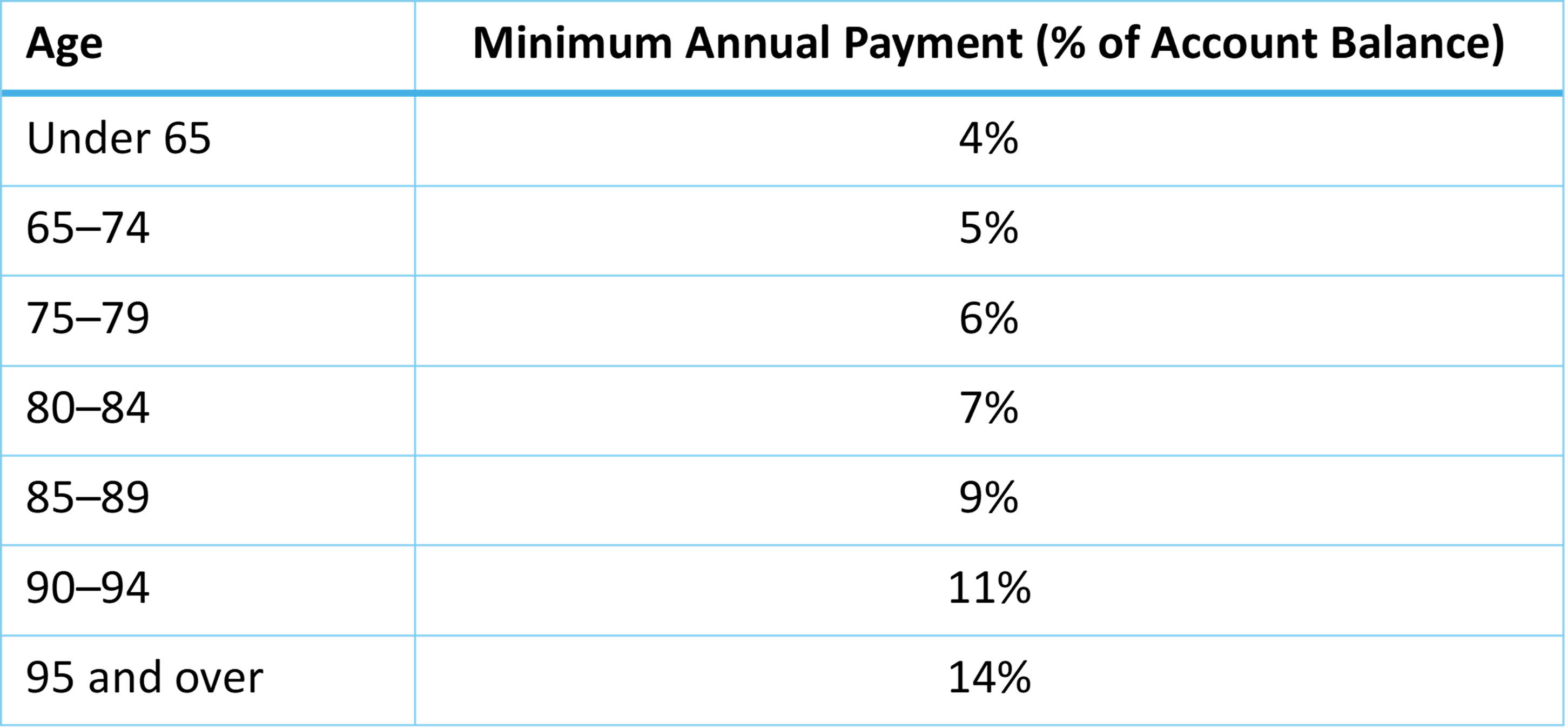
The other twist in retirement planning in Australia is that Account Based Pension streams have minimum withdrawal rates set as a percentage based on age (Table 1 below). This is now getting very confusing; retirees have to add a variable Age Pension rate to a mandated minimum percentage level of superannuation withdrawals. (And the Minimum Drawdown rate is higher than Bengen’s 4% for anyone over 65.) No wonder, in our Retirement Essentials Retirement Checklist quiz, we found that 51% of people are uncertain as to how to combine super and the Age Pension to meet their spending needs.
Table 1: Minimum Pension Drawdown Rates — Account-Based Pensions
SuperEd research on historical sustainable spending rates
The easiest way to show that spending a fixed percentage of assets is misleading is to delve into the numbers.
We simulated sustainable retirement spending over each 30-year time horizon in the last 140 years of financial market history. We tested four personas — a Full Age Pensioner, a Part Age Pensioner, a Future Age Pensioner and a Never Age Pensioner[1] — differentiating them by super assets at retirement.
The question was: if you started retirement in year X with Y in super, how much could you have spent each year over the next 30-year period without running out — given the past market conditions and current Age Pension rates and thresholds?
As there are 112 30-year periods since 1885, there are 112 observations for each persona. We calculate the achieved spending rate for each starting year's “retirement era” in current dollars — so in real terms, keeping up with inflation. The results vary dramatically by the year retirement commenced, revealing the impact of very different financial market return regimes.
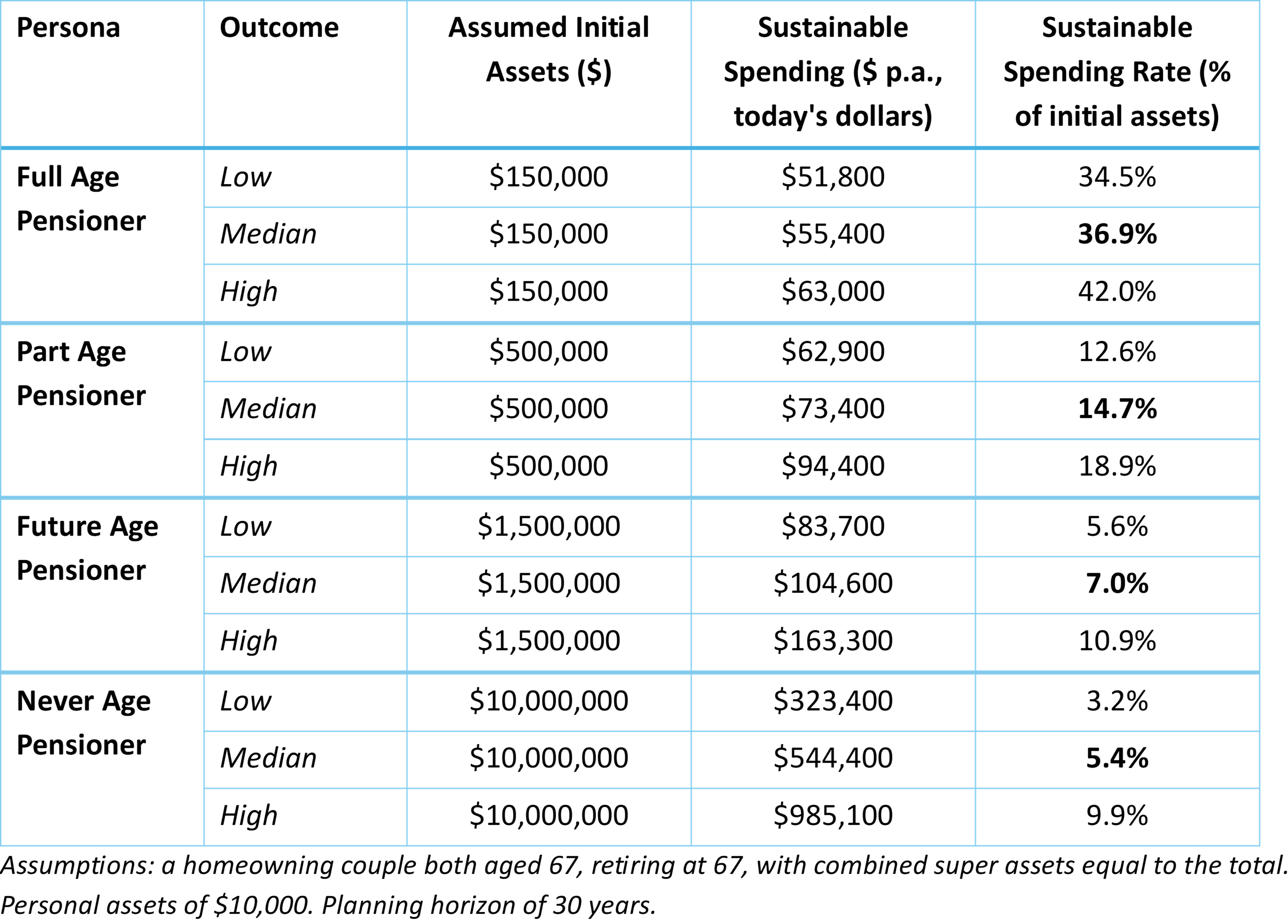
Table 2 shows the results for our four different personas. For each persona we show the Low (worst markets), Median and High (best markets) outcomes.
It's the dollars that count. But we also show the sustainable spending rate calculated as a percentage of the starting level of superannuation assets.
Table 2: Sustainable Retirement Spending by Persona — Historical Simulation (1885–1997 Start Years) (60/40 Portfolio)
Observations
The results are quite remarkable.
There are wide discrepancies between poorest, average, and best market periods. Market returns and sequencing matter a lot.
For example, the Part Age Pensioner with $500,000 in starting super balances at retirement would historically have experienced a range of outcomes from $62,900 in annual spending in the worst market progression to $94,400 in the best market sequence of returns. The worst was 14% less than the median outcome, and the best was 129% better.
The percentage calculation of sustainable income vs the initial starting balance shows no relation to Bengen's 4% rule. A Full Age Pensioner, even in the worst mraket conditions, was able to spend an amount equal to almost 35% of the starting super balance — almost entirely thanks to the Age Pension.
The same finding holds for the Part Age Pensioner and the Future Age Pensioner; again, their sustainable spending is not reflected by Bengen's 4% rule.
The only exception is the Never Age Pensioner, who could only spend an annual amount equivalent to 3.2% of the starting balance. This finding is comparable — if lower — than Bengen's results. It shows that, using our 60/40 allocation, 4% wasn't quite achievable in the worst of times.
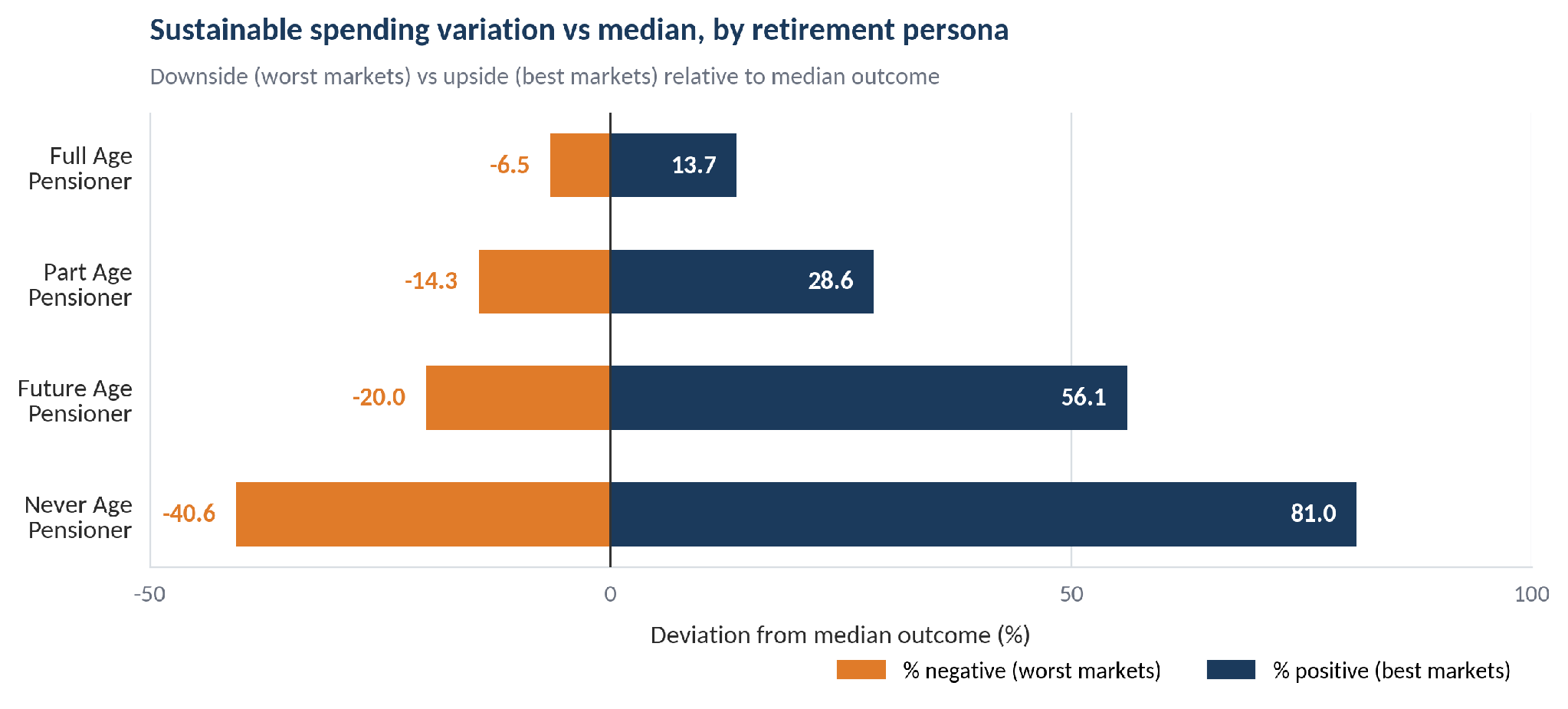
There's remarkably less uncertainty for those relying more heavily on the Age Pension. The chart below shows the discrepancy between worst and best outcomes vs median for the different Age Pension personas. Those with access to more Age Pension have much less volatility in their retirement outcomes — a result of both the lower exposure to markets and the optionality implicit in the Age Pension.
Figure 1: Sustainable spending variation vs median, by retirement persona
Conclusion
Our analysis of historical retirement scenarios, with today's Age Pension rules and rates, shows that the Bengen rule can be widely misleading for most Australians — those who will benefit from the Age Pension at some point.
This analysis does not suggest Bengen's work was incorrect. Bengen examined sustainable withdrawals from a private portfolio, while Australian retirees often fund consumption from a combination of superannuation and Age Pension entitlements. The interaction between these two sources means that a portfolio withdrawal rule alone may provide an incomplete picture of sustainable retirement spending.
Instead of using a US rule of thumb, older Australians are better off focusing on the dollars — not percentages — they can spend in the future, using a forecasting tool that incorporates the Age Pension and its interdependence with assets and income. As markets are anything but a straight line, retirees need access to strong stochastic models using reasonable return expectations; and they need to be prepared for a range of outcomes, because the one certainty is that there's volatility in retirement outcomes ahead.
[1] We define a Never Age Pensioner as someone who is unlikely to get the Age Pension until very late in life, if at all.
Jeremy Duffield is Co-founder and Director and Mikhail Walden is Senior Financial Engineer of SuperEd/Retirement Essentials.