Register For Our Mailing List

Register to receive our free weekly newsletter including editorials.

Home / 685

Why does the system treat capital gains and losses differently?

The new CGT regime announced in the May 2026 Federal budget now sees capital losses treated differently to capital gains in two important ways.

  1. Gains are taxed, but losses cannot be deducted against other income. Instead, capital losses can only offset capital gains, otherwise they are quarantined to offset against future gains. This has always been a feature of the CGT system. [Note that prior to the Budget, gains were taxed like normal income, but now there is a 30% minimum CGT to contend with.]
  2. Gains are determined against a cost base indexed for inflation, while losses are not. The result is a new regime that taxes real gains but measures losses only in nominal terms.

Capital gains and capital losses are simply opposite sides of the same investment outcome. Yet the tax system treats them asymmetrically.

Had both simply been termed a ‘capital outcome’ from the outset, the question of treating them differently for tax purposes might never have arisen.

The effect of not indexing capital losses

The following example illustrates the effect of excluding capital losses from indexation.

Assume two investors.

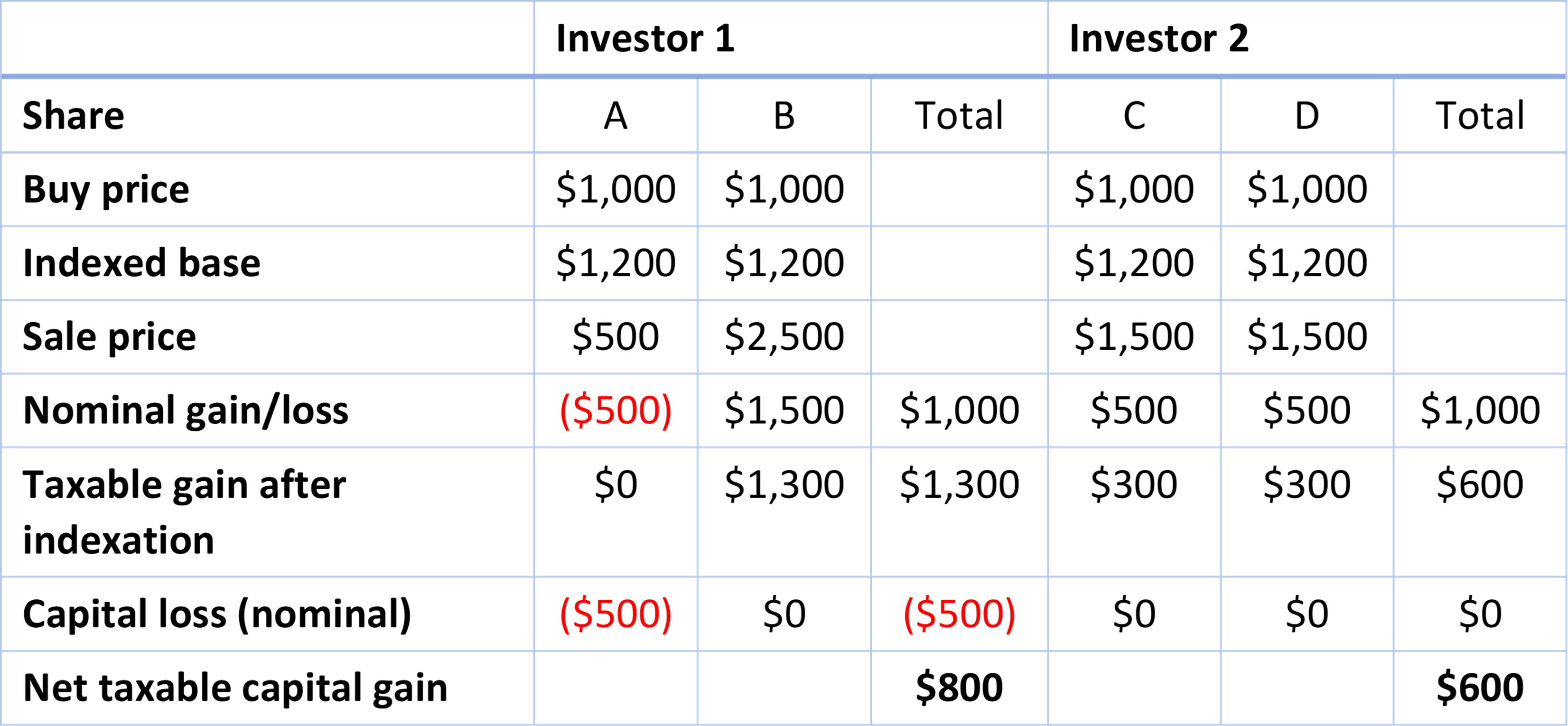
Investor 1 buys shares A and B at a cost of $1,000 each. At the same time, Investor 2 buys shares C and D for $1,000 each.

All the shares are sold at the same time, with the cost base of all four shares indexed for inflation to $1,200 per share.

Investor 1 sells his shares at $500 for share A and $2,500 for share B.

Total portfolio capital gain is $1,000. The nominal gain on share B is $1,500, which after inflation is a real gain of $1,300. However, the real loss of $700 on share A does not count. Only the nominal loss is recognised such that Investor 1 pays tax on a $1,300 gain - $500 loss = $800.

Investor 2 sells shares C and D for $1,500 each.

Total portfolio gain is $1,000 also. And after inflation, the real gain per share is $300. Investor 2 therefore pays tax on $600. Both investors earned the same total nominal gain, yet Investor 1 reports a taxable gain one-third higher than Investor 2.
The asymmetry becomes greater when losses are carried forward. If Investor 1 retains share B therefore there is no capital gain to offset against, the $500 nominal loss must be carried forward. Frozen at $500, that loss would steadily be eroded by inflation over time, ensuring increasing asymmetry with the time taken to use the loss.

When two investors achieve the same economic outcome but face different tax outcomes, the design of the system deserves scrutiny.

If gains and losses are not measured symmetrically, it is reasonable to question both the rules for measuring those outcomes and their differing tax treatment.

Should the tax treatment of an investment portfolio depend on how its return is distributed across individual holdings?

The structure of ownership matters

If the portfolios of Investors 1 and 2 were held inside pooled investments such as ETFs, their investor-level CGT outcomes should be the same, assuming the same unit purchase and sale prices.

An investor owns units of an ETF rather than directly owning underlying shares. The ETF itself is the asset upon which outcomes are determined based on units bought and sold, not the dollar gains or losses of the underlying shares. Identical CGT outcomes assume that the ETFs buy and hold their stocks.

So we have another anomaly. Should the tax treatment of an investment portfolio depend on the structure through which the investments are held?

A potential distortion of investment

The new legislation would therefore seem to penalise direct stock picking and more volatile portfolios. The CGT treatment could influence how people invest their money.

An investor who selects individual shares faces the possibility of unindexed, quarantined capital losses. Yet investing in a pooled portfolio of similar underlying risk could yield more favourable tax outcomes.

And if the investor did choose to stock pick, investing in less volatile stocks theoretically produces steadier gains without oscillating so much between gains and losses. From a tax perspective, smoother return paths may become preferable to more volatile return paths, even where the latter offer higher expected pre-tax returns.

There may also be a bias towards holding underperforming assets rather than realising losses. Why crystallise a loss today if the system reduces its economic value over time? This lock-in effect would be more pronounced if there were no gains to offset against.

A more neutral tax system should reduce distortions around investment decisions. And more broadly, it should encourage more risk-taking and therefore the allocation of capital towards more innovative businesses prepared to invest in technology and take risks in research and development.

That is, tax policy that promotes investment in businesses focused on more productive activities, in an economy crying out for a boost to productivity.


Tony Dillon is a freelance writer and former actuary. This article is general information and does not consider the circumstances of any investor.


  •   21 October 2026
  • 11
  •      
  •   
11 Comments
James#
October 22, 2026

Jenny Wilkinson (The Secretary of the Australian Treasury), let the cat out of the bag when she said "the revenue has to come from somewhere!".

If so, why then didn't they just adopt Ken Henry's (The Australia's Future Tax System Review Final Report or colloquially The Henry Tax Review") recommendation from 2010, and just reduce the CGT discount to 40% and KISS is beyond me!

What we are left with is an investment disincentivising, ridiculously complicated, unfair, discriminatory, turducken of a dog's breakfast!

Well done Chalmers and Treasury!

You've just confirmed and removed all doubt that you have absolutely no idea what you are doing!

19
Ben
October 22, 2026

Labor seems adamant to keep the budget changes whereas One Nation and the coalition have stated publicly they will reverse them. The changes come into effect July 27 year we have an election in 2028. The fact is the changes were introduced to raise more tax meanwhile we have a government and public service, that is larger than ever before, whose only answer to soaring costs is to raise taxes to pay for itself. Given these changes are in no way beneficial to voters then should we carry on as though the changes weren’t introduced and wait for them to be unwound or modified so at least losses are treated equally with gains?

10
Franco
October 22, 2026

The 2026 Budget total was $833 billion and spend on government and public service was less
than $40 billion. Less than 5% so we cant really blame that.
Majority of voters do not receive Cap Gain/Loss??
My wife and I will be affected as we are carrying a large Cap Loss (sold put options major error in Covid)
but things happen and we will play by the new rules (as we did when J.Howard introduced 50% CapGain)

Graham W
October 22, 2026

I certainly can blame money spent on public servants Australia wide as an issue because they represent 18% of total employment nation wide. So four workers needing a public servant is not affordable in my opinion. Hopefully AI will reduce this but don't hold your breath.

1
OldbutSane
October 22, 2026

Surely the capital gain calculation would be the same in the ETF and this would then be reflected in the ETFs share price or distribution?

And yes, ETFs have a nasty habit of distributing quite a bit of capital gain every year.

BTW, I didn't think losses were indexed under the original CGT rules.

That said I think it's time for Chalmers (and possibly a few Treasury boffins) to go. Whilst I think there is merit in a broad context of the changes to trusts, super and CGT, I can't believe the ineptitude of the way this has been done. No one seems to have thought through the consequences and developed sensible changes from the start. I'm no Hason fan, but her suggestion of retrospectively limiting people to 2 negatively geared properties makes some sense.

If the Government was really serious about tax/benefit reform they could look at current asset limits for full pension (about $400k for a single), CSHHC income limits (incredibly generous), parenting and child care benefits (why do families earning over $300k need them?), etc.

6
Tony Dillon
October 25, 2026

Hi OldbutSane, in my comparison it is assumed that nothing is realised within the ETF. It's the ETF itself that is realised. So with the ETF unit prices of the underlying shares reflecting the same dollar gains and losses of Investor 1's shares, selling the ETF yields a different CGT outcome: the ETF units' indexed cost base is $2,400, so the ETF investor's taxable gain is $3,000 - $2,400 = $600. But Investor 1’s taxable gain is $800 in my example. Same economic outcome, different CGT outcome.

Trevor
October 22, 2026

Thanks Tony,
ETFs don’t really work for investors outside of super because they tend to distribute capital gains which are then taxed at a minimum 30% rate. Not so good for low marginal tax rate investors who want to take advantage of compounding.

4
Nadal
October 22, 2026

"A more neutral tax system should reduce distortions around investment decisions. And more broadly, it should encourage more risk-taking and therefore the allocation of capital towards more innovative businesses prepared to invest in technology and take risks in research and development."

I disagree: I would prefer an investor decide on their own risk appetite towards the type of investment they make, rather than being "encouraged" to go riskier by tax incentives.

I also don't think there is necessarily a causal connection between risk levels and productivity levels. Multi-factor productivity levels will be impacted by levels of capital investment relative to labour and other inputs.

1
Barry
October 23, 2026

Maybe there is a silver lining to this new tax system, because it will reduce risk-taking and incentivise people into safer and steadier investments with better sleep-at-night factor. It will steer people away from the situation where they have 2 stocks equally weighted and stock A loses 90% and stock B gains 90%, they sell both and then get a tax bill for this situation, when they actually made no money at all overall.

Ramani
October 25, 2026

When overall public engagement and financial literacy badly needs to improve; when matters of taxation getting increasingly more complex are so off-putting to taxpayers; when our self assessment regime bravely assumes taxpayers get it right as the ATO is not resourced into drill into every return; when for every convoluted revenue measure, there are armies of Panama professionals able and willing to game the system, such ill-thought asymmetries steal from the compliant taxpayers. More fundamentally this brings the system into disrepute.


Leave a Comment:

RELATED ARTICLES

Completing the reform of CGT: tax real losses like real gains

Bring back indexation to replace big CGT discount

The strange effect of the 30% minimum capital gains tax

banner

Most viewed in recent weeks

Division 296: the initial moves to make before the windows close

What if the best superannuation strategy isn't about earning more, but acting before your options disappear? Several overlooked planning windows are narrowing, with consequences that can last for decades.

The retirement scorecard: how many of these questions can you answer?

From the maths of retirement, estimating spending and picking the right asset allocation to survive a poor decade, here are the questions every retiree – current or future – should be able to answer for themselves.

Testamentary trusts: Treasury has picked the wrong reading

A decades-old estate planning tool has survived one tax crackdown only to be caught by another. The surprise isn't who the reform is targeting, but who could end up paying the price for drafting choices made years ago.

Superannuation’s structural failings

Politicians are fighting over access to super, but they may be arguing about the wrong thing. The system’s three fundamental flaws have been hiding in plain sight for decades, costing Australians far more than they realise.

Avoid unnecessary CGT with this estate planning clause

A simple estate plan can create a ticking time bomb. One overlooked clause can pit spouses against children, delay inheritances, and potentially leave a family facing an unexpected tax bill worth hundreds of thousands of dollars.

Higher yields are creating opportunities in global bonds

Bond markets are adjusting to a new reality, but not in the ways investors expect. With markets repricing and capital competing for attention, investors may need to rethink where resilience and opportunity lie. 

Latest Updates

Superannuation

Superannuation’s structural failings

Politicians are fighting over access to super, but they may be arguing about the wrong thing. The system’s three fundamental flaws have been hiding in plain sight for decades, costing Australians far more than they realise.

Planning

The great wealth transfer myth

Why do some families preserve wealth for generations while others struggle to? As the great wealth transfer unfolds, the determining factor is often not the structure of the estate, but the preparation of those who will inherit it.

Investment strategies

What comes after bank hybrids?

For years, bank hybrids have been a cornerstone of portfolio income. With tens of billions of dollars now disappearing from the market, investors face a critical question: what comes next, and are the obvious replacements enough?

Investment insights from the US

What happens when knowledge becomes a commodity? The latest themes emerging from the US tech sector suggest AI could reshape company moats, disrupt incumbents and create winners and losers in unexpected places.

Investing

Can Berkshire thrive without Buffett?

Warren Buffett's departure marks the end of an era. But the more important question for investors is whether Berkshire's culture, discipline and capital allocation framework can survive without the man who built them.

Retirement

The Bengen 4% Rule: Lost in translation

For years, retirees have been told to focus on withdrawal rates. But the real question is far simpler: how many dollars can you safely spend? The answer may be very different from what conventional retirement wisdom suggests.

Interest rates

Super low interest rates came with side effects

For more than a decade, investors lived through an era of near-zero interest rates. With bond yields now surging, it's worth asking whether cheap money solved economic problems, or introduced a much larger set of risks.

Sponsors

Alliances

  • ASA-Logo-RGB-ActiveGreen-web.png

© 2026 Morningstar, Inc. All rights reserved.

Disclaimer
The data, research and opinions provided here are for information purposes; are not an offer to buy or sell a security; and are not warranted to be correct, complete or accurate. Morningstar, its affiliates, and third-party content providers are not responsible for any investment decisions, damages or losses resulting from, or related to, the data and analyses or their use. To the extent any content is general advice, it has been prepared for clients of Morningstar Australasia Pty Ltd (ABN: 95 090 665 544, AFSL: 240892), without reference to your financial objectives, situation or needs. For more information refer to our Financial Services Guide. You should consider the advice in light of these matters and if applicable, the relevant Product Disclosure Statement before making any decision to invest. Past performance does not necessarily indicate a financial product’s future performance. To obtain advice tailored to your situation, contact a professional financial adviser. Articles are current as at date of publication.
This website contains information and opinions provided by third parties. Inclusion of this information does not necessarily represent Morningstar’s positions, strategies or opinions and should not be considered an endorsement by Morningstar.