Australia’s new capital gains tax (CGT) system, which is set to commence from 1 July 2027, will introduce cost base indexation for eligible assets held by resident individuals. However, indexation will be asymmetric: cost bases will be indexed when calculating gains, while losses will be measured against original (unindexed) nominal costs.
Under the existing CGT system, which remains in effect until 30 June 2027, nominal gains and nominal losses are netted, and tax is paid on 50% of nominal capital gains at the taxpayer’s marginal rate.
The government has been clear about its intended aims with the new system. Budget Paper No.1 identifies “appropriately compensating taxpayers for inflation” as an aim of indexation. The accompanying tax explainer says the changes will make CGT “broadly asset neutral”. These are sensible objectives.
However, our modelling suggests that indexing gains without recognising real losses on the same basis delivers neither inflation-neutral taxation of net capital gains nor neutral treatment of assets that are identical in terms of expected growth but differ in terms of risk (Giesecke and Nassios 2026).
The new system’s asymmetry can also generate a CGT burden that rises with holding period and can exceed that under the existing system.
Does indexation mean that only real gains are taxed?
Consider an individual taxpayer who buys two assets for $100 each, and holds them for 30 years. With annual inflation of 3%, the indexed cost base of each asset after 30 years is about $243. Under the new indexed/loss-limited system, each asset’s sale price must fall into one of three tax zones:
- If the asset is sold for more than $243, it generates a taxable real gain.
- If it is sold for less than $100, it generates a nominal loss, which can be deducted from taxable real gains.
- If the asset is sold for between $100 and $243, it has lost value in real purchasing-power terms, but because the asset is above its nominal cost base, the real loss is not recognised as a deduction.
Suppose that after 30 years one asset is worth $300 and the other is worth about $186. The first asset has a real gain of $57, while the second has an equal magnitude real loss. Hence, the taxpayer has made no net real gain. Nevertheless, under the new CGT system, the $57 gain on the first asset is taxable, while the equal real loss on the second asset is ignored because its value is above its original $100 cost. The tax base is therefore $57. At a 47% marginal tax rate, the CGT liability is about $27 despite the taxpayer having made no net real gain.
How large is the CGT burden under the new system?
We model a large equal-weight portfolio of directly held shares, whose expected capital-price path tracks the CPI, but whose constituent assets experience dispersed outcomes. Our central case assumes 3% inflation, 30% annual individual-asset volatility, zero expected real gain, a 47% marginal tax rate and a 30-year holding period. Dividends, transitional arrangements, and the minimum 30% CGT rate under the new system, are outside the model.
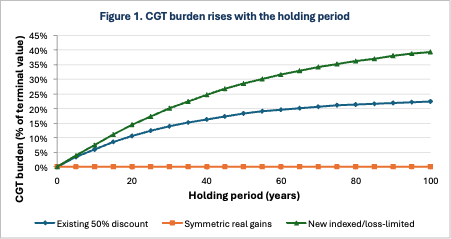
Notes: CPI-centred case: inflation 3%; expected real capital-price growth zero; marginal tax rate 47%; annual individual-asset volatility 30%. Source: Giesecke and Nassios (2026).
With a 30-year holding period, the existing 50% discount system produces an expected CGT liability equal to 13.8% of the portfolio’s terminal value. This is the result of the existing system’s familiar defect: it taxes nominal gains generated by inflation, even when the real gain is zero.
Nevertheless, despite ostensibly correcting for inflation, the new indexed / loss-limited system produces a larger tax burden: 19.9% of the portfolio’s value at the 30-year mark. A symmetric real-gains system, which treats real gains and real losses in the same way, would produce no burden, consistent with a zero expected net real gain.
Under both the existing and the new system, the CGT burden rises with the holding period. Under the new system, expressed as a proportion of the portfolio’s value at each point in time, the contingent CGT burden is 3.8% after five years, 7.5% after 10 years, and 19.9% after 30 years. The corresponding burdens under the existing system are 3.2%, 6.0% and 13.8%. The CGT burden rises with the holding period under the existing system, because the longer horizon allows accumulated inflation to become a larger proportion of the portfolio’s value. Under the new system, longer holding periods increase the dispersion of asset values and the expected amount of taxable real gains. Expected real losses also increase, but are recognised only to the extent that they are nominal losses. As inflation accumulates, the gap between the indexed and original cost bases widens, leaving a larger component of real losses that are unrecognised.
Will riskier assets be taxed more heavily?
Figure 2 reports CGT burdens under varying volatility, holding the other central-case assumptions constant. Under the existing system, changing individual-asset volatility does not change the tax burden, because nominal gains and losses are pooled equally, before applying the discount and the marginal tax rate. Under a symmetric real-gains tax, the burden also remains zero, as the portfolio’s expected net real gain is zero.
The new system behaves differently: higher asset-level dispersion increases the expected amount of taxable real gains without equivalent recognition of real losses, hence, the expected tax burden rises with volatility. At zero volatility, every asset tracks inflation, so the new system generates no burden. Thereafter, the burden rises with volatility, crossing and then surpassing the burden of the existing system at approximately 15.9% volatility.
Figure 2 makes clear that asset-level return dispersion becomes a tax parameter under the new system. This is potentially a serious economic distortion. Assets or sectors with the same expected real capital-price growth but different return dispersion can face different expected CGT burdens. This sits uncomfortably with the stated policy objective of broad asset neutrality.
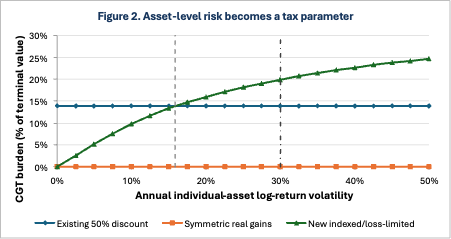
Notes: T = 30 years, inflation 3%, expected real capital-price growth zero and marginal tax rate 47%. The vertical lines mark the 15.9% break-even volatility and the 30% central calibration. Source: Giesecke and Nassios (2026).
Does indexation make CGT inflation-neutral?
Under the existing system, inflation creates taxable nominal gains directly. Under the new system it operates indirectly through the different thresholds for gains and losses created by asymmetric loss recognition.
Consider an investor who purchases an asset for $100, and suppose its value falls by 5% in real terms over one year. With inflation of 3%, its market value is about $98. It has lost 5% in real terms, but only the nominal loss of about $2 is recognised. With inflation of 6%, the same 5% real loss produces a nominal sale price of about $101. Despite being the same 5% real loss, inflation has pushed the outcome into the loss-recognition dead zone. More generally, because the loss recognition threshold remains fixed at $100, while the indexed-gain threshold rises with inflation, higher inflation widens the band in which real losses are unrecognised.
Figure 3 plots the relationship between inflation and tax burdens under the three CGT systems. In the zero-real-growth scenario, all three expected burdens are zero at zero inflation. With no gap between the original and indexed cost bases, there is no middle band of unrecognised real losses under the new system. As inflation rises, the systems diverge. Under the existing system, inflation creates taxable nominal gains. Under the new system, inflation widens the range of real losses that are not recognised. Across the inflation rates in Figure 3, the new-system burden is higher than the existing-system burden. A symmetric real-gains system remains at zero because the expected real capital-price gain remains zero.
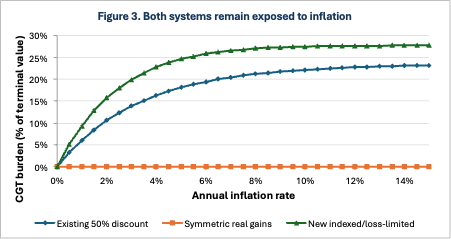
Notes: T = 30 years, expected real capital-price growth zero, marginal tax rate 47% and annual individual-asset volatility 30%. Source: Giesecke and Nassios (2026).
Have these issues been identified before?
The indexed/loss-limited system has been implemented before in Australia (1985-1999) and in other jurisdictions, and its consequences have been identified before. Officer (1990) described the asymmetry as “a bias against the taxpayer”. The US Congressional Budget Office (1990) identified the three-region tax schedule and illustrated its consequences using two investments with identical expected pre-tax returns but different risk. In its example, the asymmetric treatment of gains and losses left the risky investment facing an expected tax bill 50% higher than the safe asset. Sherris (1992) subsequently represented the payoff generated by the Australian CGT system for a single asset as an option. In Britain, where indexation was extended to losses in 1985 and restricted again in 1994, Bracewell-Milnes (1994) argued that the restriction raised effective rates, discouraged risk-taking and favoured structures allowing wider aggregation of gains and losses. In the context of this earlier literature, our contribution has been to quantify the expected burden across a range of asset outcomes, show how the tax burden changes with holding period, inflation and risk, compare three CGT systems on a common basis, move beyond Sherris’s (1992) analysis of a single representative asset to examine expected tax burdens across a large portfolio, and show that our key results are not dependent on any particular statistical assumption about asset-price movements.
Policy recommendations
Our analysis suggests that the new CGT system falls short of its policy objectives of compensating taxpayers for inflation and being broadly asset neutral. Under the new system, the CGT burden rises with inflation, risk and holding period, and can produce higher expected CGT burdens than the existing system. A symmetric real-gains system, which would measure real gains and real losses on the same basis, could better align with the stated policy objectives.
The existing discount system remains imperfect because it taxes part of inflationary gains. But if policymakers are unwilling or unable to recognise real losses on the same basis as real gains, our results suggest it may be a less damaging second-best than the new system. Under the holding period, inflation, volatility, and return-shape sensitivities examined in our paper, it produces the lower burden and does not make asset-level volatility a tax parameter.
With this background, retaining the existing nominal-gains system with discount deserves consideration as a second-best alternative, particularly if Canberra cannot make a commitment to a symmetrical real gains system that will be credible to long-term investors. While the current system is flawed by its taxation of inflation, only partly offset by the discount, it has the redeeming feature of treating gains and losses symmetrically within the CGT framework, and thus avoiding the additional dispersion-dependent tax penalty created by the new system.
References and further reading
Bracewell-Milnes, B. (1994), “Finance Act Notes: Indexation of Capital Losses: The Price of Principle – Section 93”, British Tax Review, no. 4, pp. 291-298.
Congressional Budget Office (1990), Indexing Capital Gains, Washington, DC, August.
Giesecke, J. A. and J. Nassios (2026), “Effective Capital Gains Tax Burdens Under Asymmetric Recognition of Real Losses”, Centre of Policy Studies Working Paper No. G-373, Victoria University, August 2026.
Officer, R.R. (1990), “The Australian Imputation System for Company Tax and Its Likely Effect on Shareholders, Financing and Investment”, Australian Tax Forum, 7(3), pp. 353-378.
Sherris, M. (1992), “Reserving for Deferred Capital Gains Tax (An Application of Option Pricing Theory)”, Journal of the Institute of Actuaries, 119(1), pp. 45-67.
Citation
Giesecke, James & Nassios, Jason, (2026), Indexing capital gains but not losses: an old problem revisited, Austaxpolicy: Tax and Transfer Policy Blog, 12 October 2026, Available from: https://www.austaxpolicy.com/indexing-capital-gains-but-not-losses-an-old-problem-revisited/
James Giesecke is a Professor; and Jason Nassios is an Associate Professor and Deputy Director (Engagement and Impact) at the Centre of Policy Studies, Victoria University.
This article was originally published by Austaxpolicy, a digital publication of the Tax and Transfer Policy Institute, and is republished with permission.