Australia’s housing-affordability debate usually centres on prices, deposits and interest rates. Less attention is paid to mortgage terms.
Thirty years has become the conventional Australian home-loan term, but there is nothing sacrosanct about that number. If the price of housing has structurally increased relative to household income, it is reasonable to ask whether the repayment structure should also change.
Australia already has a real-world example. Great Southern Bank offers eligible first-home buyers terms of up to 40 years. The structure is limited to owner-occupiers, requires at least one first-home buyer, and is available only to applicants aged 40 or under. Investment property is excluded.
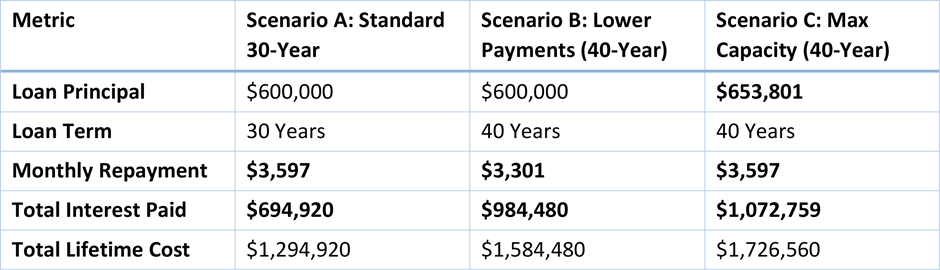
The appeal is evident in the numbers. Consider a $600,000 principal-and-interest loan at a constant 6% interest rate. Over 30 years the monthly repayment is about $3,597. Over 40 years it falls to about $3,301, a reduction of $296 a month, or 8.2%.
A borrower able to service $3,597 each month could theoretically support a loan of around $654,000 over 40 years instead of $600,000 over 30 years.
That does not mean a bank would automatically approve 9% more debt. APRA-regulated banks still assess borrowers using a mortgage serviceability buffer of 3 percentage points, along with living expenses, liabilities and other credit criteria. High debt-to-income lending is also subject to macroprudential limits.
The key point is simpler: loan maturity changes the minimum required repayment and therefore forms part of affordability.
Mortgage maturity is widely recognised as part of the affordability question. IMF economists Nina Biljanovska, Chen Fu and Deniz Igan developed a cross-country affordability measure that includes house prices, income, mortgage rates, loan-to-value ratios and mortgage maturity. Their framework recognises that the same house price can have very different repayment consequences depending on how the mortgage is structured.
The trade-off is that lower monthly payments come at a high lifetime cost.
If the $600,000 loan remained at 6% until maturity, total interest would be about $695,000 over 30 years and $985,000 over 40 years. A 50-year mortgage would reduce the monthly payment further to about $3,158, but total interest would rise to about $1.295 million.
The extra decade from 40 to 50 years saves only around $143 a month while adding more than $310,000 in lifetime interest under the constant-rate assumption.
On these assumptions, a 40-year mortgage appears a more defensible compromise than a 50-year term.
The case for a longer term is strongest when viewed through the life cycle of a first-home buyer. RBA research has found first-home buyers tend to be younger, have higher loan-to-value ratios and smaller liquidity buffers when they enter the market. Yet they have historically experienced relatively strong income growth around the years of home purchase and have not been more likely than other owner-occupiers to experience mortgage arrears.
A younger borrower may therefore have the weakest income at precisely the stage when housing needs are greatest. A longer contractual term can reduce the compulsory repayment early in the borrower’s career while preserving the option to pay faster later through additional repayments, offset savings or refinancing.
Importantly, a 40-year mortgage need not be a 40-year repayment plan. Instead it can operate as a lower repayment floor rather than a target repayment horizon, allowing borrowers to accelerate repayments as incomes rise.
Sweden provides an instructive international comparison.
It is sometimes described as having 100-year or even “generational” mortgages, but that is an oversimplification. In 2013, Swedish regulator Finansinspektionen reported that among first mortgages that were being amortised, the average actual repayment period implied by the repayment rate exceeded 140 years. The issue was not a standard 140-year loan contract. Principal was simply being reduced extraordinarily slowly.
Sweden later strengthened amortisation requirements. Under rules effective from April 2026, mortgages with an LVR above 70% generally require annual principal reduction of at least 2%, while mortgages above 50% and up to 70% require at least 1%. At the same time, Sweden raised the maximum LVR for a home purchase to 90% and removed an extra amortisation requirement previously applied to borrowers with very high housing debt relative to income.
The Swedish lesson is therefore balanced. Lower entry barriers can support ownership, but principal repayment still matters.
For similar reasons, I would be cautious about long interest-only periods for first-home buyers. Interest-only repayments on $600,000 at 6% are $3,000 a month, but after 10 years the borrower still owes the original $600,000 principal. Eventually converting to principal-and-interest repayments can create a significant repayment shock.
A 40-year P&I loan lowers the minimum payment but still reduces principal from day one.
There is also a broader policy risk. Making it easier for everyone to borrow more does not necessarily make housing more affordable. In a supply-constrained market, increased purchasing power can be capitalised into higher prices. In that case, some of the benefit accrues to existing homeowners rather than first-home buyers.
The IMF’s latest assessment of Australia has warned that demand-side home-buyer assistance can add to near-term price pressure when housing supply is constrained.
For that reason, any extension of 40-year mortgages should be confined to owner-occupiers rather than investors.
A targeted approach would be more defensible: younger first-home buyers, owner-occupied property, normal serviceability rules, principal-and-interest repayments, and the ability to repay faster without material penalty.
The purpose should not be to maximise debt. It should be to recognise a life-cycle mismatch between when younger households need housing and when their earning capacity is strongest.
Longer mortgages will not solve Australia’s housing shortage. They cannot substitute for planning reform, infrastructure and new construction.
Yet mortgage structure remains one component of affordability. A carefully targeted 40-year P&I loan could modestly improve early cash flow for younger first-home buyers while retaining prudent repayment discipline.
The main long-term risk is that borrowers carry mortgage debt further into middle age and potentially into retirement. For that reason, longer loan terms should be accompanied by flexibility to accelerate repayments as incomes rise, rather than becoming a mechanism for permanently higher household leverage.
As with most housing policies, the key is targeting. If longer terms are used to help first-home owner-occupiers rather than to expand investment leverage, and if housing supply rises alongside them, they may deserve a larger place in Australia’s affordability toolkit.
Jade Xie is an MFAA accredited Mortgage Broker and Managing Director of Easyhome Mortgage. She has approximately 25 years of experience in finance, banking and credit in Australia and New Zealand. Her interests include housing finance, mortgage credit, household financial capacity and property-market policy. The views are personal and are general information only.