Register For Our Mailing List

Register to receive our free weekly newsletter including editorials.

Home / 665

Tax deductibility of financial advice improves affordability

The rapid decline in the number of financial planners in Australia over the past decade (from around 28,000 at the peak in early 2019 to just over 15,100 today) has been a huge factor in reducing the accessibility and affordability of financial advice. On top of this, the impact of increased regulation and red tape has made it more expensive for advisers to run their business, which also affects the cost of advice.

And of course, this is happening at a time when more Australians than ever would benefit from financial advice. The intergenerational wealth transfer, the rising cost of living, taxation reform and economic uncertainty, are all contributing to an environment where Australians need quality, professional financial advice in order to achieve financial wellbeing.

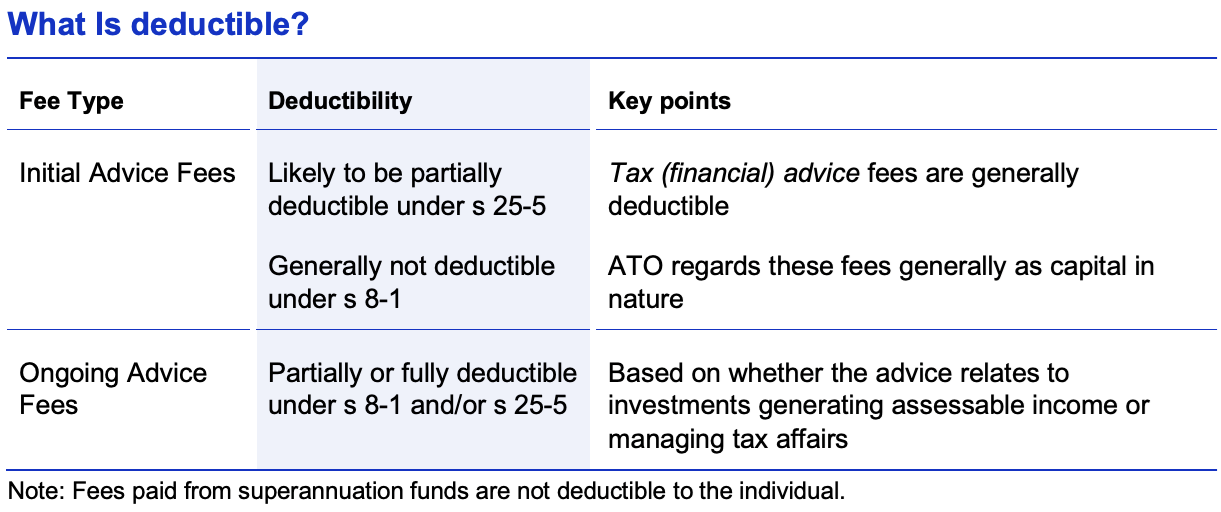
One simple step to make advice more affordable for more Australians has been to make more types of financial advice tax-deductible. Most ongoing financial advice is already deductible, but an important extension was finalised by the ATO in late 2024, confirming that some upfront advice can also be tax deductible.

In TD 2024/7, the ATO has confirmed that upfront financial advice fees are deductible to the extent they relate to tax advice.

The result is that more Australians should be able to deduct a larger portion of both their initial (as well as ongoing) financial advice fees.

What is deductible

The definition of tax (financial) advice can include all or part of the fee for superannuation advice about contributions such as salary sacrificing, advice around superannuation pension strategies, advice on whether or not certain insurance policies should be held inside or outside of super, gearing strategies, some estate planning advice and investment structuring for taxation purposes.

Source: FAAA

How the adviser determines what portion of the advice given relates to taxation advice is complex and must be evidence based. An example can help illustrate how this might work.

Let's look at the case of Leo, a pre-retiree in his 50s looking to retire in the near future and seeking advice from financial adviser Amy. The total initial advice fee paid by Leo (i.e. not his super fund) is $5,500.

Amy and Leo have an initial consultation of one and a half hours, during which they discuss a range of factors, including a general discussion about tax affairs.

After the meeting, Amy investigates and analyses Leo's existing investments and circumstances for half an hour which includes a CGT report and an examination of his contribution caps.

Overall, Amy breaks down each portion of time she spends on Leo's affairs and what part of that time is spent on tax (financial) advice. This includes 1.5 hours spent on strategy modelling, 2 hours spent on strategy development, 5.5 hours spent on writing the statement of advice and another hour-long meeting with the client to present the Statement of Advice.

In total, Amy assesses that $2,831 of the initial fee of $5,500 is tax deductible (51%).

If Leo is on a salary of $155,000 and a marginal tax rate of 37 cents in the dollar for income earned over $135,000, that tax deductibility represents a saving of $1,047 on his upfront advice fee, reducing the effective total fee to $4,453.

Affordability gains

In this example, the deductibility of certain portions of the financial advice fee is an effective 20% reduction in cost.

Our annual Value of Advice consumer research consistently shows that advised clients are much more confident about their financial affairs, with 96% in our most recent survey for 2025 saying that it has provided them with more value than it costs, and 93% reporting that their financial adviser has made them tangibly financially better off.

By reducing the overall effective cost of advice, the tax deductibility of some parts of the advice fee further improves affordability and allows more Australians to access financial advice.

So if you are a financial advice client, make sure you talk to your accountant and financial adviser about tax deductibility of any advice fees, when finalising your tax return for FY26!


Sarah Abood is the Chief Executive Officer at the Financial Advice Association Australia (FAAA).


  •   3 June 2026
  • 3
  •      
  •   
3 Comments
Carolyn
June 04, 2026

Hi Steve. You are clearly a well informed, articulate individual who has an understanding of part of the role of a financial adviser. Considering your education on investing and risk, you are self directed & take care of your own financial affairs which is terrific. However, the vast majority of people that I see (and yes, full disclosure, I am a financial adviser) do not have your level of knowledge and experience, and want the peace of mind of working with a professional.

This morning, for example, I spent time at an Aged Care centre visiting clients who I have worked with for over ten years, and discussing investment performance / risk profile etc, was not on the agenda. It was about making sure they are financially well organised and that the cost of their care is going to be comfortably met, that their estate planning is in order, and providing peace of mind for them & for the next generation (adult kids) who attended the meeting. Of course, at previous interactions investment performance has been discussed, however it is less of a focus for a financial adviser who provides holistic advice, than you might be aware.

I suspect financial advisers with strong interpersonal skills, in addition to their knowledge & education on financial matters, might be around for some time to come.

5
Steve
June 07, 2026

Hi Carolyn,
I have no problem at all with the type of service you provide particularly to the elderly and vulnerable and more complex situations with deeper legal problems for example. There is a clear need for this. My main point was for the bulk of the population where the needs are more around investment matters (as opposed to estate matters etc) there is a real challenge to show value when the fees are typically around $5000 give or take. Hence the shrinking numbers....

2
 

Leave a Comment:

RELATED ARTICLES

Lending policies can spoil good SMSF strategies

Super is catching up, but ageing is a triple-threat

Investment bonds for intergenerational wealth transfer

banner

Most viewed in recent weeks

Noel Whittaker’s take on the budget

Marketed as a fix for inequality and housing affordability, the latest budget instead delivers a tangle of tax changes that leave everyday Australians worse off.

Australia has no death duties. Technically.

Australia may not levy formal death duties, but a growing web of tax measures is quietly shaping what wealth passes between generations. Now, the 2026 budget adds another layer.

Welcome to Firstlinks Edition 662 with weekend update

The debate over the budget is increasingly shaped by frustration and perceptions of unfairness, rather than clear-eyed assessment of policy outcomes.

How to minimise tax with a will

Inheritance tax implications in Australia may surprise some, as poor estate planning without proper wills or trusts can lead to costly tax bills and delays for beneficiaries.

How inflation is quietly moving the goalposts on retirement

Inflation doesn’t just raise today’s bills - it quietly increases the amount needed to retire, while simultaneously making it harder to save. Three steps to take before June 30th to improve retirement outcomes.

Testamentary trusts post-budget: Estate planning, tax reform and the ‘death tax’ debate

Proposed Budget changes to taxation are casting new uncertainty over testamentary trusts, prompting closer scrutiny of estate planning structures and the real implications of reforms still taking shape.

Latest Updates

Investment strategies

High quality businesses are on sale

Beneath the dominance of the ASX's largest stocks, much of the market has been left behind. High-quality companies are now trading at levels rarely seen, offering opportunities for investors willing to look deeper.

Investment strategies

The whirlwind is upon us

Something unusual is happening in markets. The winners are pulling further ahead at an extraordinary pace. As return dispersion hits extreme levels, volatility is rising and the investing landscape is becoming harder to navigate.

Strategy

Inequality destabilises economies

Extreme wealth concentration is no longer just a side effect of growth. As inequality deepens, its consequences are shifting from a social concern to a broader threat to economic stability and democratic resilience.

Investment strategies

Have AI’s four horsemen arrived?

AI exuberance is colliding with economic reality. Cracks are emerging as spending surges, ROI remains uncertain and enterprise behaviour shifts. The next phase may look less like an expansion and more like a reckoning.

Taxation

Budget tax changes only scratch the surface. Here are 4 reforms Australia needs next

The 2026 budget has reignited Australia’s tax reform debate, but more work remains. Beneath the surface lies a harder question: what structural reforms are needed to make the country's tax system fit for the future?

Taxation

Negative gearing: quarantined, not killed

The Budget's negative gearing changes defer deductions rather than deny them, yet a worked example shows quarantining can reduce the tax benefit's present value for buyers of established dwellings.

Investment strategies

Family offices have quietly taken over Australian private capital

In just four years, Australia's private capital landscape has transformed. We are seeing changes across who deploys capital, how deals are structured and why new platforms and investor pathways are rapidly emerging.

Sponsors

Alliances

© 2026 Morningstar, Inc. All rights reserved.

Disclaimer
The data, research and opinions provided here are for information purposes; are not an offer to buy or sell a security; and are not warranted to be correct, complete or accurate. Morningstar, its affiliates, and third-party content providers are not responsible for any investment decisions, damages or losses resulting from, or related to, the data and analyses or their use. To the extent any content is general advice, it has been prepared for clients of Morningstar Australasia Pty Ltd (ABN: 95 090 665 544, AFSL: 240892), without reference to your financial objectives, situation or needs. For more information refer to our Financial Services Guide. You should consider the advice in light of these matters and if applicable, the relevant Product Disclosure Statement before making any decision to invest. Past performance does not necessarily indicate a financial product’s future performance. To obtain advice tailored to your situation, contact a professional financial adviser. Articles are current as at date of publication.
This website contains information and opinions provided by third parties. Inclusion of this information does not necessarily represent Morningstar’s positions, strategies or opinions and should not be considered an endorsement by Morningstar.