Rising government debt doesn't just affect taxpayers. It can reduce the number of takeovers, discourage corporate investment and weigh on the returns of the very blue-chip companies many investors own.
Investors watch the Reserve Bank closely, and with good reason. Last month it lifted the cash rate for the fourth time this year, to 4.6%. Canberra deserves almost as much attention. Australia’s federal and state governments carry around $1.6 trillion in debt, and in September the International Monetary Fund urged them to rein in spending.
The debt debate is usually framed around the future: the interest bill, the tax rises our children will face, the fiscal room needed for the next crisis. For investors, however, part of the cost arrives much sooner. It shows up in the investments and takeovers that never occur, and in the quality of the deals they do.
How government borrowing crowds out companies
Every dollar governments borrow competes for the same pool of savings that funds business. When governments issue more bonds, banks, super funds and other investors shift money from lending to companies towards lending to government.
A study by John Graham of Duke University, Mark Leary of Washington University in St. Louis and Michael Roberts of the Wharton School traces this through almost a century of US company data. When the federal government borrows more, companies borrow less, invest less in plant and equipment, and hold more cash.
The surprise is who bears the cost. It isn’t the weakest borrowers but the strongest. The effect is largest among big, low-risk companies, because their bonds are the closest substitutes for government bonds. When governments flood markets with safe assets, investors need less exposure to corporate bonds that serve a similar purpose. The result is that blue-chip companies can find funding conditions deteriorating just when investors assume they are safest.
Fewer takeovers, and worse ones
Using US data from 1981 to 2016, we find that a typical increase in government debt, measured relative to the size of the economy, reduces a company's likelihood of making an acquisition in the following year by about a fifth, from roughly 10% to 8%.
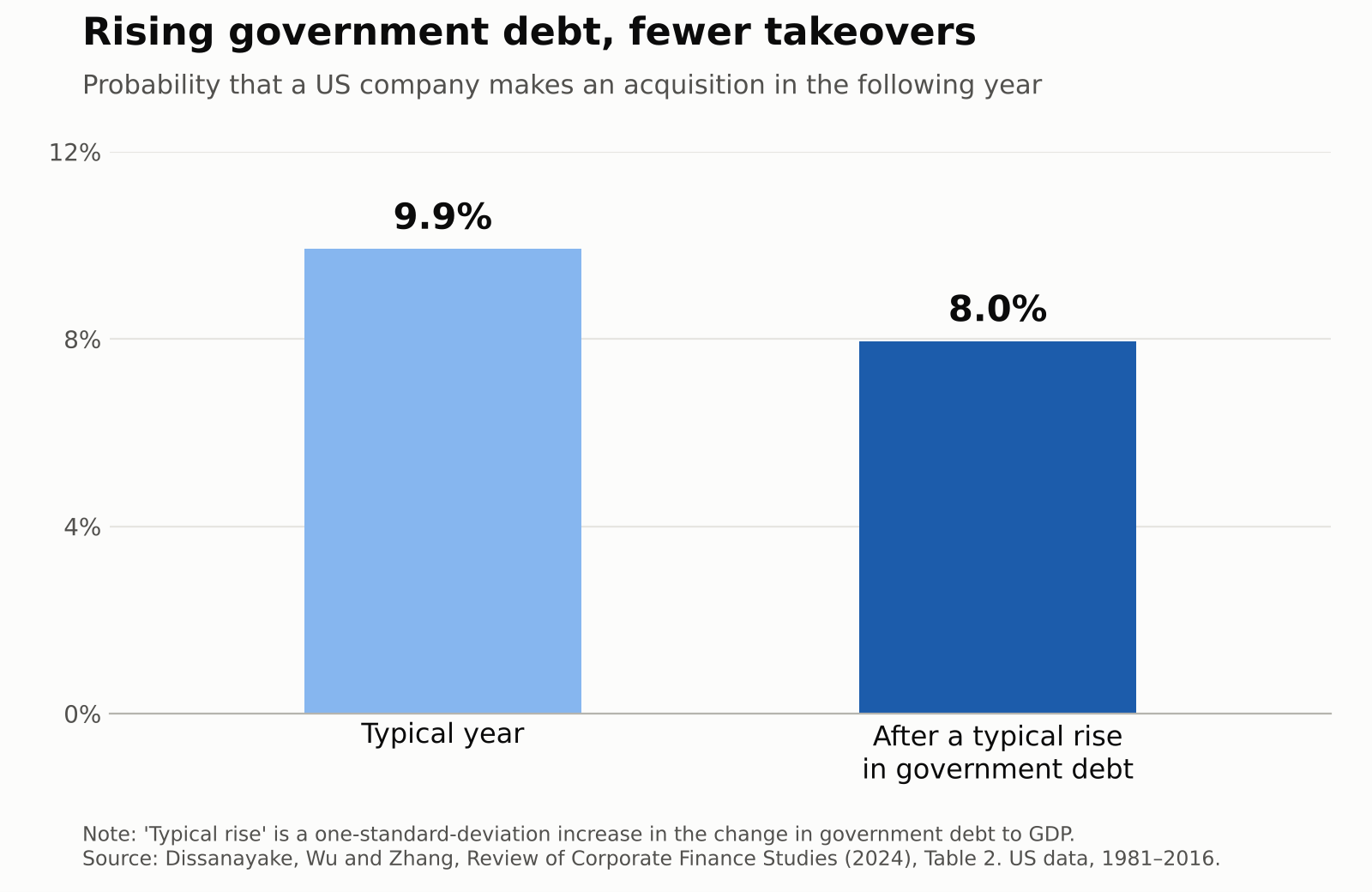
The drop is sharpest among the most creditworthy companies, and among those most exposed to uncertainty about future taxes and government spending. That second point matters. A board considering a major acquisition today can’t know whether future governments will rely more on higher corporate taxes, lower spending or other measures. Separate research by Mariano Croce of Bocconi University and colleagues links that tax uncertainty to weaker returns on corporate innovation. Companies facing an unresolved fiscal bill often wait before committing to long-lived investments.
The deals that do go ahead are also poorer. Fiscal uncertainty makes it harder for boards and investors to judge what a deal is worth, and weaker managers can take advantage of that. Acquisitions announced when public debt is rising deliver lower returns to the acquiring company's shareholders and smaller combined gains for the two companies, and the acquirers tend to have weaker governance.
Most of this evidence comes from the United States, but most Australians are exposed to this dynamic whether they realise it or not. Through their superannuation funds, they own a large slice of US and other global companies, where government debt has been rising for years. The direct effect at home may be more muted, because a large share of Commonwealth bonds is held offshore. Heavier public borrowing still has to be absorbed somewhere, however, and with federal and state governments both borrowing heavily, the question of how the debt will be repaid is as live here as anywhere.
What it means for investors
Four implications stand out.
First, be cautious about counting on takeover upside. Bid activity is one of the ways shareholders in smaller and mid-sized companies get rewarded. When public borrowing is rising, the evidence suggests there are fewer bidders around.
Second, look harder at acquisitive companies. When a company announces a large acquisition during a period of rising public debt and fiscal uncertainty, the historical record says buyers’ shareholders tend to do worse. That’s a reason to scrutinise the price paid, the strategic logic and the board’s track record more closely than usual.
Third, the 'safe' end of the market is not insulated. It is natural to assume high-quality companies ride out fiscal pressure best. On financing and investment, the research suggests they feel the squeeze the hardest, because they compete most directly with government bonds for investors' money.
Fourth, watch for fiscal clarity, not just the size of the debt. Part of the damage comes from not knowing how the bill will be paid. A clear, credible plan for stabilising debt, whichever mix of tax and spending measures governments choose, would reduce that uncertainty well before the debt itself falls. Budget updates and statements that bring that clarity are worth reading as closely as an RBA decision.
To be clear, government borrowing is not always harmful. Borrowing that funds productive infrastructure or supports the economy during crises can generate benefits that could outweigh these crowding-out effects. But it does mean that the price of borrowing is higher than the interest bill suggests. Franco Modigliani, who went on to win the Nobel Memorial Prize in Economic Sciences, argued in 1961 that public debt leaves future generations with less private capital. Modern takeover evidence now suggests the burden doesn’t wait that long. The impact can appear today through weaker corporate investment, fewer takeover opportunities and poorer acquisition outcomes.
Dr Ruchith Dissanayake is a Senior Lecturer in the School of Economics and Finance at QUT Business School. He is a Chief Investigator on an AHURI-funded research project on housing supply, and Principal of BID Capital, a Brisbane mortgage and finance brokerage.
This article is general information only and does not consider the circumstances of any individual. The views expressed are the author's own.
Research referred to: Dissanayake, Wu and Zhang, 'The Burden of National Debt: Evidence from Mergers and Acquisitions', Review of Corporate Finance Studies (2024), open access; Graham, Leary and Roberts, 'How Does Government Borrowing Affect Corporate Financing and Investment?', NBER Working Paper 20581; Croce, Nguyen, Raymond and Schmid, 'Government Debt and the Returns to Innovation', Journal of Financial Economics (2019); Modigliani, Economic Journal (1961).