Register For Our Mailing List

Register to receive our free weekly newsletter including editorials.

Home / 688

Welcome to Firstlinks Edition 688

  •   12 November 2026
  • 1
  •      
  •   

For whom the bell tolls

John Donne's famous line, later borrowed by Hemingway, is usually remembered as a meditation on death. What is often forgotten is that it was also a meditation on attention.

Historically, church bells functioned as a mass-communication system to announce any form of breaking news. Whether it was a birth, death, emergency or new arrivals, the bell rang because something had happened that the community needed to know. Recently, it has felt as though bells have been sounding from every quarter.

Nvidia, now down 25% over the past month, has prompted a different set of questions than investors have become accustomed to asking. At the same time, political developments in the United States suggest that public enthusiasm for an AI-driven future may be less unanimous than markets have assumed.

Markets have always produced enough controversies to fill a newsroom and to no one's surprise, politics remains an endless theatre of ambition and disappointment. However, there are moments when seemingly unrelated stories start to appear like fragments of a larger one.

The mood of the past few years in markets has been one of confidence, gradually morphing into a sense of inevitability. Investors will know the prevailing narrative well. AI will transform the economy, Nvidia will supply the picks and shovels and the hyperscalers are willing to spend whatever necessary to secure their advantage. Eventually, these immense expenses will all be justified by significant productivity gains. Investors may disagree on valuations, timelines and beneficiaries, but far fewer question the direction itself. The trouble often begins when a hypothesis ceases to be questioned.

None of this is to suggest that artificial intelligence is a passing fad. I find that history offers very little support for that conclusion. The internet transformed modern life so completely that I often struggle to imagine a world in which accessing information required patience.

In this sense, the technology itself was rarely the source of the misunderstanding. Rather, investors consistently struggled to distinguish between a revolutionary innovation and a sound investment. The former is usually much more obvious.

What strikes me as most interesting is not the technology itself, but the behaviour surrounding it. One of the more curious developments has been the increasingly frantic search for capital across the AI ecosystem. Though funding remains abundant, the appetite for capital simply continues to expand.
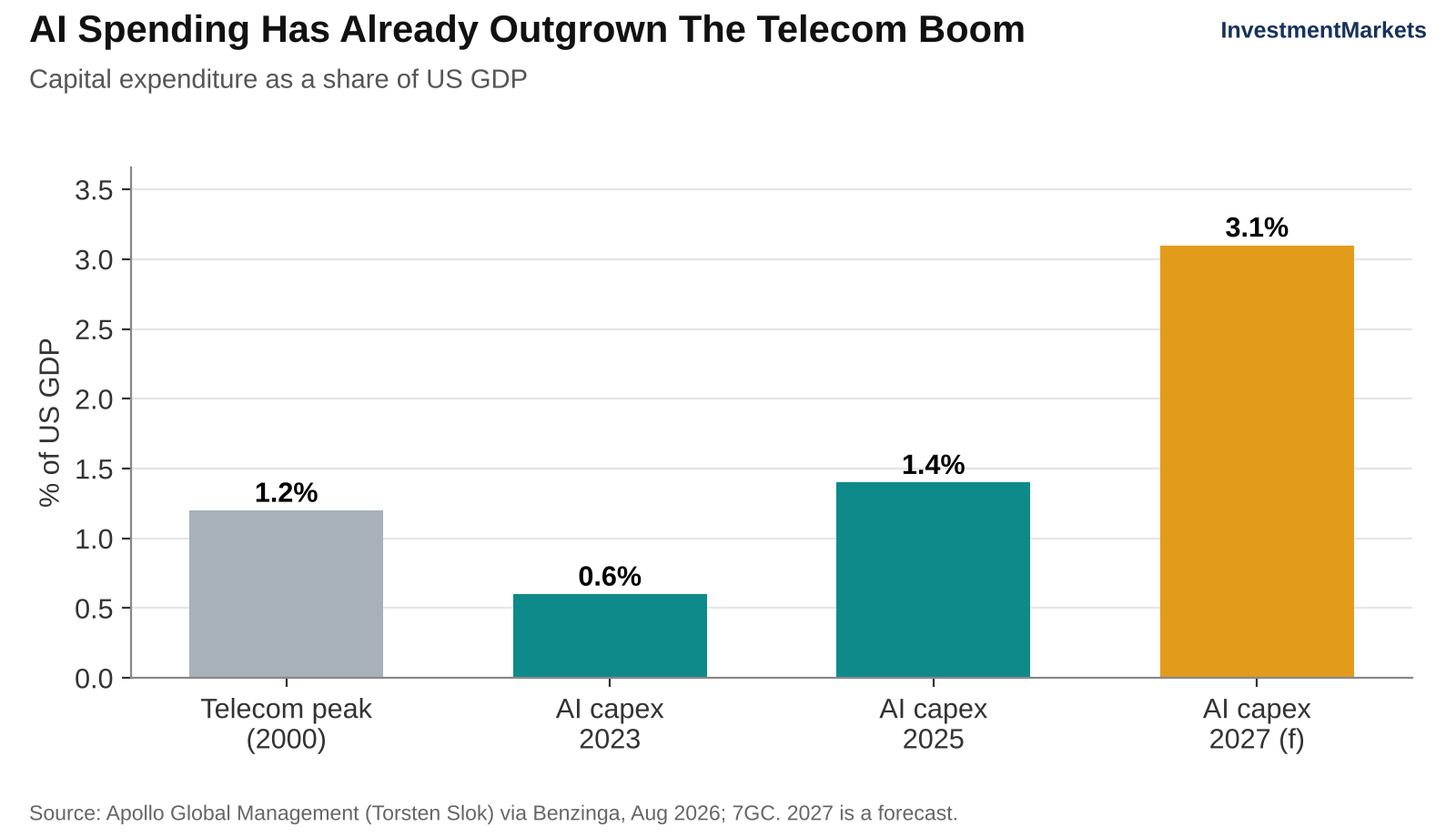
Against that backdrop, the growing enthusiasm around public listings feels noteworthy. Such events are often treated as milestones of ambition and the natural progression of successful companies. Often they are. Yet I cannot help wondering whether some of the recent manoeuvring in the industry reflects confidence or concern. Things are not always as romantic as they seem. Public markets have also historically functioned as a liquidity event for early investors and employees seeking an exit.

None of these developments constitute a crisis or entire collapse of conviction. I prefer to make observations rather than predictions. However, what these events collectively suggest is that the extraordinary confidence which has characterised recent years may no longer be quite as secure. Ultimately, that may be what the bells are signalling.

Donne understood that uncertainty has always been a communal experience. Investors (despite their frequent attempts to convince themselves otherwise) remain part of a similar community. 

Simonelle Mody

Also in this week's edition...

Retirees can be reluctant to draw on their savings due to fear of running out. David Bell and Geoff Warren propose an additional retirement savings account that Australia should have.

The Democrats have regained control of Congress and shifted the equation in Washington. Shane Oliver returns to discuss the implications of the US midterm results for investors. 

A reader's query about the recent CGT reforms has raised a bigger issue. Tony Dillions asks whether policymakers are forgetting to reward investors for taking on risk.

Rising yields have made bonds attractive again, but the team at Fidelity Australia argue that the role they play in a portfolio has become more complicated.

Signs of a recovery are emerging for dividend investors. Marc Jocum explores the important trade-off that investors face when seeking yield and building reliable income.

The market has delivered some of the strongest returns have arrived when the outlook seemed least attractive. Jason Teh explains why 'overvalued' has been such an expensive word for portfolios.

Investor obsession with AI is attracting unprecedented amounts of capital and confidence. Satyajit Das questions whether the enthusiasm is a good kind of bubble or simply a bubble.

Curated by Simonelle Mody and Leisa Bell

Latest updates

PDF version of Firstlinks Newsletter

Monthly Gold ETF Flows from World Gold Council

Monthly Bond and Hybrid updates from ASX

Monthly Investment Products update from ASX

Listed Investment Company (LIC) Indicative NTA Report from Bell Potter

Plus updates and announcements on the Sponsor Noticeboard on our website


  •   12 November 2026
  • 1
  •      
  •   
banner

Most viewed in recent weeks

Division 296: the initial moves to make before the windows close

What if the best superannuation strategy isn't about earning more, but acting before your options disappear? Several overlooked planning windows are narrowing, with consequences that can last for decades.

The retirement scorecard: how many of these questions can you answer?

From the maths of retirement, estimating spending and picking the right asset allocation to survive a poor decade, here are the questions every retiree – current or future – should be able to answer for themselves.

Testamentary trusts: Treasury has picked the wrong reading

A decades-old estate planning tool has survived one tax crackdown only to be caught by another. The surprise isn't who the reform is targeting, but who could end up paying the price for drafting choices made years ago.

Superannuation’s structural failings

Politicians are fighting over access to super, but they may be arguing about the wrong thing. The system’s three fundamental flaws have been hiding in plain sight for decades, costing Australians far more than they realise.

Avoid unnecessary CGT with this estate planning clause

A simple estate plan can create a ticking time bomb. One overlooked clause can pit spouses against children, delay inheritances, and potentially leave a family facing an unexpected tax bill worth hundreds of thousands of dollars.

Higher yields are creating opportunities in global bonds

Bond markets are adjusting to a new reality, but not in the ways investors expect. With markets repricing and capital competing for attention, investors may need to rethink where resilience and opportunity lie. 

Latest Updates

Retirement

The retirement account that Australia should have

Our retirement system asks one account to do two very different jobs. A dedicated "rainy day" account separating income from emergency savings could deliver better outcomes and greater peace of mind for retirees.

Investing

What the US midterm results mean for investors

Democrats have regained control of Congress, changing the equation in Washington. Whether that proves positive for investors will depend less on the result itself and more on what happens next for growth and markets.

Taxation

Should the capital gains tax reward risk?

A reader query on the recent CGT reforms has revealed a bigger issue. One overlooked feature of the old system may have done more than compensate for inflation. As we move to indexation, are we forgetting to reward risk?

Investment strategies

Bonds: The income and diversification trade-off

Rising yields have made bonds attractive again, but that does not mean they will behave as expected. As inflation, fiscal pressures and geopolitical risks reshape markets, the role of bonds may be more complicated than it appears.

Investment strategies

Why high-dividend investing deserves another look

Income investors have endured several lean years, but signs of a recovery are emerging. As opportunities improve, investors face an important choice between chasing headline yields and building a reliable source of income.

Investment strategies

Why 'overvalued' has been such an expensive word

Investors love simple rules, especially when markets appear stretched. Yet some of the strongest returns have arrived when the outlook seemed least attractive. This leaves an important question that history struggles to answer.

Investment strategies

AI – A good kind of bubble or just a bubble?

Investor obsession with AI is attracting unprecedented amounts of capital and confidence. But beneath the excitement lies uncertainties about returns, funding and risks that enthusiasts may not be paying enough attention to.

Sponsors

Alliances

  • ASA-Logo-RGB-ActiveGreen-web.png

© 2026 Morningstar, Inc. All rights reserved.

Disclaimer
The data, research and opinions provided here are for information purposes; are not an offer to buy or sell a security; and are not warranted to be correct, complete or accurate. Morningstar, its affiliates, and third-party content providers are not responsible for any investment decisions, damages or losses resulting from, or related to, the data and analyses or their use. To the extent any content is general advice, it has been prepared for clients of Morningstar Australasia Pty Ltd (ABN: 95 090 665 544, AFSL: 240892), without reference to your financial objectives, situation or needs. For more information refer to our Financial Services Guide. You should consider the advice in light of these matters and if applicable, the relevant Product Disclosure Statement before making any decision to invest. Past performance does not necessarily indicate a financial product’s future performance. To obtain advice tailored to your situation, contact a professional financial adviser. Articles are current as at date of publication.
This website contains information and opinions provided by third parties. Inclusion of this information does not necessarily represent Morningstar’s positions, strategies or opinions and should not be considered an endorsement by Morningstar.