Register For Our Mailing List

Register to receive our free weekly newsletter including editorials.

Home / 685

Why does the system treat capital gains and losses differently?

The new CGT regime announced in the May 2026 Federal budget now sees capital losses treated differently to capital gains in two important ways.

  1. Gains are taxed, but losses cannot be deducted against other income. Instead, capital losses can only offset capital gains, otherwise they are quarantined to offset against future gains. This has always been a feature of the CGT system. [Note that prior to the Budget, gains were taxed like normal income, but now there is a 30% minimum CGT to contend with.]
  2. Gains are determined against a cost base indexed for inflation, while losses are not. The result is a new regime that taxes real gains but measures losses only in nominal terms.

Capital gains and capital losses are simply opposite sides of the same investment outcome. Yet the tax system treats them asymmetrically.

Had both simply been termed a ‘capital outcome’ from the outset, the question of treating them differently for tax purposes might never have arisen.

The effect of not indexing capital losses

The following example illustrates the effect of excluding capital losses from indexation.

Assume two investors.

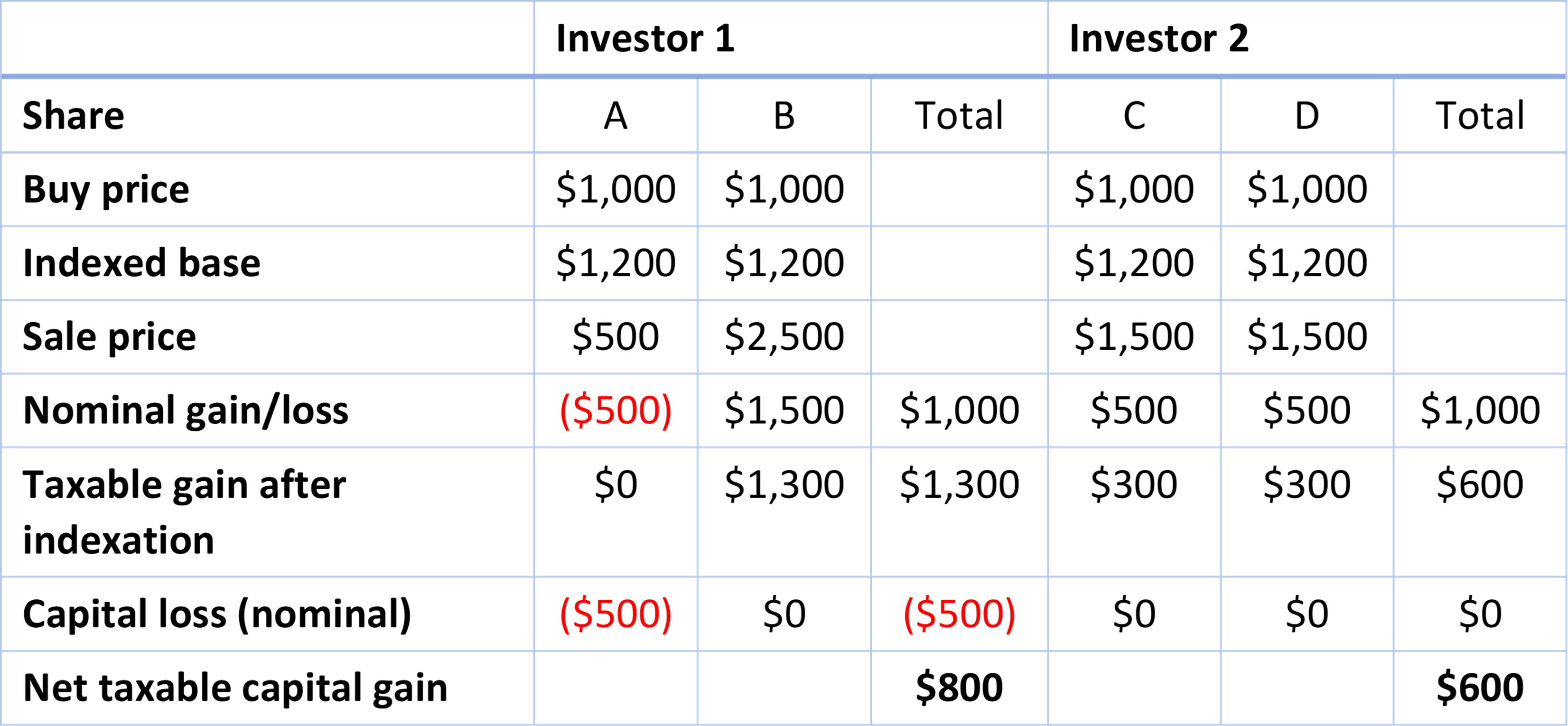
Investor 1 buys shares A and B at a cost of $1,000 each. At the same time, Investor 2 buys shares C and D for $1,000 each.

All the shares are sold at the same time, with the cost base of all four shares indexed for inflation to $1,200 per share.

Investor 1 sells his shares at $500 for share A and $2,500 for share B.

Total portfolio capital gain is $1,000. The nominal gain on share B is $1,500, which after inflation is a real gain of $1,300. However, the real loss of $700 on share A does not count. Only the nominal loss is recognised such that Investor 1 pays tax on a $1,300 gain - $500 loss = $800.

Investor 2 sells shares C and D for $1,500 each.

Total portfolio gain is $1,000 also. And after inflation, the real gain per share is $300. Investor 2 therefore pays tax on $600. Both investors earned the same total nominal gain, yet Investor 1 reports a taxable gain one-third higher than Investor 2.
The asymmetry becomes greater when losses are carried forward. If Investor 1 retains share B therefore there is no capital gain to offset against, the $500 nominal loss must be carried forward. Frozen at $500, that loss would steadily be eroded by inflation over time, ensuring increasing asymmetry with the time taken to use the loss.

When two investors achieve the same economic outcome but face different tax outcomes, the design of the system deserves scrutiny.

If gains and losses are not measured symmetrically, it is reasonable to question both the rules for measuring those outcomes and their differing tax treatment.

Should the tax treatment of an investment portfolio depend on how its return is distributed across individual holdings?

The structure of ownership matters

If the portfolios of Investors 1 and 2 were held inside pooled investments such as ETFs, their investor-level CGT outcomes should be the same, assuming the same unit purchase and sale prices.

An investor owns units of an ETF rather than directly owning underlying shares. The ETF itself is the asset upon which outcomes are determined based on units bought and sold, not the dollar gains or losses of the underlying shares. Identical CGT outcomes assume that the ETFs buy and hold their stocks.

So we have another anomaly. Should the tax treatment of an investment portfolio depend on the structure through which the investments are held?

A potential distortion of investment

The new legislation would therefore seem to penalise direct stock picking and more volatile portfolios. The CGT treatment could influence how people invest their money.

An investor who selects individual shares faces the possibility of unindexed, quarantined capital losses. Yet investing in a pooled portfolio of similar underlying risk could yield more favourable tax outcomes.

And if the investor did choose to stock pick, investing in less volatile stocks theoretically produces steadier gains without oscillating so much between gains and losses. From a tax perspective, smoother return paths may become preferable to more volatile return paths, even where the latter offer higher expected pre-tax returns.

There may also be a bias towards holding underperforming assets rather than realising losses. Why crystallise a loss today if the system reduces its economic value over time? This lock-in effect would be more pronounced if there were no gains to offset against.

A more neutral tax system should reduce distortions around investment decisions. And more broadly, it should encourage more risk-taking and therefore the allocation of capital towards more innovative businesses prepared to invest in technology and take risks in research and development.

That is, tax policy that promotes investment in businesses focused on more productive activities, in an economy crying out for a boost to productivity.


Tony Dillon is a freelance writer and former actuary. This article is general information and does not consider the circumstances of any investor.


  •   21 October 2026
  •      
  •   


Leave a Comment:

RELATED ARTICLES

Completing the reform of CGT: tax real losses like real gains

Bring back indexation to replace big CGT discount

The strange effect of the 30% minimum capital gains tax

banner

Most viewed in recent weeks

It’s time for LICs to die

A high-profile dividend cut and a prominent fund manager’s apology have reignited a long-running debate. If investors can access similar exposures more cheaply and efficiently elsewhere, what exactly is keeping LICs alive?

Testamentary trusts survived the trust tax. The drafting battle has just begun.

The fight over testamentary trusts looked settled. Then the draft legislation arrived. Hidden in a technical detail is a question that could force many families to rethink wills they thought were already future-proof.

The new capital gains tax trap for your portfolio

Investors have long accepted one portfolio rule without much question. A major tax shift could change that calculation entirely, forcing difficult trade-offs between risk, discipline and an overlooked cost lurking beneath.

The retirement scorecard: how many of these questions can you answer?

From the maths of retirement, estimating spending and picking the right asset allocation to survive a poor decade, here are the questions every retiree – current or future – should be able to answer for themselves.

How the typical Australian Family could save $844,350 in taxes

The value of a testamentary trust is not determined by wealth alone. Depending on circumstances, it can reduce the tax burden on inherited income, create efficiencies and help build intergenerational wealth.

The housing slide could become a crash

House prices are sliding across Australia, yet the most dangerous ingredient for a housing crash is still missing. If job losses surge amid growing economic risks, today's correction could become a historic property downturn.

Latest Updates

Testamentary trusts: Treasury has picked the wrong reading

A decades-old estate planning tool has survived one tax crackdown only to be caught by another. The surprise isn't who the reform is targeting, but who could end up paying the price for drafting choices made years ago.

Latest from Morningstar

Does an American retirement rule work for Australians?

The 4% rule has survived decades of scrutiny, but Australia's retirement system changes the equation in ways most overlook. Before accepting or rejecting this rule of thumb, it pays to understand what really drives retirement outcomes.

Shares

Glencore lands on the ASX. Should BHP and Rio shareholders switch?

A coal-heavy miner with governance concerns isn't the obvious choice for investors. Yet, Glencore's ASX listing may offer something BHP and Rio can't. The challenge is working out whether the opportunity outweighs the risks.

Why does the system treat capital gains and losses differently?

Investors are often told not to let tax policy drive their investment decisions. Yet, under the new CGT rules, portfolio construction, volatility and even how assets are owned may have an outsized impact on their final outcome.

Economy

Three common sense reforms that Australia needs

What do frozen bank accounts, mortgage traps and pension penalties have in common? They're all symptoms of a system that makes life much harder. Yet the obvious solutions seem to have escaped the attention of Canberra.

Shares

The hidden cost of government debt for investors

Some of the important effects of rising public debt never make the headlines. Research shows the immediate effects may already be unfolding, influencing corporate behaviour in ways that many investors would never suspect.

Investment strategies

When do fundamentals matter?

Is fundamental investing losing its grip on markets? Investors continue to search for valuation-based explanations for every price move, but the dominant force behind short-term returns may be something else altogether.

Sponsors

Alliances

  • ASA-Logo-RGB-ActiveGreen-web.png

© 2026 Morningstar, Inc. All rights reserved.

Disclaimer
The data, research and opinions provided here are for information purposes; are not an offer to buy or sell a security; and are not warranted to be correct, complete or accurate. Morningstar, its affiliates, and third-party content providers are not responsible for any investment decisions, damages or losses resulting from, or related to, the data and analyses or their use. To the extent any content is general advice, it has been prepared for clients of Morningstar Australasia Pty Ltd (ABN: 95 090 665 544, AFSL: 240892), without reference to your financial objectives, situation or needs. For more information refer to our Financial Services Guide. You should consider the advice in light of these matters and if applicable, the relevant Product Disclosure Statement before making any decision to invest. Past performance does not necessarily indicate a financial product’s future performance. To obtain advice tailored to your situation, contact a professional financial adviser. Articles are current as at date of publication.
This website contains information and opinions provided by third parties. Inclusion of this information does not necessarily represent Morningstar’s positions, strategies or opinions and should not be considered an endorsement by Morningstar.