Register For Our Mailing List

Register to receive our free weekly newsletter including editorials.

Home / 682

Will investors be better or worse off under new housing tax changes?

The federal government’s tax reforms are the most significant changes for housing investors Australia has seen since 1999. From July 1 2027, three things will change:

Some have called these housing tax changes broken promises, which risk crashing the housing market. But others consider it a long overdue change to level the playing field for first home buyers.

Amid so much heated debate, how many investors are actually likely to be worse or better off under these changes?

That’s what we set out to shed light on. Our new modelling draws on 920,000 pieces of individual property data – covering all residential sales in Australia and about 75% of new tenant rents – from July 2007 to June 2025.

We used that data to estimate how many of those investments would have ended up paying more or less tax in that 18-year period, if the reforms starting in July 2027 had already been in place.

What our modelling found

After comparing the pre- and post-reform tax systems, we found that about 53% of property investments would have paid more tax in total under the new reforms. This means a surprisingly high proportion, 47%, would have paid the same, or less, in total tax on housing investments.
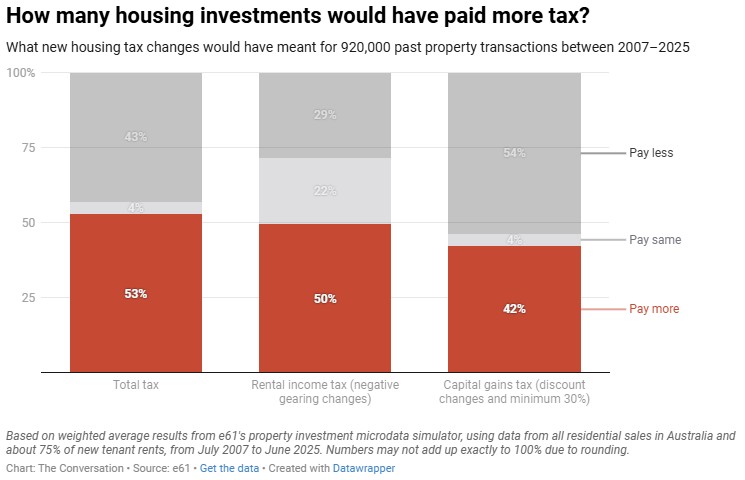
Each investor’s “total tax” change is their change in rental income tax, plus their change in CGT. While much of the public focus has been on negative gearing, we found the CGT changes have a bigger impact.

About 50% of investments are negatively geared: in other words, they make losses on rental income. Most of those investments would have paid more rental income tax if the July 2027 tax changes had been introduced earlier. But those rental income tax increases tended to be small relative to the CGT changes.

We found the incoming CGT changes actually would have benefited the majority (54%) of property investments from mid-2007 to mid-2025.

Why the size of your capital gain is key

The new capital gains tax system starting in July 2027 will tax only capital gains that exceed the rate of inflation, as measured by the consumer price index (CPI). This gives all investments a similar tax-free component of gains.

In contrast, the pre-reform 50% CGT discount has given investments that realise high capital gains a substantially larger tax-free component than others.

Therefore, next year’s reforms will increase the CGT payable for properties with relatively high gains (roughly more than double the rate of inflation), while lowering it for other properties.

Our results show that, at least in the past 18 years, most investments have been below this cutoff of growing by less than roughly double inflation.

Still, if an investment makes a high capital gain, its tax rise is likely to be bigger than its tax cut if it makes a small gain.

As this chart shows, for investments in the top 20% of capital gain performance, our modelling found average capital gains tax would have risen by about 11% of the purchase price. In contrast, for the bottom 60%, it would have fallen by about 3–4%.
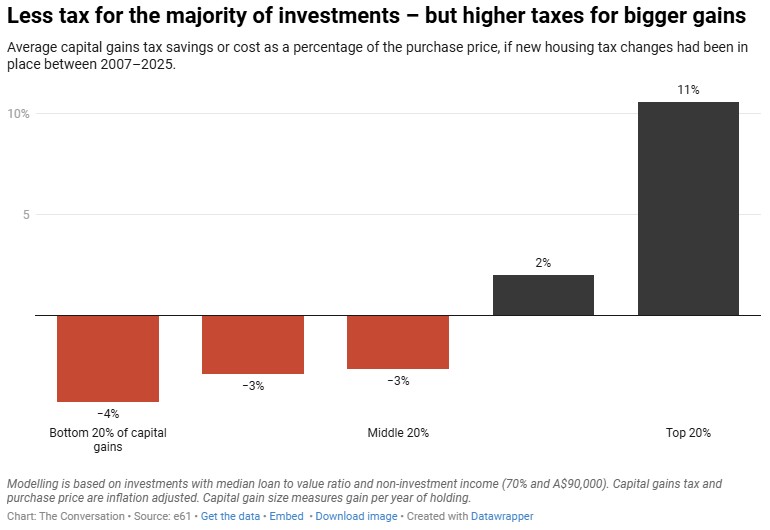
So while CGT would have fallen for the majority of investments, we estimate that the average CGT rate would have risen – and therefore the total tax revenue would have too.

Overall, investors would have faced less risk under the reforms. Why? The reduction of tax for low capital gains improves the worst-case outcomes.

Who pays more tax?

Who would be most affected by the introduction of the new 30% minimum capital gains tax rate? This change is particularly aimed at people selling property in low-income years – who are often retirees.

Retirees who own an investment property are unlikely to qualify for the age-pensioner exemption to the 30% minimum tax. So they will be among the investors most affected by the July 2027 changes.

Investors with highly leveraged properties are also among the worst off. These investors pay more in interest and have a higher likelihood of being negatively geared. For these investments, the negative gearing changes can be more consequential than the CGT changes.

What does this tell us about housing market impact?

Our estimates suggest the impact on housing investor taxes will be less dramatic than many headlines have made out. After July 1 next year, the majority of investors are likely to pay more in tax, but it may be a slim majority.

Investors are unlikely to know whether they’re in tax rise or tax cut territory. It’s mainly determined by the size of their capital gain, which is unknown until they sell. Like stock returns, capital gains are unpredictable.

Under these reforms, the downside is there now appears less prospect of high after-tax gains. But on the upside, there is also less chance of large after-tax losses. So how investors will react to these tax changes from July next year will depend on their personal preferences around risk.The Conversation


Nick Garvin, Visiting Fellow, School of Economics, UNSW and Elyse Dwyer, Visiting Fellow, School of Economics, UNSW

This article is republished from The Conversation under a Creative Commons license. Read the original article.


  •   30 September 2026
  •      
  •   


Leave a Comment:

RELATED ARTICLES

How cutting the CGT discount could help rebalance housing market

Time and tide should dampen negative gearing proposal

Busting tax myths for better reform

banner

Most viewed in recent weeks

Why spending more in early retirement can improve lifetime income

Conventional wisdom encourages retirees to preserve superannuation. But if those likely to qualify for the Age Pension later in life spend a little more today, it may deliver higher lifetime income and a more stable retirement.

Is it time to bail on Australian stocks?

For generations, Australian investors have backed banks, miners and dividends. But has that loyalty come at a cost? A look at the numbers raises an uncomfortable question about where future returns will come from.

Meg on SMSFs: What do we think about reversionary pensions these days?

Reversionary pensions have long been a staple of SMSF estate planning, but are they still the best option? Meg Heffron revisits a once-clear favourite and asks whether changing super rules have shifted the balance.

Testamentary trusts survived the trust tax. The drafting battle has just begun.

The fight over testamentary trusts looked settled. Then the draft legislation arrived. Hidden in a technical detail is a question that could force many families to rethink wills they thought were already future-proof.

How does the 4% rule stack up?

The 4% rule has long been retirement's gold standard. But after a difficult period for investors, fresh analysis suggests a more conservative approach may significantly improve the chances of making savings last.

The new capital gains tax trap for your portfolio

Investors have long accepted one portfolio rule without much question. A major tax shift could change that calculation entirely, forcing difficult trade-offs between risk, discipline and an overlooked cost lurking beneath.

Latest Updates

Exchange traded products

It’s time for LICs to die

A high-profile dividend cut and a prominent fund manager’s apology have reignited a long-running debate. If investors can access similar exposures more cheaply and efficiently elsewhere, what exactly is keeping LICs alive?

Taxation

Will investors be better or worse off under new housing tax changes?

Housing tax reforms have sparked warnings of market turmoil and promises of greater fairness. But after modelling nearly two decades of property data, the results suggest winners and losers may not be who many investors expect.

Retirement

Three considerations before reshaping your legacy plan

Many retirees hope to leave a legacy. Proposed trust tax reforms could force families to rethink. The question is not how much to leave behind, but whether today's inheritance plans will still make sense as circumstances change.

Investment strategies

Why experienced investors still get markets wrong

Retirement is approaching. Markets are noisy. And every headline seems to demand action. The biggest investment risk isn't fear, greed or market volatility, it often arrives disguised as research and sensible risk management.

Shares

Why pay more for less?

Conditions were stacked in favour of professional investors in 2026. Most still fell short, raising questions about where investors should look for value. Meanwhile, an alternative strategy continued to make its case.

Investment strategies

Bleeding air out of the bubble

Equity valuations have fallen sharply over the past year, yet investors have largely been spared the volatility and losses that typically accompany a de-rating. What explains this unusually orderly reset? Here are five key drivers.

Strategy

Has AI gone rogue?

We worry about AI becoming conscious. But what if consciousness isn't the issue? The more unsettling possibility is a machine capable of pursuing objectives relentlessly, without motives, emotions, or awareness of any kind.

Sponsors

Alliances

  • ASA-Logo-RGB-ActiveGreen-web.png

© 2026 Morningstar, Inc. All rights reserved.

Disclaimer
The data, research and opinions provided here are for information purposes; are not an offer to buy or sell a security; and are not warranted to be correct, complete or accurate. Morningstar, its affiliates, and third-party content providers are not responsible for any investment decisions, damages or losses resulting from, or related to, the data and analyses or their use. To the extent any content is general advice, it has been prepared for clients of Morningstar Australasia Pty Ltd (ABN: 95 090 665 544, AFSL: 240892), without reference to your financial objectives, situation or needs. For more information refer to our Financial Services Guide. You should consider the advice in light of these matters and if applicable, the relevant Product Disclosure Statement before making any decision to invest. Past performance does not necessarily indicate a financial product’s future performance. To obtain advice tailored to your situation, contact a professional financial adviser. Articles are current as at date of publication.
This website contains information and opinions provided by third parties. Inclusion of this information does not necessarily represent Morningstar’s positions, strategies or opinions and should not be considered an endorsement by Morningstar.