Register For Our Mailing List

Register to receive our free weekly newsletter including editorials.

Home / 650

How cutting the CGT discount could help rebalance housing market

Capital gains tax is once again the subject of parliamentary debate, with Treasurer Jim Chalmers declining to rule out options for reform.

Along with negative gearing, the capital gains tax discount has long been suggested as one cause of Australia’s housing affordability crisis.

The tax applies to the capital gain when an asset is held for more than a year, and it currently includes a “discount” of 50% on the total gain as a nominal offset for inflation.

These policies make speculative investment in housing more attractive, driving up prices and making it harder for first home buyers.

The true cost to the federal budget

Australia only introduced a capital gains tax in 1985, applying it to all gains made from investments. Importantly, the family home was not included, but investment properties were. Originally, the tax applied to the gain in value above inflation, known as the consumer price index (CPI) method.

In 1999 the Howard government, informed by the Ralph Inquiry, changed the way capital gains tax was calculated. A flat 'discount' of 50% was applied to capital gains, rather than adjusting the price by inflation. This figure was an estimate given the limitations with the available data.

Each year, Treasury calculates the costs of tax policies. This data reveals that in 2024–25 the 50% discount cost the budget an estimated $19.7 billion. This is partly driven by increases in housing prices which have far outpaced inflation, as shown below.
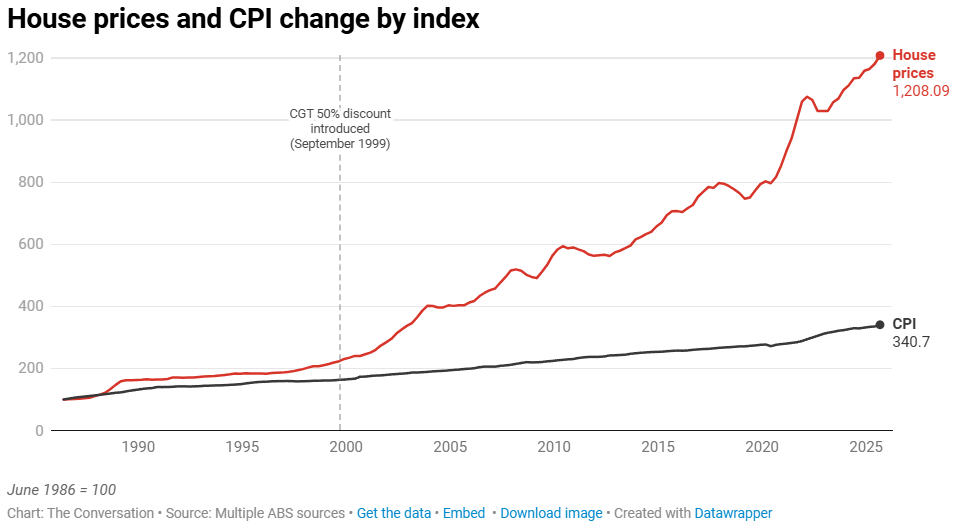
It is notable that between 1986 and 1999 housing prices were growing slightly faster than inflation, but since 1999 (the year the 50% discount was introduced) they have accelerated.

The benefits flow to the wealthy and people over 60

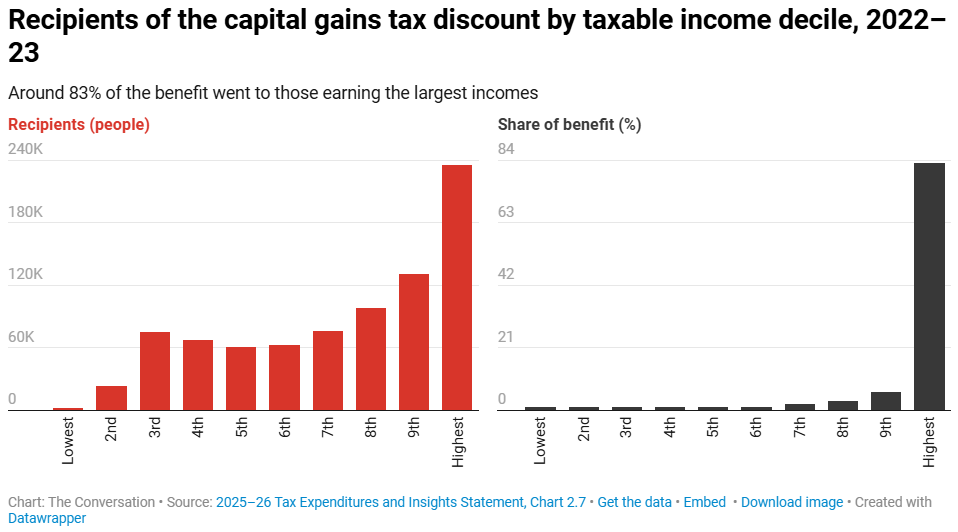
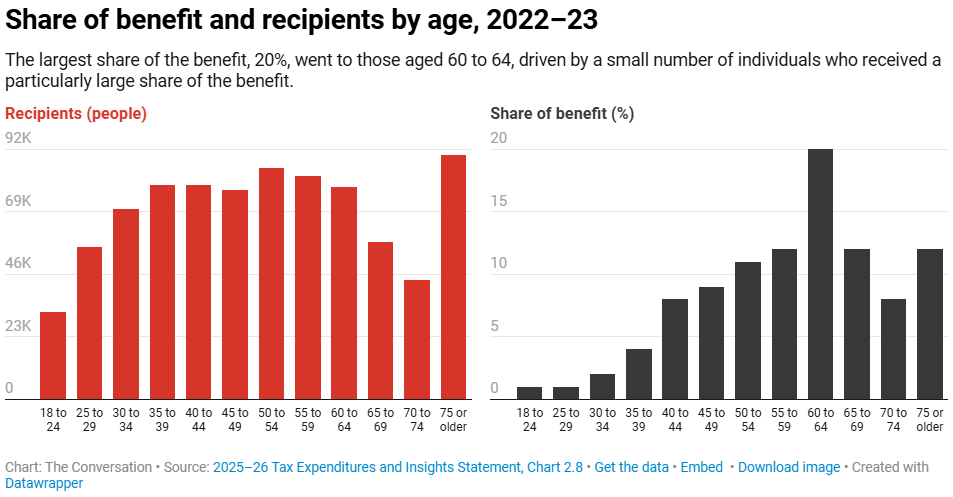
The benefits from the capital gains tax discount overwhelmingly benefit the wealthy and older people.

The Treasury’s Tax Expenditure and Insight Statements show that in 2022–23 89% of the benefit went to the top 20% of income earners, with 86% flowing to those in the top 10%. On average, the highest income earners received a benefit of more than $86,000, while those in the bottom 60% received around $5,000.
Similarly, older people benefit far more than younger people. People over 60 received 52% of the benefit, while those between 18 and 34 received 4%. That is despite both groups comprising around 29% of the adult population.
Some options for reform

Current attention is centred on the prospect of the government reducing the capital gains tax concession for landlord investors in residential property. This reduction would have the combined effect of reducing the attractiveness of owning an investment property.

A further option is to retain this 'gift' to landlords and investors, but to make it work much harder to improve housing outcomes, especially for households who are caught in the lower-quality end of the private rental market.

We have previously proposed to make negative gearing and capital gains tax concessions available only to investors who adhere to higher national dwelling and tenancy quality standards or who participate in social housing investment schemes. Landlords who did not want to operate according to these requirements would not receive either negative gearing or capital gains tax concessions.

How the housing system rewards wealth, not work

But a bigger problem lies beyond the investor segment of the residential housing market.

The total overall value of Australia’s residential stock is around $12 trillion. Of this, about $4.5 trillion is growth since 2020, spurred in part by very low interest rates over 2020–22. Around 65% of residential dwellings are owned by owner-occupiers, who are exempt from paying capital gains tax on their primary residence.

Growth in dwelling prices is due to many factors. Income growth and availability of credit are among the most important.

Since the deregulation of Australia’s financial sector in the 1990s, greater access to housing finance and relatively low interest rates have allowed households to leverage their incomes into tax-free capital gains in housing.

Wealthier households can gear their incomes and existing assets into even more valuable housing assets that they can also live in. This comes at the expense of households with lower incomes and assets, or those who are renters.

There is no sound economic reason why owner-occupied housing should be exempt from capital gains tax.

A more rational taxation system that supports home ownership but discourages asset speculation could provide greater financial support to first home buyers but also demand a greater tax share of the capital gains that their asset enjoys.

The tax rate could be set to allow capital growth in line with inflation, wages or the economy (gross domestic product), but then apply to the gains beyond that.

Such an arrangement could also tax higher-value properties at a higher rate than cheaper properties – thus tilting the burden of taxation towards the wealthy whose properties see the greatest capital growth.

Is housing a human right or an asset?

Ultimately, there is a more fundamental question to be answered about role of housing in society.

While housing has always had a speculative dimension in addition to providing shelter and comfort, the past 30 years since financial deregulation has seen the balance shift in favour of the former.

The question facing the current government is to what extent it is prepared to reduce speculation in housing in favour of the social purpose of housing? Does it have the appetite for a structural reset that prioritises housing as a home, rather than as a debt-geared speculative asset?

Is this a government of nervous tweaks and twiddles, or might the dire times in housing embolden landmark transformation? Can the values that Labor espouses be translated into progressive policy?The Conversation


Jago Dodson, Professor of Urban Policy and Director, Urban Futures Enabling Impact Platform, RMIT University and Liam Davies, Lecturer in Sustainability and Urban Planning, RMIT University

This article is republished from The Conversation under a Creative Commons license. Read the original article.


  •   18 February 2026
  • 60
  •      
  •   
60 Comments
Dudley
February 19, 2026


"not tax deductible":

0. Capital losses are not tax deductible.

3
John Lansell
February 19, 2026

"Johnny's Been Thinking" column.
Why not use the averaging provisions similar to farmers to apportion Capital Gains?
I wont elaborate very much as there are a few variations this could be introduce.eg isolate capital gains/losses and tax at marginal rates. Get the average income and include it as taxable income. etc etc.

1
Lauchlan Mackinnon
February 19, 2026

Good points.

Also, I thought the fundamental reason for not taxing he family home was that housing (for the family home) is more than an investment, it is a home. It is where you bring up your children and where your family lives.

So, if you have a tax on selling the family home (which the CGT, even with a discount, would be), that tax would be a disincentive on upsizing, downsizing, tree-changing, or any other move for family or lifestyle reasons.

So the government quite sensibly excludes the family home from CGT.

I think one could make an argument that the "final" sale of a family property (the last time you ever sell a home, after which you never buy a new one) should be subject to CGT ... but then it's hard to identify what is the "last' sale until afterwards, and this probably belongs more in the bucket of "estate taxes" than CGT.

You could also make the argument that a vacation home (beach house, ski chalet, etc) should be subject to CGT, but I think it's a relatively weak argument ... a second home tends to already be subject to other state taxes anyway, like land tax.

4
OldbutSane
February 22, 2026

2nd homes as mentioned are subject to CGT on sale. You can only have one PPR exempt from CGT at any one time.

1
Nicholas O'Connor
February 19, 2026

Damn right, GeorgeB. Applying CGT to the sale of principle places of residence would mean a reduced market of such properties because no one would want to sell. This extends to all CGT changes, something not understood by those within the Canberra Bubble.
Reverting to the initial method of ratcheting up the cost base by an infation factor is fairer and equitable and reduces the arguments against CG taxation.
I'd like to see the mental calculations by Professor Dodson when considering moving house but faced with reduced capital for a new home, caused by a CGT bill.

6
Claudia
February 19, 2026

The 50% discount is only generous if you hold your asset, such as property for a relatively short period. I recently sold a property that I have owned for 37 years. The 50% discount didn't even come close to compensate me for the inflation in all those years. In other works, I paid tax on gains that I didn't make in real purchasing power terms. Reducing it further is simply not equitable for longer term property investors. If the Government wants to tinker with capital gains tax it should it should go back to the old days and re-introduce indexation and averaging of multiple years for all assets not just single out property. After all, the calculations were never as difficult as made out to be at them time and now technology will do the calculation all in nano seconds. If people don't keep proper records, that's their problem. They can fight it out with the ATO.

In respect of taxing gains on the principal place of residence (PPR) - the government is already complaining about older people not downsizing and younger people not relocating to where the jobs are. Taxing the PPR will definitely entrench that even further. It would result in older people not being able to afford to downsize as the tax on a long held family home would reduce the after tax money left over to such an extent that many would find it impossible to buy another smaller and possibly more suitable home. Younger people will also think very long and hard about selling up and moving as the after tax amount left to re-establish themselves is diluted, possibly quite substantially.

As a side comment, Government should start managing the money they currently get a lot better before coming after more of ours.

36
Michael
February 19, 2026

@Claudia. Totally agree. I have many long held investments and if sold would be better under the old indexation method for calculating capital gains. The discount would be much higher than the current 50% disount.

10
Robert
February 22, 2026

Only if they told the truth about inflation. Roy Morgan research used to publish true inflation and unemployment numbers and unsurprisingly they were much higher than official figures. Nobody who shops, or pays the bills believes government inflation numbers.

1
John N
February 19, 2026

Fully agree that a 50% CGT discount favours short duration holders of investments. Perhaps the problem is not the discount but the duration as to when it kicks in. PPR also need a duration period of sorts before 100% CGT exemption is available. Also agree the government ( both sides to date ) need to constrain their spend to match their income (eg taxes). May not play out this way every year but over a rolling x years basis this needs be the case. Where we are as a nation today is an outcome of nonsense policies implemented or supported by both major parties over the last 30 years.

5
Lauchlan Mackinnon
February 19, 2026

I'm getting a bit bored with this exercise of indiscriminately "bashing the wealthy".

Re "The benefits flow to the wealthy and people over 60" - of course they do. By definition, wealthier people are exposed to more taxes on wealth. And it's kind of obvious that as people accumulate assets (property, superannuation, investments) over the course of a lifetime, so older people tend to be wealthier. There's nothing new, or contentious, in that. It's just how the world works, and has worked for decades if not centuries.

Re "Along with negative gearing, the capital gains tax discount has long been suggested as one cause of Australia’s housing affordability crisis." - I think it's better described as a "contributing factor" than a "cause." Modelling has been done that shows that if you get rid of negative gearing and ALL CGT discounts (on property, businesses, shares, etc as well as investment properties) you get maybe a once-off reduction of a few percent in housing prices ... and then prices keep soaring upwards from there on their current trajectory. It's hardly "a", or "THE", significant factor leading to high house prices. Alan Kohler's Quarterly Essay "The Great Divide" does a great job unpacking the actual key factors (like zoning laws).

But that's not even the main point to me. The article suggests that "Each year, Treasury calculates the costs of tax policies. This data reveals that in 2024–25 the 50% discount cost the budget an estimated $19.7 billion." So, ALL of the CGT discounts (for business sales, share sales, etc as well as investment properties) accounts for around $20B a year.

No-one is contemplating eliminating all of that discount - even the Keating era version indexed CGT to real values, not nominal values. And the changes to the CGT discount for investment property, mooted in the media, are only for reducing it (to say 33% instead of 50%), not eliminating it. But of course if you eliminated all CGT discounts for everything, you'd "save" $20B a year. Let's put that into perspective.

If you want to talk about intergenerational equity, the climate and saving the planet from catastrophic changes is a huge intergenerational equity issue. Expenditure on fossil fuel subsidies in Australia is currently around $15B a year. That's pretty much a subsidy to help for-profit companies build roads and infrastructure to make more money. There is no reason we should be paying that - commercial companies should be able to make their own commercial decisions about what infrastructure to build without help from the government. Let's get rid of that subsidy as a first step in addressing intergenerational equity.

Then there's global multinationals, who make huge profits and then use accounting tricks to shift the profits offshore. Apply a minimum tax based on revenues in Australia, not based just on profits, and pick up hundreds of billions of extra revenue. Let's fix that.

Then there's all the gas that's being exported, while gas is wildly expensive in Australia because we pay global prices. There's overwhelming majority support across party lines for putting an extra 25% tax on gas exports. That's easy politically.

There's a lot of "simple" ways to generate far more government revenue than $20B a year.

Taxing the wealthy more is of course a policy choice the government can make, if it has the votes. But calling it an intergenerational equity issue is nonsense. The "old, wealthy people" now were "young, poor, working" people earlier. Both face or faced essentially similar tax regimes - at the same age and point in their wealth development journey. There is no substantial intergenerational tax inequity.

And there are better ways to tackle the real intergenerational inequities, like climate crisis or housing affordability.

Tere is a case for broader reform of the taxation system, but just tinkering at the edges with the CGT discount, or the superannuation tax surcharge, is not that.

The CGT discount issue is a distraction and red herring, taking attention away from solving problems that matter.

33
Steve
February 20, 2026

Just wait till Labor (and of course the Greens) decide to lower the voting age to 16 like the UK. All this intergenerational envy will be on steroids as all the youngsters want just what mum & dad or grandma & grandad have, NOW, without putting in any hard yards.

8
Lauchlan Mackinnon
February 21, 2026

They can try that.

I think they'd need to do a referendum though, and I'm not sure they have the appetite for that.

And, if we are going to do another referendum, let's become an independent Republic already ;)

Anyway, there is no dominant political party in Australia. No major party (Labor, Liberals, Greens, Nationals, One Nation, "Teals", or anyone else) currently has more than 1/3 of Australia's support, e.g. https://www.roymorgan.com/findings/9967-federal-voting-intention-january-18-2026 stats on primary votes. Labor have little vision and are fiddling around the edges. The Liberals are a mess, and their only political instinct is to oppose, not construct. They show no indication of shifting their policy platform to be competitive in the inner city seats they've handed over to the Teals, and they're not going to beat One Nation on the populist right. Greens are socially and environmentally progressive but not economically serious (e.g. their current conversations around CGT, or their ideas around wealth taxes or housing policy with rental freezes). It's hard to see how much of substance might get done in the near to medium term, in my view, regardless of who can vote.

GeorgeB
February 21, 2026

“It's hard to see how much of substance might get done in the near to medium term, in my view, regardless of who can vote.”

Reminds me of the following quote sometimes attributed to Winston Churchill:
“it has been said that democracy is the worst form of Government except for all those other forms that have been tried from time to time.…”

Lauchlan Mackinnon
February 21, 2026

@GeorgeB, yep. :)

I do think though that Democracy works best when it has political parties with strong leadership (think Paul Keating, Bob Hawke, Bob Brown, or John Howard as leaders with some conviction around their policy platform) who hold out a vision, that they believe in, and sell it to the Australian people, build cross-party support, and then implement it effectively. I don't think Australia has that now.

6
Rob
February 19, 2026

Another story which falls for government ideology and its right to claim other peoples money.

After 45 years in property investment, the house price driver is hardly CGT it is thing like high immigration, supply constraints (shortage of trades, excessive regulation such as town planning reg's and DA obligations), price signals (expensive labour rates, high material prices), high government taxes (c. 45% of new builds is consumed in government taxes and charges),

The CGT argument on the housing market is laughable. It is simply a tax grab on the middle class salary earners who do the right thing and take personal responsibility and forsake current consumption for future financial comfort and to rely less (ir not al all) on tax payer funding during retirement.

A "tax saving" (anything less than 48%) is the Treasury's concept that it somehow has the right to half of all earnings. If that's what they want then it's time to find another more friendly county. Its not like Australia's lifestyle and culture has advanced in the last two decades.

20
Steve
February 20, 2026

Well Rob, the Treasury is in Canberra, staffed by most likely rabid Labor idealogues, so no surprise they think everything is "theirs" and you should be grateful for what they let you keep. We think because they have economics degrees they might be professional, but the criteria in Canberra is ideology first, ability second.

5
Former Treasury policy maker
February 21, 2026

Steve I disagree. Treasury is staffed by a huge range of people who hold a variety of economic policy philosophies and different political perspectives. When they start working there, most of them are fresh out of university and, like I did a few decades ago, join because they want to help make Australia a better place through solid economic analysis supporting good policy making. Accusing a whole department of being "rabid Labor idealogues" is unfair, unhelpful and wrong.

7
Steve
February 22, 2026

Former treasury policy maker, you are talking about the same people who think taxing unrealised gains is a reasonable thing. Wonder what side of politics would even think of this, let alone propose it as a serious policy. OK maybe the whole department may not be rabid idealogues, but it seems there are enough to drive the bus.

8
Dean
February 24, 2026

A few decades ago when "Former Treasury policy maker" joined Treasury, it was staffed by some of the best and brightest in the land. Many of them went on to successful careers in the private sector.

Unfortunately with the shift from merit based recruitment to DEI based recruitment in the public sector, the standard of Treasury bureaucrats has declined markedly.

1
James#
February 21, 2026

"There is no sound economic reason why owner-occupied housing should be exempt from capital gains tax."

So, I have to sell my home to move elsewhere for work. Before I only had to pay selling costs, moving costs and stamp duty on the purchase of a new property. Now, I would also have to pay capital gains tax, leaving me with less money to buy a home. And this somehow makes homes more affordable?! God help us. When is enough enough?

A better place to start is to curb governments insatiable need for more tax to fund out of control spending e.g NDIS, universal "free" childcare, above cpi increases in public servants wages, more public servants per capita than any other country in the world, Snowy 2, endless renewal subsidies, EV subsidies, battery subsidies.......

16
James
February 19, 2026

Reduction of CGT would disproportionately affect lower-income Australians. If investors are disincentivised, many will exit the market. While this may increase opportunities for first-home buyers — which is positive — it also reduces the supply of rental properties. For those who cannot, or may never be able to, afford to buy a home, this would mean fewer rental options and increased pressure in an already difficult rental market.
Further, why is it that the Government and others support punishing the population with ever increasing taxes? Stockholm Syndrome? How about incentivising by decreasing taxes? Bracket creep is an example, not only are people punished for working, the more they work, the more they are punished. Quite psychotic really.

10
Allan Abrahams
February 19, 2026

@ James,
You are 100.0% correct

Stephen
February 19, 2026

James, at any point of time there are a fixed number of houses and apartments and a fixed number of those dwellings are owned by investors, who presumably rent them out. If some of the investors who hold property sell and the number of investors is reduced, those dwellings will be purchased by those who were formerly renters. The only change is that the number of investors has been reduced and the numbers of renters reduced in the same number, because they became first home owners. The dwellings don't magically disappear as investors leave the market.

To provide evidence that the supply of the total number of properties would be reduced over time you would have to establish that a reduction in the CGT discount would lead to fewer dwellings being constructed following a reduction in the CGT discount. But would it?

That would depend on whether the overall effect on demand for dwellings was reduced by the removal of some investors and then whether that reduction in demand would lead to fewer properties being built. Given that the price effect of reducing the CGT discount is thought by most economists to be only a few percent, although it might be higher in the corner of the market that is most contested by investors - properties below $1.5 million - the reduction in supply due to slightly lower prices could be fairly small and might even be offset by incentives for first home owners.

One further point. When the CGT discount was increased in the late 90's one of the arguments conspicuously absent in support of the change was that it would lead to an increase in dwelling commencement. Strangely the argument that a reduction in the CGT discount would lead to fewer dwelling commencements is now trotted out.

11
Steve
February 20, 2026

I am not sure the assumption that renters can displace landlords is correct. The percentage of renters has been remarkably steady over the last 50 years (around 30%). Many of these people cannot afford to buy a house/apartment. Many are even subsidised by the nasty landlord (the much maligned negative gearing means the tenant is actually paying less to rent the property than the cost to the landlord to own it). Landlords have other options on where to invest their money. Tenants have much less flexibility. So where would new homes come from - do we go back to the old housing commission estates? Governments wanted out of these due to the cost and encouraged the private sector to take up the slack, but there has to be some kind of return. And landlords are not to blame for all the supply constraints - this is classic deflection by the government trying to blame someone else for their own failures. Too many people (100% controlled by the Federal govt) chasing too few homes (largely impacted by governments at all levels via taxes & regulation). It is all about just 1 word. SUPPLY.

10
James
February 22, 2026

Stephen, as many of those on the lowest incomes will still not be able to afford to buy a home and as prices will not decrease because supply hasn't increased. New investors into the market will want higher rents to justify their investment due to the increased cost (reduced CGT) or they won't invest in the housing market and so will take their money to invest elsewhere. That leaves those on the lowest incomes worse off paying higher rents.

Stephen
February 22, 2026

James, you are assuming that investors will leave the market. However the unique feature of real estate is that the investor can leverage his or her initial capital and be reasonably assured of having an income from the rent and a gradual increase in capital value, all of which is captured by the investor.

Sure, leverage can be applied to other investments but property is the favoured investment for leveraged investment. Reducing the CGT discount won't change that unique feature.

As for supply reducing following a reduction of the CGT discount most analysis does not show this to be material. The Grattan Institute estimated that a change to the CGT discount made now would result in 10,000 fewer homes being built over 5 years to 2030, a reduction but not material. They also estimate a very modest increase $1 increase per week in median rents caused by the change and this and the reduction of 10,000 new builds could be more than offset if some of the revenue from the reduction in CGT were used to boost Australia's social housing stock.

https://grattan.edu.au/wp-content/uploads/2025/12/Grattan-Institute-2025-Senate-Select-Committee-Capital-Gains-Tax-Inquiry.pdf

Steve
February 23, 2026

Yet again, using more government money from the CGT windfall won't help, it'll just add to demand. This plan does zero to address the supply problem. One word. Supply. If any plan can't address that (or lower demand meaning population growth) it is a mirage, no matter how alluring.

2
Dudley
February 23, 2026


"Supply. If any plan can't address that (or lower demand meaning population growth) it is a mirage, no matter how alluring.":

Spenders gotta spend.

Positive real net interest rates reduces demand for living area.

Decreases living area per person.

Until demand for area = supply of area.

Jill
February 22, 2026

“I have never understood why it is "greed" to want to keep the money you have earned but not greed to want to take somebody else's money.” - Thomas Sowell, Barbarians Inside the Gates and Other Controversial Essays

10
Kieran
February 22, 2026

Spot on.

Peter Bayley
February 19, 2026

The real problem with house prices is that too many people and chasing too many houses. Tax policy on housing is a subsidiary matter.

9
Greg McKay
February 19, 2026

of all the comments i've read yours is the shortest and the best.

1
Geoffrey S
February 19, 2026

People who buy, occupy (or pretend to occupy) a home as principal place of residence for at least 12 months, renovate then sell are exempt CGT on profits. Many people (known as "flippers) do this as an ongoing business so really should pay 30% tax on profits.
Another way would be to require payment of CGT linked to period of ownership or residence eg:
50% discount after 1 year
40% after 2 years
30% after 3 years
20% after 4 years
10% after 5 years
then no CGT
This would deal with what is currently an obvious rort for some - while helping to protect families who don't move often.

9
Lauchlan Mackinnon
February 19, 2026

I like the idea, it makes sense.

But it might also penalise people who had to sell a home sooner than they wanted to, due to financial distress (e.g. steep interest rate rises).

Rob
February 22, 2026

A marginal tax system with tax brackets applied exists, why not:
1. a CGT system with CGT brackets
2. A CGT system per item 1 above and time brackets too. Perhaps an end outcome of rewinding Howard’s move away from linking with CPI in the 90s!

D Ramsay
February 26, 2026

Your Idea is on the right track but I say turn the numbers around in order to discourage property "flippers"
Viz - CGT discount rates
50% after 6 years
40% after 4 years
30% after 3 years
20% after 2 years
10% after 1 year

Also the formula used for farmers selling a farm has merit, but would need modifications as we are not talking about a farm.

Kieran
February 21, 2026

I bought my home 22 years ago. On paper it looks like a huge “windfall” capital gain. However that’s not the true picture.. Over the years I have actually paid
- the original loan capital
- 22 years of interest on this capital
- capital for renovations - one major, 2 smaller
- interest on loan for renovations
- solar panels and battery
- replacement fencing
- 22 years of repairs, maintenance, painting , garden etc
- rates, insurance, pest control etc over the period
- throw in many hundreds of hours myself on maintenance
A significant amount of value increase is due to the work owner occupiers do on their homes over time which appears to have been ignored by the authors.
Unlike an investment of course none of this is tax deductible and I haven’t kept precise records because of this. Likewise there is no requirement to keep track of costs regarding capital gain because I bought my home on the understanding it would not be taxed on sale.
Like me, most owner occupiers I know have worked hard for many years and made sacrifices to provide this security for their families.
No tax deductions on any of this so over the years I have absolutely given the government their pound of flesh in income tax.
The authors see no reason for the government not to help itself to a portion of my home when sold. Presumably the government in its great wisdom will redistribute this to more deserving people ( voters) than me.
I would suggest if they want to play Robin Hood there are many more deserving targets than owner occupiers .
Multinational companies helping themselves to gas Australian gas reserves, NDIS rorters , politicians extremely generous entitlements etc , etc

7
GeorgeB
February 21, 2026

I am in a similar situation and have a similar list of private expenses over a 30 year period of ownership.
I also added to the list of private expenses the stamp duty paid on purchase as well the interest paid on the additional loan funds required to pay that stamp duty up front (6% in Victoria).

You can also add to that list of "deserving targets" the bloated public service in Australia. According to one source Australia now ranks number one in the world for the number of public servants per head of population and they are also the best paid public servants.

3
Ben Snooks
February 22, 2026

All these expenses apply to landlords who rent out their properties and maintain them as well. These expenses are tax deductible for landlords but as a consequence they have to pay capital gains tax when they sell the property whereas home owners don’t.
I don’t agree with the premise of increasing taxes on the PPOR because there is already a disincentive to downsize now because of stamp duty. Many older people want to right size multiple times as they ages for example, kids moving out, garden becoming too much, one person dies etc. Stamp dilute prevents older people right sizing multiple times. Stamp duty contributes to the housing affordability problem because people are stuck in large houses but don’t want to pay tax to move. If homeowners had to pay CGT they would never move and just keep the asset in the family. The same thing is likely to happen with investment properties if the CGT is increased.

Dr David Arelette
February 22, 2026

Intergenerational issues are not new. My father and mother met in 1948, prior to this both had invested 5 years stopping and reversing the Japanese push to Australia, both were demobilised early in 1946 with a few hundred pounds in the bank. All the good jobs were held by those who did not enlist, went to university and were now set for life. I graduated with my BSc and BEc in the depths of the OPEC tripling of crude oil prices and all housing loans were funded by having to save (more the better you looked to them) into a bank for at least three years even to get an interview. The 1992 recession cost me my job, the 2000 Dot Com ruin slowed my business to a crawl, the 2009 Asian Money run on the banks added 4 years to no income gains and so on - we need a "Get Over It Idiot Act" so you are forced to live by your decisions and not expect the now 70yo dooers to bail you out.

5
David
February 22, 2026

OMG!!
1. Let's simplify the tax system rather than add more layers of complexity
2. Let's not get sucked into the notion of intergenerational division as this is exactly what the incumbent government wants to get votes from younger generations.
3. Of course I would expect the older generation to on average to have more wealth than the younger gyrations as they have worked and saved for it for an extra 30-40 years!!!!! So stop all this inflammatory talk about intergenerational wealth as we already have more division in the country than I have ever seen.
4. The ATO belief that the CGT discount is a cost to the budget is ridiculous. This indicates to me that the real purpose is to increase taxes without costing votes for the incumbent government!
5. If we really want to address housing issues, go back to simple basics rather than messy fiddling with the tax system. I.e. Think about basic supply/demand principles and immediately stop all taxpayer funded purchasing subsidies along with decreasing rate of population growth to something a bit below the rate of current housing supply growth for awhile.

4
Dudley
February 22, 2026


"basic supply/demand principles and immediately stop all taxpayer funded purchasing subsidies":

Make Interest Rates Positive Again.

1
David
February 19, 2026

Not only is it difficult for first home buyers to enter the market, but there is also a problem with finding affordable places to rent. Do we need to make it easier for the first lot at the expense of the second? While not trying to be party political, I subscribe to the statement by Angus Taylor that taxing something more leads to a bigger shortage of that something.

2
Lauchlan Mackinnon
February 19, 2026

David,

I've heard Jane Hume make a similar argument as well, on Insiders last week. I think she went further and said that increased taxes will increase prices.

I don't get the logic.

Clearly, if you tax something more, that's a disincentive to take ownership in that thing, which reduces demand for that thing, which presumably (supply and demand) reduces the price of that thing ... which in the case of housing seems to be precisely the inter-generational equity policy outcome we'd want.

What is unclear - as you point to - is what precise impact that would have on the rental market. If the demand for investment properties halved, that would be great new for non-investor home buyers. Prices would be down. But presumably, over the long term, it would mean there are half as many rental properties available. But what would it mean for renters? Does the number of people exiting the rental market and becoming new home owners balance out the decrease in the number of rental properties available, or does it means rental becomes more (or less) expensive? Modelling can give some ideas, but no-one really knows till the policy is actually implemented.

G Hollands
February 22, 2026

It has been a long time since I have seen so much rubbish written about a topic. Especially when most of the comments are being offered by economics graduates ( who obviously received their degrees in a Kelloggs Corn Flake packet.) Some obvious points to be made - no surprise that a large proportion of people receiving benefits are over 60 years of age - they have the benefit of age before investing! What appears to be missing is the very obvious fact about supply and demand - the less supply, the more demand!!! Remember those lectures in Economics 101? Apply some logic people !

Greg
February 20, 2026

Look at the graph. The discount applied after only 12 months gave rise to a whole ecosystem supporting property investment. Investment seminars, TV programmes on how much you could make from doing renovations, spruiking by the real estate industry, and government arguing that everyone was happy with rising house prices. It supports flipping - buy, kick out tenants, renovate, raise the rent and sell after 12 months and get a huge bonus. Adjusting the discount won't have an immediate or substantial effect but it is part of the solution to a problem that has been 30 years in the making.

2
Dorian
February 22, 2026

This article is disappointing coming from a Professor. But then he does not seem to be a Professor of Economics. In line with Dr Chalmers who is not a Doctor of Economics. Demand comes mainly from more people wanting - not profiteers - supply is the issue relative to demand - driven significantly by immigration, which is controllable. The Government doesn't have the money to build enough housing, the superfunds don't sound keen, so it must be the private sector that funds it surely- who else? The private sector has other less lumpy options for investment of old age savings. The Making it less attractive will most likely benefit new homeowners at the expense of renters. Didnt Paul Keating try this years ago and had to scrap it because of the negative impact on renters? I do think that, with the benefit of hindsight, the CPI Index method should have been retained. Getting 50% discount whether you hold it for 1 year or 20 years doesnt seem well targetted. A higher % discount for new builds makes more sense too. Of course it will be older people who receive the concession-they are closer to retirement and have saved more - its not a plot against the young - tax incentives are targetted at people who already pay high taxes to get them to change their investment behaviour- it's not evil. A higher rate for people whose houses sell for me? They already pay more tax because their taxable amount on the property is higher.

2
Sven
February 19, 2026

Jago, I agree with your position on taxing capital gains on owner-occupied housing. Doing so would help free up the housing market and encourage people to buy homes that genuinely suit their needs rather than making decisions to maximise tax advantages.
For such a policy to work, several conditions would be essential:

1. Mortgage interest should be tax-deductible.
2. Capital gains below a set threshold should remain tax-free—for example, the first $500,000.
3. Stamp duty should be tax-deductible.
4. Improvements should be added to the cost base of the property.
5. Rollover relief should apply, reducing the tax payable when someone sells and purchases another home.

Additional considerations:

- Routine maintenance would not be tax-deductible.
- A sunset date should be implemented for the introduction of the new regime. This would shift market behaviour as homeowners reassess both their housing needs and their tax positions.
- Australia would need to embrace upzoning reforms, similar to the changes implemented in Auckland, New Zealand.

Yes, introducing capital gains tax on owner-occupied housing would likely create short-term downward pressure on prices as the market adjusts. But with the right incentives and transitional arrangements, it could also unlock substantial private capital to fund essential national infrastructure—water, energy, transport, and telecommunications.

Based on 2025 data, Sydney is now the second most expensive housing market in the world, behind Hong Kong. Australia’s housing costs also sit at roughly twice the affordability levels of the United States when measured by income multiples. At some point, we will need to confront these structural issues. Reform will require political courage and bipartisan cooperation, but long-term, changes of this nature are what Australia needs.

1
Doug
February 19, 2026

If “invest to rent” business assets (ITR) are not treated like every other investment opportunity in the taxation sphere, then it will need to have outsized returns elsewhere to compensate.
After all, it is the after tax return which matters.
Already ITR are disadvantaged as the whole must be sold in one line, pushing the received capital gain into the top marginal tax bracket (and above) for the vendor.
To get that outsized return then requires a combination of:
increased rental during the holding period (at present, returns after outgoings are lucky to be 3% on the purchase price before tax, and a much lower return on properties in the $1million plus bracket); and
an even higher selling price to offset the loss of the present discount (to whatever replaces it) and the higher tax burden from that higher taxable capital gain.
Clearly the Government wants all ITR to be government owned as the combination of low returns and discriminatory tax burden will make sane investment decisions avoid the sector.

1
Steve
February 20, 2026

Can people make up their minds? Is the affordability issue because of excessively generous tax breaks to landlords, or because principal places of residence are not taxed? Is it the landlords, or the owner-occupiers who are to blame? Or is it multi-levels of government with too many regulations, too little supply and the only solutions ever proposed amount to juicing up demand and never seem able to help supply (memo to Albo - having a target is a joke if there are no measures to make the target actually happen; you need a lot more than just a vibe at election time). Pus the monster elephant in the room - no party will ever go to an election proposing taxing gains on the PPOR. Ever. So get a bit real, this is just academic/Treasury dreaming.

1
Ben Snooks
February 22, 2026

We should actually step back to principles and look at why house prices rise. People are competing in many cases for few resources (land) to live next to cities, jobs, amenities, natural features such as beaches etc. The Sydney housing market is probably the best example for this competition because supply is limited due to environmental barriers.

Can Australia actually do better than having 5 major capital cities? Take the USA or Europe as examples. Additionally something to consider is that Canada paused immigration for 2 years and rents and house prices decreased. It’s all good to talk about tax but tax is not a reason why 65% of home owners are buying houses now. 65% of people are still competing at auctions etc. and pushing prices up. Population density and immigration are likely to be bigger drivers for house price growth than tax policy because 65% of people don’t pay housing taxes for existing stock except for stamp duty and council rates.

Many wealthy overseas people have moved money into Australia and bought up swathes of inner ring houses of our capital cities over the last 20 years. These people live in these houses and are not necessarily investors. They are now Australians and I accept that. Though this has helped push first home buyers to the outer fringes.

We can’t just keep cramming more people into the few cities we have now and not expect people to keep competing for limited available land. Especially when everyone wants a trophy 4-5 bedroom house on the large piece of land possibly close to a CBD or beach, commonly known as ‘The Australian Dream’.

How can we move businesses and people to the regions where there is more available land to house people affordable? Tax policy might be an option here. Lowering taxes on business and housing in the regions and raising taxes in the capital cities. How to we ensure fast links between regional and capital cities, investing in high speed rail, not rail that travels less than 200km/h.

1
Dobi
February 23, 2026

A lot of these comments are flawed. I have a long held investment property on which I pay 70% tax if you add rates(local), land tax(state), income tax(federal). This is without any running costs agent's fees, repairs and maintenance etc. The options I am considering are: 1 Continue to hold, and the property will eventually go to a testamentary trust and probably be used as security to purchase another investment. 2 Sell and trigger capital gains tax not desirable while the property is increasing in value. If sold it will come out of the rental market and be developed. 3 Increase the rent to achieve a better return, it is close to market value now and I have good tenants, so not really an option.
Be careful what you wish for. Properties may never get sold or the rental supply will reduce.

1
Maurie
February 20, 2026

Victorians would argue that the Federal ALP have already missed the boat when it comes to reviewing the merits of the CGT discount in relation to property investment. The Victorian Government, by opting for a ownership tax as opposed to a transactional tax, have successfully reduced the incidence of land speculation much to the detriment of the Federal Government's coffers. Like all tax policy, it is a fine balance between curbing speculation and driving away investment completely.

Scott
February 22, 2026

My assessment of this article is that it is a somewhat naive and idealistic motivated article albeit with noble intentions but whose proposed solution is really a sugar hit. The authors would do well to take into consideration and incorporate relevant points being raised by others above.
It also labels/demonizes demographics as a whole as if they are all undeserving of the benefits of their hard work, risks and sacrifices made. In real life those people are also often battlers that have managed to achieve often in difficult conditions with personal sacrifice.
It also makes no attempt to be balanced in that it fails to recognize the benefits to the Australian people from not paying capital gains. For example the over 60s not having to draw a pension because of exemption.
Investing in housing is less attractive now given interest rates are 5 to 6% but long term rental returns above that is difficult to attain and future capital gains somewhat risky and uncertain which means less investment in housing and the money will go elsewhere like the stock market and more than likely given current returns - offshore.
Thats what I would advise my hard working children to do - take a look at resources, Japan, Korea, Defense etfs, the Nasdaq - over past several years.
I am not an investment property owner but own my own home whose sales proceeds will go to retirement home payment and any residual balance to my Super pension so hopefully I don't have to draw a pension for more years and also hopefully saving my children or the government and subsequent younger generations having to support me in my old age - all the more important given extended life expectancy.

Steve
February 22, 2026

With Economics my best subject, and my Uncle (Prof Emeritus in Economics NSW) who has trained many of Australia's leading household name economists, it astounds me why there is virtually no discussion by Govt about demand for housing (created by excess immigration) and wall to wall discussion about housing supply/taxes etc. Its all rather shallow. However most 35 to 55 yr olds (who have to compete for rentals or a mortgage) have worked it out ok.

Jack
February 22, 2026

For most residential property investors, the income (rent) produced does not cover their costs. That’s why we have negative gearing. Landlords are obviously prepared to wear this loss in the expectation that their profit will arrive as capital gains. We used to call those buyers, speculators, just like traders taking bets on the currency or oil futures.??The 50% discount on CGT means that in the short term (less than 5 years) about 40% of that capital gain is tax free. In the long term (more 30 years) it is a tax on inflation.??

If we could make the speculation in residential property less attractive, some of those landlords would invest their capital elsewhere to get a better return. But the house they sell is not demolished. It will be bought by an owner-occupier. By reducing the demand for housing from speculation we will increase the supply of available homes for owner-occupiers and will also make them more affordable. The Victorian experience demonstrates this. ??

So how do we make speculation on residential property less attractive?

Reader
February 22, 2026

"There is no sound economic reason why owner-occupied housing should be exempt from capital gains tax."

As a renter of nearly 25 years, I tend to wonder about this too. As a single person who has often been in contract or non-permanent employment, without a long-term income horizon and taking opportunities to move cities several times, buying has not at any time seemed realistic or appealing, given the high (and increasingly higher) cost and risks involved.

I too have 'sacrificed' and saved my post-tax income at a high rate for these past 25 years, squirreling my savings into the stockmarket and elsewhere to try not to fall behind, such that I now have enough invested to buy a residential property outright if I wanted to. It still doesn't seem appealing, and I feel the pressure to buy something too big, not suited to my needs, as it would then become an 'investment' and apartments and 1-bedrooms don't have as much capital growth, don't you know.

These have been my choices, but I wonder why I should be taxed for capital gains on all that I've invested (if say, I decided to liquidate and buy a home), while someone who put the same amount into their own housing from the start would not? On top of that, the home is treated very concessionally when it comes to assessing assets for pensions etc. (equivalent to only around $300k from memory) - while non-home investments are assessed at their full value.

It's perplexing, and I don't often see much commentary from people who don't own homes and don't benefit from the tax treatment.

GeorgeB
February 23, 2026

Whilst the Government and numerous commentators cite increasing supply as the miraculous solution to the housing crisis currently faced by the younger generation, no one has advanced a solution to the massive decline in construction productivity witnessed since the mid-2000s which together with an unprecedented rise in the cost of materials has dramatically increased the cost of construction in this country.

This decline does not have a single cause but most research converges on a dominant theme, namely rising complexity + fragmentation of delivery = falling efficiency per labour hour.

Below is an attempt at a breakdown of the main drivers:

1.Regulatory & Compliance Explosion
Over the past 20–30 years, projects now involve:
• More detailed planning controls
• Energy efficiency standards
• Accessibility requirements
• Fire engineering complexity
• Environmental and heritage overlays
• Workplace safety compliance documentation

Each rule may be justified individually, but cumulatively they:
• Increase design time
• Increase documentation volume
• Increase approval delays
• Increase rework and redesign

In Australia, especially in metro areas like Melbourne and Sydney, planning and compliance overhead has grown faster than physical building complexity.
Result: More professional hours per project without proportional physical output.

2. Fragmentation of the Industry
Construction used to be vertically integrated (large firms doing most trades in-house).
Now:
• Heavy subcontracting
• Multi-tier contracting
• Risk pushed down the chain
• Adversarial contract structures

This creates:
• Coordination inefficiencies
• Claims culture
• Defensive documentation
• Disputes and delays

The shift from “builder as master” to “builder as contract manager” has reduced on-site productivity.

3. Risk Transfer & Insurance Blowouts
After:
• Kevin Rudd era stimulus construction
• Julia Gillard education building programs
• Daniel Andrews Big Build rollout
Contracting models increasingly:
• Push fixed-price risk to contractors
• Penalize delays heavily
• Require massive compliance documentation

Builders respond by:
• Adding contingencies
• Slowing decision-making
• Over-documenting everything
Productivity drops when risk management replaces build efficiency.

4. Loss of On-Site Skill Density
Several shifts occurred:
• Apprenticeship completion rates declined
• Experienced tradespeople retired
• Immigration mix changed skill distribution
• Project supervision ratios fell

More supervision is now required per worker, reducing output per hour.

5. Building Design Has Become More Complex
Modern buildings have:
• Mechanical ventilation systems
• Fire compartmentation
• Acoustic treatments
• Energy management systems
• Façade engineering

A 1970s apartment block is vastly simpler than a 2026 compliant apartment block.
Output is measured in square metres — but complexity per square metre has increased dramatically.

6. COVID Disruption (Temporary but Significant)
• Stop-start worksites
• Social distancing inefficiencies
• Supply chain volatility
• Material substitutions
COVID didn’t start the decline — but accelerated it.

7. Poor Technology Adoption
Unlike manufacturing:
• Limited automation
• Building Information Modeling not fully integrated into site execution
• Limited prefabrication scale
• Site conditions remain highly variable
Construction remains craft-based rather than industrialized.


The Big Irony is that Governments often respond to productivity decline by:
• Adding more regulation
• Adding more reporting
• Increasing compliance audits

Which tends to:
• Further reduce productivity

The issue is acute because:
• Planning systems (especially in Victoria and NSW) are complex
• Industrial relations rules differ by state
• Insurance and defect litigation risk has risen sharply
• Apartment construction quality crises (e.g., cladding issues) led to heavier oversight

Francis H
February 25, 2026

As Sir Humphrey would say, any Government proposing to tax capital gains on owner occupier dwellings would be a very courageous Government indeed. Applying it to all investor property regardless of when it was acquired would require similar levels of courage. So the revenue gains are limited. Any changes will only encourage people to put more money into their primary residence and superannuation. Rents will rise. The housing affordability problem will not improve markedly and may even get worse if investors shun new builds. The horse has bolted. Better to get serious about cutting wasteful expenditure and fraud. We hear nightly on the news stories of fraud against DVA, Centrelink, NDIS, ATO, Medicare etc. Government administration is appalling. Yet the mandarins keep getting paid outrageous sums of money and getting Public Service medals.


Leave a Comment:

RELATED ARTICLES

The 5% deposit scheme is bad for homeowners and Australia

The 3 biggest residential property myths

Labor policies and the impact on housing

banner

Most viewed in recent weeks

How cutting the CGT discount could help rebalance housing market

A more rational taxation system that supports home ownership but discourages asset speculation could provide greater financial support to first home buyers.

3 ways to fix Australia’s affordability crisis

Our cost-of-living pressures go beyond the RBA: surging house prices, excessive migration, and expanding government programs, including the NDIS, are fuelling inflation, demanding bold, structural solutions.

Is there a better way to reform the CGT discount?

The capital gains tax discount is under review, but debate should go beyond its size. Its original purpose, design flaws and distortions suggest Australia could adopt a better, more targeted approach.

Making sense of record high markets as the world catches fire

The post-World War Two economic system is unravelling, leading to huge shifts in currency, bond and commodity markets, yet stocks seem oblivious to the chaos. This looks to history as a guide for what’s next.

Welcome to Firstlinks Edition 648 with weekend update

This is my last edition as Editor of Firstlinks. I’m moving onto a new role though the newsletter will remain in good hands until my permanent replacement is found.

  • 5 February 2026

It’s economic reality, not fear-based momentum, driving gold higher

Most commentary on gold's recent record highs focus on it being the product of fear or speculative momentum. That's ignoring the deeper structural drivers at play. 

Latest Updates

Superannuation

Super is catching up, but ageing is a triple-threat

An ageing Australia is shifting the superannuation system’s focus from accumulation to the lifecycle of retirement. While these pressures have been anticipated for decades, they are now converging at scale and driving widespread industry change.

Investment strategies

Corporate earnings show resilience against volatility but risks remain

Evidence for a strong reporting season had been piling up for months and validated an upgrade cycle already underway. However, risks remain from policy uncertainty.

Superannuation

Want your loved ones to inherit your super? You can’t afford to skip this one step

One in five Australians die before retirement and most have not set up their super properly so their loved ones can benefit from all their hard work and savings. 

SMSF strategies

Sixteen steps in a typical SMSF borrowing

Getting a mortgage is never an easy process but when an investment property is purchased in a SMSF the complexity increases significantly. Read this before taking the plunge. 

Planning

Do HNWI get better advice?

Good advisers lead to more diversification, lower turnover and less home bias. However, studies show the average adviser may not be adding much value to clients. 

Strategy

AFL Final Ten with wildcard edit 'unlevels' the field

When the new AFL season kicks off a wild-card will be added to the finals. Is this new formula fair and how does it impact the odds of winning the premiership.

Planning

Love them or hate them, it's worth understanding annuities

Investors have historically balked at exchanging a lump sum for a future steam of income. Breaking down the financial and emotional considerations of purchasing an annuity.        

Sponsors

Alliances

© 2026 Morningstar, Inc. All rights reserved.

Disclaimer
The data, research and opinions provided here are for information purposes; are not an offer to buy or sell a security; and are not warranted to be correct, complete or accurate. Morningstar, its affiliates, and third-party content providers are not responsible for any investment decisions, damages or losses resulting from, or related to, the data and analyses or their use. To the extent any content is general advice, it has been prepared for clients of Morningstar Australasia Pty Ltd (ABN: 95 090 665 544, AFSL: 240892), without reference to your financial objectives, situation or needs. For more information refer to our Financial Services Guide. You should consider the advice in light of these matters and if applicable, the relevant Product Disclosure Statement before making any decision to invest. Past performance does not necessarily indicate a financial product’s future performance. To obtain advice tailored to your situation, contact a professional financial adviser. Articles are current as at date of publication.
This website contains information and opinions provided by third parties. Inclusion of this information does not necessarily represent Morningstar’s positions, strategies or opinions and should not be considered an endorsement by Morningstar.