Register For Our Mailing List

Register to receive our free weekly newsletter including editorials.

Home / 641

The 3 biggest residential property myths

“I do this for a living …” I plead in vain when confronted with the confident assertions of my be-suited friends in the big end of town mouthing off about residential property. Just because you are an expert bond trader, management consultant, CEO, banker or lawyer, doesn’t mean you know everything about residential property. I mean – do you live in a house? Yes, in fact you may have bought and sold a few over the years. You went to school too, but that doesn’t make you an education policy expert.

Yet with the same confidence – rightly earned, I don’t doubt – in their professional callings in other disciplines, I hear otherwise sensible people mouthing complete nonsense when it comes to residential property. And no amount of gentle prodding or even quoting clear quantitative evidence by me will shake their unshakeable certainty about their opinion.

So, with the Barmy Army in town, I shall borrow from their vernacular and rather than plead professional expertise, a 7-year veteran data science team, and decades of professional buying advisor experience, I’ll just say “bollocks” to all of that!

Myth 1: We’re in a debt funded bubble headed for another crash!

I’m sorry you must have mistaken Australian housing for some long-lost equities market somewhere. When you say, “another crash”, I want to ask, when was the last one? The GFC? Paul Keating and 17% interest rates? Yes and yes, I am confidently told.

In reality, even since before I was born, Australian house prices have never suffered a greater peak to trough loss than 12% – and that was hardly a “crash”. It happened over a leisurely two-year period from a frothy high to a modest low. The market recovered almost completely in the third year.

So, this frantic “blokes-jumping-from-buildings crash” period? It happened in mid-2017, until Bill Shorten and negative gearing were dispatched by the electorate in May 2019.

For the record, here’s the recession we had to have’s impact on property prices. See the “crash”?
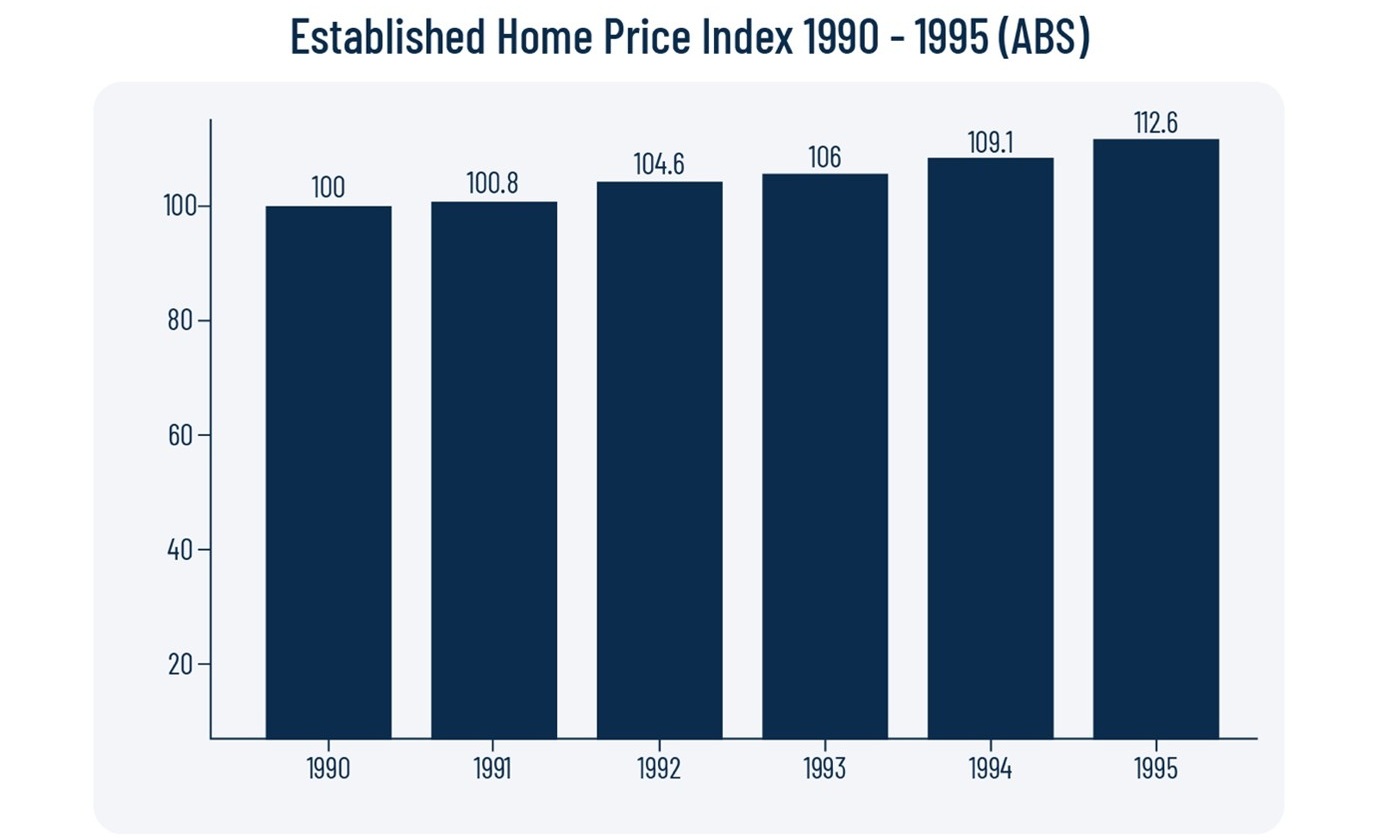

Source: Australian Bureau of Statistics.

Don’t see it? Nor can I. But even this won’t stop my blow-hard experts telling me otherwise. “I do this for a living” is my plaintive reply.

Speaking of “debt-funded bubbles”, in an asset class that is routinely between 21% and 24% geared, this seems unlikely. But that has never stopped the experts – starting with many major bank economists in the country – predicting blood in the streets when rates started to rise in 2023. “Bollocks,” we said. LongView and PEXA published a white paper called “What Drives Australian House Prices?”, which amongst other things included a graph any 12-year-old with Google could have produced in less than a minute:
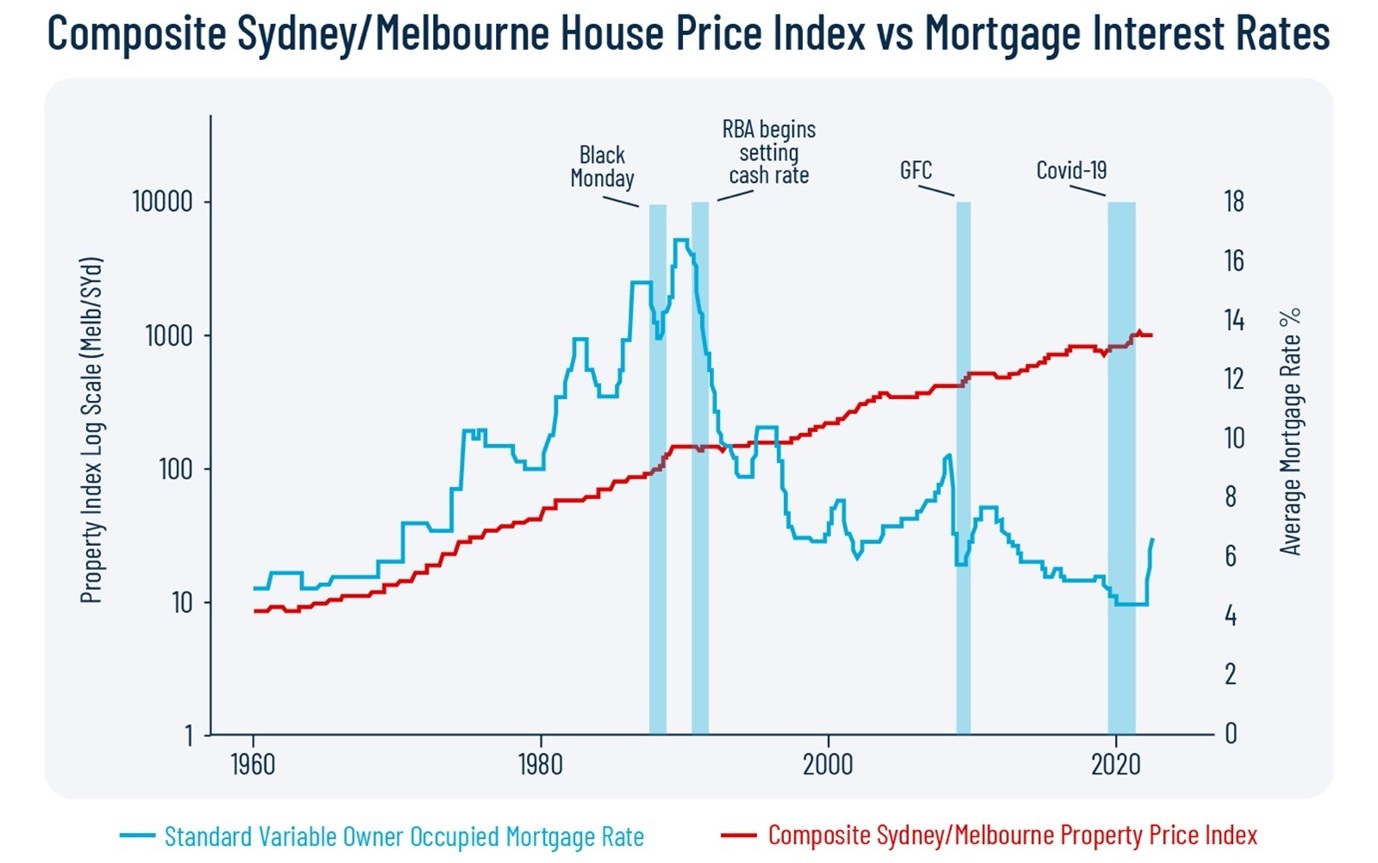

Source: PEXA LongView White Paper No.1 “What Drives Australian House Prices Over the Long Term?” February 2021.

See the obvious correlation between interest rates and house prices? Nope. I can’t either. I’m not saying interest rates don’t have an impact. They do. But overall, it’s surprisingly modest.

As otherwise erudite rate/bond expert Christopher Joye confidently predicted in the AFR, “a 100 bps rise in interest rates will lead to a 15-25% drop in house prices”.

Umm… Did it?

So much for “debt funded bubbles” and “crashes”.

Myth 2: It’s all the fault of negative gearing

If only those greedy property investors weren’t fleecing the taxpayer, the sunlit uplands of housing affordability would re-appear… Bollocks.

Don’t get me wrong, I could take or leave negative gearing. I’ve seen it’s pernicious influence on unsuspecting buyers of rubbish high rise apartments being swooned into thinking that wasting a dollar to save 50c in tax will make them rich. I’d happily see it gone if only to save Mum and Dad investors from being fleeced by unscrupulous developers yet again.

I spent nearly five years at McKinsey but the most important lesson I learnt was in the first two weeks – let’s separate the big numbers from the small.

Take capital growth in residential property: just the growth, not the underlying $12 trillion of asset value. Capital growth, just this year, and most other years, will be bigger than the entire Federal Government budget. Truly. 4-5x the size of all the earnings of every company on the ASX combined.

That is the speed and scale at which Australian housing is getting less affordable. Best part of $800 billion p.a.
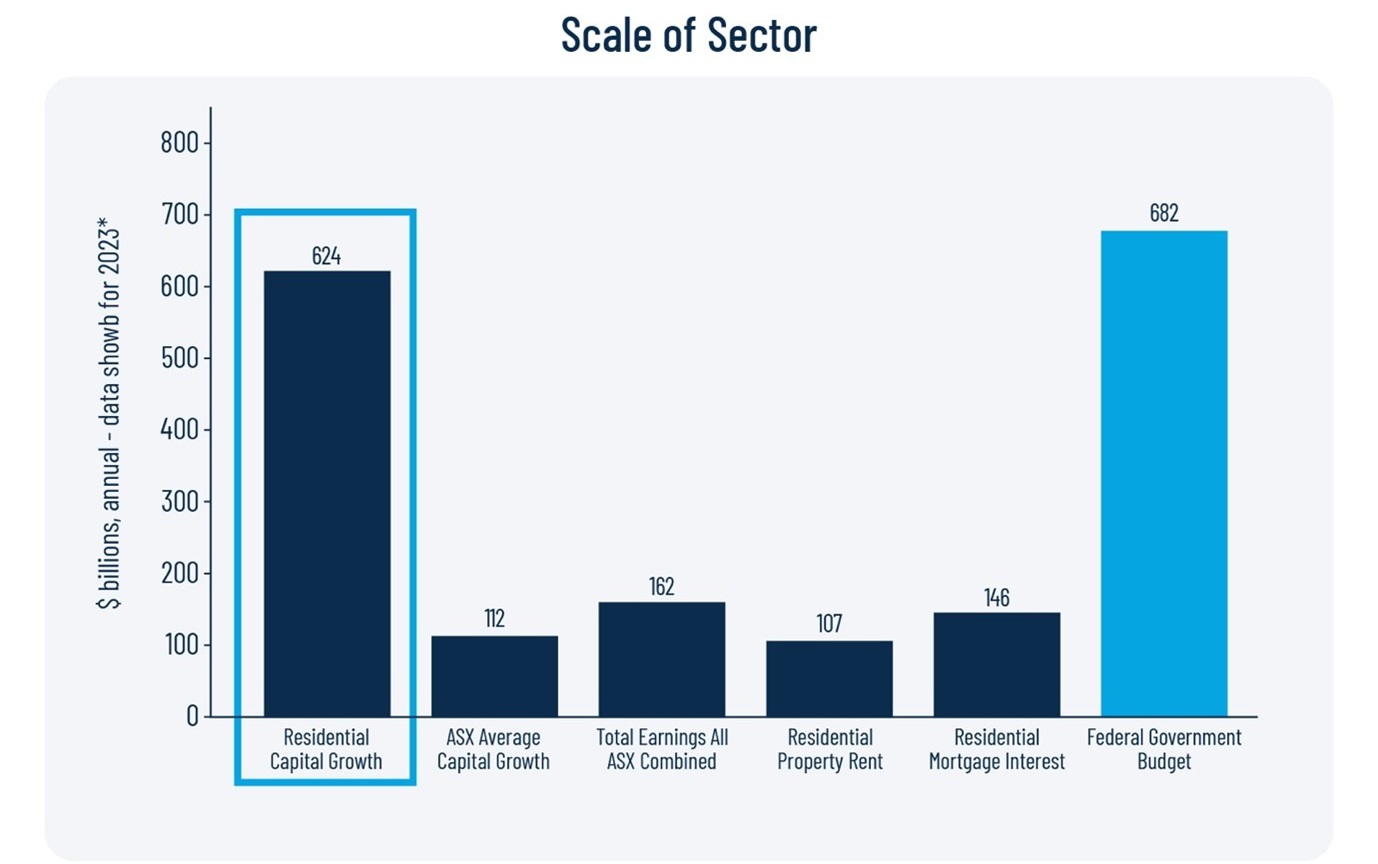

Source: ABS; RBA D2 Lending and Credit Aggregates; ASX; Bloomberg; Australian Budget 2023–24. Data reflects a 6.5% interest rate and a median rent of $601. Residential capital growth includes realised and unrealised capital growth for all homes. ASX capital growth source: historical market statistics (asx.com.au). Average ASX capital growth shown for the period 2019–2023.

How on earth can a tax concession drive an $800 billion p.a. growth engine?

As even the modelling done by proponents of eradicating it will show, eliminating negative gearing may have a once-off impact on house prices of maybe 1-3%. They would then continue their generations long climb at 7.2% p.a.

I’m not making a political point. I honestly don’t care if it stays or goes. It’s just mathematically irrelevant. Although not politically irrelevant – if I could make one suggestion “of all the hills to die on, Bill, that one wasn’t worth it” – it would have changed nothing.

Myth 3: It’s the greedy landlords and speculators that are causing the housing crisis

Well if they are, they’re doing a remarkably bad job at making money out of it.

As LongView and PEXA showed in White Paper #2, the average landlord is making an internal rate of return of just 6% p.a. on their money. They would have been better off putting it into a balanced super fund. Half of them made even less than that.
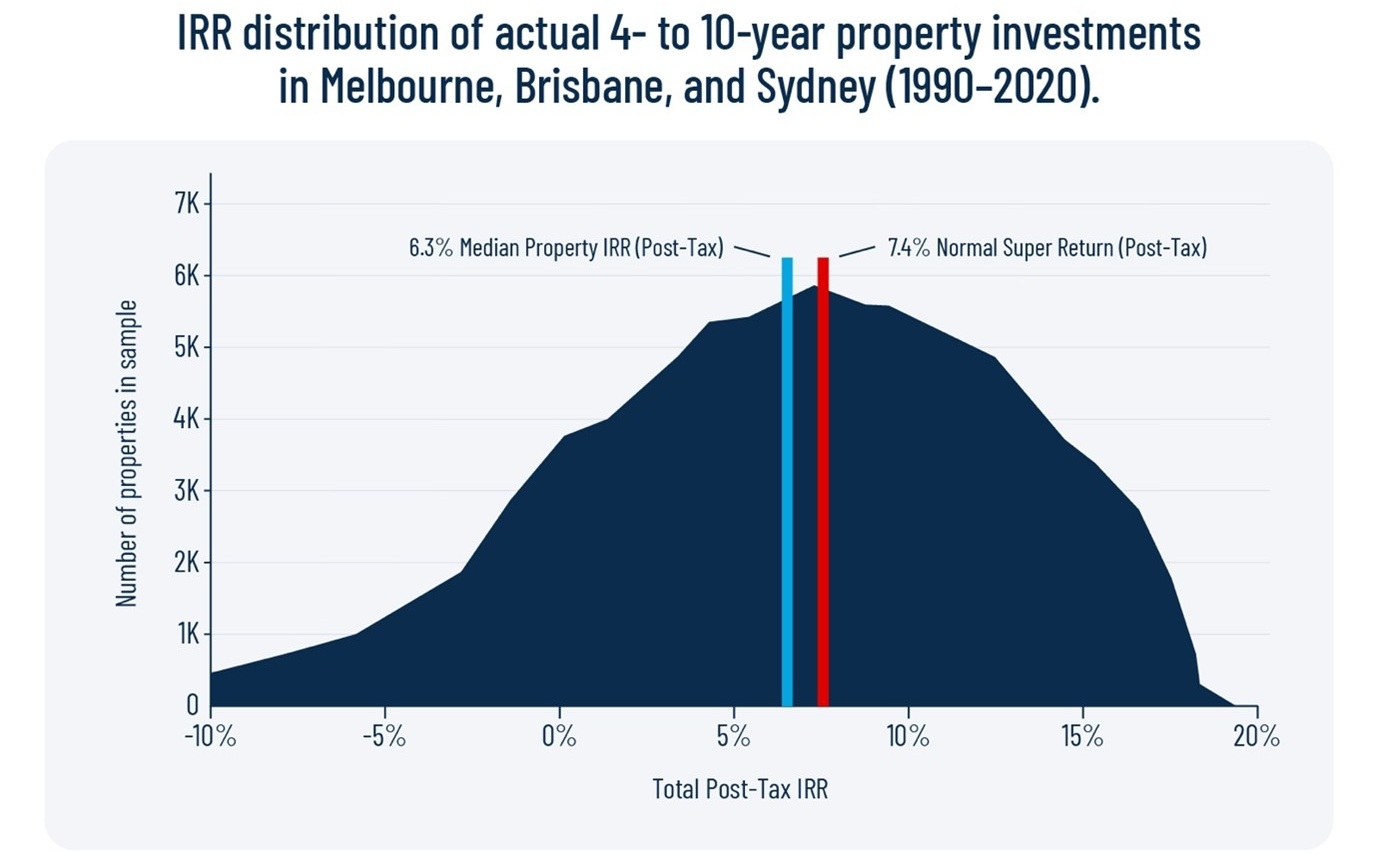

Source: PEXA LongView White Paper No.2 “Private Renting in Australia – a Broken System” March 2023.

So, I’m not saying there aren’t some very successful property investors out there. I’m just saying that, on average, those providing rental housing are doing so on a 6% p.a. return.

Undiversified. With volatile net income flows from maintenance, arrears, vacancy and taxes.

Really, being an individual investor in individual rental properties is generally a lousy way to make money.

Our business, along with its Funds Management arm, manages 4,000 rental properties for landlords. Almost without exception the following statement is true of those landlords: they made a better return on investment on the owner-occupied home they bought for lifestyle reasons than they did on the investment property they thought they were buying to make money. And that’s even before adjusting for tax.

Whenever I say that to a landlord client, it stops them in their tracks. You can see the cogs turning over and they reply, “I think that’s true for me too”.

Better quality assets deliver a better return. Land appreciates, buildings depreciate.

Who knew?

The $2 million family home almost always outperforms the $700K apartment bought down the road as an “investment”.

That’s why at LongView we say we “invest in dirt disguised as houses”. 81% of the value of our portfolio of homes is in the dirt underneath them. We call them RODWELLs – Robust Older Dwellings on Well Located Land. The sort of homes most of us live in.

So, most of the rise in house prices has nothing whatsoever to do with negative gearing or greedy landlords.

It’s to do with scarce urban land with family homes on it going up rapidly in value. Why? Because we have the second highest population growth rate in the world that we try to cram almost into the same big three urban centres.

Hence land values in good locations in those cities have been doubling every 8 years. For 100 years.

As Mark Twain said when counselling investment in land, “They’re not making any more of it.”


Evan Thornley is CEO and Co-Founder of LongView, an integrated residential property business focused on fixing Australia’s broken housing system. Evan is a technology and social entrepreneur who has been a property investor for 30 years in Australia and the US.


  •   10 December 2025
  • 17
  •      
  •   
17 Comments
Evan Thornley
December 11, 2025

If it’s all driven by borrowing power, how come the asset class is only 22% geared. Nearly half the entire asset class by value has no gearing at all. How does borrowing power impact those prices as opposed to accumulated equity ?

The discussion on real v nominal is important and somewhat more complicated but happy to engage in that 1:1z

Tom
December 11, 2025

Prices are set by marginal buyers, not aggregate debt. The gearing ratio you cite (housing debt/housing value) includes the equity of every property in the country, but ignores that prices are determined solely by the tiny fraction that actually sell.

This mechanism is foundational to asset pricing. Housing valuations rely on "comparable sales," (Hedonic Regression) meaning the ~5% of stock that turns over dictates the value of the 95% that doesn't.

Take it to its extreme: Imagine the total turnover of the property market next year was a single house bought for 50% over market value. The increase in mortgage debt from that one transaction would be miniscule, yet the capitalized value of every house in the country would rise by 50% instantly.

It works exactly the same in reverse. Most downturns occur on low volume where the sellers are "forced" (distressed) and the buyers are constrained (job losses, lower borrowing power). If a single distressed seller sells into an illiquid market, every house on the street is revalued lower, regardless of the low debt/equity ratio of the neighbours.

8
Wayne
December 11, 2025

Prices are set at the margin, not by existing owners. Average gearing might be 22% as many people purchased years ago and own their home outright or have paid down a significant part of their initial debt. The gearing/LVR ratio on properties being bought and sold today would be much higher.

5
Evan Thornley
December 11, 2025

Tom and Wayne, sure prices are set by marginal buyers. Most of whom are lowly geared due to equity from their previous home.

If your theories were correct, prices would indeed have plummeted as interest rates soared in the last few years as most commentators predicted using exactly the same logic as you have yet again here.

Did they ?? As the French philosophers might say your claim may work in theory but it doesn’t work in practise!

To other commenters, I never said prices won’t come down and your example of reductions in immigration, were they to be substantial and sustained, would indeed take pressure off land values - exactly as in the form I am arguing this works on the other side.

It’s really not that hard - if you put an MCG and a half more people into Melbourne every year - and likewise with Sydney and Brisbane, most of them will prefer to live in the same scarce well located spots and the value of said land will then keep rising.

And if interest rates were the main driver, why do properties which are 80% land values growing at twice the speed as properties which are 40% land values- there is no difference in gearing levels.

Please … try analysing every sale price of every property in the last 50yrs (such as they are available in the public data and largely they are) and keep trying to explain capital growth or lack of it with your gearing theory and see how it works out for you.

No, really, I do this for a living. But thanks for confirming the very point made in the opening paragraph.

And David, yes I read Alan’s article and my reply was published in the following Quarterly. Here’s our White Paper which has stood the test of time.

https://blog.longview.com.au/hubfs/whitepaper-what-drives-australian-house-prices-over-long-term.pdf

1
Peter Thornhill
December 11, 2025

Why would anyone waste time and money speculating in property.

7
Boomer Bob
December 11, 2025

Property beats your industrial LICs any day Peter and you know that

1
David Wilson
December 11, 2025

This is a pretty lightweight article on what actually should be a serious topic. It is full of the type of the selective logic favoured by residential property spruikers. Others have commented already below on some of the article's shortcomings (such as the misguided point about 22% leverage).

For a more reasonable, fact based account of state of residential property in Australia, readers should consider Alan Kohler's Nov 2023 Quarterly Essay 'The Great Divide: Australia's Housing Mess and How to Fix It'. https://www.quarterlyessay.com.au/essay/2023/11/the-great-divide/extract

6
John
December 11, 2025

Many in Canada and New Zealand though they couldn't have decent drop in house prices too. Then migration was cut and interest rates rose and they now understand that trees don't grow to the sky.

A Federal Government that was focused on the long term prosperity of Australia would cut migration, reform the tax system (lower income taxes, higher land taxes), end the RBA's negative real interest rates after taxation and end the taxpayer funded schemes that inflate house prices (taxpayer debt guarantees, shared equity, rent subsidies). It's unlikely to happen soon, but all of these would be great for productivity and negative for house prices.

3
Derk Vanderbent
December 11, 2025

Spot on in breaking down the old RE agent clech'es Evan. "Position, position, position" made me a wealthy man. Remember the drawing in all the RE offices back in the 70s/90s, of a bent over old man, with the caption "the young man who waited for the price of RE to go down". If you didn't get a piece of the action then, it's not to late. REITS are one way to get in with limited capital, and soon we'll see fractional blockchain investments offering opportunities. But remember, POSITION, POSITION, POSITION, and as Evan warns invest in "dirt" not 'pie in the sky'.

2
Pete L
December 11, 2025

Derek, you are correct when you say that REITS are one way to get in with limited capital (and APZ and EGH) are two smaller listed companies focussing on residential real estate in various states of Australia. An investor in APZ will be up over 120% in the last 12 months and 45pa over the last 3 years. That beats the hell out of any residential real estate I hold and it would have been cheaper and easier to get a foot in the door. That’s assuming that someone who is focussed on property isn’t so fixated on the image of bricks and mortar that they can’t see that there’s more than one way to achieve their property goals (and with significantly less ongoing expenses). To this degree, Evan is probably correct, that sometimes it would be wiser (and more profitable) to leave property management, either direct, unlisted or listed to the experts.

Jay
December 11, 2025

Thank you for a brilliant article. This should be published in every major newspaper.

1
Petet taylor
December 11, 2025

Global debt both private and goverment have us now in uncharted waters. Mass immigration is the tool of choice to drive up both house prices and GDP to try and avoid recession. How sustai able this model is has yet to be seen.

1
Property to the MOON!
December 11, 2025

Property is a credit fueled feedback loop!
1. Rising prices ? more collateral value
2. More collateral ? more lending capacity
3. More lending ? higher demand
4. Higher demand ? rising prices again

Policy engineered wealth machine.

1
Kim
December 11, 2025

I love the old billboard poster outside Real Estate agents' offices - a picture of an old man saying "this was once a young man who waited for housing prices to go down". Thankyou for your article -very sensible.

Rod
December 11, 2025

HOUSING CRISIS. Not an issue 5 years ago, NO WORD ON MASS MIGRATION BEFORE PREVIOUS ELECTION, now we have 2 million migrants in 6 odd years and NOW WE HAVE A HOUSING CRISIS?
WATER CRISIS. A decade ago water was THE PROBLEM, from 1970 till 2020 Australia’s population DOUBLED, in that time water storage increased 4%. It’s NOT RIGHT V LEFT, it’s RIGHT V WRONG.

harry p
December 11, 2025

Hmmm. Boxes for people to sit in rising in value more than the national sum of all human endeavour. That's miserable. We don't produce enough, and we pay for our excess by greedily selling off our country one block of land at a time. Forget AUKUS. we are not going to have our country taken. No. Were selling it !


Leave a Comment:

RELATED ARTICLES

7 key charts on the state of the Australian property market

Australian house prices close in on world record

A housing market that I'd like to see

banner

Sponsors

Alliances

© 2025 Morningstar, Inc. All rights reserved.

Disclaimer
The data, research and opinions provided here are for information purposes; are not an offer to buy or sell a security; and are not warranted to be correct, complete or accurate. Morningstar, its affiliates, and third-party content providers are not responsible for any investment decisions, damages or losses resulting from, or related to, the data and analyses or their use. To the extent any content is general advice, it has been prepared for clients of Morningstar Australasia Pty Ltd (ABN: 95 090 665 544, AFSL: 240892), without reference to your financial objectives, situation or needs. For more information refer to our Financial Services Guide. You should consider the advice in light of these matters and if applicable, the relevant Product Disclosure Statement before making any decision to invest. Past performance does not necessarily indicate a financial product’s future performance. To obtain advice tailored to your situation, contact a professional financial adviser. Articles are current as at date of publication.
This website contains information and opinions provided by third parties. Inclusion of this information does not necessarily represent Morningstar’s positions, strategies or opinions and should not be considered an endorsement by Morningstar.