Register For Our Mailing List

Register to receive our free weekly newsletter including editorials.

Home / 654

3 ways to defuse intergenerational anger

Intergenerational bickering continues and with over 50% of voters in the Gen Z and Millennial cohorts, Canberra is listening to the grievances from young Australians.

Allegra Spender the independent member for Wentworth released a 75-page tax reform white paper and Treasurer Jim Chalmers has announced there will be significant tax changes included in the budget.

Proposing bold plans gets media attention but that doesn’t mean radical change is the best way to address concerns in different parts of the electorate.

The generational dispute

For young voters the narrative is clear. Housing prices are being boosted by entrenched tax incentives that benefit older homeowners while pricing new homeowners out of the market.

Meanwhile stubborn inflation and stagnant wages are lowering living standards while assets overwhelmingly owned by older Australians continue to appreciate.

Conversely, older generations feel attacked for simply having done the right thing by saving, investing and building equity in their homes. Now the rules are being changed after they’ve gone down a prescribed pathway. 

On better days it is an informed debate about the best approach. On other days selfish and lazy are lobbed back and forth between younger and older Australians.

Firmly entrenched in middle age I can understand and sympathise with the frustration of both sides. As an incrementalist at heart, I’m less inclined to support radical changes to tax law. Given the complexity of incentive structures these radical changes often prove counterproductive.

I’ve proposed three changes that could help over the long-term and might assuage some of the generational anger as conditions change. However, none of these changes will address the source - property prices.

For many young people my proposal won’t be enough. But the only way to make housing more affordable is to make a concerted effort to lower prices. That takes a good deal of political will, and as New Zealand has demonstrated a recession will likely follow. A long recession won't help any generation. 

Index income taxes

The age pension and the general transfer balance cap for super pensions are both indexed to inflation. This makes sense as it protects retirees from rising prices and maintains the inflation adjusted value of one of the central tax benefits of super.

What isn’t indexed to inflation are the marginal tax brackets that determine how much working Australians get to keep from their salaries. Even if salary growth keeps up with inflation working Australians are worse off on an inflation adjusted basis.

Bracket creep disproportionately impacts Australians that are in the prime of the careers with 35- to 54-year-olds paying the highest average tax rates.

The following charts shows the average tax rate between 2001 and 2023 from the Household, Income and Labour Dynamics in Australia (HILDA) survey.
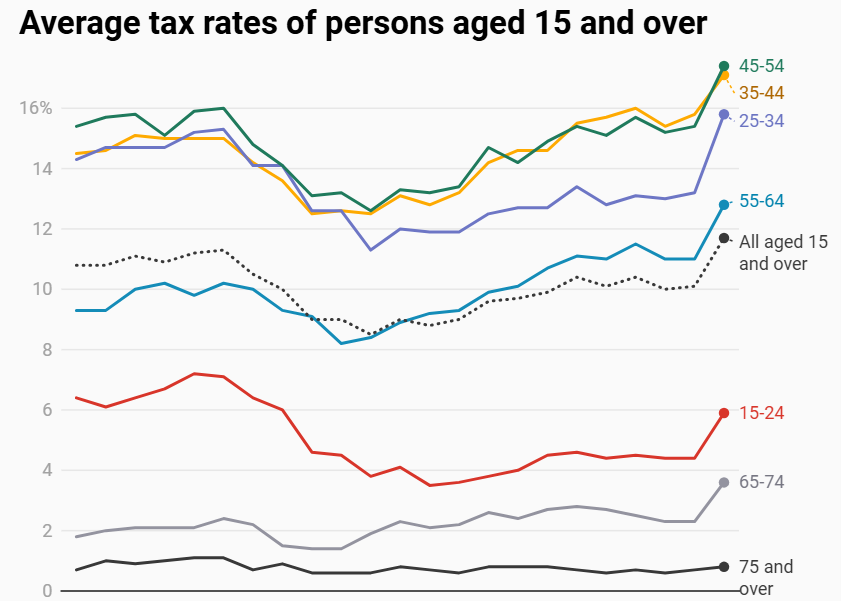
Not having marginal tax rates indexed to inflation provides two benefits to the government. It is a stealthy way of increasing government revenue without announcing new taxes. It also provides the ability to announce ‘tax cuts’ which are popular with voters even if they are simply retrospective corrections for bracket creep.

Since 2011 successive governments have chosen to use salary inflation to increase revenue. There has been a steady increase in the average tax rates despite three ‘tax cuts’ which occurred in 2012 / 2013, 2020 / 2021 and 2024 / 2025.

Against this backdrop of bracket creep wages are growing slower than inflation – especially for private sector workers whose wage growth has fallen behind the public sector.

Does indexing solve all the issues? Not even close. But it is a simple step that applies a consistent approach to working age and retired Australians. It also aligns Australia with the globe as 60% of of OECD countries have indexation built into their tax laws.

Rental protections

The focus of much of the generational anger centres around housing. I recently covered the folly of trying to make housing more affordable without resorting to policies designed to bring house prices down. A deliberate attempt to reduce property prices is politically perilous which makes it unlikely anything meaningful will happen.

Stronger rental protections could be an easier way to enact a middle ground measure. Many Australians view housing as a pathway to building wealth but home ownership also provides peace of mind and security. Many renters have less financial security and protecting them is worthwhile.

I don’t ever envision Australia looking like Germany where over half the population rents but caping annual rent increases and facilitating longer term leases could bring more security to many Australians.

Eliminating negative gearing is popular with a portion of the electorate. While this may lower property price appreciation it would likely result in higher rents. Adding stronger rental protections is a way to support the most vulnerable Australians in exchange for the benefits already bestowed on investment property owners. This seems like a compromise that many Australians would back.

Grandfathered changes to the age pension

The age pension is vital to the welfare of many retired Australians. Today’s retirees didn’t have compulsory super for much of their careers and I’m not suggesting making changes for any current retirees or anyone close to retirement.

However, at this point compulsory super has been around for 34 years. It took years for the contribution rate to become meaningful but as the next generation retires, there is the opportunity to change the eligibility criteria for the age pension. Announcing changes early will allow people to plan adequately for retirement.

The change I’m suggesting is to no longer ignore the value of the primary residence in the means test for the pension. In a country where so much wealth is tied up in housing it makes little sense to completely exclude the primary residence from the means test.

There are several ways this could be done. Only a portion of the value of a primary residence above a certain value could be included in the means test and provisions could be made based on the property prices in the area a house is located.

The goal should be eliminating the perverse incentives where wealth remains trapped in homes during retirement while taxpayers foot the bill for day-to-day expenses of retirees. Those homes are then passed tax free to heirs. 

In some cases the exclusion of housing in the age pension means test is part of an estate planning strategy. The financial advice industry provides guidance to this end. This is legal but changing the incentives can lead to better outcomes for the country.

Retirees have contributed years of taxes to fund the pensions they are collecting but as a society we all need to determine if there is a better way to spend the $65 billion that goes to the pension annually. The age pension is the second largest government expenditure and makes up nearly 8% of the budget.

I know this is a bitter pill to swallow for many and this is the most extreme of the policy changes I’ve proposed. The goal is not to take homes from people but instead to recongnise the value of the wealth held in homes and extract it to support retirement through measures like a reverse mortgage.

If done thoughtfully it can be used to lock in other parts of the retirement system like the current tax incentives in superannuation which are in the political crosshairs.

There are two ways to lower the disparity in tax rates across the age spectrum. One is to raise taxes on super, eliminate negative gearing and increase capital gains taxes. That seems to be the route the government is going down. The other is to find ways to fund tax reductions for struggling working age Australians. To do that in a fiscally responsible way means finding the money to offset tax reductions. The age pension is one way to do that.

Final thoughts

Not everybody will agree with what I’ve proposed. Any change in government policy generally favours some voters and disadvantages others. That is just life.

The longer the status quo persists which a major portion of the electorate deems untenable the more radical the eventual policy response. Now is the time to start taking steps to address the grievances of young Australians.


Mark LaMonica, CFA, is Director of Personal Finance at Morningstar Australia.


  •   18 March 2026
  • 40
  •      
  •   
40 Comments
Annabel
March 19, 2026

1.Close borders (unfortunately our population will reduce as we're not replacing ourselves quickly enough, reducing the tax base and our economy wont grow)
2. Unskilled workers do a lot of the work that current residents wont do. Look at the personal care industry.
3. Climate change is a hoax and forget about equity of access. Not the sort of country I want to live in.
4. No rules. Forget building codes, height limits, safety on worksites. Drill baby drill. Really?
5. Add history, so that we don't repeat the mistakes of the past. History is very underrated. Is that woke?
6. Subjective - where do we start? Healthcare, research, roads...
7. I can go one better - perhaps start by charging the big miners and gas exporters properly and we can set up a fund like Norway has done to make tertiary education and childcare free (hope that isn't too woke)

Eve
March 19, 2026

Quoting from the above article “ Retirees have contributed years of taxes to fund the pensions they are collecting”.

No. Their taxes did not pre-fund their age pension. Their taxes were spent on the government budget of the day - healthcare, education, etc. Age pensions are paid out of current working people’s taxes.

12
Rob W
March 19, 2026

Spot on, Eve....saved me from saying the same thing.

4
Mark LaMonica
March 19, 2026

I agree that is technically correct but there is some merit to the argument. Current retirees funded the generation before them and expect the same thing to happen after they’ve retired. We can't all simply fund things exactly when we need them - only paying taxes for education when your children are school age, only paying for disaster relief when the disaster impacts where you live, etc. I still think the means test for the pension should change but so often these debates come down to what some person or generation “deserves” while not acknowledging they made any contribution.

12
Bernie Masters
March 19, 2026

How can you talk about "Housing prices are being boosted by entrenched tax incentives that benefit older homeowners while pricing new homeowners out of the market." but not once mention the extremely high levels of migration which is almost certainly placing the strongest pressure on dwelling availability and hence prices? The article's failure to address this issue renders the article shallow and largely irrelevant.

9
Mark LaMonica
March 19, 2026

Hi Bernie -

I was paraphrasing the prevailing narrative from younger voters. Whether you agree with that or not it is likely to influence the policy proposals in the upcoming budget. My point was to try and propose alternative approaches and admitted they didn’t address property prices.

2
st
March 19, 2026

I think that young people seeing entrenched tax benefits as the cause for expensive housing, and not excessive demand from population growth exceeding supply growth of housing is part of the communication problem. And part of that is the current trendy and somewhat misplaced use of the word "intergenerational", usually used by the younger "journalists"/influencers. As alluded to by someone else, some basic literacy around finance wouldn't go astray. The basic concept of supply and demand (and the manner "price" tries to balance the two); the bleeding obvious concept that those who have earned an income for longer (and saved) amazingly have more money than those just starting out; and finally that those who pay the most taxes usually get the most value from any tax benefit (there's lots of talk about who gets the most benefit but the reason they do so, that is they pay alot more tax to start with (the top 1% pay nearly 20% of income tax, and the top 10% pay nearly half of all income tax and around 40% of adults pay zero income tax), is usually conveniently left out of the conversation). But lets just stick with "intergenerational", the media just love to stir up a fight rather than trying to be factual and educate.

5
BMC
March 19, 2026

Things the government, not property investors, has done (and could undo) to impact younger generations ability to save/afford a house or to lead any decent lifestyle that their parents/grandparents didn't face?

* Compulsory 12% Super.
* HECS/HELP debt is too high
* Bracket Creep - the governments dirty little secret to lazily increase taxes.
* Population - in 1980s Australian population was 14M, hence the relative demand (and hence price) for that house was, by definition, lower.

I am dismayed that my 20yo and 22yo children work in part time jobs, where 12% of their earnings is "withheld" until they are 60yo, whilst meanwhile they accrue an annual $17K HECS/HELP debt which must be paid off and impacts ability to get a mortgage, and they can look forward to joining the work force effectively paying a 30% (ATO) +12% (SGC) + 15% (HECS) = 57% marginal tax rate.

4
john
March 19, 2026

10% super should be more than suficient over a working lifetime as long as the fund manager performs properly and not fraudulently

Nadal
March 19, 2026

The 12% of their earnings going to super should be in a High Growth fund which will deliver 5+%pa real after tax. The HECS debt interest rate is 0% real. It is a no brainer to preference super contributions over HECS debt repayments.

Kim
March 19, 2026

There is a problem here that many young people are encouraged to go to University and accrue HECS debts. Whilst many benefit, others drift and are unable to find employment -yet our trades are suffering through lack of trades-people. Migration has not addressed this issue, with so many family reunions for older parents who are not able to contribute taxes. Universities endeavour to attract large numbers of overseas students, and quality of degrees is suffering. Aspiring University applicants need to assess whether there will be employment for them. Personally I had to contribute 5% of my small pay from 1962 into a Bank's Provident Fund, and then 50% to cover boarding costs for mandatory country service until I married. At least a banking career cut short by retrenchment at 49 taught me how to manage my, and customers' finances.

1
GeorgeB
March 19, 2026

“Things the government… has done …(that their parents/grandparents didn't face?”
"HECS/HELP debt is too high"

My generation didn’t have HECS/HELP debt but we had to pay for our education up front or miss out (uni was not free until 1974) - at least the current generation has an option- pay up front or borrow and pay back over time.

"Bracket Creep - the government’s dirty little secret to lazily increase taxes"
Bracket creep affected all generations, particularly during periods of very high inflation as occurred during the 70s and 80s, because it was every government's dirty little secret and no government wanted to introduce a measure (such as indexation of tax scales) that deprived them of more income without appearing that they were increasing taxes.

2
AndyP
March 19, 2026

BMC, you are repeating a commonly-held misconception. Your children are not having 12% of their earnings withheld. Rather, your childrens' employers are paying your children 100% of their earnings, less tax at their marginal rate, and THEN those employers are paying 12% in addition to those 100% wages, as Superannuation Guarantee Contributions, to your childrens' complying fund/s. As an small-business employer for many years I endured that creeping Government-mandated impost at every payday, which has finally plateaued at 12%. Whether, by cancelling that mandate and maintaining their employers' outgoings to your children at what would be 112% of their current earnings, the difference for them to spend or save as they see fit and thus forego the long-term compounding returns of super, they would be better off in the long run, is a decision for them as voters to make.


Michael
March 19, 2026

The Treasurer has shown he is is very good at drawing the media's (including economists) and voter's attention away from the underlying problems in the economy, including the significant increase in Government spending, requiring increased taxation; inflation which is now at much higher risk of being embedded; lack of productivity improvement in the workforce; and in housing the failure by a significant margin to deliver the housing supply targets which the Government itself set.

Rather than be diverted into a tax debate by the Treasurer, let's focus on the issues that will provide housing that younger generations can afford to purchase. The issues are primarily on the supply side:

- Lack of trades partly contributed to by an infrastructure construction build which is much higher than a decade ago and requires significant trade input. As an example - Do we really need to construct the Suburban rail loop in Victoria now?

- The fall in productivity in the construction sector. No one cause, but a variety of issues including changes in workplace laws and increasing regulatory and safety requirements by Federal & State Governments and local councils. Some of the requirements are sensible - others over the top. Some simply create the need for expensive reports that are largely copy and paste.There must be a better way. Do we really need 4 stop and go personnel to ensure safety when a single person monitoring a light set (or remotely multiple sets!) could do the job. Other regulations require higher standards than in past decades. Some are justifiably so e.g asbestos. But other requirements e.g. Basix rules, sometimes just add to cost for little benefit.

Improve productivity, and significantly shorten the build time, by increasing the use of manufactured and prefabricated technologies. There is a important role for government play as this needs a commitment on minimum quantites over a time period due to the set up period. It also requires good modular designs to meet varying needs and family sizes which impacts the minimum quantity. Surely this should be a much higher priority for Government expenditure than building solar panels?

And very importantly, the priority and level of commitment given to the creation of communities in new areas. This is not easy but if it was genuinely given priority and a sense of urgency imparted by all levels of government it could be done. At the basic level this requires essential infrastructure supporting housing development - power, water, sewerage, roads. At the next level it is provision for commercial, business and manufacturing centres, schools & universities, hospitals. Why is so much of our infrastructure spend focused in already developed areas, when the cost of the housing build itself in greenfield areas is much cheaper than brownfield housing built in inner areas?


3
Cam
March 19, 2026

Definitely agree with including the value of the family home in an altered age pension assets test. My parents would just do a reverse mortgage earlier, so currently everyone is paying tax so I get a bigger inheritance.
Bracket creep has been around I think since income tax started. I expect most are OK with an annual CPI increase of thresholds.
Extra rent protections could reduce the number of investors. and push up rent prices.

2
GeorgeB
March 19, 2026

“Housing prices are being boosted by entrenched tax incentives that benefit older homeowners while pricing new homeowners out of the market”

Unfortunately this narrative ignores what IMHO has been the PRIME driver of ballooning housing prices over the past 30 years or so, namely the dramatic DECREASE in the cost of borrowing money. For example a $500k mortgage in the early 1990s cost at least $60k per annum just to service the interest on the debt. That same mortgage today would cost about half that amount even after the recent rate increases are factored in, meaning that the same income could now service a $1M debt. This is the main reason that house to income ratios have ballooned dramatically.

In contrast and based on recent reports and economic modelling from Treasury and independent institutions, reducing the 50% Capital Gains Tax (CGT) discount is generally estimated to have only a modest downward impact on house prices, with estimates typically ranging between 1% and 4% lower than they would otherwise be.

2
Dudley
March 19, 2026


"dramatic DECREASE in the cost of borrowing money":

Herding of home buyers into mort-gages by negative real net SAVINGS rates.

Craig
March 19, 2026

Government has made this problem worse with excess spending, give aways to other countries & groups, immigration out of control and not being corrected, complete waste as seen with Vic. Government, & ridiculous waste on net zero when our countries emissions are so low, and now they come after retirees who have always paid their way, and houses go to their children who cannot waite...correct these problems and let the younger generation work, save and waite for their handouts and they will end up with house, savings and super, but need to have respect for the way retirees did it the hard way....

2
Edward
March 19, 2026

Generally a sensible approach, so unlikely to have much impact I am afraid.....
Regarding the vexed question of including the primary residence in the asset test for pensioners: the easiest and fairest way to determine which value to exclude is to include the value of the primary residence and eliminate the distinction between home owners and renters for the asset test. What has been determined to be a fair amount of excluded capital for renters should be a fair value for home owners.
Superannuation: an easy and reasonable solution would be to require compulsory withdrawal of the age-based minima and do away with the distinction between pension and accumulation accounts. Once you achieve pension age, you must withdraw. If you don't need the money, just invest it outside the tax sheltered super environment. That also takes away a lot of complexities.

1
Rob W
March 19, 2026

Agree on the superannuation point, but your suggestion of simply including the full value of the PPR may seriously disadvantage those in rural and regional areas, where house prices have not grown by anything like those in the capital cities, thereby possibly entrenching further the city/country divide.

Paul B
March 19, 2026

A % weighting on the house value by postal code perhaps?

Aussie HIFIRE
March 19, 2026

I agree with the proposal to incorporate the value of the house into the Assets Test for the Age Pension, the issue will be how to do it in a somewhat "fair" way and also in a way that Centrelink can actually make work. I'm not sure which of those will be more difficult, but neither of them are likely to be easy.

1
Allan Gardyne
March 19, 2026

If we incorporate the value of the house into the Assets Test for the Age Pension, we should also remove stamp duty on the sale of houses. It's a vicious tax on any retiree who wants to downsize or a worker who wants to improve their life by moving to a better job.

When talking about property prices it's essential to look at supply. We need to analyse the myriad costs and hurdles involved and make it much easier for any individual or company to build more housing. That's a massive part of the problem.

And, of course, restrict immigration to people who have the skills and attitude needed to make Australia a much better place in which to live.

1
Andy R
March 19, 2026

Australian inequality is subsidised by the tax system. While countries like Germany and France prioritise renter stability (indefinite leases and rent caps), Australia treats housing as a tax advantaged investment rather than a basic utility. Taxing work to subsidise wealth.

Politicians need to grow some and do the right thing!

1
GeorgeB
March 19, 2026

"Australia treats housing as a tax advantaged investment"

This comment now excludes the state of Victoria which treats housing as a tax DIS-advantaged investment spawning an investor exodus and making Melbourne a standout under-performer. Mooted changes to CGT and/or negative gearing at Federal level will be the final nail in the coffin.

1
Eve
March 19, 2026

Thank you VIC, my Melbourne based youngest son and his wife, in their late twenties have purchased a home and their first bay is due next month.

Sydney based sons are renting and can’t afford a dog, let alone a house to start a family.

GeorgeB
March 20, 2026

"Thank you VIC"

While those that can afford to buy may be grateful, long term renters are not grateful because "affordable" rentals are skyrocketing and there are reports of 140 people queuing for a single "affordable" rental. Moreover nobody is prepared to build into a market where up to 8000 new apartments remain unsold because they are no longer viable investments.

Michael
March 19, 2026

Firstly, inrelation to investment properties. ABS and ATO data shows that approximately 20% of investment properties are owned by boomers, with the remaining 80% mostly owned by GenX and GenY age groups.
Secondly, many elderly persons sell their home to pay to enter aged care facilities. Including the value of the family home in the asset test will not effect self-funded retirees, but for aged pensioners, this will see a reduction in capital equity which overtime will see families have to fund the $700k+ fees each for their parents to enter aged care facilities or the government will have to fund the increased costs.
Finally, superannuation was designed to fund retirement. The big change to superannuation that would reduce aged pension costs is to stop access to lump sum payments and make access by regular fortnightly payments with maximum annual withdrawal linked to average weekly earnings. To many people are withdrawing large lump sums and spending to enable access to the aged pension.

Dudley
March 19, 2026


"people are withdrawing large lump sums and spending to enable access to the aged pension":

Then they would spend lumps more before retirement on gilding their homes to coast into the Age Pension on retirement.

Better to abolish Mean Testing Age Pension. Then people will 'calculate' themselves their best fit of home and retirement assets and not be driven into an ill fit forced by one size fits all Age Pension Mean Tests.

3
Michael
March 19, 2026

If lump sum withdrawals from superannuation were abolished they would not be able to spend superannuation savings, noting also the requirement to be retired or transitioning to retirement to access superannuation. How people spend their savings outside of superannuation, there is not much governments can do.

Steve
March 19, 2026

Yes a pretty glaring weakness of a system forced on people to "pay for their retirement" but no means to ensure the savings are used for this "primary purpose". It's like gifting your kids some money to pay for education or a house deposit and they decide to blow it on a new car or world trip. Perhaps a new tax "incentive" (of the "stick" variety, to counter the loss of the initial "carrot" variety. The tax incentives behind super (in accumulation) means the amount you have in super is greater than if you had just saved some after tax income; that is one of the main points, to help achieve a higher balance in retirement. So some of the final balance is effectively foregone tax (which was deliberate of course, to make lifelong compulsory saving "fair"). So one could argue that to just spend the money that was tax advantaged for the primary purpose of retirement, on something other than retirement, one should forego any tax benefit accrued. That is, if you keep your money in super and use it to fund a pension, the rules would stay as-is. But if you withdraw to pay for a cruise or pay off a house extension, or anything else really, the lump sum should be classed as taxable income.

Jim Bonham
March 19, 2026

Mark, Thanks for the article.
I agree with many of the points you raise, especially indexation. I would state it more strongly, though: every threshold throughout personal income tax, super and the age pension should be indexed in exactly the same way, preferably in the same way as the full age pension (which attempts to maintain its value relative to living standards).
The guiding principle here, is twofold in my view: first, every independently adjustable parameter is another button for the politicians to play with, making the entire system ever more complex and unintelligible; and second, if different thresholds are indexed differently, their relative values change over time, so an element of instability is built in.
Another really important point is the interaction between asset values and the age pension. For example, any tax on super (at any stage) which reduces the value available to fund retirement can be counter-productive, because it will increase age pension cost for anyone affected by the assets test at some point in their retirement (not necessarily at the start). Forced withdrawals from an account-based pension have the same effect. I see no evidence that the government or Treasury has ever bothered to think this through.
It is commonly believed, as you say, that the age pension asset test does not assess the pensioner’s home. Indeed, Centrelink says as much (https://www.servicesaustralia.gov.au/asset-types?context=22526): “We assess most of the assets you own in your asset test. This generally doesn’t include your principal home …”
But compare the asset limit (value at which the test reduces the pension by $78 per annum for every extra $1,000 of asset value) for a single homeowner with that for a single renter: $321,500 versus $579,500. Effectively, the homeowner has an extra $258,000 added to whatever other assets he or she has, when calculating the assets test.
In other words, the value of the home is assessed (deemed) as $258,000.
Why does Centrelink lie about this (as they have for a long time)? Why does the financial industry let them get away with it? Why $258k, and not some other value?
And, with respect to this article, by how much would you suggest increasing the deemed value of the home? And how would you expect an affected pensioner to respond?


Dudley
March 19, 2026


"none of these changes will address the source - property prices":

'Death to mort-gages' would reduce prices.
That would force s-S-SAVING to buy a home. Or demands that the olds paid c-C-CASH to get rid of the non-s-S-SAVERS sods.

Those paying off a mort-gage would be non-too-pleased.
Positive real net interest rates operating over a long term would be middle ground.
Soothing savers and saving spenders.

Dudley
March 19, 2026


"none of these changes will address the source - property prices":

'Death to mort-gages' would reduce prices.
That would force s-S-SAVING to buy a home. Or demands that the olds paid c-C-CASH to get rid of the non-s-S-SAVERS.

Those paying off a mort-gage would be non-too-pleased.
Positive real net interest rates operating over a long term would be middle ground.
Soothing savers and saving spenders.

Stuart
March 19, 2026

Agree with the author's suggestions.

In addition, the tax rules for superannuation are needlessly complex, are contributing to intergenerational inequity and exacerbate the revenue hole we will see as the population continues to age. Here is how the superannuation system should've been structured:

- system remains compulsory with no withdrawals until retirement;
- 0% tax on contributions and on income within superannuation accounts;
- annual limit on contributions;
- drawings from superannuation accounts taxed at marginal tax rates.

Obviously huge difficulties in trying to transition at this point however it could at least be introduced for those entering the workforce now and there may even be a workable approach to create an (indexed) credit for tax paid which can be applied against tax on future withdrawals.

Justin
March 19, 2026

Introduce long term housing leases and cut out the spruking real estate lobby. Introduce stability and reduce housing stresses including FOMO.

Stability further banks, investors, owners and renters, short term leases are part of the fear generating cycle, hurt all parties.

Graham W
March 19, 2026

If a pensioner couple had to draw against a fund calculated on all the income tax they ever paid, it would not cover even three years of pension. This would especially be the case for those in their seventies and eighties as many relied solely on the man's pay as many women stayed home and never entered the work force when the kids left school.So in many ways the current system is pretty generous as the taxes they paid were used up by the government of the day.each . It seems a long time ago that Peter Costello produced five budget surpluses to ostensibly fund future pensions
Regarding BMC's comment on his overtaxed children , I recall paying 60% tax and 66% Provisional Tax on not a large income from business income that was invested back in the business and was very hard to pay

Jon Kalkman
March 20, 2026

Oh how quickly we forget. In the last 20 years there has been no change to the tax system but, the world has experienced two major financial shocks - the GFC and the global pandemic - which threatened to plunge the global economy into deep depressions. In both cases central banks flooded the economy with cheap money through quantitative easing and extremely low interest rates.

While the mechanics of quantitative easing are complex, the purpose is not. Central banks printed money that retail banks were strongly encouraged to lend out at extremely low interest rates. Since there is nothing easier to sell than money, cheaper lending encourages spending and investing. The aim and effect of this deliberate policy was to raise asset prices, thereby fuelling inflation. Heh presto house prices exploded.

But the benefits of quantitative easing are not evenly spread. Asset owners who are typically older, benefit from increased asset prices, whereas young people and renters did not. In averting financial disaster it is possible that the central bank saved their jobs, because in a depression, large scale unemployment affects many unskilled workers, but they continue to be hurt by elevated house prices.

We know that inflation is always and everywhere a money supply problem. But, instead of reducing the money supply, the monetary response is always to raise interest rates to make credit more expensive. And once again this has an asymmetrical impact on the young and renters.

Governments could apply a fiscal response to reduce excessive consumer spending by raising taxes or withdrawing subsidies but that has a political dimension, governments prefer not to contemplate.

Jack
March 20, 2026

The age pension / family home conundrum is readily solved. The family home is a financial asset, especially to your estate, and it saves you the cost of rent. That’s why non-homeowners can have more assets, simply to generate more income to pay rent.

We should include the deemed income (and the rent saved) from the family home in the income test and that will level the playing field between home owners and non homeowners. We would then need to increase the threshold on the income test before the age pension is reduced and thus increase the incentive for retirees to continue working part-time while they are able.


Leave a Comment:

RELATED ARTICLES

How cutting the CGT discount could help rebalance housing market

Why the $5.4 trillion wealth transfer is a generational tragedy

A capital gains tax discount is legitimate but how much?

banner

Most viewed in recent weeks

How cutting the CGT discount could help rebalance housing market

A more rational taxation system that supports home ownership but discourages asset speculation could provide greater financial support to first home buyers.

Is there a better way to reform the CGT discount?

The capital gains tax discount is under review, but debate should go beyond its size. Its original purpose, design flaws and distortions suggest Australia could adopt a better, more targeted approach.

Want your loved ones to inherit your super? You can’t afford to skip this one step

One in five Australians die before retirement and most have not set up their super properly so their loved ones can benefit from all their hard work and savings. 

Super is catching up, but ageing is a triple-threat

An ageing Australia is shifting the superannuation system’s focus from accumulation to the lifecycle of retirement. While these pressures have been anticipated for decades, they are now converging at scale and driving widespread industry change.

Meg on SMSFs: Last word on Div 296 for a while

The best way to deal with the incoming Division 296 tax on superannuation is likely doing nothing. Earnings will be taxed regardless of where the money sits, so here are some important considerations.

Has Australia wasted the last 30 years?

The 20 years after Peter Costello left Treasury have been deemed wasted...by Peter Costello. The missed opportunities for Australia began long before.  

Latest Updates

Taxation

3 ways to defuse intergenerational anger

With the upcoming budget increasingly likely to include bold proposals to alter the tax code I’ve outlined three incremental steps with fewer unintended consequences.

Economy

Why an extended US-Iran war will punish mortgage holders

The impact of the Iran War is far more than expensive petrol. Higher oil prices have secondary inflationary impacts that reverberate throughout the economy which could be bad news for Australians with mortgages.

Infrastructure

Don’t forget the yield

Global Listed Infrastructure dividends are forecast to grow 5-6% p.a over the next two years. After a hiatus, share buybacks are back on the agenda and will play an integral role in shareholder returns.

Iran war hands politicians free ticket to blame oil prices for inflation

Past oil shocks offer lessons for investors dealing with the fallout from the Iran War and the ongoing impact on inflation.

Economy

Japan 2026: A new PM heralds a new golden age?

Former Australian Prime Minister, Paul Keating, once said "When you change the government, you change the country." We're about to see whether that holds true in Japan.

Investment strategies

Why are central banks moving from US Treasuries to gold?

Central banks now hold more gold reserves than US Treasuries, signalling a shift in safe-haven asset strategy and portfolio diversification as geopolitical risks increase.

Strategy

Has global human wellbeing peaked? What the data reveals

Historically economic progress is measured by GDP growth but there is an increasing body of work that explores quantitative measures of wellbeing.

Sponsors

Alliances

© 2026 Morningstar, Inc. All rights reserved.

Disclaimer
The data, research and opinions provided here are for information purposes; are not an offer to buy or sell a security; and are not warranted to be correct, complete or accurate. Morningstar, its affiliates, and third-party content providers are not responsible for any investment decisions, damages or losses resulting from, or related to, the data and analyses or their use. To the extent any content is general advice, it has been prepared for clients of Morningstar Australasia Pty Ltd (ABN: 95 090 665 544, AFSL: 240892), without reference to your financial objectives, situation or needs. For more information refer to our Financial Services Guide. You should consider the advice in light of these matters and if applicable, the relevant Product Disclosure Statement before making any decision to invest. Past performance does not necessarily indicate a financial product’s future performance. To obtain advice tailored to your situation, contact a professional financial adviser. Articles are current as at date of publication.
This website contains information and opinions provided by third parties. Inclusion of this information does not necessarily represent Morningstar’s positions, strategies or opinions and should not be considered an endorsement by Morningstar.