In 2015, Tai Lopez started running his now famous “Here in my garage” ad on YouTube as a way to promote his 67 Steps self-help course. The ad featured Lopez standing in front of a brand-new Lamborghini before panning over to seven bookshelves he had installed to fit 2,000 books he had recently purchased.
Following the release of the ad, Lopez became an overnight sensation. Despite being widely ridiculed, “Here in my garage” was a massive success that, according to some sources, generated over $50 million in revenue for Lopez. Based on this success, Lopez founded a marketing business that did well as his YouTube following grew.
However, by 2019, Lopez shifted his focus and created a holding company, Retail Ecommerce Ventures LLC (“REV”), to invest in distressed brick-and-mortar stores. REV raised $112 million from investors to buy companies like Radio Shack, Pier 1 Imports, and Linens N Things.
Unfortunately, this is where things went south. As these distressed investments failed to pan out, REV allegedly started missing payments to investors, and everything came undone. In September 2025, Lopez was charged with fraud and running a Ponzi scheme by the SEC.
I’ve been thinking about Lopez’s story a lot over the last six months. How does someone who’s won the game end up losing so badly? I don’t mean to pick on Lopez either, because it’s happened with so many others. Sam Bankman-Fried went from the world’s richest person under 30 to a 25-year prison sentence. Elizabeth Holmes went from the cover of Forbes to 11 years in prison.
All of these falls from grace illustrate a deeper truth—survival is the only success. It doesn’t matter what you do in life if you can’t sustain it. You could make $100 million, but if you end up in a prison cell or broke, who cares? That’s not success. In fact, it’s the opposite.
Using this definition, you are more successful than Tai Lopez, Sam Bankman-Fried, and Elizabeth Holmes. I am too. If you don’t believe me, ask yourself one question: Would you trade places with any of them?
I know I wouldn’t. I bet you wouldn’t either. There’s no amount of money and fame that is worth the loss of reputation and freedom.
Here’s the funny part though—Lopez, Bankman-Fried, and Holmes all could’ve enjoyed their success if they had just stopped earlier. Lopez and Bankman-Fried had real, profitable businesses. They didn’t need to chase after more. Holmes could’ve failed with Theranos (without the fraud) and I guarantee she’d get funding for her next venture.
But they didn’t stop. Why? Because greed is a hell of a drug. Greed drives people to behave in absolutely irrational ways. It drives some people to risk everything for just a little bit more. It’s the most negatively asymmetric payoff you could imagine—the upside is capped, but the downside is unlimited.
And yet people still make this trade all the time. There are people out there doing it right now. They may look successful today, but they won’t hold onto their success.
I was reminded of this after recently re-reading Fooled by Randomness by Nassim Taleb. Taleb tells a story of a trader who is rewarded with larger and larger bonuses each year by pursuing a high risk, levered strategy. The trader outperforms all of his peers, further affirming that his approach is best. All is well until something happens in the market that the trader wasn’t expecting. Their strategy blows up and they lose everything.
Taleb’s story demonstrates why survival is the ultimate financial goal. Because it doesn’t matter how you perform for a month, a year, or even a decade. All that matters is what you can keep in the long run. Whether you can make it to the end game.
This is why I’m not a fan of those who “generate income by selling options.” These people are trading immediate rewards for future risks. And when those future risks inevitably arrive, many of them get wiped out. As Taleb writes:
Options sellers, it is said, eat like chickens and go to the bathroom like elephants.
Unfortunately, option sellers are the opposite of investors. They collect rewards now for risk later. Investors take risks now for rewards later. So which do you want to be?
You don’t have to sell options or run a Ponzi scheme to fall victim to this either. There are plenty of ways that retail investors do this on a much smaller scale. They put most of their money into a single stock because it’s surging upward. They juice their returns with leverage or chase the latest trend.
All of these work great…until they don’t. Unfortunately, when they stop working, you can lose more than just your capital. You can lose your confidence too. That’s where the psychological cost of investing shows up. You start to question whether you know how to invest or whether you’re just lucky.
This is why survival matters far more than short-term performance. Because survival allows you to compound your money for a longer period of time. And it’s this compounding that builds true wealth.
There’s a great irony in this though. Because the people who compound their money for decades aren’t the ones you typically read about. There’s no headline for someone who invested consistently for 40 years and retired comfortably. There’s no documentary about someone who built a small fortune while working a 9-5 job. But these are the real financial success stories. Everything else is just noise.
It reminds me of this interaction I saw not too long ago about index investors:
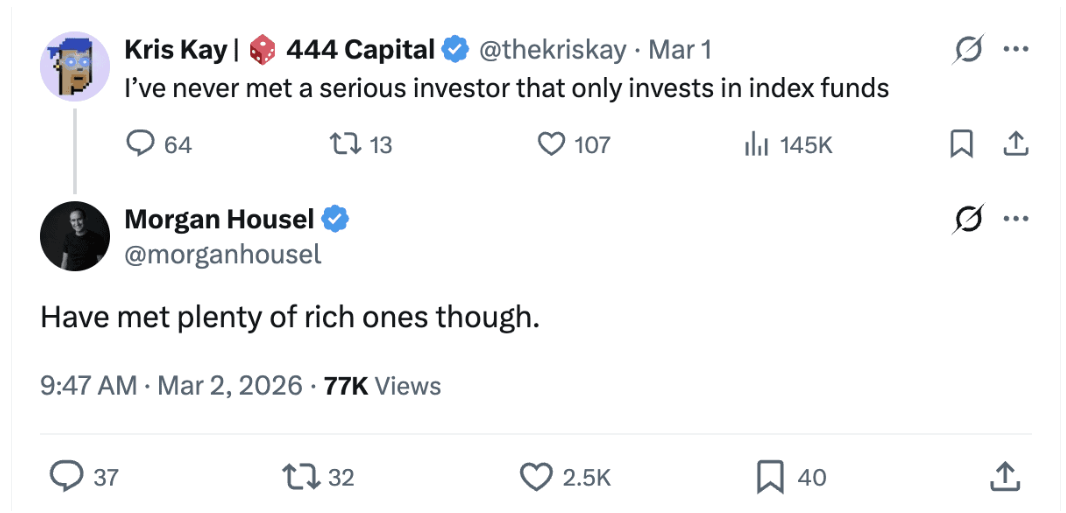
So, if you want to be financially successful—just survive.
Nick Maggiulli is the creator of personal finance blog Of Dollars And Data and the Chief Operating Officer at Ritholtz Wealth Management. For disclosure information please see here. This article was originally published on the Of Dollars and Data blog and is reproduced with permission. If you liked this article, consider signing up for Nick’s newsletter.