For those of you who have just connected I retired 4 months ago from being a full-time academic after researching retirement planning for nearly 20 years. Now I am focusing on implementing my findings: for myself, for individuals and for organisations. As I promised when I retired, I am providing a month-by-month account of my findings from the other side. Before I get into the top four things I want to talk about this month, I just want to say how much I am enjoying the fruits of my labour and making the most of retirement. Honeymoon in full swing. Double rainbows. This month I want to talk about: work, social, health and motivation.
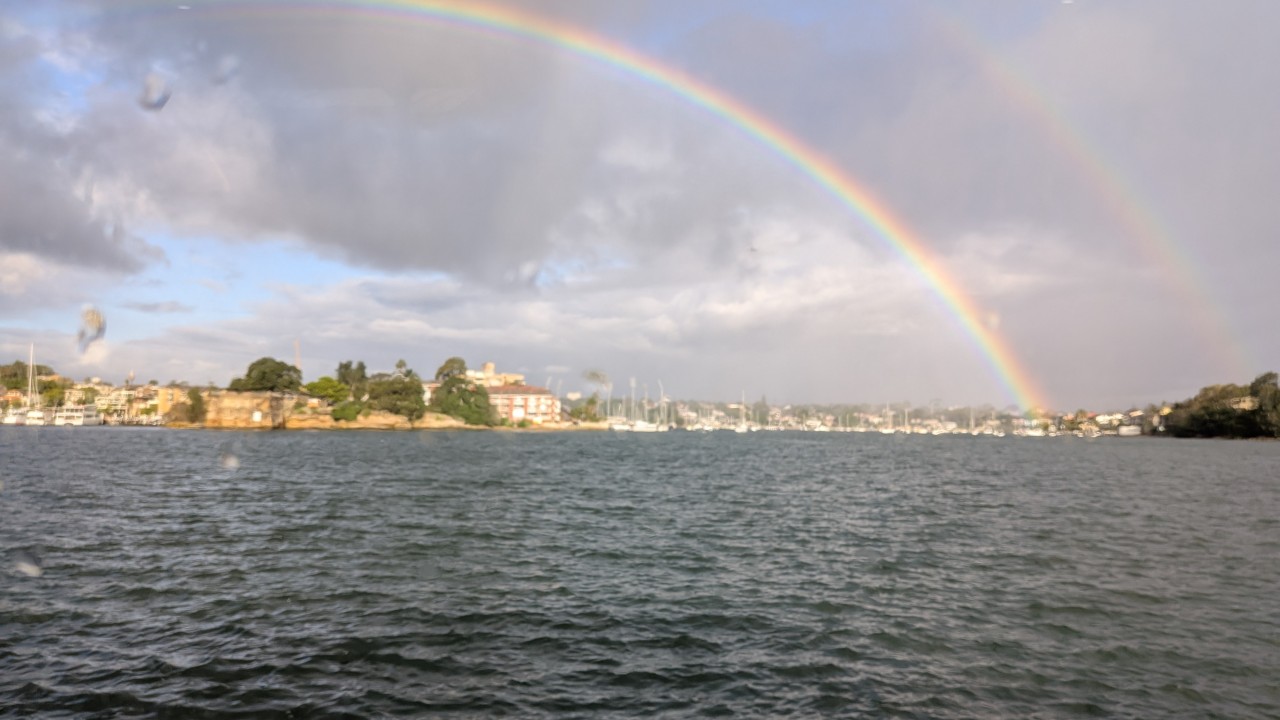
Sydney Harbour from the Ferry on the way to Abbotsford. Taken with my own camera (sorry about the raindrops).
Work
What work will you continue to do in retirement, and will it be paid or unpaid? If your work is unpaid (i.e. voluntary) who will you be volunteering for? What will you do? Where do you draw the line? It’s an interesting question. I’ve been very busy with individual meetings, talking to organisations about putting their ideas into action, working on our ARC grant extending the original retirement resources model, running workshops, writing a book foreword and participating in research round tables. I am happy to help with selected charities but if I contribute to a money-making venture then I think it’s reasonable to be paid too. It’s interesting how many people think your personal goal should be to support their own personal goals – for free. I’m not talking here about charities or community groups I’m talking about money making venues and income producing enterprises. There’s a difference between volunteering to assist a charitable cause or sharing ideas vs being used for free unpaid labour. If you are working with retirees make sure to respect their time. If you are a retiree – know your worth, fill your space and don’t allow yourself to be exploited. If a 15-year-old was asked to work for free in a bakery it would be front page news.
Social
Making new friends through activities. I’ve generally avoided stepping too far out of my comfort zone to try new activities – other than health. Probably a consequence of a well-meaning HR Director early in my career recommending that I try new hobbies to focus on work less. At that time, I enrolled in a cake decorating course. Never learnt too much about cake decorating but I did manage to update one of the other attendee’s CV, practise her interviewing skills and help her to get an apprenticeship. That made it worthwhile. None the less I can still make realistic flowers out of blu-tac – a much-valued skill when you hit a dull spot during a conference. In the interest of putting into practise the importance of extending networks in retirement, I enrolled in a jewellery making course to assist me in bringing to market a patented design I have for a hearing aid security device that looks like jewellery. I am working with a great bunch of women who are genuinely creative and it’s taught me a lot of patience. As a bonus I now understand enough jewellery lingo to speak to manufacturing jewellers about my patent. It’s not so much about the jewellery as it is making new friends, trying new things and learning new skills (patience).
Health
Although previously a conscientious objector to wearables that monitor my health, I finally succumbed this month. The main reason was sleep. Two of my retired academic colleagues have complained of poorer sleeping habits in retirement and I could see myself going down the same track. Synapses firing with new ideas day and night made for a very restless sleep indeed. So, I bought a Fitbit Air (no product review stitches here or paid endorsements just some plain home truths). It’s clear that the product testing team contained people with average or above average wrist size. More diversity was needed. It’s resulted in the strap provided wrapping around my wrist almost twice. Not quite the “light as air” experience I’d imagined. So, product developers if you want to appeal to mass audiences make sure your sampling reflects the masses. I know, I know I can also strap it to my ankle but being mistaken as a fugitive when I’m buying a new pair of shoes was not part of my retirement plan. Anyway, I’m finding the extra health information useful, especially for sleep.
Motivation
We’ve talked about the importance of setting goals with specific information using implementation intention techniques last month. For those of you who missed it there was some interesting research at Macquarie Uni showing that the absence of five key activities over a two-week period was enough to trigger depressive episodes. The five activities were: maintaining realistic thinking; engaging in meaningful activities, having goals and plans; keeping healthy routines and staying socially connected. I think this provides extra evidence for the importance of creating some routine early in the retirement journey. If you haven’t downloaded the 63 hours worksheet you can do so by visiting my website: www.RetirementDr.com.au
Joanne Earl is a Psychologist and Honorary Professor of Psychology and Retirement Planning. You can read more about Joanne’s retirement journey via LinkedIn or visit her website: www.retirementdr.com.au.