Robert Cochran tells me that it all started with a big blue bus.
Well, not quite.
One of the UK’s top pension funds started much longer ago, in 1815 in the Royal Exchange coffee rooms in Edinburgh. It was the time of the Enlightenment and a much stronger mastery of numbers. Gathered in the rooms were the money men of the day. They had been taking a keen interest in a global first-ever pension system, one for the retired ministers of the Church of Scotland and their families.
Over coffee and conversation, the decision was made to also do something for the widows of men who’d died fighting for Queen and country in the Napoleonic Wars.
These widows were not little old ladies in frumpy gowns. Their average age was 26 and they would have been condemned to a life of poverty if not for this innovative solution. Thus was born the Scottish Widows Pension Fund.
Fast forward to 2026 and Scottish Widows, now sitting within the Lloyds Banking Group, is one of the largest funds in the UK. Last year, Robert Cochran was awarded the title of Pensions Marketer of the Year and his colleague, Head of Pensions Policy, Pete Glancy calls him a ‘master’ of engagement.
So naturally I was curious to see if Robert would be prepared to share his ‘secret sauce’ with an Australian audience. And he was, answering questions including:
- What is engagement?
- Why does it matter?
- And, most importantly, how does a fund go about increasing it?
Some background
Some days in Australia it seems as though fund member engagement is a bit like the weather. Everyone seems to want to talk about it, yet no one ever seems to do anything.
Now that’s a bit harsh, but engagement has become a bit like black puffer jackets in a Melbourne winter – everywhere to be seen - but it remains an ill-defined, elusive target. Funds are, quite rightly, highly focused on the need to observe the Retirement Income Covenant (RIC), part of which, according to the Australia Prudential Regulations Authority (APRA) requires:
“Tailoring guidance and support for members by delivering retirement-focused communications, education, and guidance to assist members navigate the transition to retirement.”
Yet despite all this attention, there is still remarkably little agreement about what engagement actually means, how it should be measured, and where responsibility for improving it sits.
Some challenges may be bigger than any individual fund. For example, what if there were an agreed industry-standard retirement calculator that combined super, Age Pension entitlements, work income, private assets and lifetime income streams? Such tools already exist in various forms, but a single trusted version might reduce duplication and confusion.
Against that backdrop, let’s find out more about the magic that Robert Cochran uses to motivate his members.
Making pensions more exciting
Of the 10 million or so members of Scottish Widows, half are in workplace pensions and the majority have been automatically enrolled as a work pensions customer since auto enrolment was introduced in the UK in 2012.
Robert’s responsibility as Scottish Widows Workplace savings, innovation and engagement specialist, is to help people who are automatically ‘in’ the system to look forward to a good retirement. To better understand their needs in 2015 he did something unusual – and very clever.
That’s where the big blue bus comes in. Realising that the gateway for members was their employers, Robert wanted to make the concept of a pension more exciting. So in partnership with Pension Geeks, Scottish Widows ran a double-decker bus on Pension Awareness Day, inviting workers to visit the bus, have a coffee and ask their most pressing questions.
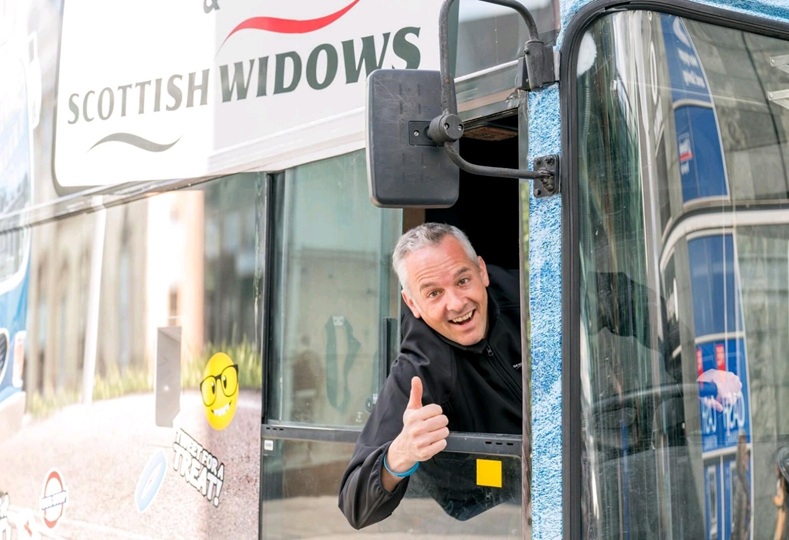
Pension Day grew to Pension Week before becoming Pension Month. And what Robert learned from the miles travelled and hours of discussions was that the language of pension entitlement and decumulation could be boiled down to three critical needs:
- What have I got?
- Is it enough?
- What can I do with it?
As more workers started to join the Pension Month conversations, the company bought their own retirement vehicles with fold-out classrooms to cater for the extra numbers. The Scottish Widows information sessions are now digital, with over 100,000 members joining the sessions in 2025 alone.
The key learning for Robert was the need to simplify the language of retirement:
“Through getting out and meeting so many people – whether digital or face-to-face – I was gifted about 6500 questions. These are the words our members use. So let’s use their language. And of course it was challenging from a compliance point of view, but it was necessary to simplify the language in order to make it easy for these members to engage.”
The power of comparison
Another innovation has been the Scottish Widows Pension Mirror. It provides an age filter that guesses the age of the member from their selfie and asks if they would like to know the average pension savings for someone of the same age. Averages are supplied by data from the Office for National Statistics. The user can also ask how much older or younger people might have.
According to Robert, this tool has been enthusiastically adopted, “…because it meets an age-old human concern – how do I compare?” The proof is in the pudding as it’s now been used over one million times and won 18 industry awards across Europe.
What does good engagement look like?
When asked to define strong engagement for a member of his fund, Robert replies that it means the customer knows:
The holy grail for Robert is the download of the company app. To date, Scottish Widows has had one million registrations, and they are pushing to increase this number further. Says Robert:
“When a member logs in, they see immediately what they have, required actions and a bright red action button. We have an engagement secret weapon too – Lloyds has over 28 million customers and they log into their online banking on average 26 times a month. If these customers also have a Scottish Widows pension, we show them that pension value right next to their bank account, it’s just another tile and it takes all the friction out of knowing your current pension balance.
“We are very tech-focused. Gamification is really important, to the extent that we have our own gaming team in Dundee, where the original Grand Theft Auto (one of the biggest gaming franchises) was conceived. If someone enters our pension app they will spend four minutes if it’s gamified, compared with 40 seconds if it’s not.
“Lloyds Bank is in the top 15 banks in the world for use of AI. We’ve started to introduce AI Agents into the app operating within the regulated boundaries. The brilliant thing is we have all these genuine questions people ask us – those 6500 recorded questions from last year have been fed into the agent alongside the answers – it’s learning just how our customers speak and how our products work”.
Another feature is the willingness to tailor communications to different audiences, using team members who genuinely understand the communities they're speaking to.
“We need to go where people are, talk the way people talk. Authenticity is key. People are using social media for all sorts of searching and in the UK we saw 118 million searches on TikTok for the word ‘pension’ last year – it’s a genuine resource. Short items get people interested. Simple measurements matter most – have they downloaded our app and used it? Have they come back again? If so, you can then nudge them to take next steps.”
It’s taken Robert’s team five years to achieve one million registrations on the app. Each month since there have been over two million log ins, and they hope to double that number over the next year.
On a separate note, next year the British government will introduce Pension Dashboards which means members will see all their pension savings in one place, so the question ‘what have I got?’ will be much better answered by technology.
What can Australia learn?
Before we finish, I ask Robert to share his thoughts on the Australian super system and where we are at when it comes to engaging members. He replies that he thinks we’ve done a good job on the accumulation side, but notes the size of our super savings pot is huge – but largely due to the high mandatory employer contribution of 12%. In the UK it’s 8%, and that includes an employee’s own contribution as well.
“Australia has got people in – in a way the government has given them a free kick – but I’m not sure that funds have yet developed the robust engagement that will see their members retire well.”
What do you think?
I tried out the Pension Mirror and got an age three years younger. I then went and put some makeup on and came up 10 years younger. Love it! Either way, the average savings by age were much lower than those in this country. But what a great tool to get people exploring and comparing their own retirement savings progress.
Interested in learning more about the Scottish Widows use of AI, gamification or their key metrics in a recent retirement report? They’re all covered as different topics in the Scottish Widows Workplace Savings podcast series.
Kaye Fallick is an independent retirement commentator and author, www.kayefallick.com. This article is general information and does not consider the circumstances of any person.