Many Australian investors continue to maintain portfolios heavily concentrated in domestic blue-chip stocks. Historically, that approach has come at a significant cost.
Over the 12 months, the Australian market has returned less than 1% whilst the US market has returned ~20%. And over the last 20 years, the Australian market has produced a compound return of 7.2% whilst the US market has returned 11.8% (Vanguard).
Is it time to bail on the Australian market?
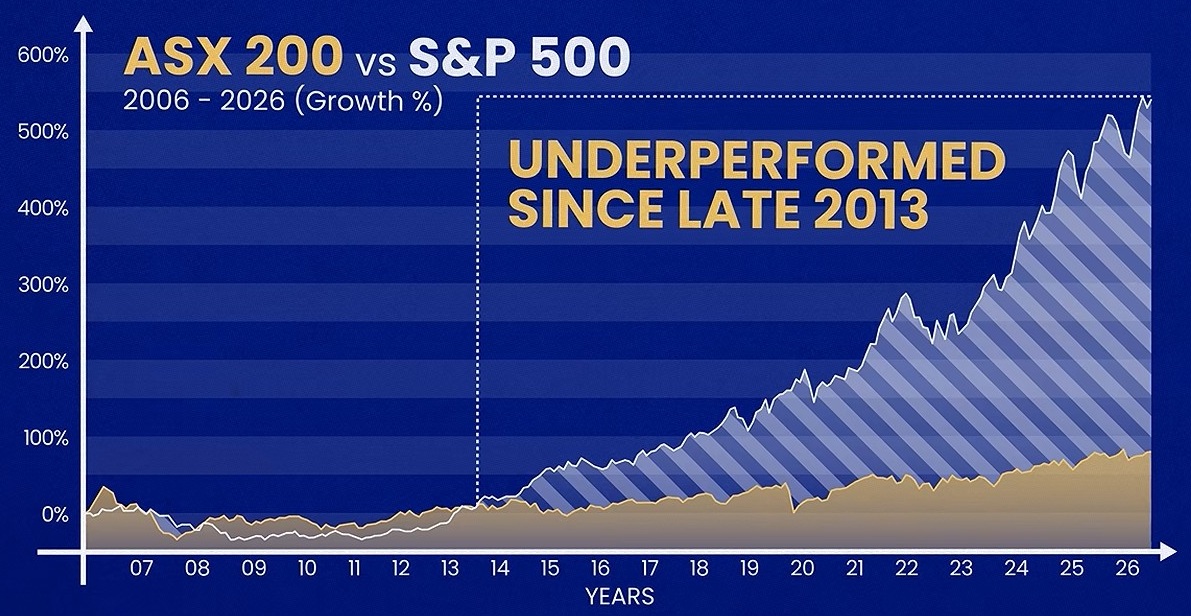
Below is a chart of the ASX 200 index against the S&P 500 index over the last 20-plus years. The chart highlights the extent to which the Australian market has relentlessly underperformed the US market. In fact, the only sustained period of Australian outperformance came during the resources boom between 2000 and 2007.
Source: Marcus Today
Following the growth
US investors generally view the stock market as a growth investment, rather than for income generation. They look to the bond market for that. Australia's market is dominated by financial institutions that have traditionally offered attractive dividend yields. As a result, many investors view domestic equities primarily as an income source.
Growth stocks in Australia are hard to come by. Outside of resources, the market is dominated by the banks, which are mature, low-growth stocks, and a collection of industrials.
Over the last 20 years, the S&P 500 is up 502%. The ASX 200 is up 76%. That's without dividends. We'd only be a little bit more competitive if you included them. Over the last 10 years, the S&P 500 is up 253%, the ASX 200 is up 66%. Over the last five years, the S&P 500 is up 75%, the ASX 200 is up 19%, and over the last year the ASX 200 is up less than 1% whilst the US market is up 22%. And that's just looking at the S&P 500 not the NASDAQ.
So why has Australia lagged so badly, and under what circumstances can it outperform?
The Australian challenge
This is a chart of the performance of the Australian market (All Ordinaries index) relative to the US market (S&P 500 index) since 1980 to 2024.
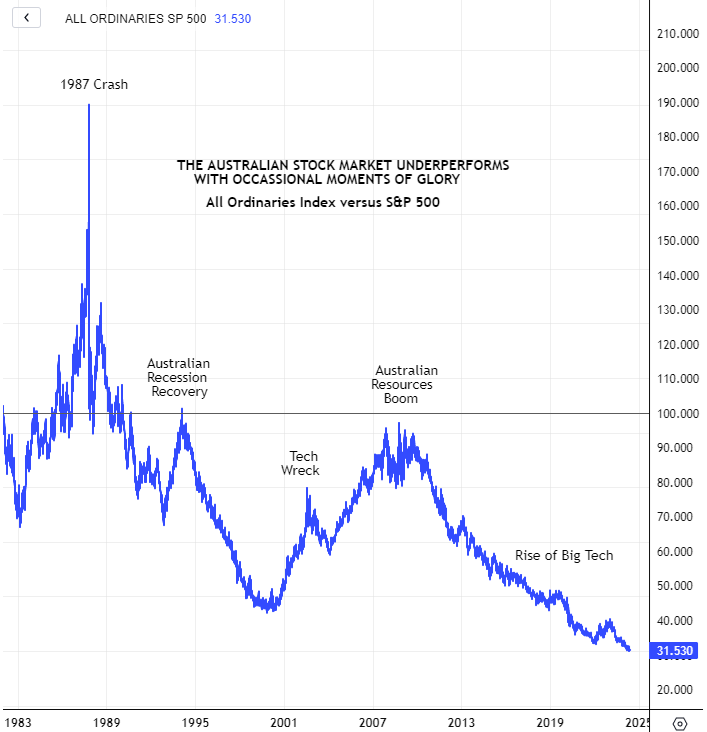
It highlights a few things:
- Australia outperforms when the US falls. The Australian market is generally more defensive than the US. That said, nobody buys Australia simply because it might fall less during a sell-off. So when the US stumbles, the answer isn't necessarily to buy Australia. Often, the better option is to reduce equity exposure altogether.
- Australia outperforms if there is a resources boom. It remains Australia's only competitive advantage in global equity markets. When the world becomes focused on resources (2000-2008), Australia and Canada suddenly become globally significant stock markets. Australia was all the rage in asset allocation meetings in every skyscraper from New York to Beijing in 2000-2008, as China's rapid development drove exceptional demand. Resource booms are fantastic for international investors because not only are they buying BHP and RIO and FMG, and not only are the share prices are going up, but when resources go up, because commodity prices are going up, the Aussie dollar also goes up. That delivers international investors the ‘Double Bubble’. They gain on the stocks and they gain on the currency. In 2005 every Wall St broker knew who Andrew Forrest was. I spoke to my Wall St broker mate in 2012 (after the resources boom) and asked if he was still interested in FMG and Forrest. He said - "Who? Oh yeah. No. That's all so 2000s". They'd moved on. About the only time Australia becomes interesting to the world is when commodity prices are rising sharply.
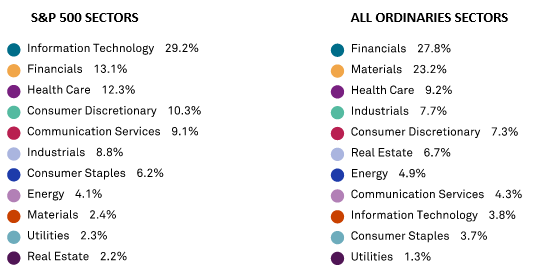
- Australia underperforms and outperforms depending on the US Tech sector. The US Technology sector now accounts for 29.2% of the S&P 500 with Communication Services (also Tech) accounting for another 9.1%. The US is very tech-heavy. Our market has a tiny Technology sector (3.8% of the All Ords). The relative performance of Australia is related to the US Technology sector which is why one of the few times Australia outperformed the US was during the Tech Wreck. If Big Tech falls over, then Australia will outperform again (but again, relative defensiveness alone is rarely a compelling long-term investment thesis).
Australia's competitive advantage
One factor that could quickly restore international interest in Australian equities is another resources boom. Australia remains a commodity-driven economy, and the Australian dollar has historically been closely linked to commodity prices and resource sector strength.
During the last major resources boom, the Australian dollar surged to more than US$1.10. That currency appreciation created a powerful incentive for overseas investors to allocate capital to Australia.
The attraction was what investors often call a "double bubble". Not only were resource stocks such as BHP and Rio Tinto generating strong share price gains as commodity demand surged, but foreign investors were also benefiting from a rising Australian dollar.
Given that the resources sector accounts for roughly 25% of the Australian sharemarket, global investors seeking exposure to commodities had little choice but to look at Australia. As they bought Australian resource companies, they gained exposure to both rising commodity prices and a strengthening currency.
For a US investor, for example, returns were driven by two separate sources: capital growth from Australian mining stocks and the currency gain from holding assets denominated in Australian dollars. The combination proved highly lucrative and led to significant international capital inflows into the Australian market. During this time, the share price of many stocks were becoming overinflated.
The ETF revolution and international investing
Fortunately, investing internationally has become significantly more accessible over the past two decades thanks to the exchange-traded fund (ETF) market. The ASX now hosts over 400 ETFs, meaning investors can access overseas markets as easily as you would click and buy CBA.
International investing also offers another potential benefit that many investors overlook: currency exposure. If US stocks go up and the Australian dollar goes down, investors benefit from something referred to as a "double bubble", benefitting from both equity returns and favourable currency movements.
Australian investors with unhedged exposure to international equities can benefit when overseas markets rise and the Australian dollar weakens. As the Chinese economy stagnates, the Aussie dollar is facing relentless pressure against several major currencies and may not recover until there is another commodity boom. Investors heavily concentrated in Australian assets risk missing opportunities that take advantage of international currency strength and international stock markets.
For many Australian investors, this may not be a concern. The banks have historically provided attractive dividend income and remain a core holding for many portfolios. But there is opportunity to take advantage of growth stories that don't exist in Australia. The most obvious example is the technology sector, which has been a major contributor to the US market's outperformance of the Australian market.
Investors focused primarily on domestic blue-chip stocks may have benefited from dividends and stability, but at the cost of access to many of the global growth opportunities available through international markets. Today, ETFs provide a simple way to broaden that exposure beyond Australia.
Outside periods of resource-led outperformance, Australia's market has struggled to match the returns available in larger and more diversified global markets. Unless investors expect another sustained commodity boom, the case to broaden your investment universe beyond Australia remains compelling.
The bottom line is that Australia probably needs either a resources boom or a US Big Tech collapse to outperform again. For now, the trend is set - Big Tech, helped by AI prospects, is seeing tremendous earnings growth relative to any other section of the economy and relative to any Australian sector.
This is an adapted version of a transcript from the Marcus Today YouTube channel. The full video can be found here.
Marcus Padley is the author of the daily stock market newsletter Marcus Today, see marcustoday.com.au. This content is general information only and does not consider your personal circumstances. It is not personal financial advice. Please consider whether it is appropriate for you or seek professional advice before making investment decisions.