Capital gains tax (CGT) has been a hot topic since the 2026 budget, but the discussion of high-profile issues has tended to neglect taxpayers at the lower end of the scale.
Their situation is characterised by a complicated tax structure that can produce highly non-progressive outcomes, especially for seniors. A progressive tax structure, which many people mistakenly think we have, charges lower rates at the lower end of the income scale to ease the burden on those least able to afford it.
Adding to this complexity is a new definition of taxable capital gains and also the misleadingly named ‘30% minimum CGT’, which defines a new calculation mechanism for CGT under some circumstances, justified by the income you might have earned in years or decades past: “This reduces the benefit to taxpayers of deferring realisation to years in which their marginal rates are low” (Explanatory Memorandum page 10).
I have assembled a cast of characters to show how a complicated system has been made even more so, leading to the deeper problem of complexity itself. Cherry picked? Sure, but the fact that cherries are there for the picking is the issue. Finally, we’ll look at a simple fix.
Just a few technical words first: these stories are set in a parallel universe where the new rules have been in place long enough to capture any capital gains mentioned; the tax parameters are as per 2026-27, plus the 30% minimum CGT where relevant. All characters are single.
All cases include the Low-Income Tax Offset (LITO), the Medicare Levy and, where relevant, the Seniors and Pensioners Tax Offset (SAPTO).
The 30% minimum CGT is applied before the levy and offsets, which means that the true CGT rate may actually be above or below 30%, or even zero. Age pensioners and some others are exempt, as a half-hearted attempt to protect low-income taxpayers: “Certain income support recipients will be exempt from the minimum tax to ensure that low-income, low wealth individuals are not adversely affected” (Explanatory Memorandum page 10).
Case studies
Let’s meet the cast:
Sophie is a 75-year-old homeowner, living on $46,000 of gross dividends from a $900,000 share portfolio held outside super. She only trades shares occasionally, to fine tune her portfolio and maintain its ability to at least keep up with inflation.
Mark has a taxable income of $38,000, including a part age pension. He has a few shares he might sell, or maybe that small block of land in the bush.
Rob is too young at 65 for the age pension. His taxable income is $28,000, which includes some dividends from shares held outside super. He also has some tax-free money from super, so he’s not starving but he’s not rich either. Like Sophie, he only trades shares occasionally.
Larry has the same taxable income as Rob. He does not get the age pension, but he does get SAPTO, being a few years older than Rob. Not sure what he’s contemplating selling, but it doesn’t matter here.
Sally is a full-time student living with her parents. She has no job, receives no government assistance and has no significant assets other than four paintings inherited from her grandmother. Checking with a valuer and an accountant revealed that each of those paintings would create a $5,000 real gain if sold. She contemplates selling one or more of the paintings and investing the proceeds or perhaps buying a car – her first foray into the world of adult finance.
Realising a gain
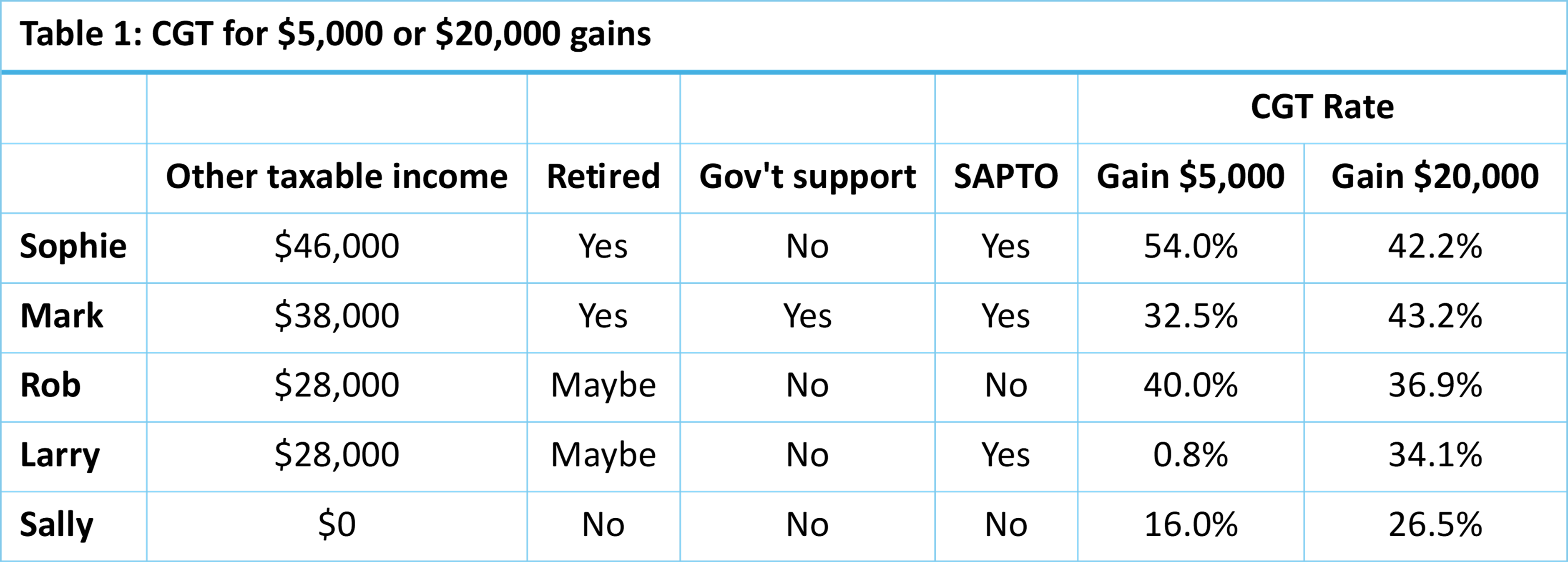
Table 1 shows how each of our cast would be affected if they sold enough assets to realise taxable capital gains of either $5,000 or $20,000.
There’s a huge variation within this small data set.
Sophie, on less than half the average wage, and close to qualifying for a part age pension, pays an astonishing 54% CGT on small gains!
This is made up of 30% basic marginal rate, plus 1.5% LITO fade-out (every extra dollar of taxable gain reduces LITO by 1.5 cents, thus increasing the marginal tax rate by 1.5%), plus 12.5% SAPTO fade-out, plus 10% Medicare levy fade-in.
That high CGT rate’s not new; it’s been the case for years. But it’s become more important with the new definition of taxable capital gains.
Mark, with slightly less income than Sophie, but a part age pension, pays 32.5% on small gains. What about the exemption from the 30% minimum CGT for pensioners? He wonders if he’s been conned, but it’s there, buried in the calculations. Without it, he would pay 47.5%, slightly more than anyone on an income over $190,000.
Rob pays 40% CGT on small gains, which is a serious blow to someone on his level of income (even with the money he gets from super).
Larry is happy with small gains, where he pays virtually no CGT because SAPTO and LITO overwhelm the depredation of the 30% minimum CGT. With larger gains, though, he ends up in much the same position as Rob.
Sally faces an especially harsh outcome. If she sells just one painting, the resulting tax liability is $800. If she sells the lot, she pays not 4 x $800 = $3,200, but $5,300 in tax. Sally was not born when her grandmother bought the paintings, thus setting the cost base, and she has never had any taxable income. She has fallen foul of the 30% minimum CGT rate, with no protection from the exemption (which would have reduced her CGT to zero, even if she sold all four paintings).
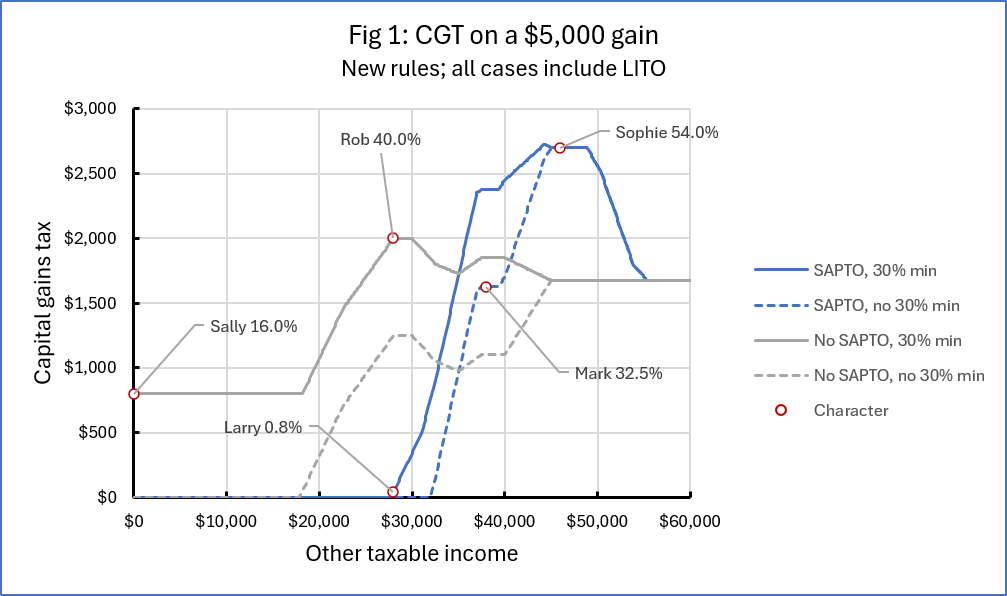
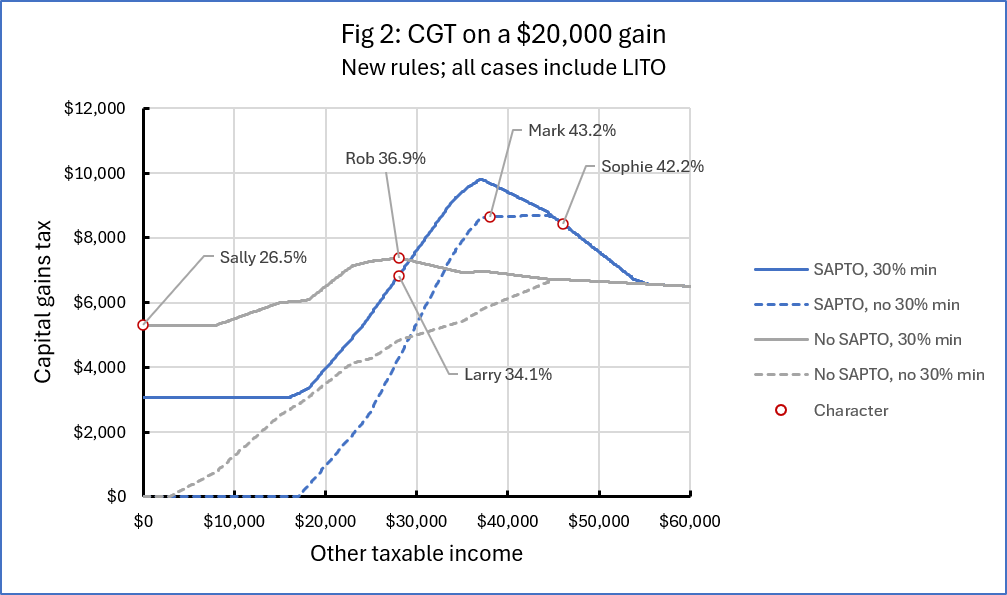
Mark, Larry and Sally pay a higher rate on the higher gain, but that reverses for Sophie and Rob. These inconsistent outcomes are a consequence of the non-progressive tax structure.
The graphical presentation in Figures 1 and 2 gives a better appreciation of how the positions of the various characters relate to each other, and where they sit with regard to other combinations of income and other parameters.
The blue lines indicate that the taxpayer is entitled to SAPTO (qualifies for the age pension, except possibly the means tests). The grey lines indicate no SAPTO.
The dashed lines in each case indicate that the 30% minimum CGT has not been applied, implying the taxpayer receives the age pension or other government assistance. They also apply to the way things were before the budget. The 30% minimum has no effect if other income exceeds $45,000.
Capital gains are different
“Should be taxed the same as other income” is a common call. Ironically, the 30% minimum CGT is deaf to it. For relatively low-income investors, the new rules tax capital gains much more than other income.
But there is a deeper issue, best illustrated by Sophie: CGT sabotages her investment strategy by introducing a cost and, since her trading is entirely discretionary, it may scare her away from that strategy to the government’s cost in the long term, as well as her own.
Complexity is the deeper issue
Complexity itself has many unsavoury aspects:
- Every additional parameter gives governments another button to press in pursuit of particular political or policy outcomes.
- Complexity creates opportunities for both misunderstanding and manipulation.
- Governments tend to trip over their own feet by adding further rules to address unintended consequences, thereby exacerbating complexity.
- In extreme cases, the combination of complexity and administrative zeal can produce serious policy failures, of which RoboDebt is a prominent example. AI increases the risk.
What to do?
Nothing fundamental will change until there is recognition that complexity itself is a problem, and that the system design should aim for straightforward and comprehensible outcomes. That would be a hallmark of genuine tax reform.
This does not mean ignoring the needs of special cases, just that care must be taken to ensure that secondary consequences don’t ruin the basic benefit. Ample opportunity needs to be provided for public feedback, which the government should take seriously.
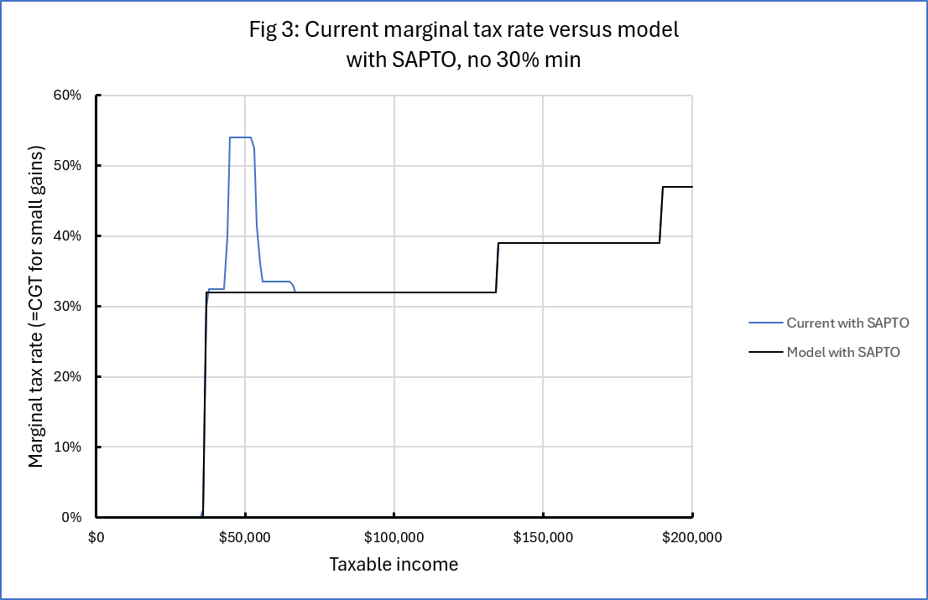
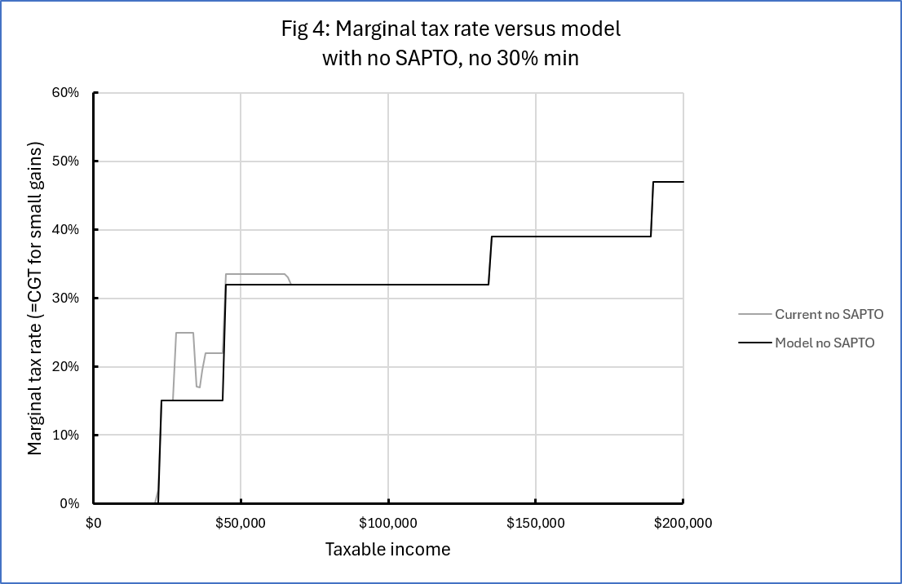
In that spirit, here is a straightforward model to show how the system can be simplified, so as to create a progressive structure for both total income and CGT.
(It’s not a polished solution, which would also look at issues such as the optimal CGT rate and interaction with the age pension, which has its own dysfunctional complexities.)
- Abandon the 30% minimum CGT for reasons already stated.
- Abandon the fade-outs and fade-in of LITO, SAPTO and the Medicare Levy. They are the root cause of the excessively complex non-progressive tax structure.
- Retain the fundamental aspect of LITO and SAPTO, which is to increase the tax-free threshold from $18,200 to about $23,000 and then to $37,000 respectively.
- Add 2% to the 30%, 37% and 45% basic marginal rates and project the 32% rate for SAPTO recipients back to $37,000.
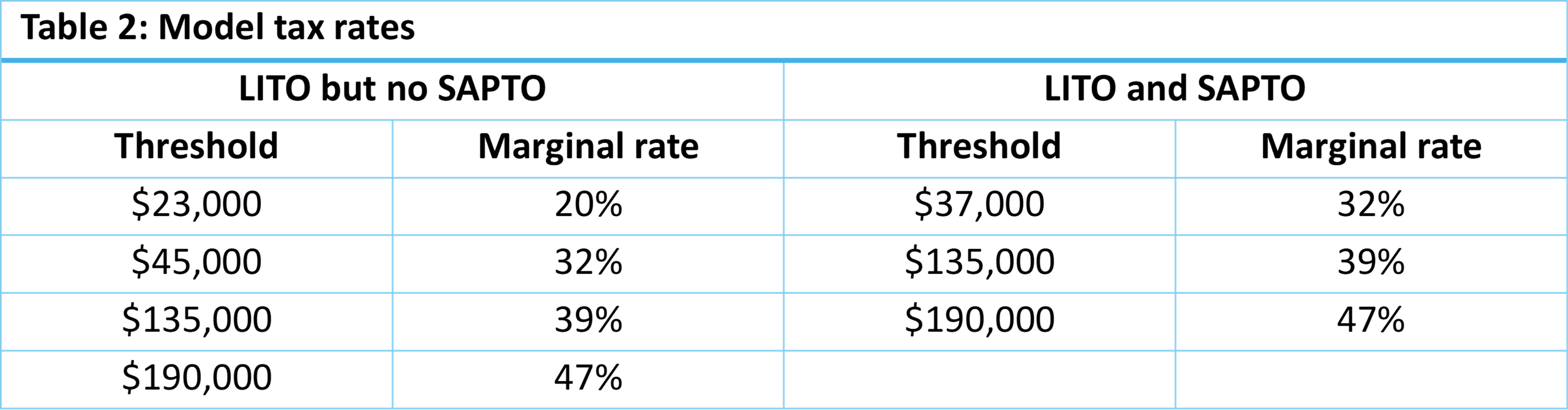
This is far simpler than what has been legislated from the 2026 budget. It is progressive and easy to understand, and there is little change in the total tax paid by most individuals, except where the 30% minimum CGT is significant. The 54% peak for seniors is gone, and the low-income end of the graph is simplified in both cases.
Compare Figures 3 and 4 with the solid curves in Figure 1 (noting that $5,000 is a big enough gain to cause some broadening of the curves).
We need not accept such an impenetrably complex system.
Jim Bonham PhD has been a self-funded retiree for 21 years, following 25 years in the paper industry, managing product and process R&D. For 7 years before that he was an academic researcher and physical chemistry lecturer. This article expresses opinions on tax policy based on experience and analysis. Nothing in it should be construed as advice.