The Retirement Income Covenant requires superannuation trustees to help retirees maximise income, manage risks and maintain flexible access to capital.
Among the most significant challenges are longevity, investment and inflation risks, which can all affect the sustainability and stability of retirement income.
While much of the debate focuses on investment returns and longevity risk, one important component of Australia's retirement income system is often overlooked: the Age Pension.
One example is the role that the Age Pension can play in reducing longevity, investment and inflation risks for many retirees. It provides a government-backed lifetime income that is indexed and not directly exposed to market fluctuations. While future policy settings can never be guaranteed, the Age Pension remains stable and sustainable, with Australia expected to have the lowest cost for public pensions of any OECD economy by 2030[1].
Of course, the Age Pension is means-tested with both income and asset tests. This means that retirees who preserve a large portion of their superannuation, may not qualify for a part or full Age Pension later in their retirement. This raises an important question for retirees who are likely to receive at least a part of the Age Pension later in life.
Could a modestly faster drawdown of superannuation improve both the stability and lifetime of income?
A popular approach
As an example, let’s take a 67-year-old single homeowner retiree who has a remaining superannuation balance between $250,000 and $1 million, after paying off any debts and incurring some immediate expenditure following their retirement. Let’s also assume that this retiree invests this benefit into an account-based pension (ABP) which earns a tax-exempt return of 6.7% pa[2].
Figure 1 shows the total income in today’s dollars[3] received by the retiree from their ABP and the Age Pension (where applicable) for 30 years of retirement for four different superannuation balances, assuming the minimum drawdown rates apply.
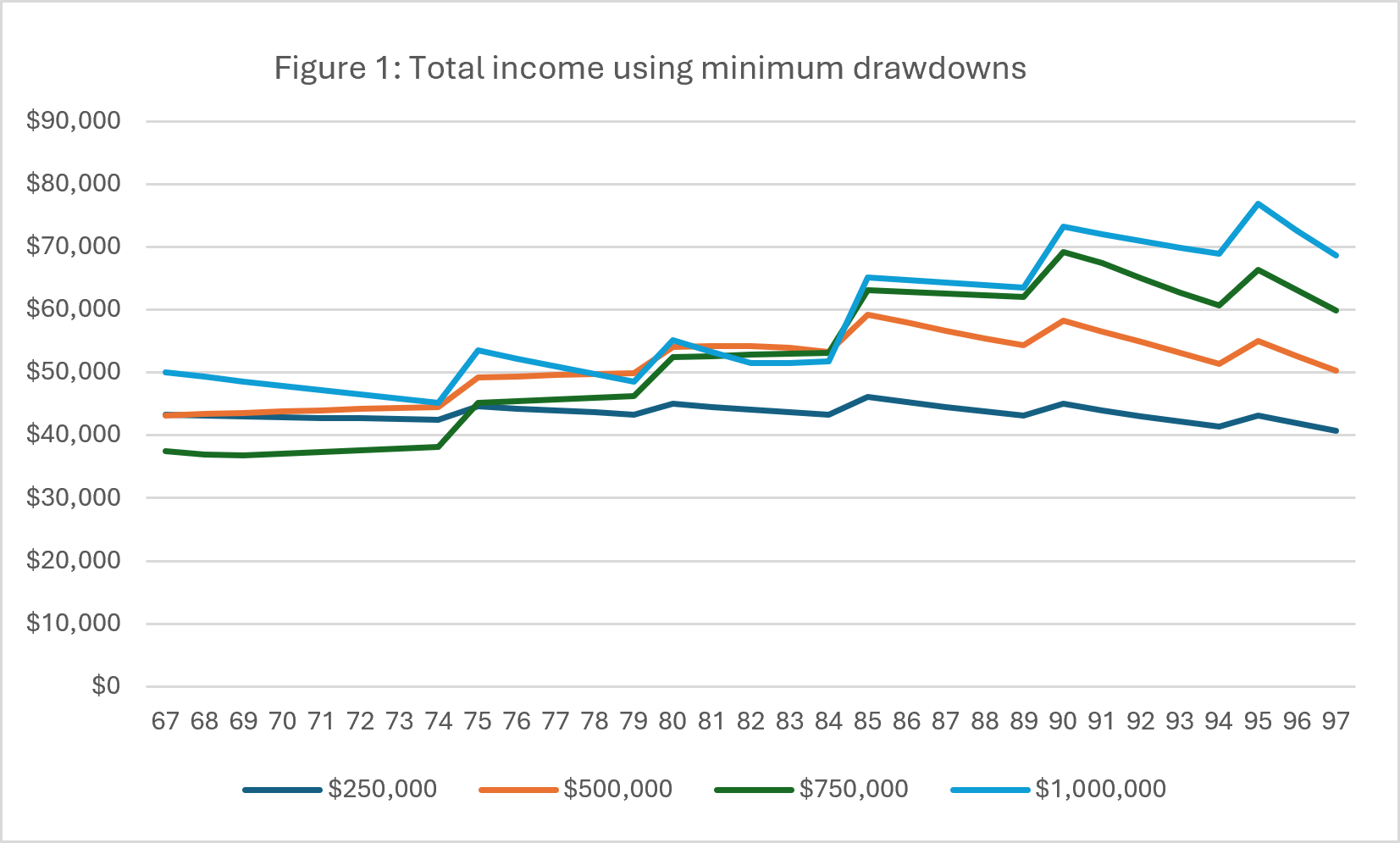
Several interesting features are evident, including:
- For most retirees, the annual income jumps every five years due to the increase in the minimum drawdown rates. The exception is for the retiree with $250,000 where most of the income is from the Age Pension, which is assumed to be indexed to inflation.
- For retirees with the higher balances, the total income is not stable throughout their retirement. In fact, there is a general increase in the level of real income, which may be a less desirable outcome, as spending needs are often higher in the earlier years.
- Because of the means tests on the Age Pension, the retiree with $750,000 begins with a lower income than those with a superannuation balance of $250,000 or $500,000. However, it then increases in real terms as the importance of the Age Pension rises.
The conclusion from these examples is that for many retirees the use of the minimum drawdown rates does not provide them with stable income throughout retirement, contrary to one of the objectives of the Retirement Income Covenant. Of course, minimum drawdown rates were designed as regulatory minimums rather than as optimal spending strategies. Accordingly, there is also no reason to expect them to generate the most stable pattern of income, even though they are often used.
An alternative approach
Instead of using the minimum drawdown rates, let’s commence with the minimum 5% drawdown from the ABP in the first year but then index the drawdowns to inflation each year and only apply the minimum rates, when needed. Figure 2 shows the total income for the four superannuation balances.
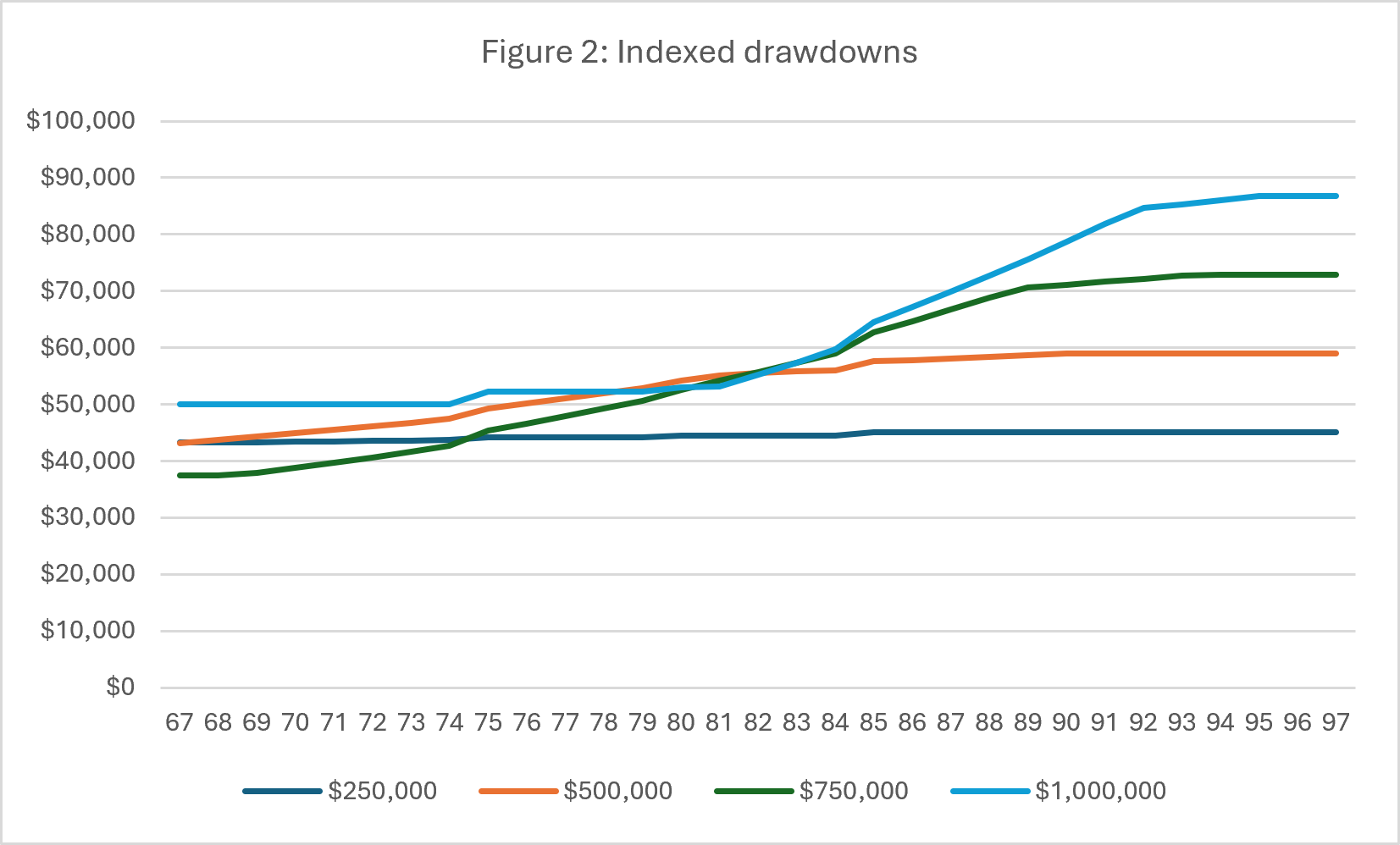
While there are some similarities with Figure 1, there are some important differences. These include:
- There are very few spikes in income due to the annual indexation of the drawdowns from the ABP.
- The impact of indexing the drawdown every year, means that the total income has increased from Figure 1. The increase in the average retirement income varies from 2.0% for the lowest balance to 9.0% for the highest balance.
These increases in the level of total income arise from two causes:
- a higher level of drawdowns from the ABP; and
- increased Age Pension payments for those with the higher balances.
Of course, the higher drawdowns from the ABP means that the value of the ABP at age 97 has decreased from 25.3% to 12.5% of its original balance, when expressed in real terms. There is no ‘correct’ answer for the balance between the level of drawdowns during retirement and the need to maintain access to some capital. Whether this remaining balance is appropriate will depend on individual circumstances. Some retirees will prioritise higher spending during retirement, while others may place greater value on maintaining reserves for aged care, unexpected expenses or gifting. Nevertheless, a remaining balance equal to one-eighth of the original capital after 30 years is consistent with the objective of superannuation.
A composite approach
Although the previous approach removed the spikes, the increase in real income continues through retirement, particularly for those with higher superannuation balances. One possible response is to increase drawdowns in the earlier years of retirement. This provides additional income when spending needs are often highest, while gradually increasing eligibility for Age Pension payments as the retiree’s ABP balance reduces.
There is no single answer to deliver the ‘best’ outcome for every retiree, but to illustrate a composite approach, let us assume that the ABP drawdown in the first year is 6.5% of the balance and is then indexed to inflation for five years. Thereafter, it remains fixed in nominal terms as the relative importance of the Age Pension increases. Figure 3 shows the result for retirees with balances between $500,000, $750,000 and $1,000,000. This composite approach is not applied to the $250,000 balance as the income for this retiree is predominantly from the Age Pension and is therefore relatively level in real terms.
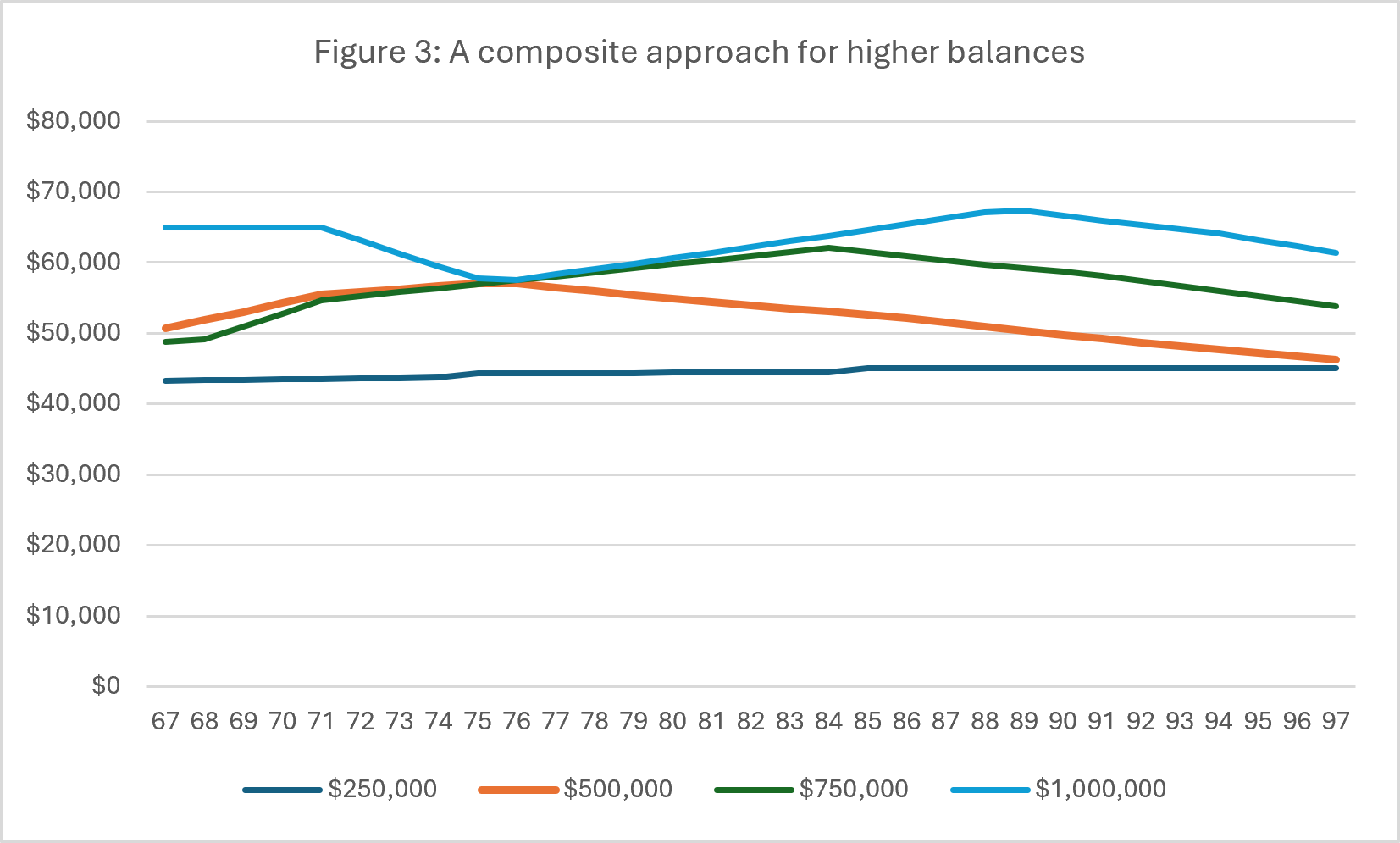
The findings from this composite approach are:
- The variation in annual income is reduced, particularly for those with higher balances.
- Income in the earlier years is higher, which is often when retirees are more active and spend more.
- The average income for the two higher balances has increased due to the greater role of the Age Pension arising from the higher drawdowns in the earlier years.
- The value of the ABP balance at age 97 is 14.9% of the original balance in real terms, which is slightly higher than in Figure 2.
Conclusion
The Age Pension can play a very significant role in providing stable income for many Australian retirees. For some retirees, particularly those who are likely to qualify for a part Age Pension later in life, spending superannuation a little faster in the early years of retirement may increase average lifetime income while also producing a smoother income profile.
This finding runs counter to much advice from overseas pension experts. The reason is simple. Australia has one of the highest levels of ‘targeted’ pensions, expressed as a percentage of the average wage, amongst OECD economies[4]. Our system is different with no basic or universal pension.
The Age Pension and superannuation are two fundamental sources of retirement income for most Australians. The ‘best’ balance between the two will depend on personal circumstances such as home ownership and the presence of a partner, as well as changing circumstances during retirement.
The purpose of superannuation is to support consumption during retirement, not simply to maintain account balances during retirement. While many retirees understandably wish to preserve capital for flexibility, some may be sacrificing current living standards unnecessarily. The challenge is finding the right balance between spending today and preserving financial security for tomorrow. In that sense, the Age Pension represents an integral component of a sustainable retirement income strategy for many Australians.
David Knox is a global pension expert, actuary, and advisor to a range of leading superannuation funds. He co-authored, with Nick Callil, 'It's time: here's how to turn superannuation into a retirement income system' published by the Actuaries Institute April 2026.
[1] OECD, Pensions at a Glance 2025, Table 8.4. Projections of public expenditure on pensions, 2023-60, percentage of GDP
[2] This represents the assumed earning rate for the pension phase in ASIC’s Moneysmart Superannuation Calculator.
[3] A long-term inflation rate of 3% pa has been assumed.
[4] OECD, Pensions at a Glance 2025, Table 3.2, Current level and recipients of first-tier benefits.