Never give an actuary a new certificate to talk about it. She will want to talk to you about it or worse, write an article about it.
But hear me out: Division 296 actuarial certificates will be interesting. They will drive how an SMSF’s Division 296 earnings are divided between the various member accounts. In other words, they will play a significant role in calculating the tax bill.
The allocation is based on each account’s average value during the year (compared to the fund as a whole). The method appears logical, and is actually more or less the same as the method used in actuarial certificates for pension funds. However, it can produce some unexpected results when an SMSF has large transactions, specific investment portfolios for different members or reserves. This article explains how the allocation works and why – sometimes – it won’t feel right.
How will Division 296 actuarial certificates attribute earnings?
SMSFs with members subject to Division 296 tax will need to calculate their 'Division 296 earnings' at a fund level. This starts with the fund’s taxable income but is adjusted for a host of things – adjusted capital gains amounts for funds that opt into some special relief, adding back income that is exempt from tax because the fund has pensions etc.
This income then needs to be notionally divided up between the members – so that the ATO can work out how much Division 296 tax each member should pay. This is where the new actuarial certificates come in.
The legislation provides a formula for actuaries to use here. The % of the SMSF’s overall Division 296 earnings that is allocated to each 'interest' (member account) is broadly as follows:
Average value of the member account
---------------------------------------------------------------------------------------------------
Average value of all member accounts + Average value of pension reserves
The 'pension reserves' part is largely for funds that have (or used to have) defined benefit pensions. While most software systems show an 'account balance' for these pensions, technically they’re not member accounts. Rather, they’re reserves the trustee uses to pay the defined benefit pension.
(Note: SMSFs providing defined benefit pensions won’t use this method to calculate the 'earnings' attributable to the defined benefit pension itself. They’ll only use it for all the other member accounts. There’s an entirely separate formula for earnings when it comes to defined benefit pensions.)
An example – the simplest case
Monica and Chandler both belong to the same SMSF and their super balances over the 2026/27 financial year are as follows:
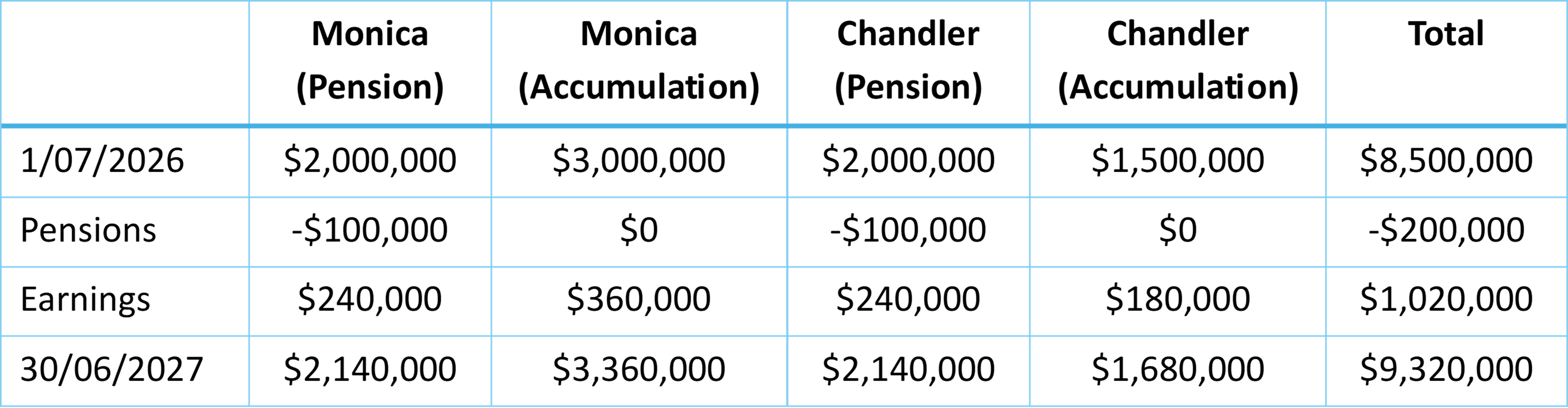
(The pensions are simple account-based pensions, not defined benefits)
The SMSF’s actuary would work out the average value of each member account. In doing the calculations, the actuary would allow for the timing of events like pension payments and contributions. In this case, for example, let’s say the pension payments weren’t taken out until the end of the year. Just before her pension payment on 30 June, Monica’s pension balance was $2,240,000. The average value of Monica’s pension would be something like:
0.5 x ($2,000,000 + $2,240,000) = $2,120,000
Once this calculation has been done for all the various member accounts in the fund, it’s possible to translate it into a proportion or percentage as follows:

In this example, the amount of earnings taken into account for Monica’s Division 296 tax would be:
58.82% (ie, 23.53% + 35.29%) x the whole fund’s Division 296 earnings
If the fund’s Division 296 earnings overall amounted to (say) $800,000 in 2026/27, the amount used to calculate Monica’s Division 296 tax would be $470,560.
Remember, of course, calculating Monica’s actual tax bill has some more steps. We’d need to work out the proportion of her balance that is over $3 million. In this example, it’s 45.45% (her balance at the end of the year is $5.5 million). Her actual tax bill would therefore be:
15% x 45.45% x $470,560 = $32,080.43
If the fund’s Division 296 earnings was much higher, Monica’s earnings (and tax bill) would also be higher.
When can Division 296 actuarial certificates produce unusual outcomes?
Large transactions for just one member
The example above 'feels' about right. Monica will be allocated around 60% of the fund’s Division 296 earnings and Chandler will get the other 40%. That looks about right given her pension and accumulation balances (when added together) account for about that much of the fund’s balance at the start and end of the year.
They’ve both belonged to the fund all year and so it feels 'fair' that any capital gains or other income should be split in that way.
But what if Chandler actually cashed out his super in full right at the end of the year? If it happened (say) on 30 June 2027 the average balance for each member wouldn’t change much (the split between Monica and Chandler would still be around 60 / 40).
But making Chandler’s benefit payment might have triggered a large capital gain – let’s say that increased the fund’s Division 296 earnings from $800,000 to $1.5 million.
Now, Monica’s Division 296 tax bill is much bigger – it will be based on earnings of $882,300 (58.82% x $1,500,000) and will amount to:
15% x 45.45% x $882,300 = $60,150.80
So action taken by Chandler has impacted Monica’s tax bill.
That will feel odd.
In fact, it would be even worse if Chandler withdrew his super right at the start of the year. In that case, the actuarial certificate would probably attribute close to 100% of the fund’s Division 296 earnings to Monica. Including all of the capital gain realised to pay Chandler’s benefit!
For most SMSFs, this won’t be an issue very often. It’s likely to emerge most commonly when someone dies as that’s a time when large amounts are taken out of super, often for just one of the two members.
Separate member investment portfolios
The rules for these actuarial calculations specifically require actuaries to ignore anything like separate investment portfolios for particular members or member accounts.
Instead, every fund needs to be treated as a “pooled” SMSF for these calculations.
Imagine a scenario where:
- Two SMSF members (Harry and Ginny) have roughly equal balances but maintain entirely separate investment portfolios,
- Harry’s assets have produced virtually no income during the year (perhaps they held a property which was not tenanted). Ginny’s portfolio generated significant income and/or capital gains.
The actuarial certificate would likely provide that around 50% of the overall income would be attributed to each member. Harry would pay Division 296 tax on this income despite receiving absolutely no benefit from it.
Fortunately different investment portfolios are rare in SMSFs, particularly where the balances are very large. But it will be interesting to see if this change prompts those who have them to reconsider.
Non-pension reserves
The formula above specifically refers to pension reserves. Mathematically, this is important to make sure that earnings on these reserves don’t fall into the other member(s) accounts.
For example, Rachel and Ross both belong to the same SMSF. Ross has a defined benefit pension and the account balance supporting that pension is $3 million. Rachel has an accumulation account of $5 million and there are no other member accounts in the fund. Let’s say these are the same as the average balances over the financial year. The formula will mean the earnings attributed to Rachel for Division 296 tax will be:
$5m (average value of Rachel’s accumulation account)
---------------------------------------------------------------------------------------------------
$5m (average value of all the member accounts) + $3m (average value of the pension reserves)
i.e. 62.5%.
(Note: Ross’s Division 296 earnings will be worked out completely differently, using a formula. It won’t equal the remaining 37.5% of the fund’s Division 296 earnings.)
But what if the reserves weren’t pension reserves? Perhaps they were investment reserves leftover from a strategy carried out in the past? Or a reserve that used to be a pension reserve but has made allocations to members that caused it to stop being a pension reserve?
In that case, the formula above would be:
$5m (average value of Rachel’s accumulation account)
---------------------------------------------------------------------------------------------------
$5m (average value of all the member accounts) + $nil (average value of the pension reserves)
Ie 100%.
In other words, all of the fund’s Division 296 earnings would be attributed to Rachel even though 37.5% of the fund doesn’t even belong to her – it’s sitting in a reserve.
Final thoughts
Division 296 tax presents a host of new issues to consider for SMSF trustees. When deciding to sell particular assets, trustees often consider the CGT impact before making a change. Now, the consideration will need to extend to the Division 296 tax impact which means thinking about:
- Who will the earnings be attributed to?
- Do they have other super (which will increase the proportion of the capital gain subject to Division 296 tax)?
- Are there steps we could take first to reduce the impact?
Meg Heffron is the Managing Director of Heffron SMSF Solutions, a sponsor of Firstlinks. This is general information only and it does not constitute any recommendation or advice. It does not consider any personal circumstances and is based on an understanding of relevant rules and legislation at the time of writing.
For more articles and papers from Heffron, please click here.