If you think a testamentary trust is only for the wealthy, think again. A testamentary discretionary trust (TDT) does not make an inheritance tax-free, but what it can do, is change who is taxed on the income that the inheritance produces. Over a generation or two, that difference can potentially be worth hundreds of thousands and in some cases, millions of dollars.
Taxation matters
Ordinarily, under Division 6AA of the Income Tax Assessment Act 1936, minors can be subject to significantly higher tax rates on passive or trust income. However, qualifying income derived through a testamentary trust can be treated as excepted trust income, allowing the minor beneficiary to access ordinary individual tax rates.
Importantly, this concession is generally confined to income derived from property that came from a deceased estate, together with qualifying accumulations and replacement property that can be traced back to that estate.
This means assets cannot simply be injected into a testamentary trust after the fact to obtain the tax concession. The relevant trust assets must genuinely originate from the deceased estate and remain sufficiently identifiable and traceable back to that estate.
For the 2026–27 financial year, the ordinary Australian resident tax-free threshold remains $18,200. In addition, the maximum Low Income Tax Offset is $700. This means that, broadly speaking, a resident beneficiary with no other taxable income may be able to receive approximately $22,866 of taxable income before actually paying income tax.
The beneficiaries who may fall within this category commonly include minor children and other beneficiaries who have little or no other taxable income.
Where a beneficiary already earns income from employment or another source, the position is different because the trust distribution is added to their existing taxable income and taxed at their applicable marginal tax rate.
This is where the flexibility of a testamentary discretionary trust becomes important. Rather than all of the investment income being taxed in the hands of one adult beneficiary, the trustee may have the ability subject to the terms of the trust and the tax legislation, to distribute income across a wider group of beneficiaries.
To demonstrate how this can work in practice, we are going to look at the typical Australian family scenario and with this in mind, explore the size of the estate, the income generated by the inheritance, the beneficiaries’ existing incomes and the number of beneficiaries available.
Assumptions used in the modelling
For the typical Australian family, we assume a 4% annual income return on the inheritance capital after death.
In simple terms, a $1,000,000 testamentary trust would therefore produce approximately $40,000 of taxable investment income each year.
For the purposes of this example, we have also assumed that the relevant estate assets are capable of generating that return. This may involve assets being liquidated, invested, sold or otherwise restructured following the administration of the estate.
Superannuation has been included in some of the modelling only where it is validly directed to the deceased's legal personal representative and ultimately forms part of the estate available under the will.
Superannuation does not automatically form part of a deceased estate. Appropriate superannuation death benefit planning is therefore required if the intention is for those funds to ultimately flow through the estate and into a testamentary discretionary trust.
The figures used are based on the 2026–27 income tax year and are illustrative only, specifically, they exclude the Medicare levy, capital gains tax, franking credits, superannuation death benefit tax, accounting fees and other taxation or administration costs.
The long-term
To give you a practical insight, which most are reluctant to forecast, we have extrapolated the annual savings over a period of 30 years to demonstrate the potential long-term effect and tax savings via use of a testamentary trust.
In the tables below, we share the typical Australian family, their inheritance and asset base, income-earning capacities, number of children and grandchildren and general estate planning needs.
In this scenario, we compare the potential trust capital, the assumed taxable income generated by that capital, the beneficiaries available for distributions and the potential difference in tax payable.
The most important point to understand is that the value of a testamentary discretionary trust is not determined simply by the size of the estate.
It is the combination of:
- the size of the inheritance;
- the amount of income the inheritance produces;
- the existing taxable income of the beneficiaries; and
- the number of lower-income beneficiaries, including minors, who may potentially receive distributions.
The typical Australian family

The couple has approximately $2.4 million of combined wealth, assuming the $1 million of superannuation is ultimately available to the estate structure.
If that capital generates approximately 4% per annum, the family has around $96,000 of investment income every year.
If the inheritance is simply divided equally between their two adult children — a teacher earning $75,000 and a musician earning $65,000 — each child effectively receives another $48,000 of taxable investment income on top of their existing salary.
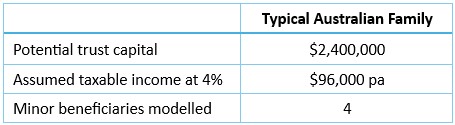
On our modelling assumptions, that additional income results in approximately $28,825 of additional income tax each year across the two children.
Now compare that with the testamentary discretionary trust structure.
We can assume there are four minor grandchildren available as beneficiaries. If the $96,000 of annual trust income were distributed equally, each grandchild would receive approximately $24,000. Based on the assumptions used in this example, the income tax payable would be only around $170 per child, or approximately $680 collectively.
That produces an illustrative annual tax saving of approximately $28,145.
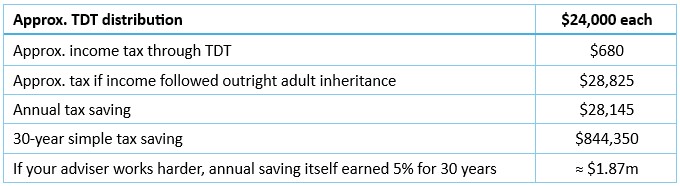
Extrapolated over, say, 30 years, without allowing for changes to tax rates, investment returns, beneficiary circumstances or the time value of money, that equates to approximately $844,350 in potential tax savings.
For this typical Australian family, a testamentary discretionary trust is therefore not simply a strategy reserved for extremely wealthy families.
It can provide a mechanism for using investment income to contribute towards expenses such as education, school fees, extracurricular activities, healthcare and other costs for the next generation, while potentially preserving considerably more wealth within the family over time.
The real power is not that the inheritance itself becomes tax-free.
The power is in the ability to control how the income generated by that inheritance is distributed and taxed over many years and potentially across multiple generations.
Ultimately, the financial benefits of a testamentary trust cannot be realised if and until the death of the will maker. Tax benefits will be determined based on the individual and their circumstances at the time of death of the will maker and subject to the valid terms of the will maker’s will.
Abbey John is the Principal Lawyer at Estates Now. Her work focuses on estate planning, wills, testamentary trusts, probate and deceased estate administration, helping individuals and families navigate succession, asset protection and intergenerational wealth matters.