Gen X investors know the rules. Don’t panic when markets fall. Don’t chase rallies. Don’t try to time every market move.
The problem is that bad investment decisions rarely seem bad when you make them.
Selling after a market fall can look like protecting your retirement savings. Buying into a rally can look like responding to improving fundamentals. Moving repeatedly as the outlook changes can look like active risk management.
There is usually a perfectly reasonable argument for acting.
That matters for Gen X because retirement is approaching and the margin for error is shrinking. With less time to recover from losses, an emotionally driven decision today can leave a lasting dent in tomorrow’s retirement income.
Russell Investments’ 2026 Value of an Adviser research shows what is weighing on Gen X investors, whether advised or self-directed. Retirement planning remains the leading reason advised Gen X investors seek financial advice. Just one percentage point behind is concern about future financial security, an issue that is equally relevant to those managing their own portfolios.
Many are trying to build that security through some of the most expensive years of their lives – preparing for retirement while helping adult children and supporting ageing parents. Behind the competing demands sits one question: “Are we going to be okay?”
Rising living costs, competing family demands and a relentless stream of market commentary give investors more reasons to question their plans – and act – than ever before.
That combination creates a particular risk for experienced investors. They know the investment rules. They can research a decision, understand the economic arguments and build a rational case for changing course.
And that is precisely why behavioural mistakes can be so difficult to spot.
The bias often comes disguised as analysis.
Investing in a 24-hour news cycle
Investors have always dealt with uncertainty. What has changed is how relentlessly they experience it.
Market movements now arrive alongside a constant stream of headlines about interest rates, inflation, geopolitics, trade tensions and the economy.
Separating the headline from what it actually means for your long-term financial position isn’t always easy.
When markets turn volatile, fear can travel faster than facts. A sharp fall can make “sell now” seem safer than “stay the course” – even when the investor’s goals, time horizon and underlying strategy have not changed.
But selling after a fall is only one response.
A strong rally creates a different pressure: the fear of missing out as prices keep rising. Constant information also gives investors endless reasons to revisit their portfolio as the outlook changes.
Put those reactions together and an investor can end up buying high, selling low and trading far more often than their long-term strategy requires. Of course, experience can change an investor’s response.
When reasonable decisions become expensive
Calendar year 2025 provided a useful example.
Global sharemarkets reached record highs, before falling sharply following the US tariff announcements on Liberation Day and then rebounded strongly.
There was a convincing reason to act at every stage.
At the highs, taking some money off the table looked prudent. During the fall, reducing equity exposure looked like sensible risk management. And once markets recovered, waiting for more evidence that the rebound would last made sense too.
The problem is that markets rarely provide certainty when investors most want it.
A $100,000 investment in the S&P/ASX 300 over the 10 years to 31 December 2025 would have grown to approximately $243,775 if the investor remained fully invested. Missing the market’s 40 best days would have left around $64,835.

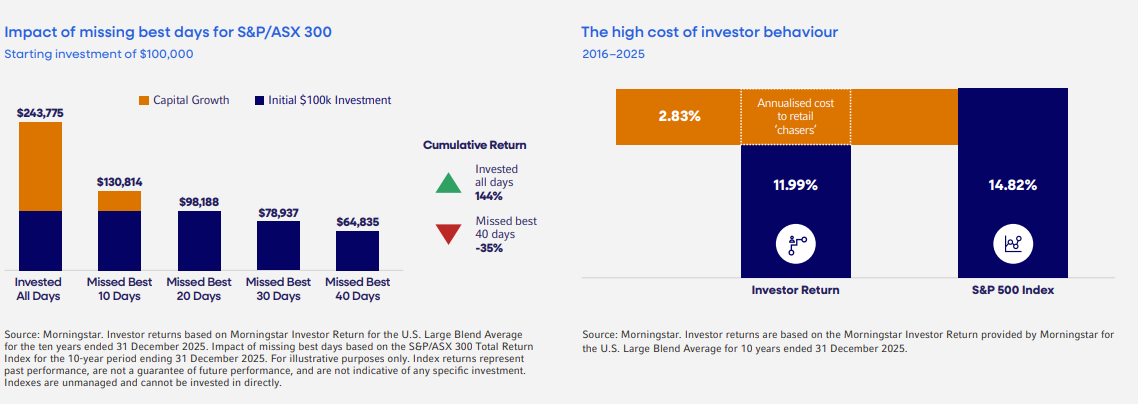
Nobody decides to miss the market’s best days. They miss them while sitting in cash, waiting for it to feel safe to invest again.
Moving out of the market therefore creates two timing decisions: when to get out and when to get back in.
The second can prove harder than the first.
The most dangerous biases don’t feel like biases
Consider a 10% market fall accompanied by warnings of a possible recession.
One investor reduces equities to preserve capital. Another stops investing until the outlook becomes clearer. A third sees better valuations and buys.
All three can make a rational case from the same information.
That’s what makes behavioural bias so difficult to spot in real time.
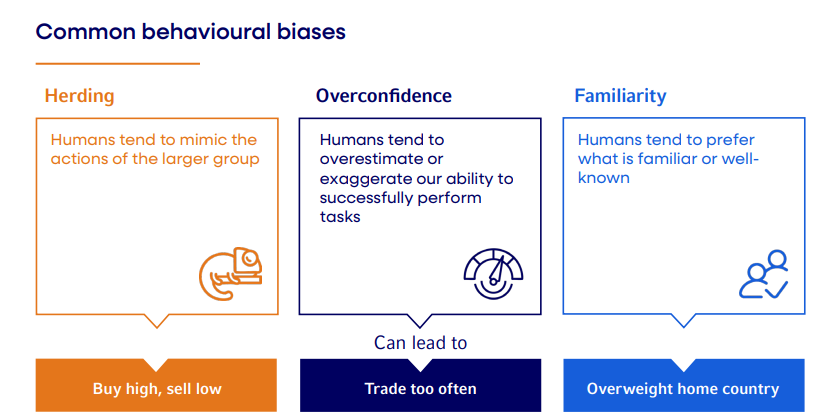
A decision to preserve capital can be loss aversion dressed up as prudence. Buying into a rally can be herding backed by an increasingly convincing investment case. Frequent portfolio changes can look like active risk management rather than overconfidence. And a concentrated Australian portfolio can feel informed simply because the companies are familiar.
We know we should buy low and sell high. Yet markets have a nasty habit of making the opposite seem sensible.
After markets fall, bad news is everywhere and risk appears greatest. After markets rise, the outlook looks brighter and confidence returns.
Create discipline before the next headline
A shorter recovery window raises the stakes.
For investors approaching retirement, the underlying concern is often brutally simple: do I have enough, and can my savings support me for the rest of my life?
The answer isn’t to remove emotion from investing. It’s to put some friction between the emotion and the decision.
Before making a significant change, ask: What has actually changed? Your financial position? Your retirement horizon? The investment thesis? Or has the news simply changed your perception of the same risk?
Set rebalancing ranges in advance. Give big decisions a cooling-off period. Keep a decision journal so you can go back and test your reasoning.
And if you’re selling, answer one more question first: What will make me buy again?
Whether an investor works with an adviser or manages their own portfolio, the real value lies in having a clear decision-making framework.
Control does not mean responding to every market move. It means setting clear rules, reviewing decisions against long-term goals and testing whether a change reflects your circumstances, or a temporary reaction to market noise.
Neil Rogan is Managing Director and Head of Distribution at Russell Investments. These views are subject to change at any time based upon market or other conditions and are current as of the date of publication. The information, analysis, and opinions expressed herein are for general information only and are not intended to provide specific advice or recommendations for any individual or entity. This material is not an offer, solicitation or recommendation to purchase any security.