Listed investment companies (LICs) have been a feature of Australian markets for decades, yet they are often misunderstood or compared against structures designed to achieve different objectives.
LICs are often compared with exchange-traded funds (ETFs) and unlisted managed funds as if investors must pick a winner. In reality, they are simply different structures. A LIC provides permanent capital that can be invested for the medium to long term. It can retain profits to provide greater flexibility when determining dividends, and it can give investors the opportunity to buy one dollar of underlying assets for less than one dollar.
The structure is only part of the equation. The investment approach, capital management and decisions of the board ultimately shape the outcome for shareholders. Used with discipline, the LIC structure can provide investors with active management, income and the potential for long-term capital growth.
How LICs differ from trusts, managed funds and ETFs
The most important distinction is between closed-end and open-end vehicles.
ETFs and unlisted managed funds are open-end. Their size changes continuously as investors put money in and take it out. Units are created when investors buy and cancelled when they sell, which keeps the price anchored to the value of the underlying assets. This makes them an efficient way to hold broad, liquid market exposure.
LICs and listed investment trusts (LITs) are closed-end. Once capital is raised, the pool of capital is relatively stable. Shares or units then trade between investors on the ASX, and the price is set by buyers and sellers. That price can be higher, lower or the same as the value of the underlying portfolio.
LICs and LITs share the benefits of permanent capital, but they differ in one important respect. A LIC is a company, so it can retain profits, smooth dividends and pay franking credits down to its shareholders. A LIT is a trust and, like an ETF or managed fund, passes its income through to investors each year and attach any franking credits received on its income in years where there is distributable income.
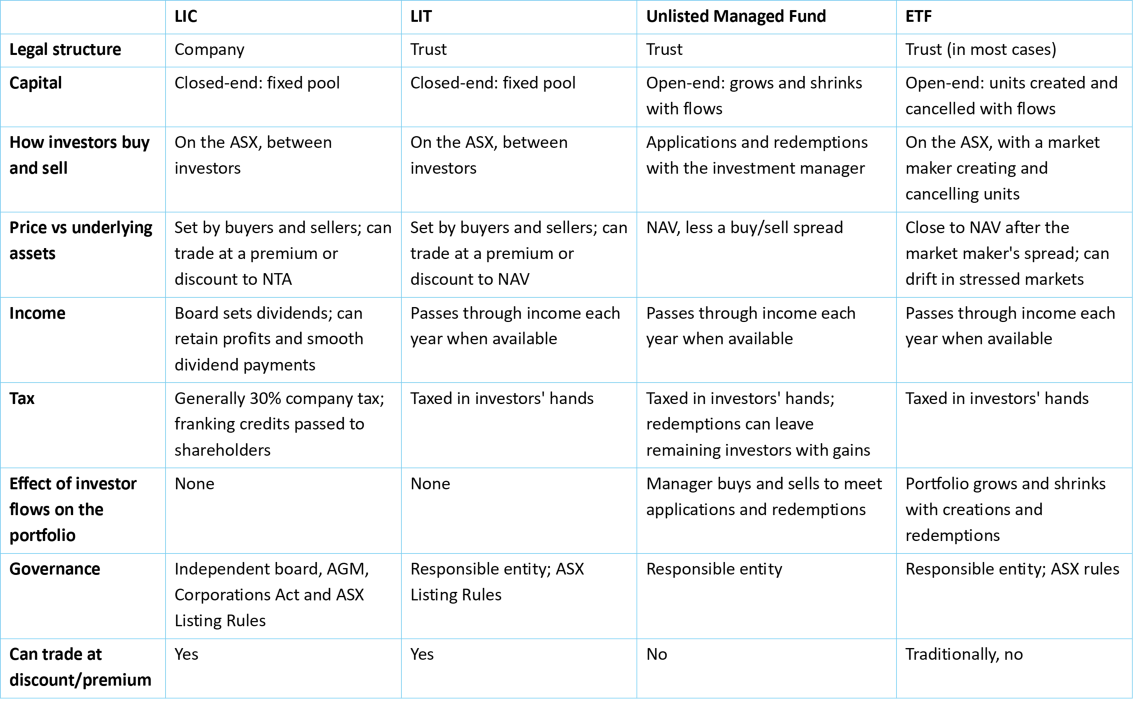
LIC = listed investment company; LIT = listed investment trust; NTA = net tangible assets; NAV = net asset value.
An open-end fund may need to buy and sell investments to accommodate investor flows, potentially creating transaction costs over time. If many investors leave at once, the fund can be forced to sell assets at inopportune times, and the capital gains realised on those sales can fall on the investors who remain.
In periods of stress, unlisted funds can also suspend redemptions altogether. A closed-end vehicle avoids these costs and pressures because investors who want to leave sell to other investors on the market.
Permanent capital supports patient investing
A LIC has a fixed pool of capital. Its shares are traded between investors on the Australian Securities Exchange without requiring changes to the size of the underlying investment portfolio. This means investment decisions can be based on opportunity, valuation and risk rather than short-term investor flows.
The investment manager is not required to buy or sell assets to accommodate investor flows or maintain liquidity to meet redemption requests. This provides greater control over portfolio construction and the timing of investment decisions.
Permanent capital also allows an investment strategy to be implemented over an appropriate investment horizon. That can be particularly valuable where an opportunity takes time to develop or depends on a corporate catalyst, and in less liquid parts of the market such as small and micro-cap companies.
Retained profits provide dividend flexibility
For many Australian investors, particularly retirees and self-managed superannuation fund members, income is an important part of the investment decision.
As a company, a LIC can retain earnings and build a profits reserve. Subject to investment performance, available profits and franking credits, the board can consider that reserve when determining dividends.
A trust, by contrast, must pass through whatever income it earns each year, so distributions can be volatile and may disappear altogether in years with no distributable income.
This gives the board greater flexibility over the timing of dividends through different market conditions.
A profits reserve is not unlimited and dividends must remain sustainable. The level of franking also depends on factors including tax paid, portfolio outcomes and dividends received from investee companies.
The advantage is not that a LIC guarantees a dividend. It is that the company can retain profits and determine how those profits are distributed to shareholders.
Where fully franked dividends are paid, eligible shareholders may also receive the benefit of franking credits. That value forms part of the shareholder outcome and should be considered alongside the cash dividend.
Changes to capital gains tax (CGT) legislated in June 2026 are the most significant shift in the relative position of the LIC structure in a generation.
For gains accruing from 1 July 2027, the 50% CGT discount for individuals, trusts and partnerships is replaced by indexation of the cost base, and resident individuals face a minimum tax rate of 30% on capital gains, subject to limited exemptions. Companies were never eligible for the discount, so the tax treatment of gains realised inside a LIC is unchanged.
Discounts can create investment opportunities
A key feature of LICs is that their shares can trade above or below net tangible assets (NTA). This adds a further layer: get the entry and exit right and the structure itself can become a source of return.
A share price discount to NTA can allow an investor to acquire exposure to one dollar of underlying assets for less than one dollar. If the underlying portfolio increases in value and the discount subsequently narrows, the shareholder may benefit from both the portfolio return and the movement of the share price towards NTA.
A simple illustration, ignoring dividends: an investor buys a LIC with NTA of $1.00 per share at a share price of $0.85, a 15% discount. Over the following period, NTA rises 8% to $1.08 and the discount narrows to 5%, taking the share price to around $1.03. The portfolio has returned 8%, but the shareholder's price return is about 21%.
The same arithmetic works in reverse. If the discount had instead widened to 25%, the share price would have fallen to about $0.81, a loss of around 5% despite the 8% gain in the portfolio.
Discounts can widen and may persist. Their existence alone does not provide a complete assessment of a LIC. Investors need to consider the movement in NTA, the movement in the share price and the reasons for the resulting discount together. Nor are discounts universal: fixed income and private credit LITs have recently traded at premiums on strong demand for income, and premiums can reward patient holders on exit.
Investors should also consider whether there are identifiable catalysts that could change the relationship between the share price and underlying asset value. A discount is neither automatically positive nor automatically negative. It is a feature of the LIC structure that can create risk or opportunity depending on the circumstances.
A more level playing field for individual investors
A historic criticism of LICs was that gains realised inside the company were taxed at 30% with no discount, while an investor holding the same shares directly paid tax on only half the gain. For individual investors, that gap has largely closed.
When a LIC realises a gain, pays company tax and distributes fully franked dividends, shareholders receive franking credits that offset their own tax and are refunded where their marginal rate is below 30%. The same economic gain passed through a LIC can therefore end up taxed at the investor's actual marginal rate. The new minimum tax on directly held gains, by contrast, acts as a floor that a low-rate individual cannot get below.
ETFs, LITs and managed funds are trusts, and capital gains they distribute to individual investors will be taxed under the new indexation regime. Some of the detail of how the rules apply to managed investment trusts is still being worked through.
Where the benefit is smaller
The reforms do not change the position for everyone. Complying superannuation funds keep a one-third CGT discount and are not subject to the minimum tax, and a fund in pension phase continues to pay no tax on gains it realises directly. For these investors, the appeal of a LIC lies mainly in dividend smoothing and predictability and the refund of franking credits rather than a tax-rate advantage.
A LIC also pays tax on gains as it realises them, so shareholders do not control the timing of that tax in the way a direct investor can. This is why LICs report NTA both before and after tax.
LIC performance has more than one dimension
A point-in-time share price or discount does not provide a complete assessment of a LIC. Investors should consider three distinct measures.
- Investment performance. Measures portfolio performance against an appropriate benchmark before expenses, fees and tax.
- NTA per share and dividends. Measures value creation after fees, tax, dividends and capital management.
- Total shareholder return. Captures the combination of share-price movements and dividends received by shareholders. Where relevant, the value of franking credits should also be presented separately or through a grossed-up return.
The investment portfolio, NTA and share price do not necessarily move at the same rate. Considering all three provides a more complete view.
Different tools for different jobs
ETFs remain a low-cost way to gain broad market exposure, although market-cap-weighted ETFs can also leave investors with unintended concentration in the largest companies. Unlisted managed funds may suit investors who prefer to transact at the value of the underlying assets without exposure to market pricing and who place less emphasis on consistent income.
LICs, however, offer distinct advantages that should not be overlooked. Their permanent capital structure supports patient, long-term investing without the pressure of investor redemptions. The ability to retain profits provides greater flexibility to deliver consistent dividends, while the opportunity to purchase shares at a discount to NTA can provide an additional source of return for shareholders.
As with any investment structure, outcomes ultimately depend on the quality of the underlying portfolio, investment management and governance. However, suggestions that LICs have had their day overlook the important role they continue to play in Australia's investment landscape. For investors seeking active management, more consistent income and opportunities created by market pricing, LICs remain a valuable investment structure with an important place in an investor's portfolio.
Jesse Hamilton is Chief Financial Officer at Wilson Asset Management.
Wilson Asset Management is the investment manager of a number of listed investment companies. This article contains general information only and does not take into account the objectives, financial situation or needs of any person. Before making an investment decision, investors should consider whether it is appropriate for them and seek professional financial and tax advice. Past performance is not a reliable indicator of future performance.