Geoff Wilson spent the beginning of September apologising. After WAM Capital slashed its dividend, he said on a shareholder webinar that the board had held the payout too high for years, draining the profit reserve. The cut should have come earlier, he said.
The apology triggered a fresh round of explanation from the LIC industry, including from Wilson Asset Management itself, about why they still offer listed investment companies rather than ETFs.
My view is that the arguments no longer stack up. Time is up for LICs: particularly their practice of trapping capital in a high-fee under-performing structure. LICs holding liquid securities should be required to convert into ETFs. Failing that, a framework should be established for winding up perpetual underperformers.
Worse returns, save for short selling
Equity LICs have underperformed ETFs by a meaningful degree.
Most Firstlinks readers understand this. A year ago, James Gruber compared popular ASX index ETFs like the Vanguard Australian Shares Index ETF (VAS) to the largest most popular Australian equity LICs. He concluded: “over three, five, and seven years, there’s just one LIC that has superior performance” to VAS et al.
If we repeat this exercise today, we see the same thing.
The ASX publishes data every month showing how LICs and ETFs perform. This makes comparing ETFs and LICs very easy.
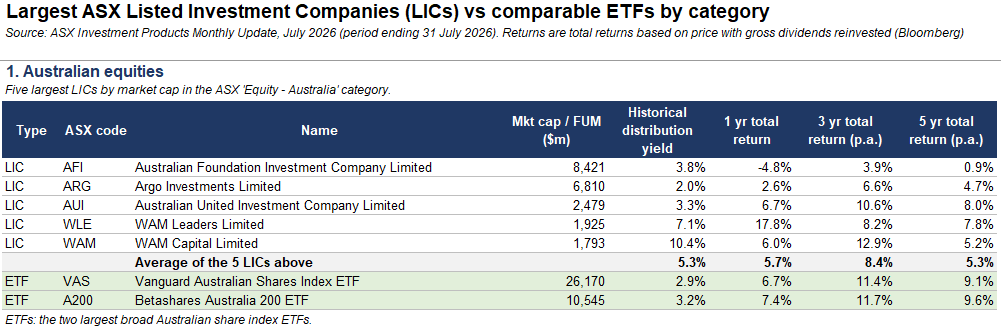
First, looking at Australian equities as Gruber did, we can compare Vanguard’s VAS and BetaShares’ A200 with the largest long-only Australian equity LICs. As we can see, over the past 5 years, the most popular two ETFs have provided almost double the returns of these LICs.
In a separate article on Firstlinks Emma Davidson responded to Gruber by arguing that the performance difference between LICs and ETFs can be explained away at least in part by franking credits (LICs can pay more).
But as we can see above, the size of this performance gap is so large that franking credit differentials cannot possibly close it.
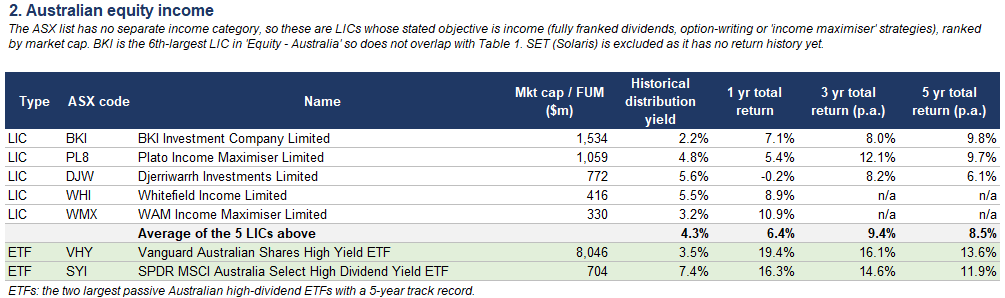
Second, looking more narrowly at Australian equity income strategies, we see a similar sized performance gap. But here again, as the table above shows, the difference is just too large.
Third, going over to global equities, things look a lot better for LICs. The average performance of established global equity LICs and vanilla ETFs has been similar over the past 5 years. And in more recent years, LICs have outperformed.
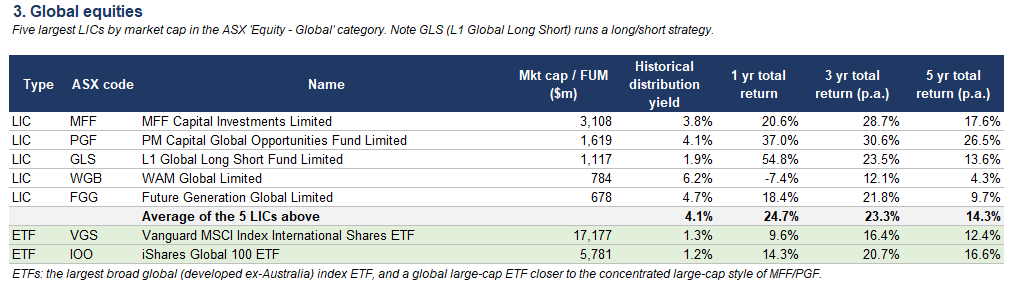
Why? The long/short strategies that firms like PM Capital and Plato have pursued have added value, the ASX data suggests. We should note that short selling cannot realistically be indexed either. And in sum, the strongest argument LIC managers can make is that their short selling – which index ETFs cannot realistically replicate – can and has added alpha.
The fee problem
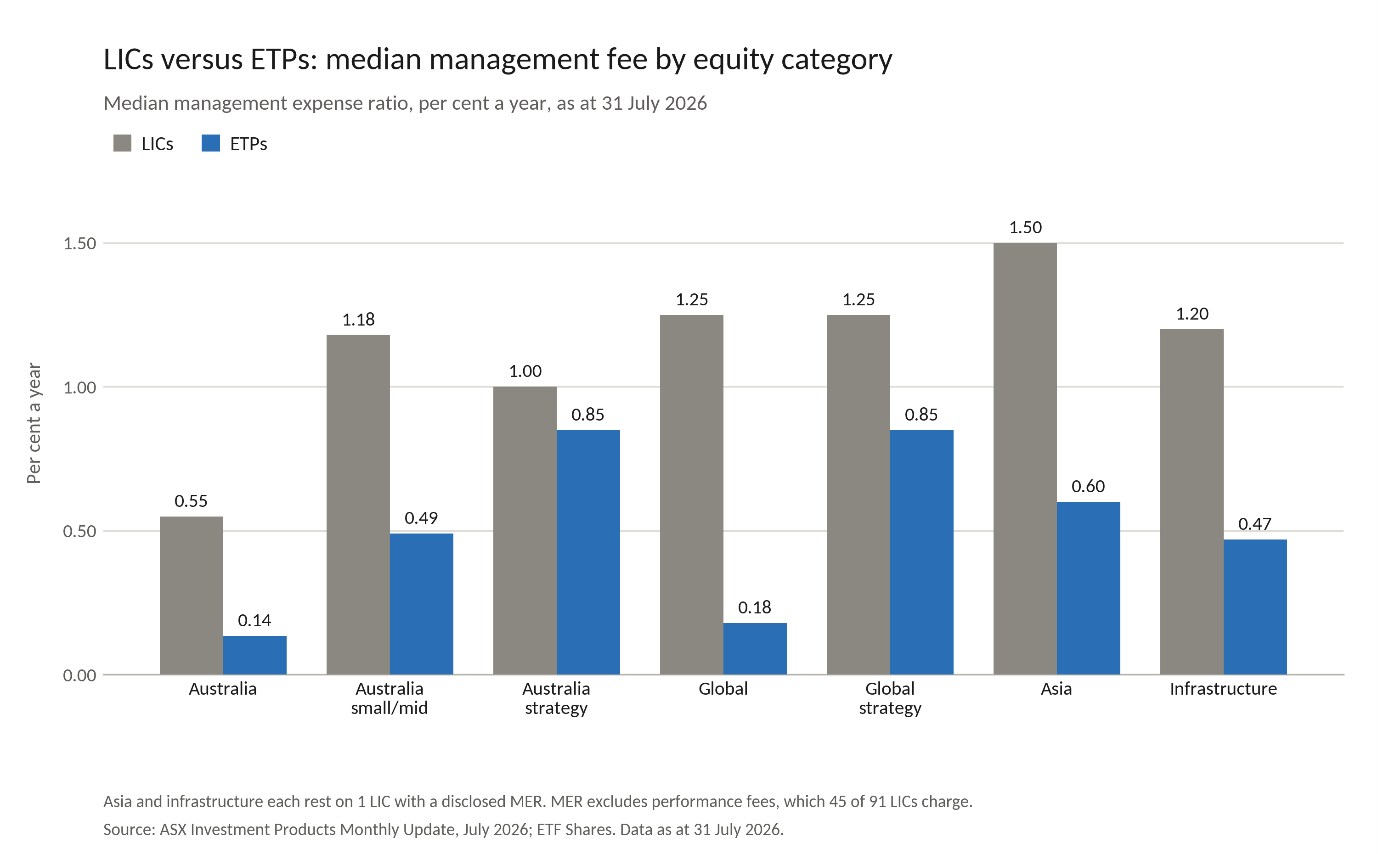
The other problem for LICs is that their fees are significantly higher. This is reflected in the graph below, which shows that LIC fees can in some cases be over 5x higher than those from ETFs. Were LICs’ performance superior, these fees wouldn’t necessarily be a problem. But they aren’t.
The graph below takes the median management fee as stated in each category per the ASX’s monthly report. It includes active, thematic and complex ETFs – not just low-fee index tracking ones.
We should note that the graph below is generous to LICs as it excludes performance fees, which are never a feature of index ETFs.
The best case for LICs, and why it isn't enough
Given the performance and fee differences, there are only two arguments for LICs.
The first is the profit reserve. A LIC is a company, which gives it the discretion to retain profits in good years and pay franked dividends out of them in bad ones. ETFs by contrast are trusts and must distribute what they receive. For a retiree who values a smooth, fully franked income stream, that is a genuine advantage.
But WAM Capital has just demonstrated the limit. A profit reserve only exists if you withhold income at other times. Sustained underperformance drains the reserve, and the dividend is eventually cut anyway.
The second argument is permanent capital. A closed-end vehicle can hold illiquid assets without being a forced seller when markets are volatile. This is correct, and the strongest argument in my view. It is precisely why unlisted and illiquid assets, private credit and venture portfolios belong in a closed-end structure. But this argument is not valid for LICs holding liquid securities, which is what most of them do.
Convert or wind up
Having established that LICs, by and large, underperform while charging more, investors may wonder what is to be gained by forcing an ETF conversion.
The answer is that ETFs are open ended, and so they never trade on the punishing discounts found in the LIC market. Discounts on LICs force investors to take a haircut when they leave and leave many investors trapped in a bad marriage. (Given they are open ended, ETFs can adjust supply to match demand and thus remove any discount. LICs are close-ended and cannot do this).
Some better-performing LIC managers have already converted or gone the ETF route. Magellan pioneered conversion back in Hamish Douglass’s day. Plato now provides both LICs and ETFs. Others are following suit.
This may sound snide and cynical, but in my view it remains the less-than-brilliant performers that continue to resist offering ETFs most strongly. One suspects the discount that poorly performing LICs tend to trade on (the relationship between discounts and poor performance is reflected below) is a signal that some LICs would struggle to retain capital if they converted to ETFs.
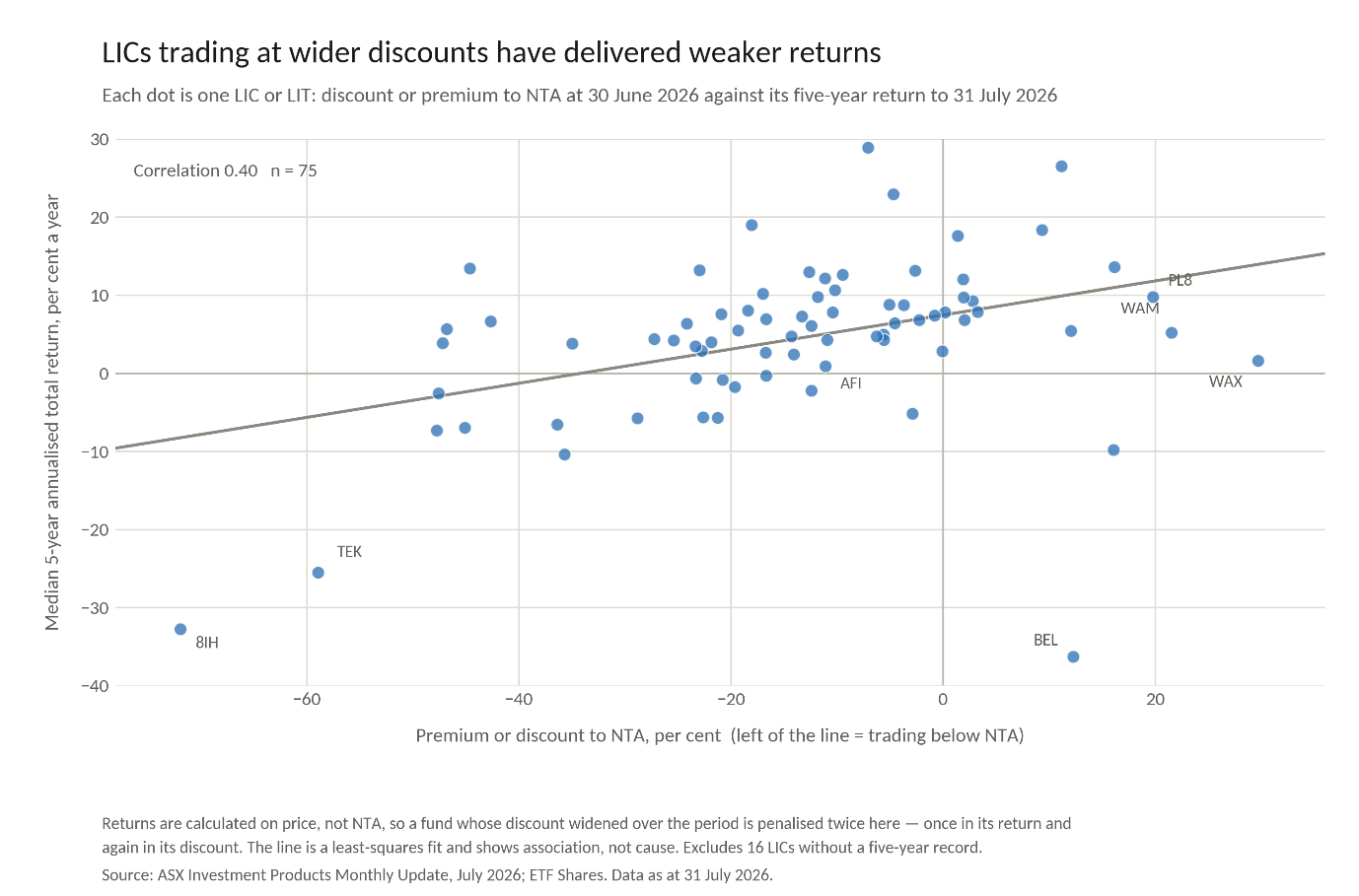
Forcing LICs to convert to ETFs
What, then, is to be done?
Exchanges cannot force a listed company to become an ETF. That requires a shareholder vote. Conversion from a company (LIC) to a trust (ETF) can also have capital gains tax consequences.
But exchanges do write the listing rules, and there is a workable precedent offshore. UK investment trusts routinely carry continuation votes: if the shares trade at a persistent discount beyond a defined threshold, shareholders must be given a formal vote on whether the vehicle continues, converts, or winds up. Import that. Any equity LIC trading at, say, a 10% discount on average over two years faces a shareholder vote on conversion to an ETF or an orderly wind-up.
That would not kill the good managers. Those trading at premiums would be untroubled, and the ones with genuinely illiquid mandates could make their case to shareholders on the merits. What it would end is the current arrangement, where a manager can underperform indefinitely, collect a fee on assets nobody can withdraw, and make excuses about franking credits.
Judging by the flows, which show ETFs raking in more capital in a month than LICs do in a year, the market has already made its decision. The listing rules should catch up.
ETF Shares provides the ETFS Global Pure Play Copper Miners ETF (ASX: CPPR) which began trading on the ASX in April 2026. For more information click here.
David Tuckwell is the Chief Investment Officer at ETF Shares, a sponsor of Firstlinks. He is also a journalist and researcher specialising in finance and international politics. The information provided in this article is general in nature. Before acting on any information in this article, you should consider the appropriateness of the information having regards to your objectives, financial situation or needs and consider seeking independent financial, legal, tax and other relevant advice. Past performance is no guarantee of future performance.
Disclaimer: This article is issued by ETF Shares Management Limited (“ETF Shares”) (ABN 77 680 639 963, AFSL: 562766) and ETF Shares is solely responsible for its issue. Under no circumstances is this article to be used or considered as an offer to sell, or a solicitation of an offer to buy, any securities, investments or other financial instruments. Offers of interests in any retail product will only be made in, or accompanied by, a Product Disclosure Statement (PDS) and target market determination (TMD) available at www.etfshares.com.au.