One of the less glamorous aspects of working in financial services is the sheer volume of emails you receive. Most promise market insights 'too important to ignore', which is generally a reliable sign they can be ignored immediately.
I also have a habit of opening ones I probably shouldn't. Outside of phishing attempts and the occasional Nigerian Prince, there exists an endless stream of industry events, media releases and marketing updates that accumulate throughout the week.
It's a wonder any of us have time to eat lunch.
The remaining few are spared from the bin, in the hope they can spark some sort of article inspiration. One such email recently notified me that Australia's ETF industry had reached almost $400 billion in assets following a record-breaking quarter. Of course, if you've been awake for any part of the last decade, this probably doesn't come as a surprise. ETFs have become one of the default allocations for investors across a broad spectrum of objectives and experience levels.
I should confess that I'm not merely an observer of this trend, as most of my portfolio sits in broad-based ETFs. This arrangement has suited both my investment returns and the preservation of my ego, after several humbling attempts at stock-picking.
Yet I've always had a soft spot for playing devil's advocate, particularly when an idea reaches near-universal acceptance.
To be clear, this isn't an argument against using ETFs. Nor is it a call to abandon them in favour of stock picking. Investors aren't forced to pledge allegiance to a single philosophy. Most of us realistically sit somewhere in the middle. But when a product becomes the default solution for almost every investing problem, it's worth re-examining a couple assumptions that often sit beneath.
Trading flexibility
ETFs have undoubtedly played a significant role in lowering the barriers to investing. Yet that accessibility without education and a steady temperament can be a double-edged sword.
The ETF Impact Survey by State Street found that the three most commonly cited reasons investors owned ETFs were diversification, lower costs and flexibility in trading. The first two are hardly controversial, but the third is what I find more interesting.
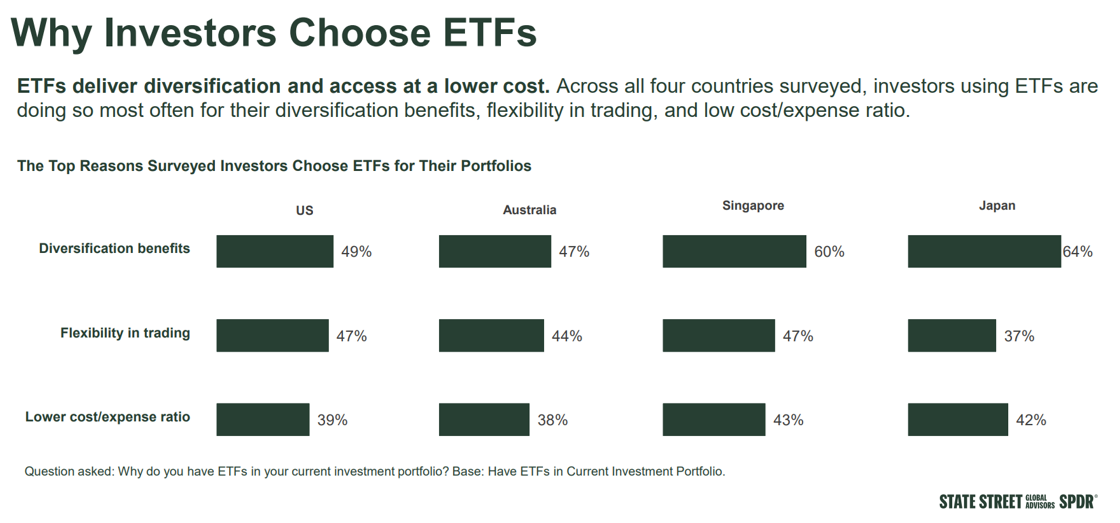
A defining feature of ETFs are their ability to trade throughout the day like ordinary shares. This provides a degree of liquidity and flexibility that many traditional managed funds lack. On the surface, investors value control, of which ETFs provide plenty. The problems arise when that control isn't exercised wisely.
A 2016 paper, Abusing ETFs by Bhattacharya et al., looked at data from a large German brokerage platform to examine the impact of ETF usage on investor outcomes. Perhaps surprisingly, the study found that ETF investors failed to improve portfolio performance over the period examined. In many cases, the outcomes deteriorated, with further evidence pointing to suboptimal ETF selection. Additionally, those who traded most actively tended to experience the worst outcomes.
In other words, one of the perceived benefits becomes a detriment. Naturally, the temptation to meddle with a portfolio exists wherever liquidity is found. But the irony is that ETFs are often marketed as long-term investment vehicles, while the market structure surrounding them encourages frequent action. It can be incredibly difficult to stay the course while simultaneously being given the ability to abandon it at any moment.
The performance paradox
For decades, Warren Buffett famously proclaimed that a low-cost index fund is the most sensible equity allocation for the majority of people. This follows a common argument in favour of using ETFs, that is, the average person is an incredibly poor stock-picker. And the evidence does broadly support this.
Hendrik Bessembinder is best known for his research on long-term wealth creation. Over decades, he has performed a series of studies analysing the lifetime performance of US stocks. The 2026 iteration of his paper found the median stock still delivers a negative lifetime return of roughly -6.9% on a buy-and-hold-basis.
If the median stock is considered a sure-fire path to underperformance, then the appeal of ETFs becomes obvious. But while they remove the risk of missing the next Nvidia or Commonwealth Bank, they don't eliminate the potential for underperformance altogether.
Morningstar’s Mind the Gap study compares the difference between a fund's overall return and the return that investors actually receive. The latest data foudn that the funds themselves delivered an aggregate annual return of 9.9%, while the average investor dollar in US stock funds and ETFs earned 8.7% p.a. over the decade ending December 2025. Investors encountered a familiar problem where they weren't picking the wrong investments, but they were getting in their own way.
This is the centre of the ETF versus stock-picking debate. Replacing single stock risk with an ETF presents its own challenges. An individual share portfolio may overlook a handful of companies that ultimately drive market returns and end up with a handful of mediocre performers. ETF investors avoid this problem by owning a larger pool, but that doesn't mean they aren't still prone to underperformance.
Ultimately, every approach will have a weak point. The more pressing question is whether investors understand the trade-offs and can unpack the assumptions baked into whichever path they choose.
Simonelle Mody
***
Weekend Market Update
My Bui, AMP
Global shares were generally weaker this week as investors shifted away from risk, with technology stocks leading the decline while defensive sectors and safe-haven assets such as bonds and gold gained some support. The S&P 500 fell 0.9% over the week, European shares lost 0.1%, while the tech-heavy NASDAQ dropped 2.4%. East Asian markets also came under pressure given their AI exposure, with Chinese shares down 3.1%, Japanese equities falling 5.1%, and South Korea's KOSPI triggering circuit breakers and leaving the index 15.8% below a week ago. Surprisingly, the ASX 200 finished the week slightly up (1%), having already underperformed in previous weeks, and also likely because rate hike probabilities were cut back. Australia saw similar sector rotations to global markets, with sharp declines in IT and industrials offset by gains in consumer staples, healthcare, energy, and financials.
It was surprising to see bond yields ending the week lower, despite inflation data and Fed commentary this week both pointing to a more hawkish stance. US core consumer and producer price inflation were both hotter than expected, pointing to a core PCE reading for September of ~3.2%yoy (remember the Fed’s target is 2%), while Fed regional presidents in San Francisco and Cleveland both signalled worries about consecutive supply shocks pushing inflation expectations higher. Over the week, yields initially climbed higher but then fell substantially, with the US 10 year dropping by 18bps to 5.06%, the lowest level in more than three weeks. As a result, Japan, UK, Germany, and Australian government bonds all rallied over the week.
The big falls in bond yields suggest investors are more concerned about the downside AI risks than inflation at the moment. This week, those concerns came into focus at CoreWeave, a cloud computing business. The company borrows heavily (they have issued more than $10bn of high-yield corporate bonds this year) in order to buy NVIDIA’s GPUs and lease them to hyperscalers who train AI models. Concerns about rising debt triggered a selloff in its unsecured bonds due in 2032 to below 80 cents on the dollar (commonly thought of as the distressed threshold), despite still strong growth in revenues. Markets were also pricing in an almost 60% probability of default by CoreWeave in the next five years.
But none of these concerns are new. We have seen this film before with DeepSeek, Moonshot Kimi, and last week’s failed Firmus IPO in Australia. Put simply, investors have long worried that: 1) AI revenues won't be sufficient to recoup the massive upfront investment. 2) AI infrastructure may need to be written down as it ages and depreciates in the meantime (which lowers book value massively), and 3) Rising government bond yields and wider corporate credit spreads are increasing financing costs, making it harder to borrow, refinance, and keep the AI infrastructure buildout going. With capital costs close to 15% (CoreWeave's current 5-year yield to maturity), companies face a very high bar to generate returns just to break even on new investments.
There is also a risk of contagion through bond markets. On one hand, there are signs this may already be happening with last week’s France government bond selloff spilling into the European credit markets, or the recent widening in CCC spreads now starting to affect the wider high yield market, including BB-rated borrowers such as CoreWeave.
This is unsurprising as the AI buildout is rather concentrated. For example, both last week's focus on Firmus, the Australian data centre operator still struggling to secure funding after its abandoned IPO, and this week's spotlight on CoreWeave highlight similarities in their funding models, backbone infrastructure, and operating models. Both companies rely heavily on debt financing, have recently pursued public listings (CoreWeave listed last year), depend on NVIDIA GPUs, and sell AI computing capacity to a small group of hyperscale customers, including Meta and OpenAI. There are also constant fears that stress in credit markets could spill over into equities: the Philadelphia Semiconductor Index, tracking shares of 30 largest semiconductor designers and manufacturers, officially entered a technical bear market this week, falling by 20.9% from its peak in June.
AI is also a source of short-term inflationary pressures for consumer prices, which could push central banks to hike further than otherwise. Recent inflation reports from China, the US and Australia have shown IT equipment inflation surging after decades of deflation, driven by the higher demand for chips and IT accessories. There are also anecdotal reports of higher regional electricity costs in the US given AI data centre demand. Over the long term though we think the inflationary impact is much milder, given that the computing cost for every AI query is still trending down consistently over the last year.
Moreover, with any new wave of investments into new asset classes comes worries and stress, and we are still optimistic on shares on a 12-month basis. We think the AI capex boom can continue for another 2-3 years, given solid fundamentals from the US and global economy. In fact, US GDP nowcast is still running at a very solid 3.6%yoy, supported by household spending on goods & services and business investment, not just AI-related construction. Meanwhile, the IMF also upgraded its global growth forecasts this week (see the Global Economic Events section below). Investment grade credit spreads are still rather contained which is a source of reassurance given that most hyperscalers are IG-rated.
Oil prices are still elevated with Brent crude at almost $106/bbl, despite oil flows recovering back to 2025 average levels. We have previously mentioned the drivers of high oil prices being higher logistics and insurance costs, especially as Iran continued to hit certain shuttle ships travelling through the Strait of Hormuz (eg. this week a Singaporean container sank after being hit by projectiles).
In addition, diesel prices remained at the highest level since the outbreak of the Russia-Ukraine War. Disruptions in the Strait of Hormuz, coupled with recent Ukrainian strikes on Russian refineries, have driven up the cost of refining crude into end products. So despite oil flowing, the world is still experiencing the impacts of elevated energy costs, with farmers and truckers among the hardest hit. President Trump sought to ease the situation by pausing sanctions on Russian diesel exports and authorising the release of 300k tonnes of diesel immediately, followed by 500k tonnes in November and a further 3 million tonnes “within a short period of time”. However, the combined total amounted to just one day of global diesel consumption!
Australian labour market data slowed to the weakest level since Covid on multiple measures. The unemployment rate rose to 4.7% in September, while August’s rate was also upwardly revised to 4.7% from 4.6% prior, a meaningful increase from the 4.3% average in the first half of this year. Employment declined by 39k over the month and is now declining by 9 thousand per month on average. Over the year, employment rose by only 1.2%, far lagging the 1.7% population growth rate. And hours worked even declined 0.4% over the last three months.
Overall, it is clear that rate hikes are starting to negatively impact the economy, with more weakness expected ahead, as the NAB employment survey this week showed that employment intentions turned negative for the first time in two years. The silver lining from slower conditions is that cost pressures aren’t accelerating either. Despite a small pickup in purchase costs, labour costs declined slightly and final product prices were unchanged. We expect inflation pressures to soften over the coming months which could allow for a hold in November from the Reserve Bank.
Also in this week's edition...
Mark LaMonica shares the key questions every retiree should be able to anwer for themselves.
Amid growing concerns about AI expenditure, Jason Teh is back to discuss one key difference that separates today’s boom from the dot-com bubble.
Trusts are facing a shake-up, but a complete overhaul may not be necessary. Anne-Marie Tassoni walks through potential restructuring strategies for families.
War, inflation and higher rates were expected to derail US equities. Jared Franz explains why the economy is stronger than many believe and what this implies for investors.
As investors have grown sceptical about policy mishaps, Shaokai Fan poses the question - how much trust is in your portfolio?
Seven months into retirement, Dr Joanne Earl returns to reflect the surprises she is still uncovering.
Varun Laijawalla explores why the next chapter of technology may not belong to the companies or business models many expect.
Curated by Simonelle Mody and Leisa Bell
Latest updates
PDF version of Firstlinks Newsletter
Investment Update from UniSuper's John Pearce
Monthly Investment Products update from ASX
Plus updates and announcements on the Sponsor Noticeboard on our website