Few subjects attract more contradictory social conventions than money.
We're often told that it shouldn't matter and that the topic is incredibly gauche to discuss openly.
Yet we observe financial media is often littered with rich lists, millionaire investor profiles and tales of eye-watering fortunes that have been amassed or squandered. Many devour these stories with a compulsive desire to understand how one person arrives somewhere another does not.
Admittedly, I am no stranger to this enthusiasm. But I'm reluctant to dismiss it as merely a form of financial voyeurism. I suspect what many find most interesting has less to do with the numbers and more with the path that produced it.
The natural assumption is that if someone has accumulated substantial wealth, there must be something to learn from them. Perhaps they are simply better investors. I wonder whether that link is as intuitive as it first appears.
Surprisingly, there are relatively few studies that directly examine the investment outcomes of households with substantial assets. An interesting one that I came across was Asset Allocation and Returns in the Portfolios of the Wealthy (2023) by Cynthia Balloch and Julian Richers.
Through analysing 180,000 portfolios from 2016 - 2022, the authors found a positive relationship between wealth and investment outcomes, where performance tended to improve at the higher end of the distribution. Wealthier households achieved both higher raw and risk-adjusted returns.
On the surface, the finding appears to confirm the intuition that the wealthy are simply superior investors. However, that may be an overly simplistic conclusion. The same research paper also uncovered an interesting finding about the changes in portfolio composition as wealth increased.
Asset allocation differences
Balloch and Richers found that wealthier households allocated a greater proportion of their capital to alternative assets like private equity, venture capital and hedge funds. While listed assets remained a key component of portfolios, they increasingly gained exposure to opportunities that are often unavailable to the average retail investor.
This complicates the idea that wealth leaves behind an easily replicable blueprint.
If stronger returns stem partly from opportunities that are inaccessible to most investors, then studying the wealthy becomes a more nuanced exercise. We may be observing not only better investment decisions, but a different set of opportunities altogether.
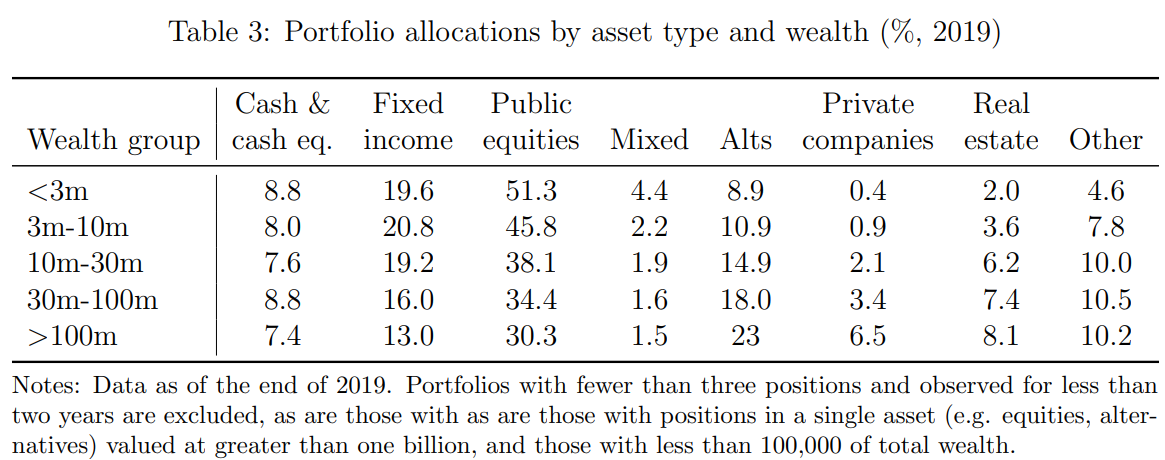
Naturally, higher allocations to private market assets can make return comparisons difficult and shift risk-adjusted metrics.
The authors' analysis tried to account for this through calculating counterfactual returns, in which all private equity and venture capital returns were replaced with the value-weighted market return in each month. In plain terms, they tested whether the result still held when private market returns were substituted with public market returns.
They still found that wealthier households continued to outperform even after adjusting for differences in private market returns. I believe that suggests something else may be at work.
The causation argument
When we observe a wealthy investor generating strong returns, it’s natural to assume the wealth is evidence of skill. But we run the risk of confusing correlation with causation. Some of the relationship might actually run in the opposite direction.
An individual with a $5 million portfolio experiences volatility differently from somebody trying to build financial security with a five-figure account balance. An affluent investor can likely tolerate extended periods of underperformance, spread costs across a larger asset base and pay for advice when needed.
Investing is often presented as an intellectual exercise but most of us know it is also an emotional one. Wealth doesn’t just change a portfolio but also the conditions under which decisions are made. This creates a structural advantage that has little to do with investment selection.
It is entirely possible that some become wealthy because they’re unusually disciplined, patient or simply have superior investing skill. It is also possible that once they’ve accumulated wealth, those same qualities become easier to maintain.
Concluding thoughts
This is a classic chicken-and-egg dilemma that I am reluctant to draw a definite conclusion upon.
Do wealthy investors outperform because wealth makes aspects of investing easier? Or does investing become easier because the habits required to accumulate wealth have already been learnt? I suppose both explanations could be true.
I am curious where readers stand.
Over your investing lifetime, what do you believe has contributed most to successful outcomes? And when we look at 'successful' investors, are we observing the causes of wealth or merely its consequences?
Simonelle Mody
Weekend Market Update
***
From Shane Oliver, AMP
The correction in shares accelerated over the last week as worries about an AI bubble, the fallout from former Nvidia CEO Jensen Huang’s departure and concerns about US rate hikes all intensified. This was despite stronger than expected earnings from Nvidia and a successful record IPO for Anthropic. This saw US shares plunge 8.6% over the past week leaving them down 11.6% from their October high with the plunge in AI related trades also weighing on the broader market. For the week European shares fell 6.6%, Japanese shares fell 7.7% and Chinese shares fell 1.5%. After several weeks of gains Australian shares also fell sharply by 5.4% taking them back to around their September low reflecting the poor global lead, falling metal prices and increasing worries about a recession in Australia. The falls on the ASX 200 were led by resource, IT, consumer discretionary and financial shares.
The “risk off” tone saw metal, gold, Bitcoin prices and iron ore prices all fall over the last week as the US dollar rose. Bitcoin is now back to its mid-year lows and so flirting with a return to the crypto winter that looked to be over with its surge in August and September. The combination of risk off sentiment, falling metal prices and increasing expectations for RBA rate cuts next year saw the $A fall back to levels seen late last year.
Oil prices fell further. This was despite US strikes on an Iranian missile launch site and ongoing Iranian attacks on its neighbours and shipping in the Strait of Hormuz. The risk of another spike in oil prices remains high, but IEA data showing rising global oil supply relative to demand is helping keep oil prices down from their recent highs.
Bond yields fell over the last week on the back of safe haven buying and in Australian on the back of reduced expectations for the RBA cash rate. The longer-term risks for bond yields remain on the upside though thanks to: the oil shock; upside risks to inflation; central bank rate hikes; concerns that maybe the neutral short-term rate has moved up; worries about big budget deficits; corporate borrowing to fund data centre investment; and a rising trend in Japanese bond yields leading reversal the “carry trade”.
The correction in shares likely has further to go. After the sharp falls of the last week US shares have now had an 11.6% fall from their high in October (taking them beyond the 10% level which some see as officially marking a correction), global shares are down around 10%, and Australian shares are down 7.3%. Shares are now technically oversold and due for a bounce. However, the correction could still have further to run given a long worry list of: high and sticky inflation; the likelihood of more global central bank rate hikes; AI bubble fears; excessive public debt; a rising long term trend in bond yields; concerns about more regulation and higher taxes after the US midterms; and the rising risk of a recession and high rates in Australia.
Looking at some of the key threats:
- Inflation is proving too high and sticky – notably in the US and Australia. Our Pipeline Inflation Indicators are yet to decisively turn down in the US or Australia.
- Most major global central banks still look like they will raise rates further. This was evident in the minutes from the last Fed meeting with almost all members thinking that further rate hikes will be necessary. Fed Governor Waller is now saying the Fed may have to hike by 1% or more and “might need to shock people to get them to remember that the central bank wants inflation to be much lower than 3%”…which is sort of what the RBA has been doing! And in Australia the minutes from the last RBA Board meeting indicated that most members are still more concerned about inflation and growth and this was the message from RBA Governor Bullock earlier in the week, albeit her comments now look rather dated.
- And in relation to AI there is an ongoing concern that AI related demand won’t be sustained, that valuations are still excessive and that the massive data centre buildout will prove unwarranted at the same time that the issues around Nvidia’s former CEO threaten a renewed crackdown on US chip sales to China. The latter could be an issue for a while as investigations into Jensen Huang’s affair with an alleged Chinese spy wind up. There are also reports of an investigation into Nvidia’s accounting practices.
Given these concerns the falls in shares likely have further to go in the near term, even if there is a short-term bounce.
However, there are several positives for shares suggesting that what we are seeing is likely a correction rather than the start of a new bear market. In particular,
- Profit growth in the key US share market remains very strong running at 33%yoy to the September quarter. Tech remains a star performer but much of the upside surprise has been in ex tech & energy.
- Strong upside earnings surprises and growth outside tech is supporting a rotation trade in US shares away from tech shares. This is evident in the average US share (as measured by the equal weighed S&P500) holding up relatively well so far.
- Nevertheless, Nvidia’s September quarter earnings report showing beats and 100% plus annual growth in sales and profits, upgraded guidance for sales and earnings growth and no signs of any cracks in AI data centre demand suggest AI related fundamentals for now remain strong. And after a 48% fall from its high Nvidia is looking a bit oversold given its profit performance.
- Anthropic’ s successful IPO which raised a record greater than expected $107bn indicates that investor enthusiasm for AI is still strong. And while one can question all the data centre investment there is a strong argument that Anthropic and Open AI are positioning themselves to become the Microsofts of the AI age, thereby locking in users. But given the mixed track record of IPOs - the greater the hype often the worse the post listing performance – and that they tend to suck money out of the wider market I don’t want to push this one too far.
- Recession risks globally are still low with not much evidence of any slowing in the US.
- In Australia softer data including for jobs has come with the silver lining of a brighter outlook for interest rates.
- And finally, seasonality for shares normally starts to turn positive from around here into year end.
Is Australia at risk of recession? This question is now getting much focus after jobs data in the last week showed a further rise to 4.9% its highest since 2021 with news of ongoing corporate insolvencies and job layoffs, with General Pants being the latest, adding to the gloom. Some have noted that the Sahm rule – which based on US data suggests a recession has started when the 3-month average of unemployment is 0.5% or more above its lowest point in the last year – has been triggered in Australia. But it famously didn’t work two years ago in the US and has given false signals on several occasions in Australia (2001, 2009, 2013 and almost in 2024). However, those false signals were neutered by rate cuts which may not come so quickly this time given inflation worries.
More broadly though, a rapid decline in leading, coincident and lagging economic indicators in Australia warn that the risk of recession is real. This is consistent with bad trading updates from numerous Australian companies in the last month or so. As can be seen in the next chart the slump is the worst since the pandemic but is not quite yet as bad as seen around the GFC.
Also in this week's edition...
Kaye Fallick interviews Bill Kelty, one of the key figures behind Australia’s super system, to debate whether we may be asking too much of a retirement savings system.
Marc Jocum explains why rising yields have put bonds back into business, however, the new challenge for investors is deciding whether they're still being adequately rewarded for risk.
Retirees, advisers and super funds all talk about the bucket strategy as if it refers to one thing. Craig Sankey doesn't agree, and argues that the differences can be significant.
Investment temptations are hard to resist. The team from Schroders outlines what 'The Odyssey' can teach us about valuation discipline.
Market concentration has been a growing source of concern in recent years. Jan-Carl Plagge explores whether that means more risk for investors.
Health goals, new friendships and lingering questions about identity. Dr Joanne Earl is back to share insights from her eight months in retirement.
Australia's economic problems are hardly a secret, but is the stock market as exposed as we think? Dion Hershan believes economic stagnation might be ok at this point.
Curated by Simonelle Mody and Leisa Bell
Latest updates
PDF version of Firstlinks Newsletter
Listed Investment Company (LIC) Indicative NTA Report from Bell Potter
Plus updates and announcements on the Sponsor Noticeboard on our website