Bank hybrids have long been a familiar source of income for Australian investors. But that source is drying up.
More than A$9 billion of bank hybrids are expected to be redeemed by mid-2027, with approximately A$30 billion more maturing through 2032 as APRA's phase-out of Additional Tier 1 (AT1) securities progresses.
So, what happens when those securities disappear? How can investors maintain portfolio income without materially increasing risk?
Australian bank subordinated debt is often cited as one of the closest structural alternatives, particularly as Tier 2 debt is expected to replace much of the capital previously raised through AT1 securities.
But there is an important distinction: subordinated debt is not a like-for-like replacement for hybrids. Sitting higher in the capital structure, it generally offers greater payment priority and has historically exhibited lower volatility, but typically also lower expected returns.
This creates a practical reinvestment challenge for income-focused investors. Based on PIMCO's illustrative modelling, Australian hybrids had an expected total return of 7.2%, compared with 5.2% for an investment-grade Australian subordinated debt index. That difference highlights why subordinated debt may not fulfil the same role in a portfolio.
Bridging that gap by moving into lower-rated borrowers, longer maturities or more complex structures can introduce additional risks. Those risks may be appropriate for some investors, but they need to be understood rather than treated simply as a way to replace lost income.
Perhaps the better question is not “what replaces hybrids?” but “what were my hybrids actually doing for me?” Hybrids have historically provided income, floating-rate exposure and access to Australian bank credit. Some investors also valued their diversification benefits relative to equities. Any alternative portfolio should therefore be assessed not only on expected returns, but on how closely it replicates the specific characteristics investors valued in hybrids.
The relative importance of those characteristics will vary across investors. But by focusing on the outcomes that need to be replaced, rather than the security itself, investors can broaden the range of potential solutions and take a more flexible approach to portfolio construction. That means looking beyond a single segment of the market for sources of income and diversification.
A broader opportunity set
The global fixed-income market spans government bonds, investment-grade credit, securitised assets, emerging-market debt and other sectors that can each contribute differently to portfolio income and risk.
That means income does not need to come predominantly from bank credit or corporate credit. As of 31 August 2026, the global aggregate bond market offered a yield of 4.4%. Meanwhile, emerging-market local debt has offered a higher yield than many developed-market sectors at 6.33%. Naturally, this comes with additional currency and sovereign risk. Additional income opportunities also exist across investment-grade credit and securitised sectors, including agency mortgage-backed securities.
The principal benefit of global fixed income is diversification of return drivers. Rather than relying on a single segment of the credit market, investors can draw income from global credit and securitised assets, with interest-rate exposure adding another source of diversification and return. That interest-rate exposure is a shift from the floating-rate coupons hybrids pay. Bond prices can fall when interest rates rise, however, high-quality bonds have historically provided diversification benefits during many equity market drawdowns.
This flexibility may become increasingly important in a more fragmented investment environment. PIMCO's secular outlook highlights a world characterised by greater dispersion across economies, markets and policy cycles. In that environment, investors may place greater value on diversification across income sources and risk factors.
High-quality bonds can help provide both income and portfolio resilience.
Accessing global fixed income
For Australian investors, accessing global fixed-income markets is also easier than it once was. Exchange-traded funds (ETFs) now provide efficient access to a wide range of fixed-income sectors, including global bonds, global credit and diversified income strategies. For investors transitioning away from hybrids, ETFs can provide daily liquidity, transparency and straightforward access to a broader opportunity set.
The decision also need not be framed as a binary choice between liquid and illiquid investments. PIMCO's analysis suggests that when targeting return outcomes comparable to Australian hybrids, a portfolio can remain predominantly invested in daily liquid bond strategies, while selectively incorporating private market exposures where appropriate and where investors are comfortable accepting reduced liquidity.
The point is not necessarily to replace one security with another, but to consider whether a combination of public and private assets better aligns with an investor's return and risk objectives.
Private credit may appeal to investors seeking additional income, but return expectations should be considered alongside liquidity constraints, manager selection risk and valuation transparency considerations.
Greater flexibility in portfolio construction is another benefit of drawing on multiple fixed-income sectors. Rather than relying on one investment to replicate everything hybrids previously provided, investors can combine different building blocks that each contribute differently to income generation, diversification and risk management.
Seeking hybrid-like returns through diversification
Investors do not need to rely on a single replacement for hybrids. A broader fixed-income allocation can help diversify return drivers while maintaining a high average credit quality profile. Australian subordinated debt may remain an important component of that allocation, complemented by diversified income-oriented strategies drawing on opportunities across global fixed-income markets.
For investors seeking additional income potential, private market strategies may also form part of the opportunity set, although any potential return benefits need to be weighed against the associated liquidity and risk trade-offs.
Rather than seeking to maximise returns, PIMCO's analysis considers how complementing an Australian subordinated debt portfolio with a global multi-sector income strategy can provide a similar risk/return profile to that of the hybrid portfolio investors are trying to replace. The analysis was calibrated to target the same expected return as Australian hybrids, estimated at 7.2%, while examining how diversification affected the portfolio's risk characteristics.
The analysis suggests that broadening the sources of return can produce a different risk/return profile from relying primarily on Australian subordinated debt. Diversified portfolios targeting similar return outcomes exhibited lower modelled volatility and equity sensitivity. Under the assumptions used in the analysis, this suggests that combining complementary fixed-income exposures may improve the balance between income and risk.
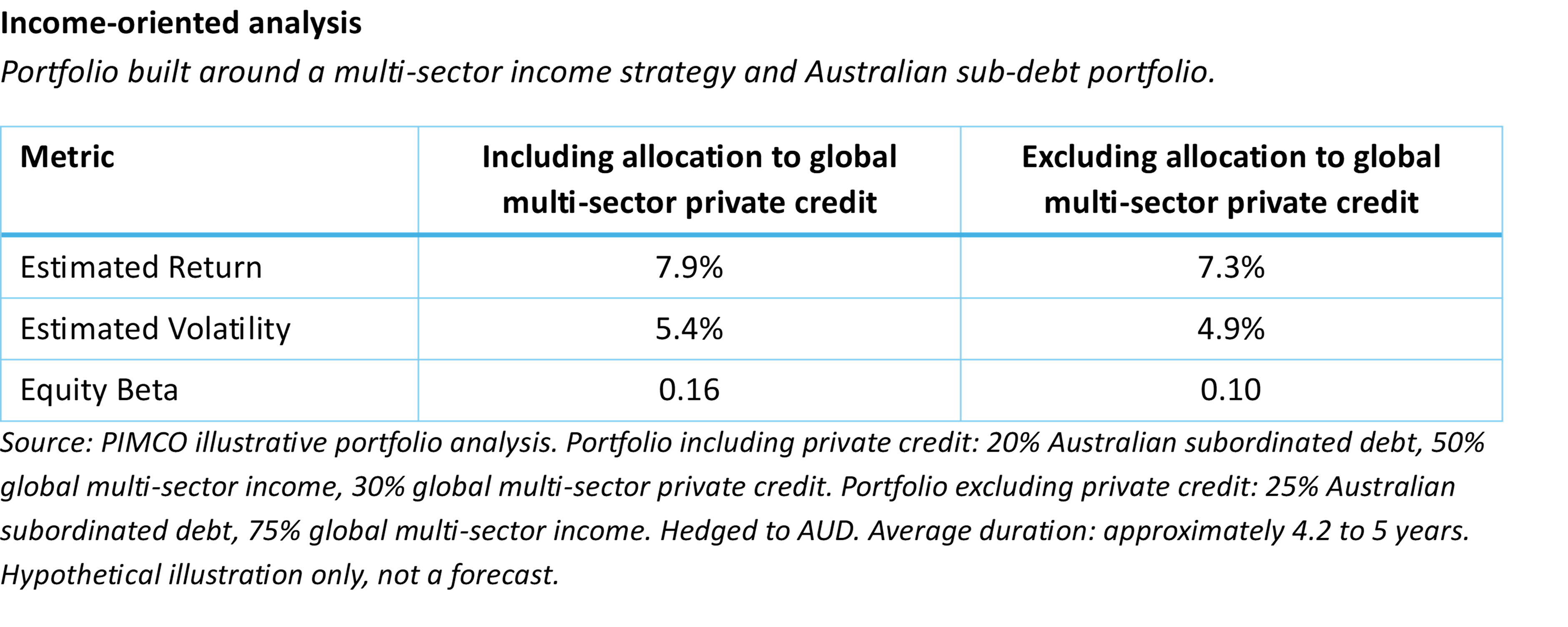
These are hypothetical illustrations rather than forecasts, and there is no assurance the stated results will be achieved. They nevertheless suggest that maintaining hybrid-like return expectations does not necessarily require concentrating risk in subordinated debt. Across this portfolio framework, diversified fixed-income portfolios achieved a more favourable balance between risk and return.
An opportunity to rethink portfolio construction
The phase-out of bank hybrids creates a choice for income investors. They can look for the next security that most closely resembles what they already own or use the transition to reconsider how their portfolio generates income in the first place.
Domestic subordinated debt is likely to remain an important component of many portfolios. However, it need not carry the entire burden of replacing hybrids. Global bonds, securitised assets, diversified credit strategies and private lending may each contribute differently to portfolio income and risk. For many investors, that may mean combining domestic and global fixed-income exposures across both listed and unlisted markets.
The opportunity created by the hybrid phase-out is therefore not simply to replace one security with another, but to build portfolios with a broader range of income sources and risk drivers. Whether implemented through ETFs, active funds or other investment vehicles, a more diversified approach may help investors achieve portfolio objectives while reducing reliance on a single source of income.
Hybrids may be on their way out, but the job they did isn't. The investors who are best placed for what comes next are likely to be the ones who spread that job across more than one source.
Kanish Chugh is Head of ETF Sales for Australia at PIMCO. This article is for general information only and has been prepared without taking into account your objectives, financial situation or needs. Before making an investment decision you should obtain professional advice and consider whether this information is appropriate having regard to your objectives, financial situation and needs.