Register For Our Mailing List

Register to receive our free weekly newsletter including editorials.

Home / 229

LIC update: benefits of international exposure

Australian equities rose marginally during the September quarter with the S&P/ASX 200 Accumulation Index up 0.7%. The performance for the 12 months to 30 September 2017 was a solid 9.2% driven by a good performance from large caps and strong gains in the resources sector with the S&P/ASX 200 Materials Index up 17.3% for the 12 months.
International LICs performing best

However, the best performing LICs for the 12 months to 30 September 2017 were those with an international focus reflecting the strong performance of international equity markets, with the MSCI World Index (Local) up 17.9% for this period. The top four performing LICs were PM Capital Global Opportunities Fund (ASX:PGF) up 30.4%, MFF Capital Investments (ASX:MFF) up 22.5%, PM Capital Asian Opportunities Fund (ASX:PAF) up 22.2% and Platinum Capital (ASX:PMC) up 20.7%. (IIR does not cover these four LICs and we make no recommendations in relation to these LICs.) The strong performance of these LICs over the past year, which significantly beat the returns of the Australian market, highlights the benefits to investors of a diversified portfolio with a proportion in international equities.

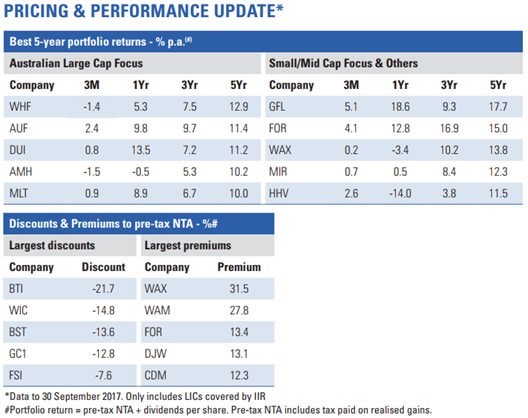
The best performing LIC in our coverage universe was also an international focused LIC, Global Masters Fund (ASX:GFL). GFL invests in quality international shares, but its largest exposure is to Berkshire Hathaway, at 73.8% of its portfolio. Berkshire Hathaway shares rose around 30% for the 12 months to 30 September 2017 helping drive GFL’s 18.6% growth in pre-tax NTA. The reason the pre-tax NTA growth did not match the growth in the Berkshire Hathaway share price was that GFL’s investment in Flagship Investments (ASX:FSI) achieved limited share price growth and the Australian dollar rose over the same period. GFL was also the best performing LIC in our universe over a five-year period delivering a pre-tax NTA return of 17.7% p.a., again, reflecting the strong performance of Berkshire Hathaway shares over the period. GFL has also delivered strong share price returns of 52.9% over 12 months and 28.7% p.a. over five years reflecting elimination in the discount to pre-tax NTA. Our rating for GFL is Recommended Plus, however, the shares now look expensive trading at roughly a 10% premium to pre-tax NTA.

Emerging Markets Masters Fund (ASX:EMF) also delivered a strong 12 month performance with a portfolio return (pre-tax NTA plus distributions) of 13.2%, although this was below the MSCI Emerging Markets Index, AUD return of 17.5%. This reflects EMF’s bias to sectors leveraged to what it believes are growth sectors such as consumer staples and healthcare. These sectors have not performed as well as 'value' sectors of the market over the past year. Over the past three years, this LIT has outperformed the benchmark with a return of 8.6% p.a. compared to the benchmark return of 8.1% p.a. EMF provides domestic investors with exposure to a professionally managed portfolio of emerging market funds, a unique proposition on the ASX. From a country perspective, the largest allocations are to China (26.9%) and India (16.9%). A significant portion (18.5%) is also invested in what the company refers to as Frontier Markets. The portfolio is significantly overweight India and the Frontier Markets relative to the benchmark. At 30 September 2017 EMF securities were trading at a 1% premium to pre-tax NTA, a reasonable entry point for long-term investors looking for emerging markets exposure. Our rating for EMF is Recommended Plus.

Cadence Capital (ASX:CDM) and Perpetual Investment Company (ASX:PIC) which both have blended portfolios of Australian and international equities also delivered returns above the domestic market return. CDM delivered a portfolio return of 10.3% and PIC delivered a portfolio return of 10.2%. Our rating for CDM is Recommended Plus and PIC is Recommended. At 30 September 2017 CDM was trading at a 12.3% premium to pre-tax NTA while PIC looked reasonable value at a 4.7% discount.

Australian large cap LICs underperform over 12 months 

The five largest Australian large-cap focused LICs delivered an average portfolio return of 8.0% for the 12 months to 30 September, below the S&P/ASX 200 Accumulation Index return of 9.2%. This largely reflects underweight positions in resources, a sector which has performed well over the last 12 months. Over a five-year period these same LICs have delivered an average portfolio return of 9.1% p.a. versus the market benchmark return of 10.1% p.a.

Over the longer-term we would expect these LICs to perform broadly in line with the market. At 30 September 2017 Australian Foundation Investment Company (ASX:AFI) and Milton Corporation were trading at slight premiums to pre-tax NTA and Australian United Investment Company (ASX:AUI) was at a slight discount. All look reasonable value for long-term investors looking for exposure to a diversified portfolio of Australian large-cap shares. Our rating for AFI and MLT is Highly Recommended and our rating for AUI is Recommended Plus. Diversified United Investment (ASX:DUI) was the best performing large-cap focused LIC over the 12 months to 30 September 2017 beating the market with a portfolio return of 13.5%. Its five-year return of 11.2% p.a. also beat the market benchmark return of 10.1% p.a. At 30 September DUI was trading at a 3.3% discount to pre-tax NTA, a good entry point for investors looking for exposure to a diversified portfolio of Australian large-caps shares. We note that DUI also has a small exposure to international shares and also Australian small caps. Our rating for DUI is Recommended.

Whitefield (ASX:WHF) was the best performing Australian large-cap focused LIC on a five-year basis. Whitefield primarily invests in Australian industrial shares meaning that it does not have exposure to the volatile resources sector. Whilst WHF underperformed the industrials benchmark over the past 12 months, its five-year return of 12.9% p.a. was slightly better than the 12.7% p.a. return from the S&P/ASX 200 Industrials Accumulation Index. At a 6.8% discount to pre-tax NTA at 30 September, WHF’s shares represent good value for investors looking for exposure to Australian industrial shares. Our rating for WHF is Recommended Plus.


Peter Rae is Supervisory Analyst at Independent Investment Research. This article is general information and does not consider the circumstances of any individual.


  •   30 November 2017
  • 11
  •      
  •   
11 Comments
SMSF Trustee
November 28, 2017

Hmmm, how to turn an asset class discussion into a product push. You don't have to be in LIC's to get the performance of global shares. Traditional international equity funds will also do the trick! Nothing special about LICs, they're just a vehicle that obtains the performance of the asset class in which they invest.

Graham Hand
November 28, 2017

Hmmm, SMSF Trustee. Are we not supposed to cover LICs and ETFs (of which there are $65 billion on the ASX and of interest to many of our readers) simply because exposure can also be obtained via unlisted funds? Our readers want to know about alternatives, it's not a product push.

SMSF Trustee
November 28, 2017

Not at all, but the opening paragraph is about the Australian market and then the body of the article says that global LICS did better. As if it was being in LICS rather than in global that made the difference. Perhaps all that was needed was another sentence in the opening paragraph that referenced Australian market LIC returns - something not done until the end of the article.

john
November 29, 2017

SMSF Trustee, the title of the article is clearly in relation to LIC's, with the article then talking about how LIC's with international exposure performed well. I, for one, get a lot of value from Cuffelinks LIC reports. A bit unusual that you took this article as a "product push". It's clearly nothing of the sort. And by the way, its silly to think that LIC's are a waste of time simply because they contain companies that one can invest in on their own. LIC offer the benefit of a managed fund, whilst often not carrying the high fees that usually accompany such funds. There is a reason why LIC's have become more and more popular in recent times.

Rob
November 29, 2017

Absolutely agree with everything you said, John.

SMSF Trustee
November 30, 2017

Clearly I misread the article, but my comments are also now being made to say much more than they did or were intended to say. I didn't say and don't believe LICS are a waste of time. I most certainly understand the investment case for them, but my main points are totally valid. The strong performance of global LICS is not because they're LICS but because they were invested in global markets. And you can get exposure in other ways, though I can now see how the article was intended to focus on comparing domestic and global LICS.

Can we call a truce now?

Ian A
November 30, 2017

Peter Rae,

Keep up the great work. There are many SMSFs and personal investors in LICs who find the information very useful.

carikku
November 30, 2017

If it was a product push, there would have been some mention of how Argo Investments (ASX:ARG), the LIC on whose board Chris Cuffe sits, outperformed.

Note: PM Capital Global Opportunities Fund is ASX:PGF not PFG as stated. That is Prime Financial Group. Just in case anyone is looking at buying (am proud shareholder).

Alex
November 30, 2017

Nice article Peter.

May I ask, why don't you cover MFF or PGF ?

Graeme
December 01, 2017

Following on from Alex's comment, I would be interested in general on what criteria IIR apply when choosing which LICs to cover. It does seem rather random.

Carlos
March 28, 2019

makes no sense to me that you don't cover MFF,
which not only is one of the largest global LICs ,with a market cap well over 1 Billion, and also has been by far and away the best outperformer, with returns of 20% per annum over the past 10 years ( as of end of Feb 2019 ) !! (Editor's note: the article does cover MFF).


Leave a Comment:

RELATED ARTICLES

Five famous investors with cheap listed funds

Four ways to invest in the same fund and save money

The merits of investing in LICs at a discount

banner

Most viewed in recent weeks

It’s time for LICs to die

A high-profile dividend cut and a prominent fund manager’s apology have reignited a long-running debate. If investors can access similar exposures more cheaply and efficiently elsewhere, what exactly is keeping LICs alive?

Testamentary trusts survived the trust tax. The drafting battle has just begun.

The fight over testamentary trusts looked settled. Then the draft legislation arrived. Hidden in a technical detail is a question that could force many families to rethink wills they thought were already future-proof.

The new capital gains tax trap for your portfolio

Investors have long accepted one portfolio rule without much question. A major tax shift could change that calculation entirely, forcing difficult trade-offs between risk, discipline and an overlooked cost lurking beneath.

The retirement scorecard: how many of these questions can you answer?

From the maths of retirement, estimating spending and picking the right asset allocation to survive a poor decade, here are the questions every retiree – current or future – should be able to answer for themselves.

How the typical Australian Family could save $844,350 in taxes

The value of a testamentary trust is not determined by wealth alone. Depending on circumstances, it can reduce the tax burden on inherited income, create efficiencies and help build intergenerational wealth.

The housing slide could become a crash

House prices are sliding across Australia, yet the most dangerous ingredient for a housing crash is still missing. If job losses surge amid growing economic risks, today's correction could become a historic property downturn.

Latest Updates

Testamentary trusts: Treasury has picked the wrong reading

A decades-old estate planning tool has survived one tax crackdown only to be caught by another. The surprise isn't who the reform is targeting, but who could end up paying the price for drafting choices made years ago.

Latest from Morningstar

Does an American retirement rule work for Australians?

The 4% rule has survived decades of scrutiny, but Australia's retirement system changes the equation in ways most overlook. Before accepting or rejecting this rule of thumb, it pays to understand what really drives retirement outcomes.

Shares

Glencore lands on the ASX. Should BHP and Rio shareholders switch?

A coal-heavy miner with governance concerns isn't the obvious choice for investors. Yet, Glencore's ASX listing may offer something BHP and Rio can't. The challenge is working out whether the opportunity outweighs the risks.

Why does the system treat capital gains and losses differently?

Investors are often told not to let tax policy drive their investment decisions. Yet, under the new CGT rules, portfolio construction, volatility and even how assets are owned may have an outsized impact on their final outcome.

Economy

Three common sense reforms that Australia needs

What do frozen bank accounts, mortgage traps and pension penalties have in common? They're all symptoms of a system that makes life much harder. Yet the obvious solutions seem to have escaped the attention of Canberra.

Shares

The hidden cost of government debt for investors

Some of the important effects of rising public debt never make the headlines. Research shows the immediate effects may already be unfolding, influencing corporate behaviour in ways that many investors would never suspect.

Investment strategies

When do fundamentals matter?

Is fundamental investing losing its grip on markets? Investors continue to search for valuation-based explanations for every price move, but the dominant force behind short-term returns may be something else altogether.

Sponsors

Alliances

  • ASA-Logo-RGB-ActiveGreen-web.png

© 2026 Morningstar, Inc. All rights reserved.

Disclaimer
The data, research and opinions provided here are for information purposes; are not an offer to buy or sell a security; and are not warranted to be correct, complete or accurate. Morningstar, its affiliates, and third-party content providers are not responsible for any investment decisions, damages or losses resulting from, or related to, the data and analyses or their use. To the extent any content is general advice, it has been prepared for clients of Morningstar Australasia Pty Ltd (ABN: 95 090 665 544, AFSL: 240892), without reference to your financial objectives, situation or needs. For more information refer to our Financial Services Guide. You should consider the advice in light of these matters and if applicable, the relevant Product Disclosure Statement before making any decision to invest. Past performance does not necessarily indicate a financial product’s future performance. To obtain advice tailored to your situation, contact a professional financial adviser. Articles are current as at date of publication.
This website contains information and opinions provided by third parties. Inclusion of this information does not necessarily represent Morningstar’s positions, strategies or opinions and should not be considered an endorsement by Morningstar.