One of the less glamorous aspects of working in financial services is the sheer volume of emails you receive. Most promise market insights 'too important to ignore', which is generally a reliable sign they can be ignored immediately.
I also have a habit of opening ones I probably shouldn't. Outside of phishing attempts and the occasional Nigerian Prince, there exists an endless stream of industry events, media releases and marketing updates that accumulate throughout the week.
It's a wonder any of us have time to eat lunch.
The remaining few are spared from the bin, in the hope they can spark some sort of article inspiration. One such email recently notified me that Australia's ETF industry had reached almost $400 billion in assets following a record-breaking quarter. Of course, if you've been awake for any part of the last decade, this probably doesn't come as a surprise. ETFs have become one of the default allocations for investors across a broad spectrum of objectives and experience levels.
I should confess that I'm not merely an observer of this trend, as most of my portfolio sits in broad-based ETFs. This arrangement has suited both my investment returns and the preservation of my ego, after several humbling attempts at stock-picking.
Yet I've always had a soft spot for playing devil's advocate, particularly when an idea reaches near-universal acceptance.
To be clear, this isn't an argument against using ETFs. Nor is it a call to abandon them in favour of stock picking. Investors aren't forced to pledge allegiance to a single philosophy. Most of us realistically sit somewhere in the middle. But when a product becomes the default solution for almost every investing problem, it's worth re-examining a couple assumptions that often sit beneath.
Trading flexibility
ETFs have undoubtedly played a significant role in lowering the barriers to investing. Yet that accessibility without education and a steady temperament can be a double-edged sword.
The ETF Impact Survey by State Street found that the three most commonly cited reasons investors owned ETFs were diversification, lower costs and flexibility in trading. The first two are hardly controversial, but the third is what I find more interesting.
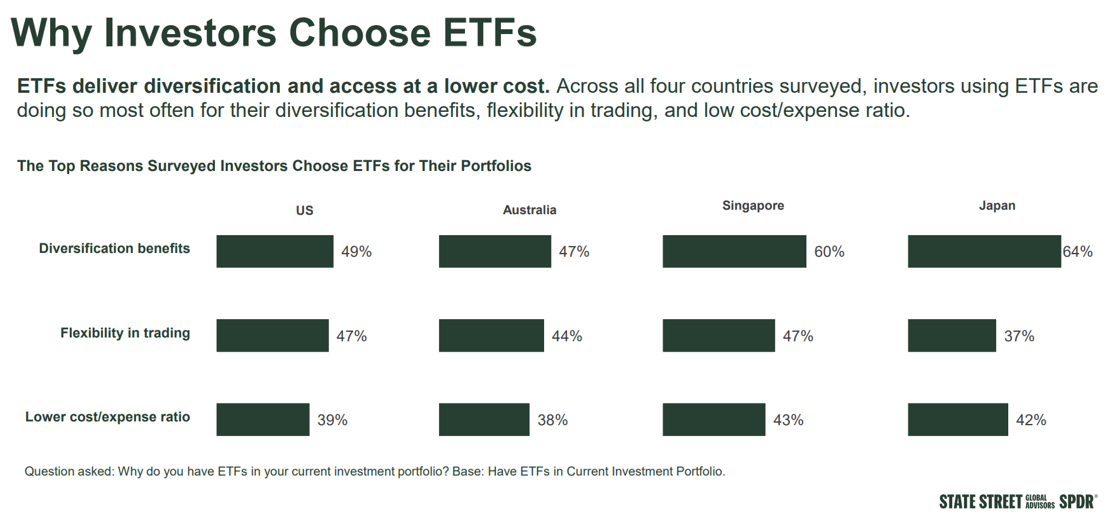
A defining feature of ETFs are their ability to trade throughout the day like ordinary shares. This provides a degree of liquidity and flexibility that many traditional managed funds lack. On the surface, investors value control, of which ETFs provide plenty. The problems arise when that control isn't exercised wisely.
A 2016 paper, Abusing ETFs by Bhattacharya et al., looked at data from a large German brokerage platform to examine the impact of ETF usage on investor outcomes. Perhaps surprisingly, the study found that ETF investors failed to improve portfolio performance over the period examined. In many cases, the outcomes deteriorated, with further evidence pointing to suboptimal ETF selection. Additionally, those who traded most actively tended to experience the worst outcomes.
In other words, one of the perceived benefits becomes a detriment. Naturally, the temptation to meddle with a portfolio exists wherever liquidity is found. But the irony is that ETFs are often marketed as long-term investment vehicles, while the market structure surrounding them encourages frequent action. It can be incredibly difficult to stay the course while simultaneously being given the ability to abandon it at any moment.
The performance paradox
For decades, Warren Buffett famously proclaimed that a low-cost index fund is the most sensible equity allocation for the majority of people. This follows a common argument in favour of using ETFs, that is, the average person is an incredibly poor stock-picker. And the evidence does broadly support this.
Hendrik Bessembinder is best known for his research on long-term wealth creation. Over decades, he has performed a series of studies analysing the lifetime performance of US stocks. The 2026 iteration of his paper found the median stock still delivers a negative lifetime return of roughly -6.9% on a buy-and-hold-basis.
If the median stock is considered a sure-fire path to underperformance, then the appeal of ETFs becomes obvious. But while they remove the risk of missing the next Nvidia or Commonwealth Bank, they don't eliminate the potential for underperformance altogether.
Morningstar’s Mind the Gap study compares the difference between a fund's overall return and the return that investors actually receive. The latest data foudn that the funds themselves delivered an aggregate annual return of 9.9%, while the average investor dollar in US stock funds and ETFs earned 8.7% p.a. over the decade ending December 2025. Investors encountered a familiar problem where they weren't picking the wrong investments, but they were getting in their own way.
This is the centre of the ETF versus stock-picking debate. Replacing single stock risk with an ETF presents its own challenges. An individual share portfolio may overlook a handful of companies that ultimately drive market returns and end up with a handful of mediocre performers. ETF investors avoid this problem by owning a larger pool, but that doesn't mean they aren't still prone to underperformance.
Ultimately, every approach will have a weak point. The more pressing question is whether investors understand the trade-offs and can unpack the assumptions baked into whichever path they choose.
Simonelle Mody
Also in this week's edition...
Mark LaMonica shares the key questions every retiree should be able to anwer for themselves.
Amid growing concerns about AI expenditure, Jason Teh is back to discuss one key difference that separates today’s boom from the dot-com bubble.
Trusts are facing a shake-up, but a complete overhaul may not be necessary. Anne-Marie Tassoni walks through potential restructuring strategies for families.
War, inflation and higher rates were expected to derail US equities. Jared Franz explains why the economy is stronger than many believe and what this implies for investors.
As investors have grown sceptical about policy mishaps, Shaokai Fan poses the question - how much trust is in your portfolio?
Seven months into retirement, Dr Joanne Earl returns to reflect the surprises she is still uncovering.
Varun Laijawalla explores why the next chapter of technology may not belong to the companies or business models many expect.
Curated by Simonelle Mody and Leisa Bell
Latest updates
PDF version of Firstlinks Newsletter
Investment Update from UniSuper's John Pearce
Monthly Investment Products update from ASX
Plus updates and announcements on the Sponsor Noticeboard on our website