One of the challenges with investor surveys is separating what respondents say from what they actually do.
The State of the Australian Investor study attempts to test the gap between intention and reality by combining survey responses with portfolio and transaction data from almost 100,000 investors.
The stereotype of the typical retail investor can be difficult to shake. Popular culture still imagines a trader glued to multiple screens, chasing tips and trying to outsmart professionals. But the investors captured in this study are quite different.
Around 65% have been investing for over 20 years, almost 70% have more than $1 million invested (excluding their home) and roughly 84% make all or most investment decisions themselves. In many ways, I'd imagine that the survey cohort looks somewhat similar to the composition of Firstlinks readers. Despite the decades of experience, they remain just as capable as everybody else of worrying about what comes next.
Concerned, but not retreating
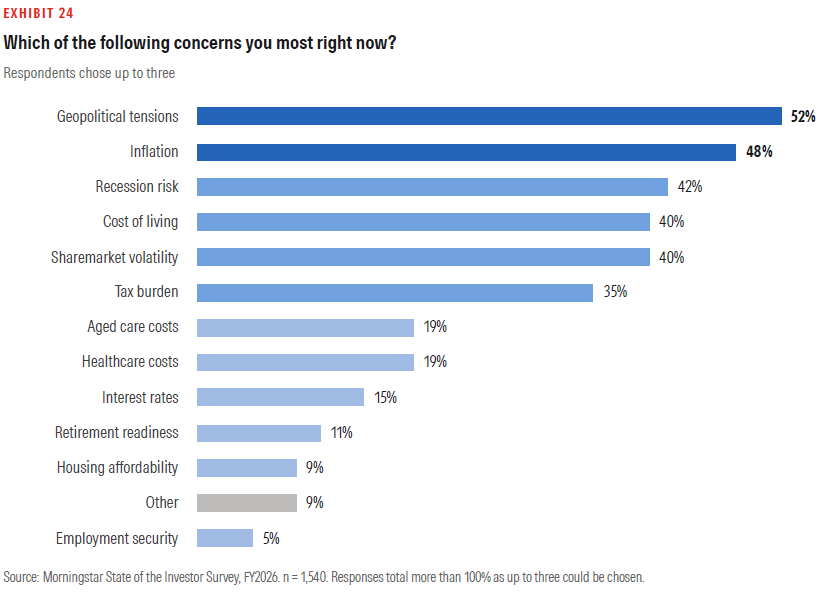
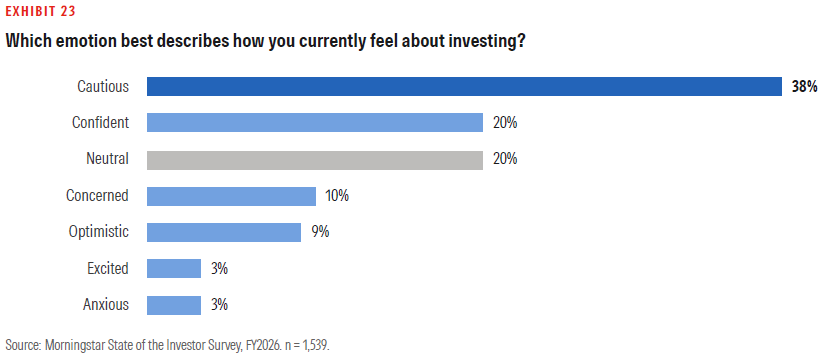
Markets have spent the past few years lurching from one fear to the next. Geopolitical tensions topped the list with inflation, recession risk, volatility and taxes close behind. "Cautious" was by far the most common emotion respondents selected when asked how they felt. If we analyse the sentiment in isolation, one could assume investors had spent the year retreating to cash and waiting for clearer skies. But that has not been the case.
During the August 2024 sell-off, the tariff correction in April 2025 and the period of tension surrounding the Iran conflict, participants became more active rather than less. The chart below shows how buying consistently outpaced selling by roughly two-to-one.
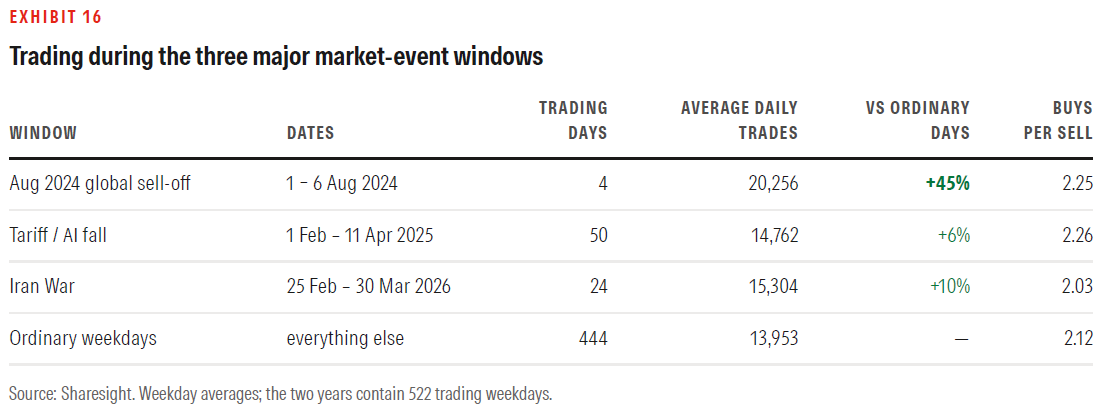
This paints a somewhat inconsistent picture. Education often focuses on the dangers of emotional decision-making and panic selling during downturns. However, many are now increasingly willing to look through market shocks, perhaps because they’ve seen enough.
One could argue that every meaningful downturn since Covid has eventually become a buying opportunity. Has this conditioned investors to buy the dip just as Pavlov trained his dogs? Or have uncertainty and extreme volatility simply become the new state of affairs? I'm not in the business of making forecasts, so I'll just say that it remains to be seen.
How did you perform against others?
What's particularly noteworthy is that portfolio returns significantly exceeded the ASX 200, which saw a 2.6% rise over FY26. The average investor enjoyed a very strong year with returns exceeding 13% in FY26. The median return was ~11% and more than 80% finished the year ahead. For most, these are enviable outcomes.
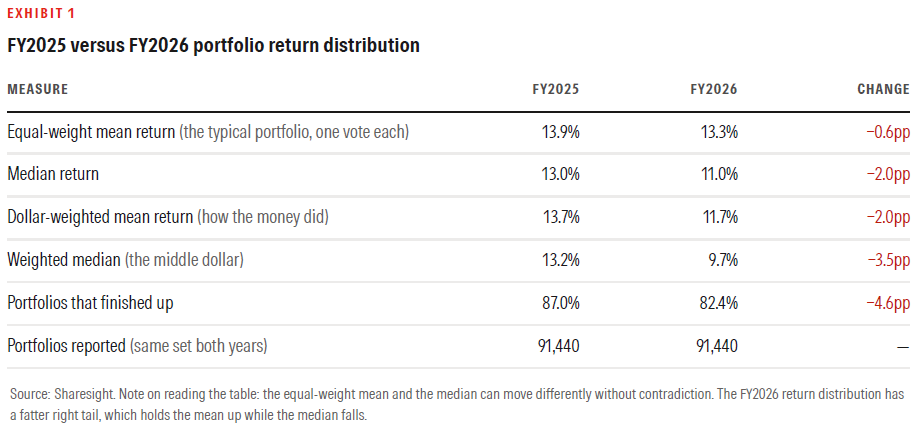
However, it is important to note that these portfolios contain a mix of global equities, cash flow from dividends, currency effects and different risk exposures. A direct comparison to the ASX is not particularly helpful. Yet the fact remains that the cohort achieved strong outcomes in a year when the domestic market was comparatively subdued. These results even outperformed most large, diversified growth-oriented industry super funds.
Income is making a comeback
A lot of industry commentary tends to frame success almost entirely through capital growth. Taking a deeper look into composition reveals that in FY26, income accounted for 4.1% of an 11.7% dollar-weighted portfolio return. In plain terms, over a third of total returns came from income.
The report argues that many are actively seeking income-producing investments rather than simply receiving income as a by-product of their portfolios. This is supported by the growing popularity of high-yield strategies like Vanguard's Australian High Yield ETF (VHY), which climbed from the 14th most traded security to 9th place over the year.
Part of the explanation may be demographic, but tax is likely also playing a role. Throughout the survey, the topic repeatedly emerged as a major concern. Recent policy changes have prompted a greater focus on after-tax outcomes, rather than simply chasing the highest headline figure. Two portfolios with identical pre-tax returns can look very different once tax is taken into account.
I believe there is also a psychological element. During uncertain periods, steady income can be a reassuring reminder that portfolio performance is not solely dependent on somebody else paying a higher price for an asset in the future. While you may not necessarily want less exposure to equities, there could still be a preference for a greater share of returns to be arriving as cash.
The ETF story isn't what you think
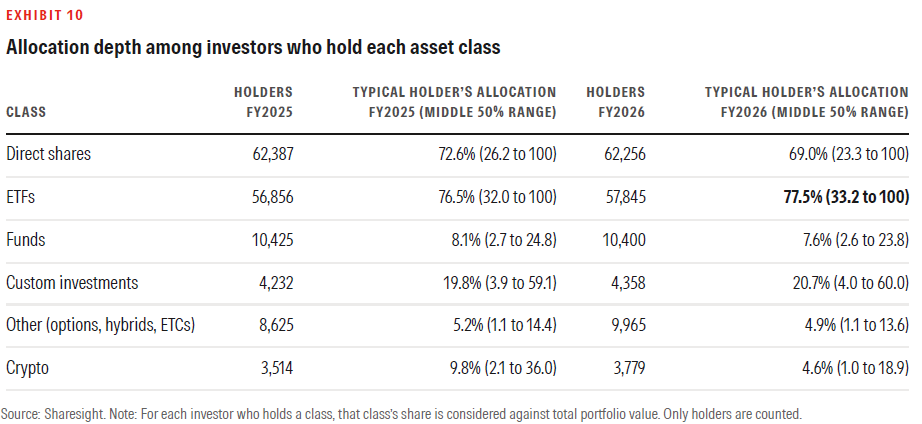
The data confirms something that most already know. ETFs are becoming the default, as purchases exceed sales by three to five times. In FY26, the median ETF holder allocated 77.5% of their portfolio to ETFs, compared with 69.0% for the median direct-share holder.
Importantly, this doesn't imply an abandonment of stock selection. The report rejects the simplistic idea that you can be either active or passive. What emerges is strong evidence that many are adopting a "core and satellite" model. Investors use broad funds as foundations, while maintaining direct holdings in companies where they possess conviction.
Retirement prospects
The final thing that stood out was the set of figures below.
Around 94% of respondents know exactly or roughly how much income they'll need once they stop working. That sits somewhat awkwardly beside the prevailing narrative that Australians are financially unprepared for retirement. Of course, there are certainly large pockets of the population where that concern is justified, but these findings reflect how many are operating from an entirely different position.
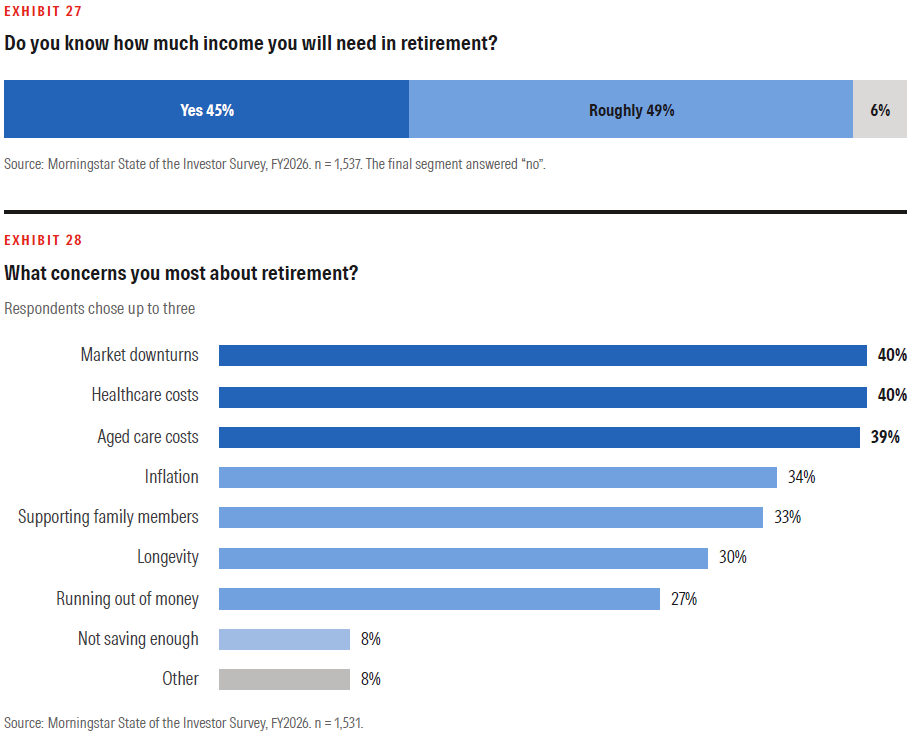
Running out of money and not saving enough aren't the primary concerns. Instead, there are worries that unknown costs or volatility will disrupt the retirement they have planned.
Simonelle Mody
Also in this week's edition...
Rachael Rofe returns to discuss the recent Bills introduced into Parliament and why she thinks Treasury has picked the wrong reading.
The 4% rule has survived decades of scrutiny, but Mark LaMonica poses the question: Does an American retirement rule work for Australians?
Glencore has landed on the ASX. David Tuckwell explores whether the company offers something BHP and Rio can't.
Noel Whittaker proposes three common sense reforms that Australia needs right now.
Tony Dillion reflects on how the new CGT regime creates distortions and raises questions around tax neutrality.
Some effects of rising public debt never make the headlines. Ruchith Dissanayake uncovers the hidden cost for ASX investors.
Is fundamental investing losing its grip on markets? Joe Wiggins suggests the dominant force behind short-term returns may be something else altogether.
Curated by Simonelle Mody and Leisa Bell
Latest updates
PDF version of Firstlinks Newsletter
Australian ETF Review from Bell Potter
LIC (LMI) Monthly Review from Independent Investment Research
Listed Investment Company (LIC) Indicative NTA Report from Bell Potter
Plus updates and announcements on the Sponsor Noticeboard on our website