AI is a once-in-a-generation wealth creation opportunity. But Australia is not well placed to capture it.
We have no Nvidia or Samsung. We have no Anthropic or OpenAI either. What we do have is a strong record of building, owning and managing property and infrastructure. Our capital market knows how to fund it.
Data centres are where Australia’s strengths meet the AI boom. They have already created some of the largest Australian fortunes of recent years.
While potentially highly profitable, data centres have a bad reputation with the Australian public. According to one recent poll, only 37% of Australians want our country to be a world leader in data centres. The same poll found only 23% would support a data centre being built in their area. Viral videos of NextDC’s data centres with diesel fumes floating through Footscray colour public perception.
Addressing this reputational problem with the public – called ‘social license risk’, in the jargon – is a key industry focus point. The recent US midterms, where victories by Democrats, who had promised to rein in data centre development, triggered a bloodbath in US data centre stocks, show the risk of failing to do so.
We believe the best path forward is Victoria’s approach, which bans data centre development within 150 metres of schools and residential areas. Providing clarity and certainty around this helps everyone move forward.
The investment case for data centres
Demand for AI computing is growing faster than the infrastructure to support it. ChatGPT alone passed 900 million weekly users in early 2026. The Australian Energy Market Operator (AEMO) expects data centre electricity use on the national grid to roughly triple by 2029-30, and reach around 13% of grid consumption in ten years.
The companies that run AI models need that capacity now and are willing to pay a premium for it. The result is that pricing power sits with whoever can bring capacity online fastest.
That creates a strong incentive to build wherever electricity, water and fibre connections already exist. Electricity is the big one: a large data centre can use as much electricity as 100,000 homes, roughly the number of homes in greater Hobart. Tenants also expect 99.999% uptime, or about five minutes of downtime a year. Proximity to cities, substations and fibre helps on every count. These are reasonable commercial demands, and they explain why data centres have clustered near where people live and work.
This is why ASX companies hoping to profit from this – like Goodman Group, the fund manager cum developer, NextDC, the data centre landlord par excellence, and Infratil, the New Zealand company – have had their designs set on Sydney and Melbourne suburbs.
Why community objections are not simply NIMBYism
OpenAI and Anthropic will pay data centre companies handsomely if they build quickly. But building a data centre quickly is only possible if there is some degree of community buy-in. Without it, objections mount and approvals slow. Governments are especially sensitive to these objections if elections are pending.
It is unfair to dismiss these community objections as nimbyism. (Nimbyism is where residents hypocritically allow infrastructure to be built in someone else’s suburb but not their own). We don’t just let anyone build anything anywhere – and we never have. Loud, hot, noisy and polluting infrastructure has always had to be built in designated industrial areas. Oil refineries are expected to be built near the coast away from suburban areas. So too are smelters.
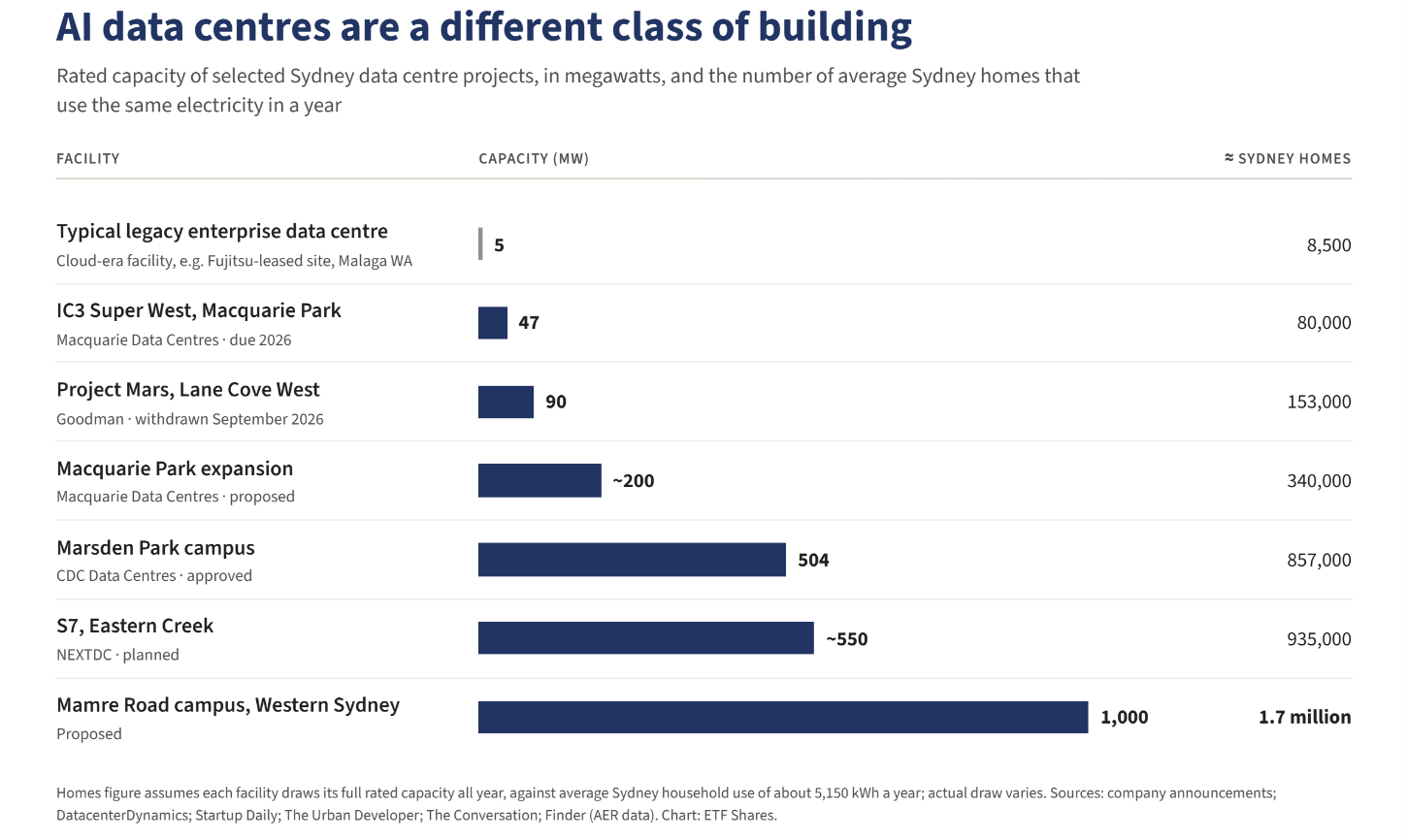
True, previous generations of data centres were built in suburban areas without fuss. But these older ones – such as those running emails and video streaming – were much smaller. They didn’t produce the waste heat, noise or consume anywhere near as much water. But NextDC’s S7 campus is set to use around 550MW of electricity. Making sense of that number: that’s around half the load of the Tomago aluminium smelter, which uses about 10% of NSW’s electricity.
The political response
The US midterms last week show what happens when these social license risks are left to fester.
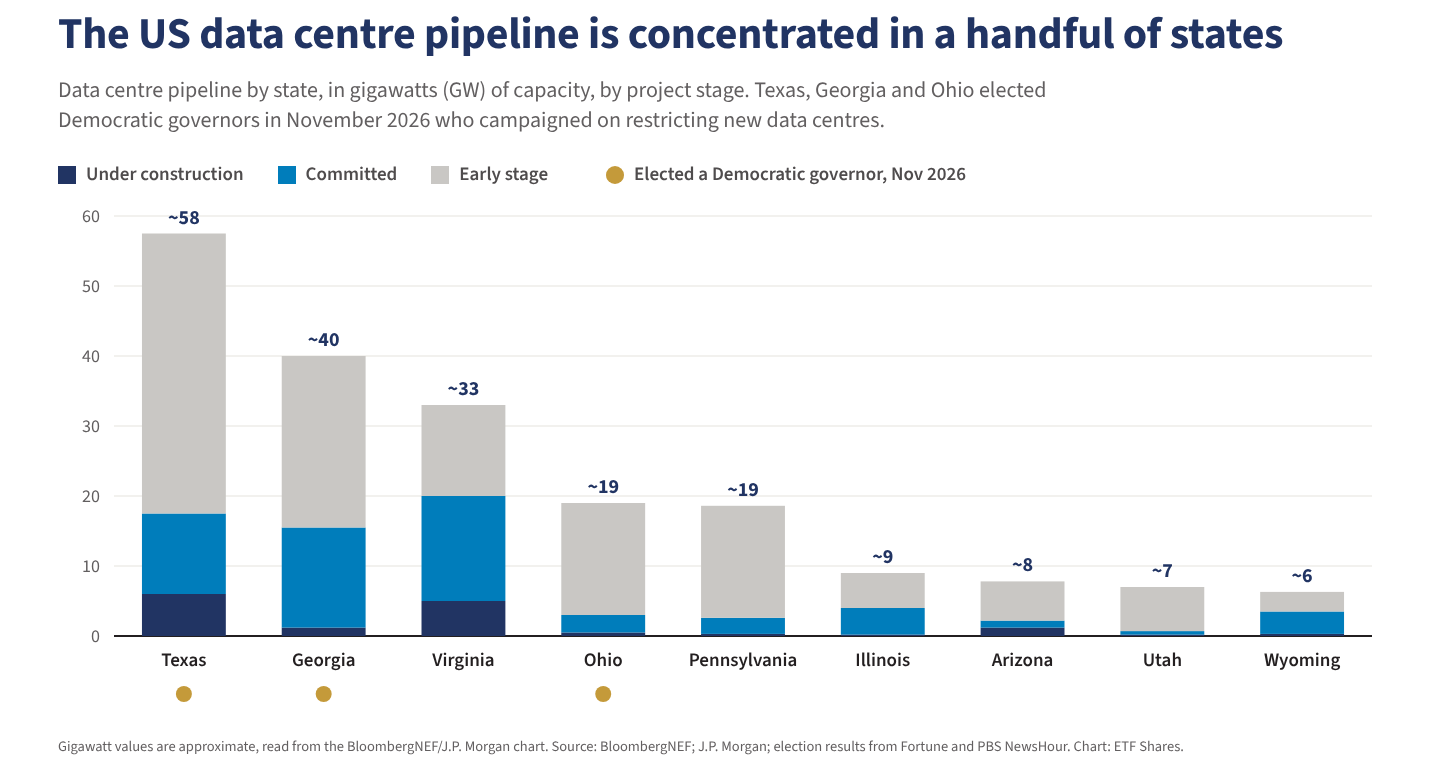
In the November midterm elections, Democrats won control of Congress and the governorships of Texas, Georgia and Ohio, three of the country’s largest data centre markets, after campaigns in which data centres and electricity bills featured prominently. The incoming governors have proposed moratoriums, pauses or conditions on new projects. Shares in AI infrastructure companies such as CoreWeave and Applied Digital fell significantly the following day.
Australia has the chance to avoid that kind of disruption by setting clear rules on where data centres can go before the build-out peaks, rather than rewriting them midstream.
Location is now part of the investment case
The answer is to plan for AI data centres as we do factories and smelters: in designated areas, with buffers from homes, schools and parks.
Macquarie Technology’s campus in Macquarie Park shows a better approach. It sits in an established commercial and technology precinct, with grid connections and fibre already in place. Its planned 200MW expansion is on a light industrial site beside Sydney’s M2 motorway and is designed to use air cooling to limit water use.
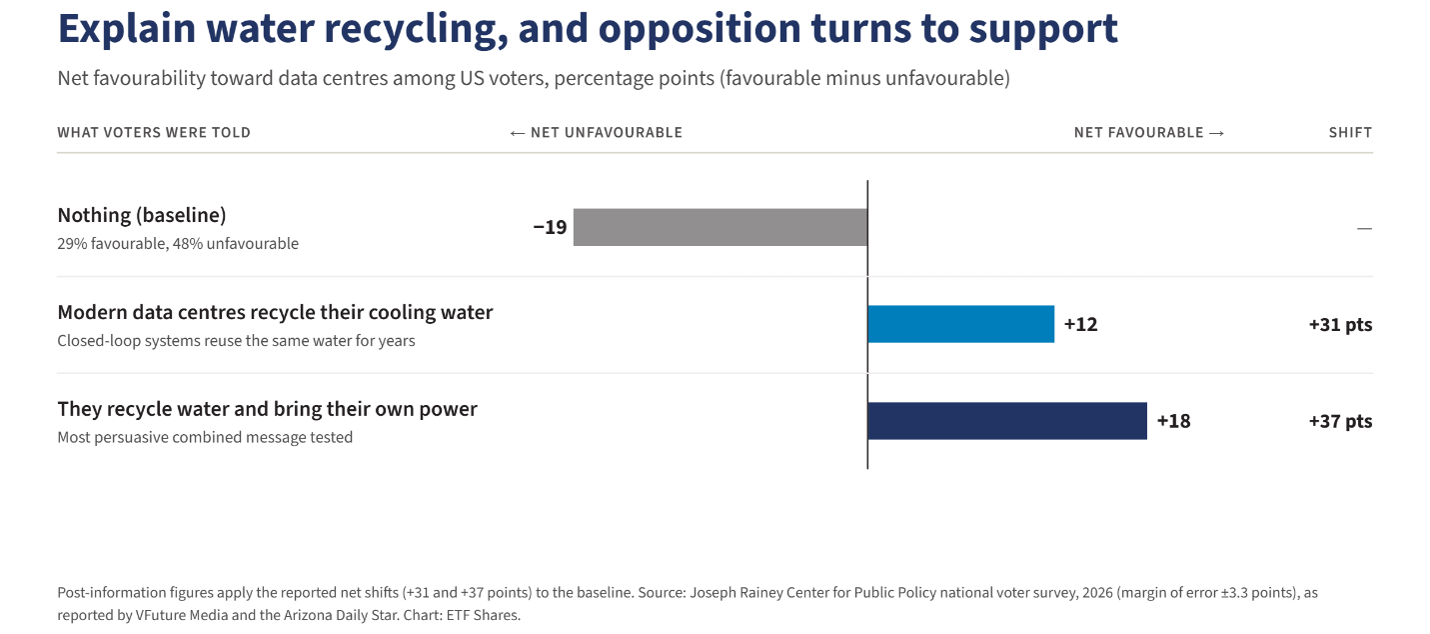
Water also needs attention. Data centres use about 0.7% of Sydney’s water today, but Sydney Water has said sector demand could go much higher than that if the industry keeps growing. There is little reason to cool data centres with drinking water when treated recycled water will do, and it can help win public support. One recent US poll found support for data centres rose by about 31 percentage points after voters learned about water reuse and closed-loop cooling.
For investors considering investing in data centre companies but worried about these social license risks, there are a few simple questions to ask. Is the pipeline on land zoned for heavy infrastructure? Are power and water secured? Are anchor tenants contracted? And does the project have the support of the surrounding community?
Getting the location right doesn’t blow Australia’s chances. It makes the opportunity durable: a sector that keeps its social licence can keep building for decades.
The ETFS AI Infrastructure and Data Centres ETF (ASX: DTCR) began trading on the ASX on 10 November 2026. For more information click here.
William Taylor is the Chief Operating Officer and Portfolio Management leader at ETF Shares, a sponsor of Firstlinks. With over a decade of ETF experience, William has a strong track record in managing portfolios across various asset classes and is a CFA charter holder. The information provided in this article is general in nature. Before acting on any information in this article, you should consider the appropriateness of the information having regards to your objectives, financial situation or needs and consider seeking independent financial, legal, tax and other relevant advice. Past performance is no guarantee of future performance.
Disclaimer: This article is issued by ETF Shares Management Limited (“ETF Shares”) (ABN 77 680 639 963, AFSL: 562766) and ETF Shares is solely responsible for its issue. Under no circumstances is this article to be used or considered as an offer to sell, or a solicitation of an offer to buy, any securities, investments or other financial instruments. Offers of interests in any retail product will only be made in, or accompanied by, a Product Disclosure Statement (PDS) and target market determination (TMD) available at www.etfshares.com.au.