Register For Our Mailing List

Register to receive our free weekly newsletter including editorials.

Home / 686

Division 296: the initial moves to make before the windows close

The most valuable planning happens before 1 July 2027 – and the single best lever, equalising balances between spouses, closes the moment one of them dies. What follows is general information for advisers and trustees, not advice on any particular fund.

Equalise balances while both spouses are alive

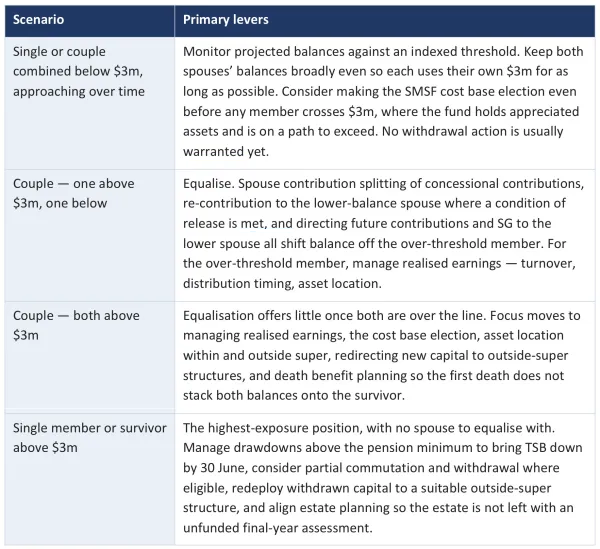
Division 296 measures each member as an individual, not the couple as a unit. A couple each holding $2.5 million sits entirely below the threshold. The same $5 million held by one spouse, with the other on nothing, exposes around $2 million to the extra tax for no reason other than how the money is split.

While both spouses are alive and both can still receive contributions, that split is movable: contribution splitting of concessional contributions to the lower-balance spouse, recontribution after a withdrawal, directing future contributions toward the spouse with room, and the spouse contribution all push the balances toward the middle.

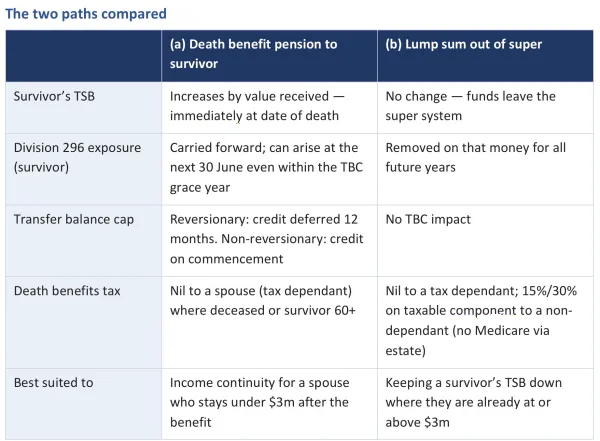
The hard deadline is the first death. When a spouse dies, their balance must leave the super system or convert to a death benefit pension for the survivor – it cannot be split back to even the couple out. A death benefit pension counts toward the survivor’s own balance, so a survivor who inherits a large benefit can be carried well above $3 million with no mechanism left to unwind it. Equalisation is the cheapest Division 296 strategy on the table, and it has an expiry date nobody can forecast. Treat it as the first conversation, not the last.
Move capital to the next generation

A parent who has met a condition of release can take money out of super entirely, lend it to adult children, and have the children recontribute it as non-concessional contributions.

The capital shifts into balances sitting far below any Division 296 threshold while staying inside the family. Document the loans as loans: written agreements, terms stated, repayable on demand or on the parent’s death. Pair that with a non-lapsing binding death benefit nomination directing the child’s remaining super to their estate, and a will that controls where it lands (loan can be repaid to the parent's), so the capital stays in the bloodline rather than leaking to a child’s former partner.

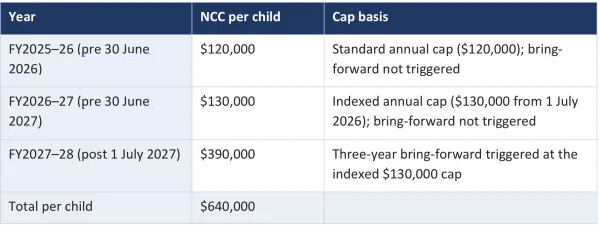
The numbers reward acting across the indexation step. Take a parent with $4 million and two adult children. Before 30 June 2026, the parent withdraws $240,000 and each child contributes $120,000 as a non-concessional contribution under the 2025/26 cap. Once the cap indexes to $130,000 on 1 July 2026, the parent withdraws a further $1,050,000: each child contributes $130,000 in 2026/27, then triggers the bring-forward in 2027/28 to contribute $390,000 – three years at the indexed $130,000 cap.

That is $640,000 into each child, $1.28 million across the two, with the children’s balances needing to be under the relevant total super balance threshold of $2.1 million for the full bring-forward to be available. The parent’s balance falls from about $4 million to roughly $2.71 million by the 30 June 2027 measurement date – under the threshold for the transitional first year, so no Division 296 reaches them for 2026/27 at all.
Commute and recontribute to reset components and protect the survivor

Pension commutation paired with recontribution does two jobs in one move. Withdrawing a taxable-heavy benefit and recontributing it as a non-concessional contribution lifts the tax-free proportion of the balance, which matters most for the death benefits tax a non-dependant child would otherwise wear. Run across a couple, the same mechanism feeds the equalisation work above: commute from the higher-balance spouse, recontribute to the lower, and the components improve while the balances even out.

The window is the period while both members are alive and both can still receive contributions. Once a member can no longer contribute, the lever is gone, so the sequencing of commutations against age and contribution eligibility needs to be mapped years ahead, not in the final return.

Direct death benefits out of super

The default outcome – a death benefit pension to the surviving spouse – is exactly the thing that compounds a survivor’s balance toward Division 296. The alternative is to direct the death benefit out of the super system to the estate, through a binding nomination, and have a testamentary trust receive it. The capital then sits outside super entirely, the survivor’s own balance keeps compounding only on its own earnings, and the testamentary trust can stream income to beneficiaries on favourable terms, including to minor children at adult marginal rates.

The trade-off is real and has to be priced. Money paid to the estate loses the concessional super earnings rate and any tax-free pension treatment it would have carried inside super. So this suits couples whose survivor is already near or above the threshold, where the saving on future Division 296 outweighs the earnings tax given up – not couples with room to spare, who are better off keeping the benefit in the concessionally taxed environment. The decision turns on the survivor’s projected balance, not a general preference for keeping money in super.
Use the cost base election deliberately, and watch the loss trap

SMSFs get a one-off election to reset the cost base of fund assets to market value as at 30 June 2026 for Division 296 purposes. For a fund sitting on large unrealised gains, resetting lifts the starting point so that future realised earnings – and the Division 296 they attract – are measured from the higher base.

The catch is that the election is all or nothing across the fund’s assets, and that is where it bites. A fund holding some assets above cost and others below cost cannot cherry-pick the winners. Electing to reset also locks in the lower market value on the loss-position assets, raising the future taxable gain on those when they recover. Model the whole portfolio before electing, not the assets in profit alone, and check the lodgement deadline – the election is made by the due date of the 2026–27 return and cannot be reversed once in.

Manage realised earnings and asset location above $3 million

Once a balance sits well above $3 million and equalisation has run out of room, the question becomes when earnings are realised and where the assets are held.

Division 296 taxes realised earnings, which makes the timing of asset sales a tax decision rather than purely an investment one. Deferring a realisation defers the liability, and bunching gains into a year a balance happens to sit below the threshold can sidestep it altogether.

Asset location is the other half of the answer: high-growth, frequently traded assets inside a large super balance manufacture the realised earnings Division 296 feeds on, while the same assets held outside super – in the member’s own name, a family trust, or an investment bond – stay out of the calculation entirely.

This is where the transfer balance cap and Division 296 pull against each other. The transfer balance cap, now $2.1 million, rewards moving as much as possible into the tax-free pension phase to minimise earnings tax. But every dollar in pension phase still counts toward the $3 million Division 296 balance.

A member who maxes their pension transfer to cut earnings tax can find that same balance sitting squarely inside Division 296’s reach. The two caps are not reconciled with each other; you choose which one to optimise, fund by fund, member by member.

None of these levers stay open forever. The cost base election closes with the 2026–27 return, the indexation step is a one-time uplift you either use or lose, and equalisation ends at the first death. The cost of waiting is not theoretical – it is a balance that has hardened above the threshold with nothing left to move it.


This article is an adapted version of an original blog post that can be found here. 

Liam Shorte is a specialist SMSF adviser and Director of SONAS Wealth. He is also a Director of the SMSF Association and he writes under the social media identity of 'The SMSF Coach'. If you’d like a no-obligation conversation about whether an SMSF is right for your situation, or you want a straight-talking second opinion on an offer you’ve received, reach out.

General Advice Disclaimer: This article is general information only and does not constitute personal financial, legal or tax advice. The rules governing SMSFs are complex and individual circumstances vary significantly. You should obtain advice from a licensed financial adviser before acting on anything in this article. The author holds AFSL authorisation through Sonas Wealth Pty Ltd, corporate authorised representative of Viridian Advisory 476223.


  •   28 October 2026
  • 22
  •      
  •   
22 Comments
Mike west
October 29, 2026

or if you are sick on your death Bed , withdraw maximum ( well sign papers) and give to relatives tax free ?

3
Liam
October 30, 2026

Hi Mike, recent ATO rulings make this much more difficult on the death bed as funds have to leave the SMSF before death. Different rules for Industry and retail funds. The rulings have been based on the fact the SMSF trustees know of the death immediately whilst Industry of retail funds may payout after death but before knowing. Huge difference in death benefits tax!

2
Rob
November 01, 2026

To a Spouse is not an issue, is the "2nd Death" that is the problem when left to non dependents. A SMSF can clearly act quicker than and Industry or Retail F but "someone" needs instructions and authority to act. Critically with a Smsf you do not need to be perfect - approximate the " live balance" and pull say 80%. Inside a week with liquid assets you are out!

Liam Shorte
October 30, 2026

Rob, I agree that a clear understanding of the actual rules and formula is crucial. Unfortunately the headlines of 30% or 40% tax on funds earnings are just not the reality. There are now a number of good calculators available for those not sure. We use the one provided by SMSF Alliance, one of our administration partners, who have the basic calculator and a modelling tool. Thanks for commenting, Liam

OldbutSane
October 29, 2026

A useful summary, but again and article with no mention of defined benefit pensions. It would be really useful if someone could write an article on how defined pension balances are going to be calculated.

My understanding/questions:

1. The 16x rule will not be used.

2. The actual pension value will be calculated using the Family Law provisions.

3. I can't find any information on how this is calculated, except it is usually done by an actuary (?cost).

4. Super funds currently only provide the relevant input figures for the calculation (and at a fee).

5. How often the calculation will needs to be done eg every year??

6. Whether super funds are going to be required to provide the amount.

Any help would be appreciated.

6
Liam
October 30, 2026

Hi, it’s a tough one but let me try as I am still learning more about how this works.

You asked how the new Division 296 tax affects your defined benefit pension. If your pension's assessed value is above $3 million, it does. Here is how the calculation works and what it's likely to mean for you each year.

How your pension is valued

Your pension has no account balance, so each year it receives a notional value using the factors in the Family Law Regulations ( https://www.legislation.gov.au/F2025L00281/asmade/text ). The calculation multiplies your annual pension by a factor based on your age and how your pension is indexed. This is not the "pension x 16" figure used for your transfer balance cap. As you get older the factor falls, so your pension's value tends to decline over time, even while indexation increases your payments.

How your earnings are worked out

You receive no investment returns in the usual sense, so the law creates a notional earnings figure. Your fund takes the closing value, subtracts the opening value, and adds back the pension payments you received during the year. The result is multiplied by 0.825, a 17.5 per cent discount set in the regulations.

Adding back your payments means you will usually have positive "earnings," even in a year when your pension's value falls.

Worked example (2026–27, illustrative only)

Item Amount
Pension value, 30 June 2026 $3,600,000
Pension value, 30 June 2027 $3,520,000
Pension payments received $203,000
Earnings: ($3,520,000 - $3,600,000 + $203,000) × 0.825 $101,475
Share of balance above $3 million: $520,000 ÷ $3,520,000 14.77%
Taxable super earnings: $101,475 × 14.77% $14,988
Division 296 tax at 15% $2,248

For 2026–27 only, the ATO uses your value at 30 June 2027. From 2027–28 it uses the greater of your opening and closing values. Because your pension's value generally falls with age, the opening value will usually be the one that counts.

When and how it's paid

If your pension is already in payment, this tax is not deferred. It is due 84 days after the ATO issues your assessment. Most defined benefit funds cannot release money to pay Division 296 tax, and you have no other super account to draw on, so you should plan to pay it from personal funds. Please confirm with your fund whether a release is possible. If the tax isn't paid on time, the ATO charges interest.

Looking ahead

As your pension's assessed value declines with age, the share above $3 million shrinks. You may eventually fall below the threshold altogether. The $3 million threshold is also indexed, which works in your favour.

The first assessments for 2026–27 will issue in the second half of 2027–28. Your fund will report your pension's value and earnings to the ATO. Once those figures are available you can check the assessment and can set aside personal cash for the payment.

Kind regards,
Liam

4
Bruce Bennett
October 31, 2026

Hi Liam
Because I have investments outside of my Defined Benefit Pension my average tax rate on my investment income and Defined Benefit Pension is about 35%. My Defined Benefit Pension is taxed at my marginal rate less a 10% offset.
When calculating Div 296 tax payable on the income from my Defined Benefit Pension does the ATO take into account the tax I already paid on the income received?
Before DIV296 taxpayers who have a normal pension account pay no tax on earnings from the first $2 million and 15% tax on anything above that. Moreover income from their super accounts is not added to their personal income and the total amount taxed at their marginal rate.

2
OldbutSane
November 01, 2026

Thanks for the reply Liam but my husband's situation is a bit different as he has a DBP plus an SMSF. The total (using his 16x amount + SMSF) is around $3m. How will the system operate in that case especially keeping track of when you are/are not over the limit?
Thanks

1
OldbutSane
November 01, 2026

The DBP is much less than $3m but the total in super (using the 16x rule) is about $3m. How do the rules apply then?

Liam
November 02, 2026

Oldbutsane

Each super fund, SMSF and DBP will report separately to the ATO and they will then do a consolidation of your multiple interests and the ATO determine the Div296 tax to be paid. So neither fund makes the decision or calculates the tax payable, they just report your figures from their fund.

Liam
November 02, 2026

Bruce

As Div 296 is a totally separate tax the ATO does not take into account the tax you already paid on the income received. This is an additional tax not a combined one.

Ian
October 29, 2026

Does the cost base reset election extinguish the prior CGT liability completely or does it mean you are still liable for the gains upto the election at the previous CGT Rates?

4
Rob
October 29, 2026

You effectively have to run two cost bases - a new one for 296 going forward as at 30th June 2026 to calculate 296 gains and the old one as at 30th June 2026 to "protect" old gains. Could they make it more complicated? No they could not! Does it sound like an accounting nightmare figuring out "which BHP you have just sold" that will likely get worse with age and increase costs? Yes it does!

The door is now shut, but my personal response was to take everything to Cash as at June 30th 2026 which was radical, realised all gains, bringing tax forward, but at least I have a single, clean Cost Base going forward!

1
Malcolm
October 29, 2026

This is a question rather than a comment. Whilst I fully understand the commute - non-concessional re-contribution strategy, to reduce the taxable component of super, it amazes me that the ATO continue to allow the strategy, as it is clearly a tax avoidance strategy. I would love to hear the ATO rationale for allowing this strategy to continue. I suppose I could ask my “know it all friend” AI Claude!

Justin
October 29, 2026

Words mean something…..

Whilst I understand and can appreciate your context and intent. There is a significant difference between tax avoidance…..a criminal offence, and tax minimisation….a structured process based in law to reduce overall tax paid.

Salary sacrifice to super is essentially tax minimisation, as is vehicle leasing. Are you avoiding paying the full rate of tax that may be applicable….yes. Is it tax avoidance in your context….no.

1
Liam
October 30, 2026

Hi Malcolm, it’s not seen as tax avoidance primarily because there is no immediate tax benefit to the member and it’s not guaranteed it will ever result in a tax benefit to their children as the member may use all their super themselves during their lifetime or may take all their super out tax free legally before death. So, it’s very contingent on future uncertain outcomes and the ATO has realised this.

Here is the answer we were trained to provide using a version provided by MLC Tech team:
The question of whether the recontribution strategy could fall under Part IVA has been considered for many years. The ATO media release in August 2004 (NAT 04/058) indicated that the general anti-avoidance provision won’t apply to the recontribution strategy where a person:
? withdraws their super and recontributes the same or a similar amount back to super, whether to the same
fund or a different fund (including a fund for their spouse), or
? makes a large undeducted contribution (non-concessional contribution) to super prior to receiving a withdrawal from that fund.

In the AAT case of Pitts v FCT (2017) AATA 685, the ATO argued that a recontribution strategy for estate planning purposes was a valid series of transactions. Therefore, it’s unlikely the ATO would reverse this position under Part IVA.

Clarification was sought from the ATO on whether the recontribution strategy for individuals aged
60 or over to minimise the tax on death benefits to non-dependants would trigger the anti-avoidance
provisions. In the minutes of the Superannuation Technical Sub-committee held on 5 June 2007, the
ATO responded ‘that it’s unlikely the Commissioner would apply Part IVA to a recontribution arrangementgiven that a key policy thrust of the simpler super amendments was to provide individuals with greaterconcessions and more flexibility to manage their superannuation in retirement.’

Hope this helps, Liam

6
Viola
November 01, 2026

thank you Liam, Justin, Rob, Malcolm.
if you are above the $3m, 70 yo and still working F/T, are you able to recontribute and does this not generate more division 296 tax? also can you only recontribute from last tax year's mandatory drawdown or can it be the sum of previous years drawdowns?

Jack
November 01, 2026

The Division 296 tax is calculated on the total of your super interests, in pension mode and accumulation mode and across multiple super funds. So a recontribution (which means taking money out and putting back in) will not change that total.
But a recontribution will reduce the proportion of your super that is taxable when it comes to the tax on death benefits because a non-concessional contribution increases the non-taxable portion of the death benefit. And you can make non-concessional (after-tax) contributions up until your 75th birthday, subject to the normal contribution caps.

Liam
November 02, 2026

Not advice and thinking on the run here while waiting in the car. A member under 75who meets the work test could make the $32,500 Concessional Contribution (less employer. sGC) for the tax deduction and submit your NOITC before 30 June and take the funds back out tax free from accumulation before 30 June and not have it count for Div 296. I will need to run this past a few colleagues to see if it passes the “not tax avoidance” pub test!

Barry
November 03, 2026

This doesn't help those of us who are single, under 60 and have more than $3 million in super. We are basically stuck with this tax, and there is nothing we can do. We can't do any withdrawals or any equalisation.

Liam
November 05, 2026

Yes, penalised for taking risk , doing your research and investing well. The tax payment can be released from your super, but no way of minimising it.

For those not sure how tax can be paid from super:
How You Pay Division 296 Tax (Under Age 60)

When your Total Superannuation Balance (TSB) exceeds $3 million, the ATO calculates your taxable super earnings and issues you a Division 296 tax notice of assessment. The debt is generally due and payable within 84 days of the notice being issued.

You have two main ways to handle the payment:
1. Pay Personally with Outside Funds
• You can choose to pay the Division 296 tax assessment out of your own pocket using personal cash, savings, or outside income.

2. Elect to Release Money from Your Superannuation
• Even if you are under 60 and have not met a standard condition of release (such as retirement), the law grants you a special release authority when liable for Division 296 tax.
• You have 60 days from the date the ATO issues the assessment to elect to have money released from one or more of your super funds.
• If you make this election, the ATO instructs your super fund to withdraw the exact amount needed and send it to pay off the liability.
• If you do not pay the debt or make a release election on time, the Commissioner of Taxation can automatically direct one of your super funds to release the money on your behalf.


Leave a Comment:

RELATED ARTICLES

Red flags to watch out for when considering an SMSF

Meg on SMSFs: What do we think about reversionary pensions these days?

Meg on SMSFs: The CGT changes don’t impact super but what about Div 296 tax decisions?

banner

Most viewed in recent weeks

Division 296: the initial moves to make before the windows close

What if the best superannuation strategy isn't about earning more, but acting before your options disappear? Several overlooked planning windows are narrowing, with consequences that can last for decades.

The retirement scorecard: how many of these questions can you answer?

From the maths of retirement, estimating spending and picking the right asset allocation to survive a poor decade, here are the questions every retiree – current or future – should be able to answer for themselves.

Testamentary trusts: Treasury has picked the wrong reading

A decades-old estate planning tool has survived one tax crackdown only to be caught by another. The surprise isn't who the reform is targeting, but who could end up paying the price for drafting choices made years ago.

Superannuation’s structural failings

Politicians are fighting over access to super, but they may be arguing about the wrong thing. The system’s three fundamental flaws have been hiding in plain sight for decades, costing Australians far more than they realise.

Avoid unnecessary CGT with this estate planning clause

A simple estate plan can create a ticking time bomb. One overlooked clause can pit spouses against children, delay inheritances, and potentially leave a family facing an unexpected tax bill worth hundreds of thousands of dollars.

Higher yields are creating opportunities in global bonds

Bond markets are adjusting to a new reality, but not in the ways investors expect. With markets repricing and capital competing for attention, investors may need to rethink where resilience and opportunity lie. 

Latest Updates

Retirement

The retirement account that Australia should have

Our retirement system asks one account to do two very different jobs. A dedicated "rainy day" account separating income from emergency savings could deliver better outcomes and greater peace of mind for retirees.

Investing

What the US midterm results mean for investors

Democrats have regained control of Congress, changing the equation in Washington. Whether that proves positive for investors will depend less on the result itself and more on what happens next for growth and markets.

Taxation

Should the capital gains tax reward risk?

A reader query on the recent CGT reforms has revealed a bigger issue. One overlooked feature of the old system may have done more than compensate for inflation. As we move to indexation, are we forgetting to reward risk?

Investment strategies

Bonds: The income and diversification trade-off

Rising yields have made bonds attractive again, but that does not mean they will behave as expected. As inflation, fiscal pressures and geopolitical risks reshape markets, the role of bonds may be more complicated than it appears.

Investment strategies

Why high-dividend investing deserves another look

Income investors have endured several lean years, but signs of a recovery are emerging. As opportunities improve, investors face an important choice between chasing headline yields and building a reliable source of income.

Investment strategies

Why 'overvalued' has been such an expensive word

Investors love simple rules, especially when markets appear stretched. Yet some of the strongest returns have arrived when the outlook seemed least attractive. This leaves an important question that history struggles to answer.

Investment strategies

AI – A good kind of bubble or just a bubble?

Investor obsession with AI is attracting unprecedented amounts of capital and confidence. But beneath the excitement lies uncertainties about returns, funding and risks that enthusiasts may not be paying enough attention to.

Sponsors

Alliances

  • ASA-Logo-RGB-ActiveGreen-web.png

© 2026 Morningstar, Inc. All rights reserved.

Disclaimer
The data, research and opinions provided here are for information purposes; are not an offer to buy or sell a security; and are not warranted to be correct, complete or accurate. Morningstar, its affiliates, and third-party content providers are not responsible for any investment decisions, damages or losses resulting from, or related to, the data and analyses or their use. To the extent any content is general advice, it has been prepared for clients of Morningstar Australasia Pty Ltd (ABN: 95 090 665 544, AFSL: 240892), without reference to your financial objectives, situation or needs. For more information refer to our Financial Services Guide. You should consider the advice in light of these matters and if applicable, the relevant Product Disclosure Statement before making any decision to invest. Past performance does not necessarily indicate a financial product’s future performance. To obtain advice tailored to your situation, contact a professional financial adviser. Articles are current as at date of publication.
This website contains information and opinions provided by third parties. Inclusion of this information does not necessarily represent Morningstar’s positions, strategies or opinions and should not be considered an endorsement by Morningstar.