Register For Our Mailing List

Register to receive our free weekly newsletter including editorials.

Home / 652

Do HNWI get better advice?

There are several studies that show that retail clients who get advice from brokers do not end up with better portfolios or improved performance. Here is a classic study from Canada that shows that while good advisers can create enormous value for clients, the average adviser does not. What made me perk up, though, was when I came across a study of clients in the rarefied world of German and Swiss private banking that shows a result to the contrary.

Maria Maas and her colleagues managed to convince a German private bank with offices in Germany, Switzerland, and Luxembourg to hand over 969 client portfolios. Of these, about 800 portfolios were self-managed by the clients, while about 160 were managed with the help of an adviser from the bank. Note that the differences between the advised and non-advised clients in this case are tiny. 92% of the clients are German, all of them have substantial financial assets (otherwise they wouldn’t be clients of the bank), and they all have very similar levels of income, age, risk profile, and financial literacy. The only real difference was the use of an adviser or the lack thereof.

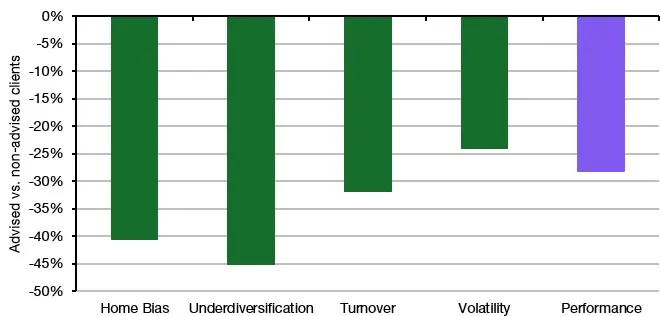
Below is a chart that summarises the key differences in terms of portfolio risks and behavioural biases between advised and non-advised clients. A negative number means that clients using an adviser have better (read: less risky) portfolios.

Difference between advised and non-advised clients’ portfolios
Source: Maas et al. (2025)

As you can see, the chart shows that clients who use an adviser have, on average, less of a home bias and more diversified portfolios. This directly contradicts the results of the Canadian study I linked to above. Clients who use an adviser also have portfolios with lower volatility and generally have lower turnover in their portfolios – something that has long been established as a key driver of underperformance.

But also note that despite these more diversified portfolios and the reduced turnover, the average return of the advised clients’ portfolios is lower than the return of the non-advised clients.

The authors of the study claim that advisers in this private bank are giving good advice because they reduce risks and behavioural biases in client portfolios. But one chart in the paper caught my attention. And I think that gives a hint at the true story.

Forgive my cynicism. As someone who has worked in Swiss private banking for almost 20 years, I don’t think private bank advisers are any better than retail advisers in Canada or anywhere else, for that matter. And the overwhelming evidence in previous studies points to advisers not adding any benefit to clients, on average (again, a good adviser can make a big difference, but you first have to find a good adviser).

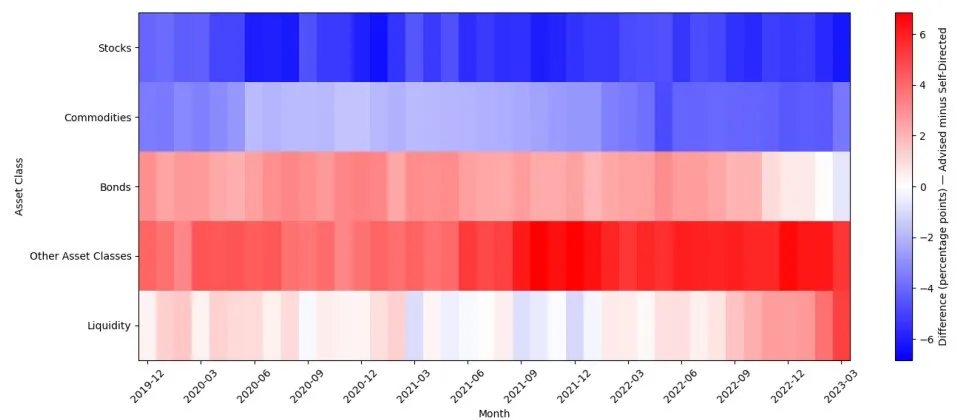
Below is that chart from the paper. It shows the average difference in portfolio allocation between advised and non-advised clients over time. Blue shades indicate that non-advised clients have a higher allocation, red shades indicate advised clients have a higher allocation.

Average difference in allocation
Source: Maas et al. (2025)

The chart shows that non-advised clients have more equities and fewer alternatives and bonds in their portfolio. Indeed, every private bank adviser will tell you that the incentive structure for them is such that they are trying to sell funds and preferably funds with high fees to the client.

Compared to non-advised clients who predominantly think about single stocks, this means that diversification is almost certainly higher in advised portfolios, while home bias and portfolio turnover are lower. That alone reduces volatility considerably.

But over the last twenty years, the trend has also been towards recommending alternative asset funds (hedge funds, private equity, infrastructure, etc) to clients because they promise additional diversification to the client and higher fees to the bank advising the client. Unfortunately, these alternative asset classes often end up with higher fees but lower returns than a simple stock/bond portfolio.

The result is that clients who use an adviser end up with more diversified and lower risk portfolios, but also with lower returns and almost always higher fees. I can’t prove that this is what is going on in this study, but I think my explanation is a bit more likely than assuming that private bank advisers are somehow better than their peers who work at brokerage firms or advise retail clients.


Joachim Klement is an investment strategist based in London. This article contains the opinion of the author. As such, it should not be construed as investment advice, nor do the opinions expressed necessarily reflect the views of the author’s employer. Republished with permission from Klement on Investing.


  •   4 March 2026
  •      
  •   


Leave a Comment:

RELATED ARTICLES

Are the good times about to end?

Platinum's new international funds boss shifts gears

Five charts show predicaments facing financial advice

banner

Most viewed in recent weeks

Making sense of record high markets as the world catches fire

The post-World War Two economic system is unravelling, leading to huge shifts in currency, bond and commodity markets, yet stocks seem oblivious to the chaos. This looks to history as a guide for what’s next.

3 ways to fix Australia’s affordability crisis

Our cost-of-living pressures go beyond the RBA: surging house prices, excessive migration, and expanding government programs, including the NDIS, are fuelling inflation, demanding bold, structural solutions.

Is there a better way to reform the CGT discount?

The capital gains tax discount is under review, but debate should go beyond its size. Its original purpose, design flaws and distortions suggest Australia could adopt a better, more targeted approach.

How cutting the CGT discount could help rebalance housing market

A more rational taxation system that supports home ownership but discourages asset speculation could provide greater financial support to first home buyers.

Welcome to Firstlinks Edition 648 with weekend update

This is my last edition as Editor of Firstlinks. I’m moving onto a new role though the newsletter will remain in good hands until my permanent replacement is found.

  • 5 February 2026

It’s economic reality, not fear-based momentum, driving gold higher

Most commentary on gold's recent record highs focus on it being the product of fear or speculative momentum. That's ignoring the deeper structural drivers at play. 

Latest Updates

Property

The 5% deposit scheme is bad for homeowners and Australia

An ‘affordability’ scheme making the county more vulnerable to economic shocks and contributing to the deteriorating financial situation of everyday Australians.

Investment strategies

Is defensive the new offensive?

Relatively boring, unglamorous, defensive stocks like Kroger and Allstate have quietly outperformed gilded tech giants, offering steady growth, visibility, and resilient returns in a market captivated by AI and flashier industries.

Shares

How the RBA scores on its inflation goal

The Reserve Bank continues to face criticism from all sides. A reminder of the RBA's mandate and a review of their track record in maintaining price stability since the early 1990s.

Investment strategies

Levered credit: A late cycle ingredient for drawdown pain

As credit spreads normalised through 2025, yield‑hungry investors have turned to leverage for high returns, uncomfortably echoing pre‑GFC behaviours. Investors need to be careful to understand the true risk‑return trade‑off.

Planning

The more things change… longevity just goes on increasing

Australia needs a major shift in longevity awareness, attitudes and behaviour if, as a community, we are to reap the benefits of increasing longevity. Adopting a national strategy is well overdue.

Property

The improving outlook of Australian commercial real estate

The sector is positioned to benefit from defensive and resilient income streams supported by embedded rental increase opportunities. 

Property

Seize hidden opportunities among 50+ home buyer schemes in Australia

There is a laundry list of government schemes to help Australian's struggling with housing affordability. Savvy buyers should take advantage to break into the property market.

Sponsors

Alliances

© 2026 Morningstar, Inc. All rights reserved.

Disclaimer
The data, research and opinions provided here are for information purposes; are not an offer to buy or sell a security; and are not warranted to be correct, complete or accurate. Morningstar, its affiliates, and third-party content providers are not responsible for any investment decisions, damages or losses resulting from, or related to, the data and analyses or their use. To the extent any content is general advice, it has been prepared for clients of Morningstar Australasia Pty Ltd (ABN: 95 090 665 544, AFSL: 240892), without reference to your financial objectives, situation or needs. For more information refer to our Financial Services Guide. You should consider the advice in light of these matters and if applicable, the relevant Product Disclosure Statement before making any decision to invest. Past performance does not necessarily indicate a financial product’s future performance. To obtain advice tailored to your situation, contact a professional financial adviser. Articles are current as at date of publication.
This website contains information and opinions provided by third parties. Inclusion of this information does not necessarily represent Morningstar’s positions, strategies or opinions and should not be considered an endorsement by Morningstar.