Register For Our Mailing List

Register to receive our free weekly newsletter including editorials.

Home / 653

Has Australia wasted the last 30 years?

Former Treasurer Peter Costello recently published an opinion piece titled “We’ve wasted 20 years. It’s time to rebuild our great nation.” The timeframe he references coincides with the period since he left the Treasurer role following the 2007 election.

Notably, the article proposed little in the way of strategic fiscal reform beyond a call to reduce government expenditure as a share of GDP, reflecting the fiscal approach of the Howard Government (1996–2007).

It is true that by the end of that period the Howard Government had repaid the majority of the approximately $100 billion of debt inherited from the Keating Government. This outcome was achieved through a combination of reducing the relative size of the budget, selling public assets, and restraining public investment. By the conclusion of the Howard era, Commonwealth bonds on issue represented less than 10% of GDP, while remaining public assets exceeded debt.

This raises an important question considering Costello’s commentary: Did Australia begin losing economic momentum well before 2007 due to an excessive policy focus on balanced budgets and debt reduction?

How did Australia become “debt free”?

The Howard Government came to power in March 1996 and remained in office until December 2007. The fiscal trajectory over that period provides useful context.
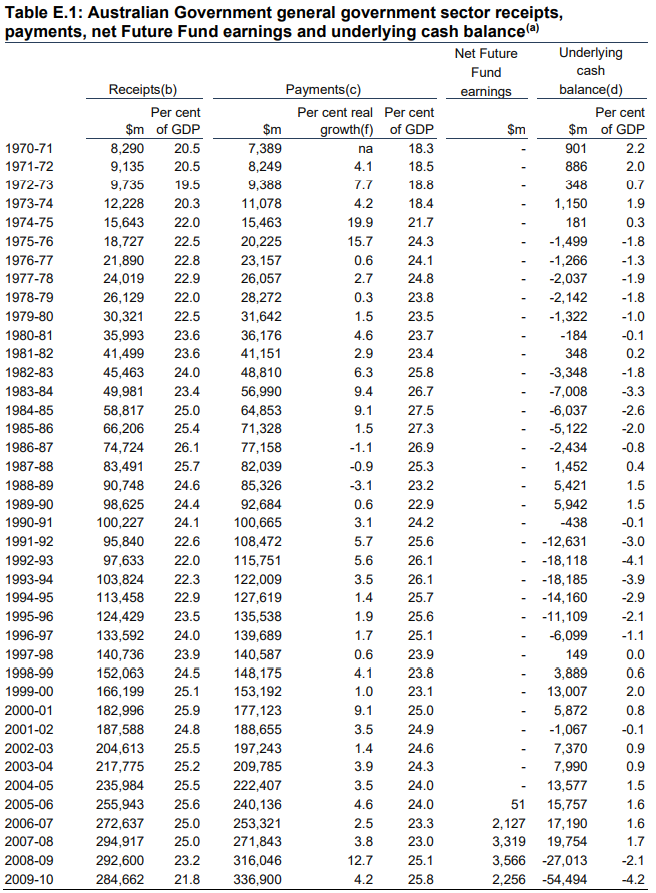

Source: budget.gov.au - Mid-Year Economic and Fiscal Outlook 2024–25, Appendix E: Historical Australian Government Data.

The first Costello budget was delivered in August 1996 (FY1997), following a Labor deficit under Treasurer Kim Beazley of $11.1 billion, or approximately 2.1% of GDP in FY1996.

At the time, Australia’s GDP was around $529 billion, and Commonwealth debt stood near $100 billion—less than 20% of GDP. By international standards this was not an elevated level of public debt. For comparison, US government debt in 1996 was approximately 64% of GDP.

Australia moved from a deficit of 2.1% of GDP in FY1996 to a surplus of roughly 2% by FY2000 as the economy recovered from the early-1990s recession. Productivity gains were supported by the adoption of computer and internet technologies that were spreading from the United States. Unemployment at that time remained around 6%.

Between FY1997 and FY2007, Costello delivered nine budget surpluses from eleven budgets, generating cumulative fiscal surpluses of approximately $77 billion.

During the same period:

  1. Australia’s GDP grew to approximately $1.1 trillion, representing nominal compound growth of around 6.5% per annum.
  2. Commonwealth asset sales totalled approximately $72 billion.
  3. The Future Fund was established with an initial seeding of $60 billion, including $9 billion of Telstra shares.

In effect, fiscal surpluses were largely used to repay Commonwealth debt, while asset sales provided the capital used to establish the Future Fund. The Fund was designed to meet defined-benefit public sector pension liabilities that were estimated at the time to be around $140 billion and now exceed $300 billion.

Is being debt free good public policy?

While a debt-free balance sheet is politically attractive, it is not necessarily sound economic policy if it prevents the use of public borrowing to finance productive investment for future generations.

A sustained reluctance to use government balance sheets for infrastructure investment can lead to delayed projects and higher long-term costs. Infrastructure built decades later is invariably more expensive due to compounding inflation and higher construction costs.

In several areas, Australia’s strategic infrastructure capacity has deteriorated.

For example:

  • Domestic oil refining capacity has declined to roughly 10% of national liquid fuel needs and with the Iran War this has exposed our nation to a potential oil shock; and
  • Energy generation and distribution has evolved into a fragmented public-private system with significant pricing and reliability challenges.

This raises the broader question: was eliminating public debt without a clear national investment strategy the optimal policy outcome?

Government debt as a structural feature

Historically, Commonwealth debt has been a normal feature of Australian economic management since the Great Depression. Every government over the past century has inherited some level of debt.

At the same time, Australia developed one of the largest pension savings systems in the world through compulsory superannuation.

However, the Commonwealth never created a meaningful infrastructure bond market to connect this growing domestic savings pool with national infrastructure investment. Instead, governments increasingly relied on asset sales—often attracting foreign pension capital—to reduce debt and fund infrastructure upgrades.

The consequence is that Australians now pay usage charges for assets that were once publicly owned, including airports, toll roads and electricity networks.

This outcome is particularly notable given the scale of domestic savings now available through superannuation.
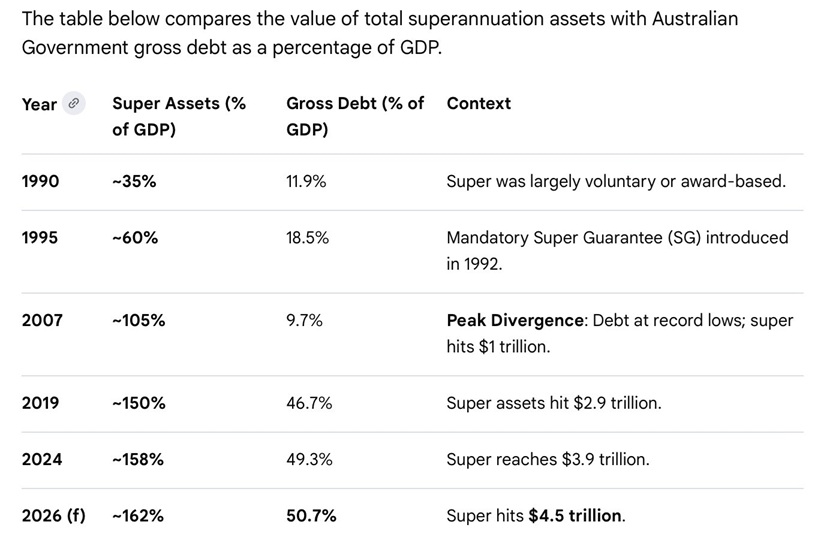

Source: AI, ChatGPT

The missed opportunity of superannuation capital

Australia’s superannuation system has grown into a multi-trillion-dollar pool of long-term capital. Yet much of that capital is invested offshore rather than deployed into domestic productivity-enhancing infrastructure.
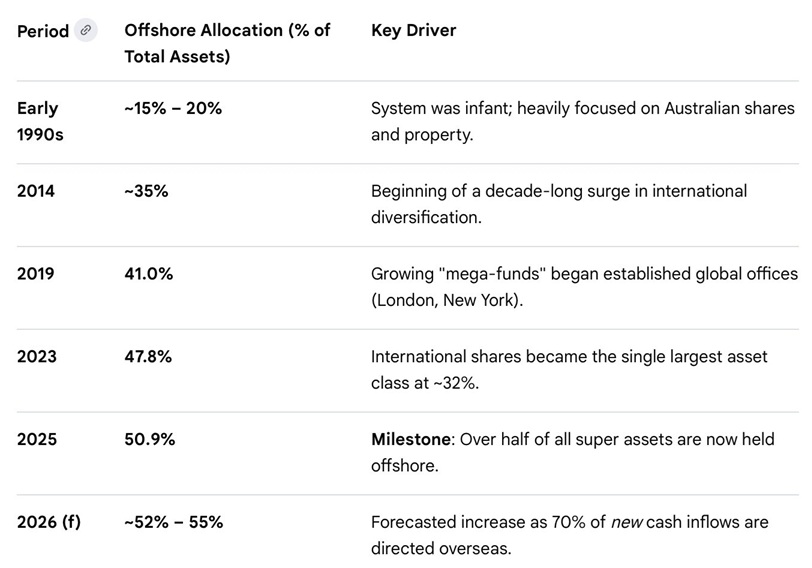

Source: AI, ChatGPT

This represents a structural mismatch:

  • Australia has abundant domestic savings.
  • Australia also faces substantial infrastructure requirements.
  • Yet policy settings have not effectively connected the two.

The result is that Australian retirement savings increasingly finance growth in foreign economies while domestic infrastructure investment remains constrained.

A simple example illustrates the opportunity cost. If Australia had financed major projects using domestic infrastructure bonds in the late 1990s—such as a dedicated rail link between Melbourne Airport and the CBD—the project cost would likely have been substantially lower than undertaking the same project three decades later.

The structural shift of the 1990s

The early 1990s recession was a defining period for Australia’s economic structure. Major banks and insurers faced technical insolvency and many highly leveraged property and industrial groups collapsed.

This environment created opportunities for international investment banks that entered Australia following financial deregulation in the 1980s and the emergence of large superannuation savings pools.

During this period:

  • Mutual organisations and cooperatives were demutualised and privatised.
  • Major Australian companies were taken private through leveraged buyouts.
  • Stable companies were advised to restructure ‘lazy balance sheets’.
  • Essential property assets were sold and leased back.

These activities were highly profitable for advisory firms but often transferred long-term value away from domestic balance sheets.

At the same time, government policy increasingly favoured asset privatisation. Major sales included:

  • Commonwealth Bank (second tranche)
  • Telstra
  • Major airports
  • Rail and freight assets
  • Transmission spectrum
  • Gold reserves

The result

Over time, these policy settings produced a structural outcome that is now increasingly visible.

Australia accumulated large private savings while simultaneously under-investing in national infrastructure and productive capacity.

The social consequences are also becoming evident.

Australia’s birth rate has been declining since the early 1990s—with only a brief interruption following the Costello ‘baby bonus’ in 2007. The long-term trend has continued downward.
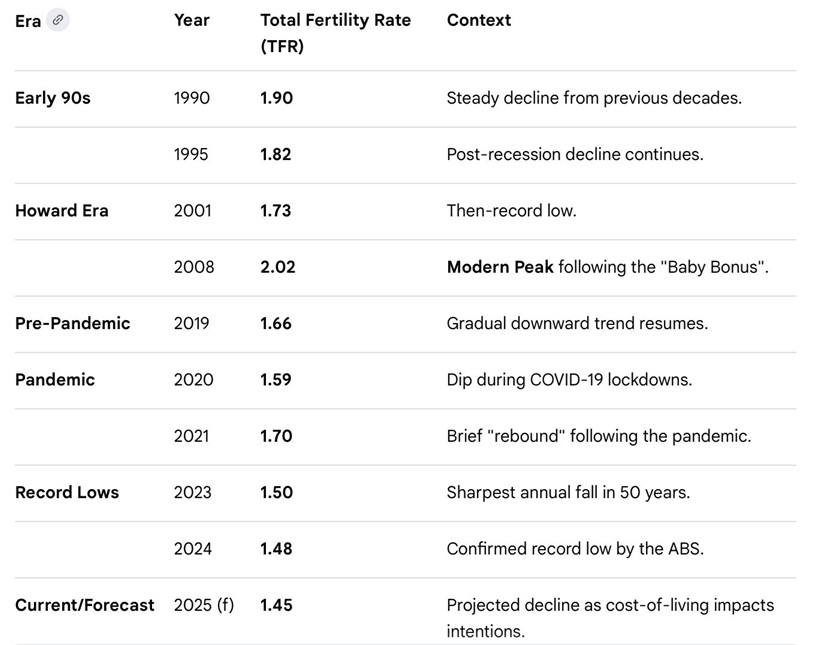

Source: AI, ChatGPT

At the same time:

  • Real wage growth has stagnated.
  • Productivity growth has slowed.
  • Younger generations face rising housing costs and declining economic security.

Policy responses have increasingly relied on higher immigration rather than addressing underlying productivity challenges.

Conclusion

The central issue raised by Costello’s commentary is not simply whether Australia has ‘wasted’ the past 20 years. The more substantive question is whether the policy framework established during the Howard–Costello era created structural weaknesses that are only now becoming visible.

The pursuit of minimal public debt became a dominant policy objective. Yet that objective was achieved through a combination of asset privatisation, reduced public investment and the failure to mobilise Australia’s growing superannuation capital toward national development.

The result was a paradoxical outcome: one of the world’s largest pools of long-term savings alongside persistent underinvestment in domestic infrastructure and productive capacity.

Rather than deploying debt strategically to fund national development, governments prioritised balance-sheet optics. The Future Fund itself illustrates this tension. While it was created to meet pension liabilities, its capital was not directed toward the type of infrastructure investment that could have expanded the productive base of the economy. It is not a true Sovereign Wealth Fund.

In retrospect, the question is not whether Australia eliminated debt, but whether the focus on doing so came at the expense of a broader national vision.

A strategy that combined moderate public borrowing, domestic superannuation capital and large-scale infrastructure investment may have produced a different outcome: higher productivity, stronger wage growth, and greater economic resilience.

The legacy of the past 30 years suggests that fiscal prudence alone is not sufficient. Without a coherent national investment strategy, a nation can maintain strong balance sheets while gradually eroding the foundations of long-term prosperity.


John Abernethy is Founder and Chairman of Clime Investment Management Limited, a sponsor of Firstlinks. The information contained in this article is of a general nature only. The author has not taken into account the goals, objectives, or personal circumstances of any person (and is current as at the date of publishing).

For more articles and papers from Clime, click here.


  •   11 March 2026
  • 22
  •      
  •   
22 Comments
Ben S
March 12, 2026

But productivity was higher during the Costello/Howard years with significantly lower government expenditure, lower taxes and little to no debt.

Now we have a housing crisis, a government spending and debt problem, runaway inflation, a productivity problem and significantly higher income taxes than the time period in question. People’s quality of living has decreased as well unless you are personally making use of NDIS or the health system regularly, ie generally older people or the disabled. Even the nation’s roads are now in a poor state.

The government has now gone into debt and spent a great deal on infrastructure without any corresponding increase in productivity. We need to start asking what is the best use of people’s income and business profits in terms of delivering outcomes for everybody and not just a select few. This is Costello’s point.

7
David Rohr
March 12, 2026

Excellent commentary and analysis by John Abernethy. It's distressing to see that Australia's vast pool of super capital, accumulated with the benefit of substantial tax concessions, is not being deployed towards long term investment in Australia and not just in infrastructure but also in R&D where Australia's performance is abysmal. Let's hope the May Budget will address these issues in a substantial way.

6
Nadal
March 12, 2026

The superannuation funds are not restricted from investing in Australian infrastructure. They would if the return hurdles / cost of capital could be met. Forcing our superannuation into investments that governments mandate does not get my support.

6
Sophie Blencowe
March 12, 2026

Brilliant article John. You highlight the epic failure of our political class over the last few decades. Unfortunately the damage done now seems irreversible.

4
Margaret Kirby
March 12, 2026

Excellent article.
To put it simply
How are we going to fix this?
We have had the wreckers in government who just don’t seem to know how it all works or have any idea on potential outcomes from what they have done to us all.

3
Steve
March 12, 2026

Clearly no easy answers but the standard theory in the past was governments managed sectors that were necessary but not economically attractive - services like roads, hospitals, telecommunication, postal services etc (the old Postmaster General). The private sector focused on more viable markets - manufacturing, agriculture, mining etc. Government has both sold off some of the service areas (to raise cash, not because of any great economic rationale), where the new owners want to make a profit where the government might have been content to break even, and now push their ideology into the private sector via various subsidies/tax breaks etc. And of course the welfare state. I don't think its too big a stretch to say our forebears who went through the depression and WW2 had a much more conservative attitude to debt and spending (credit cards themselves are only a product of the late 70's) and did not punish governments for not throwing money at them to win elections - it used to be a positive in an election to ask "where is the money coming from?" when one party or the other proposed a new expense. Now it's "why won't you match it?". No-one seems to ask that anymore. Ah the media, they have done wonders for our democracy! Not. Debt has become normalised. And I won't even go into the lies and BS around off-budget spending on things deemed "investments" by the government as a way of hiding the true state of their spending problems. We are in the era of instant gratification and a relatively healthy economy has allowed excessive government largesse to escape scrutiny. This could actually go on for many more years, but a day of reckoning will come, one day. Hope I'm not around, it will be ugly. Broke countries can't afford things like the NDIS where 16% of 6 year old boys are classed as "disabled" so they can access government funding. On hot days when we all shelter in air-conditioned comfort I often think how we would struggle if we had to endure the conditions of our grandparents or great grandparents. Perhaps we should change our flag, and just have a big Snowflake. Because we have become a country of snowflakes. Lazy, selfish and entitled. Lee Kuan Yew once predicted we would become the white trash of Asia. I reckon he was not far off the mark if we keep on this trajectory.

3
Jan H
March 12, 2026

Costello/Howard govt reduced debt by privatising many public assets. In Victoria, Kennett closed and sold schools which real estate agents sold for private profit. Closure of Kew Cottages just one example. Sale of rural and regional assets still angers country people. Kennett also privatised Govt-owned (i.e. people's asset) SEC and now our electricity bills are much higher due to new owners needing to make profits. The Latrobe Valley mines are an unmitigated disaster -huge chasms remain and rivers dying. The LV people still among the most disadvantaged in the Nation.
The state and federal Libs sold the family silver and gave our mineral resources to private companies, many foreign-owned. Joseph Stiglitz said that made us poorer. Compare Norway which established a Sovereign Wealth Fund which has paid for considerable social services for the people. Donald Horne was correct alright: The Lucky Country was ironic because Australia was/is a lazy, stupid country run by mediocre idiots. Just have to look at the mob we have now on both sides. Howard/Costello's debt reduction is now being felt by younger generation. Bit like Aesop's Ant and the Grasshopper. Howard/C the Grasshoppers extraordinaire! Norway the Ant, saving for the future. It is tragic and an utter disgrace

3
Cam
March 12, 2026

It seems that our super is invested overseas funding development in other countries, while other countries are investing in Australia and funding our development. If we changed that around we could end up in the same position, but much less diversification in our super investments, and the same for investors overseas.
The declining birth rate has occurred across all western countries and a range of other countries. So no link to 10 years of Howard/Costello.
Assets such as state banks, toll roads, polls and wires were state Government assets, and Qantas, Commonwealth Bank and CSL were sold under Federal Labor before Howard/Costello.
The stand out is the table showing net debt, which spikes during or just after each Labor Government and reduces during Liberal Government years.
An idea for super could be to have infrastructure trusts set up and people can invest through super or otherwise. A Newcastle/Sydney fast train could be funded that way, no doubt appealing to people living in Newcastle, as an example.

2
will stuart
March 12, 2026

The early comments below, sum up what angle this commentary is coming from:-
For example:

"Domestic oil refining capacity has declined to roughly 10% of national liquid fuel needs and with the Iran War this has exposed our nation to a potential oil shock; and
Energy generation and distribution has evolved into a fragmented public-private system with significant pricing and reliability challenges.
This raises the broader question: was eliminating public debt without a clear national investment strategy the optimal policy outcome?"

The above has all to do with political climate energy policies and nothing to do with sensible investment in infrastructure.

Debt based spending, ever increasing taxes, increasingly active unions and red tape strangling productivity, are what has severely damaged Australia.

2
Chris
March 12, 2026

All Labor governments fall into the same trap of pouring money into welfare services which is a good thing if done sensibly...however it is money that never gives a "return" on investment in most cases.I agree that this race to get to net zero is an absolute farce with respect to reducing climate effects when the likes of Trump,China and India continue to pollute the globe.Any investment which does not increase productivity is invariably "money down the drain" but government seems to care more about keeping the welfare community happy (and getting their vote)than concentrating on digging us out of the hole that is being dug deeper every year!!

1
Lauchlan Mackinnon
March 12, 2026

What this seems to ignore is that Howard and Costello were raking in mega-revenue from the mining boom, and largely giving it away in tax cuts. It was probably one of the easiest times in Australia’s history to balance a budget.

If the government now gets extra revenue like Costello did, other choices could become easier. For example, cancel the fossil fuel subsidy and bring in an extra $80B a year. Tax multinationals on local revenue, not profit, and bring in big dollars.

1
Lauchlan Mackinnon
March 12, 2026

Jan H's point that the Hawke / Keating and Howard / Costello governments also did a lot of privatisation is also relevant to balancing the budgets (in addition to the mining boom).

The biggest weakness of the Costello years was putting the massive proceeds from the mining boom into structural ongoing tax cuts instead of into a sovereign wealth fund.

Joanne
March 12, 2026

Post that same time period, the USA went from a net importer of oil to an net exporter of Oil, in the same time period the growth in the public service has grown significantly. The only real fact is the underperformance of Clime's performance and perhaps the author should focus on their investors. Of course this won't get the light of day.

1
Laurent
March 12, 2026

I disagree with most points:
* In the past 40 years, most Western countries (except Australia) have minimized the negative impacts of globalization on people by increasing the size of the welfare state. As a result, the US and EU have enormous debt to GDP ratios, which will clearly be the cause for the next big financial crisis. Luckily, Australia has a small (hum, reasonable) government debt and will be sheltered from the crisis to come.
* Australians rightfully complain about the "nanny state" without realizing that the welfare state is much bigger in the US and EU. The so-called "dole" or "sit down money" creates dependency and demoralizes people. The welfare state also creates fraud : see awful stories about NDIS scams starting to emerge.
* Yes, Australia may need more infrastructure, but as mentioned, "without a clear national investment strategy" the optimal policy is clearly to refrain from spending into useless (at best) or detrimental (at worst) schemes.

Robert
March 12, 2026

So what happens when AI and automation produce massive unemployment and we have a "Universal Income", who pays for that?

James#
March 12, 2026

Well according to AI:

"In a future where AI and automation lead to massive unemployment, the primary proposal for funding a Universal Basic Income (UBI) is to redistribute the massive wealth and productivity gains generated by those same machines.

The cost would likely be covered by a combination of the following mechanisms:

- Automation or "Robot" Taxes: Levies imposed on companies specifically for replacing human workers with automated systems, proportional to the labor costs they save.
- Corporate AI Profit-Sharing: Requiring dominant AI firms to contribute a percentage of their net profits into a public fund.
- Sovereign Wealth Funds (The "Alaska Model"): Directing revenues from AI-driven production into a public investment pool that pays out annual "AI dividends" to all citizens.
- Data and Algorithmic Rents: Fees charged to Big Tech companies for monetizing the massive amounts of user data required to train and run their AI models.
- Universal Basic Compute: A proposal by OpenAI CEO Sam Altman to distribute "slices" of computational power from large language models directly to individuals, which they could use or trade.
- Steeper Wealth and Capital Gains Taxes: Significantly higher taxes on the wealthy individuals and investors whose assets (robots and software) are generating the wealth previously created by human labor.
- Value-Added Tax (VAT): A tax on every stage of production for goods and services, with the revenue redistributed as a flat cash rebate to every household.

Dudley
March 12, 2026


"rather than deploying debt strategically to fund national development ...":

Deploy private and government capital instead? Government to raise capital by sell shares in state owned enterprises?

Steve
March 12, 2026

I'm not sure where this article is going. Seems to say the Howard Government built a strong financial platform for Australia to invest but didn't do the investing. Then we had 18 years of other governments (Labor and Liberal) that did not invest in Australia so let's blame John Howard for that? It seems like a solution may be to incentivize the Pension Funds and SMSF's to invest more in Australia?

Peter from the distance
March 12, 2026

Where it started to go pear-shaped was 30 years ago when Howard and Costello screwed us over. This is most likely due to the focus on debt reduction and the squandering of resources with a select few benefiting from reduction of the public's share of royalties and return on taxpayer investment in telecommunications, VET, tertiary education, and housing. This is in addition to the demonization of refugees, the influx of unqualified migrants and the surrender of sovereignty over international affairs to the USA. Deputy Sheriffs usually die in the movies .
The ALP were useless. Choosing Latham was an example of bottom of the barrel ALP NSW Right control. Abbott and Morrison were examples of the lack of depth in the Liberals, and the least said about Turnbull's character flaws the better.

We got what we deserved. Horne was so right.

Rod in Oz
March 12, 2026

Infrastructure??? The east coast Fast Train??? Where/when?
Melbourne Airport train???
Australia going downhill fast led by Victoria :(

john
March 12, 2026

Off topic but still very relevant
In regard to electricity and productivity. This issue is also worth debate and is just a fact.

The power retailers are ‘rent seekers’ who are basically ‘clipping the ticket’. Overall, thousands of personnel who do nothing to ‘get power to the door’. Such as; marketing, sales forces, advertising, large call centres, trading, tactical analysis, directors, CEOs, managements, administrations, I.T. depts, purchasing, personnel depts, safety, legal depts., multiple new plush CBD city offices. Having to 'lawyer up'. These ongoing costs are added to the actual flow from the generators to the user. Multiply the number of retailers by their internal departments. The costs are 'mind-blowing'. Many repetitions add enormous costs for the users with no added practical value.

A good idea to reduce electricity bills. Just do generation and transmission. Maybe redeploy staff into extra transmission for renewables.

Also I have seen householders' power bills where there is an extraordinary markup between the miniscule amount retailers pay per kwh in solar feed-in tariffs compared to what they charge the same people in the opposite direction. I know some that are receiving only 3 cents kwh feed in. Looks like the largest markup in the history of mankind


Leave a Comment:

RELATED ARTICLES

The bull case for Melbourne

Chalmers' disingenuous budget claims

Beware the bond vigilantes in Australia

banner

Most viewed in recent weeks

How cutting the CGT discount could help rebalance housing market

A more rational taxation system that supports home ownership but discourages asset speculation could provide greater financial support to first home buyers.

3 ways to fix Australia’s affordability crisis

Our cost-of-living pressures go beyond the RBA: surging house prices, excessive migration, and expanding government programs, including the NDIS, are fuelling inflation, demanding bold, structural solutions.

Is there a better way to reform the CGT discount?

The capital gains tax discount is under review, but debate should go beyond its size. Its original purpose, design flaws and distortions suggest Australia could adopt a better, more targeted approach.

Want your loved ones to inherit your super? You can’t afford to skip this one step

One in five Australians die before retirement and most have not set up their super properly so their loved ones can benefit from all their hard work and savings. 

Welcome to Firstlinks Edition 648 with weekend update

This is my last edition as Editor of Firstlinks. I’m moving onto a new role though the newsletter will remain in good hands until my permanent replacement is found.

  • 5 February 2026

Super is catching up, but ageing is a triple-threat

An ageing Australia is shifting the superannuation system’s focus from accumulation to the lifecycle of retirement. While these pressures have been anticipated for decades, they are now converging at scale and driving widespread industry change.

Latest Updates

Economy

Has Australia wasted the last 30 years?

The 20 years after Peter Costello left Treasury have been deemed wasted...by Peter Costello. The missed opportunities for Australia began long before.  

Retirement

Navigating the next stage of life in retirement

Retirement planning is more than just saving enough money. Long-term care needs, housing choices, and social networks are just as critical for a happy and enjoyable life.

Strategy

Showcasing your value in the age of AI shortcuts

Knowledge is becoming commoditized in the age of artificial intelligence but experience, taste, and judgement are still at a premium.

Planning

Financial advice as the pathway to economic security

Financial advice can lead to improved financial literacy, a healthier super balance and a higher standard of living in retirement. Is now the time to give yourself the gift of financial advice?

Economy

The overlooked driver of energy inflation

The impact of energy policy on inflation in Australia is often overlooked. Transitioning to renewable energy can lead to inflated costs that affect the entire economy and productivity growth.

Economy

A 2026 rotation story: Europe’s undervalued small caps

In 2026, Europe is poised for a 'Goldilocks' scenario with cooling inflation and lower rates, driven by fiscal stimulus. Small caps offer an attractive entry point before capital rotation.

Investment strategies

What we do when things go up (a lot)

Recent price spikes, particularly gold's surge, trigger behavioral responses like availability bias, storytelling, extrapolation, and FOMO, which create self-reinforcing feedback loops influencing investor sentiment and market trends.

Sponsors

Alliances

© 2026 Morningstar, Inc. All rights reserved.

Disclaimer
The data, research and opinions provided here are for information purposes; are not an offer to buy or sell a security; and are not warranted to be correct, complete or accurate. Morningstar, its affiliates, and third-party content providers are not responsible for any investment decisions, damages or losses resulting from, or related to, the data and analyses or their use. To the extent any content is general advice, it has been prepared for clients of Morningstar Australasia Pty Ltd (ABN: 95 090 665 544, AFSL: 240892), without reference to your financial objectives, situation or needs. For more information refer to our Financial Services Guide. You should consider the advice in light of these matters and if applicable, the relevant Product Disclosure Statement before making any decision to invest. Past performance does not necessarily indicate a financial product’s future performance. To obtain advice tailored to your situation, contact a professional financial adviser. Articles are current as at date of publication.
This website contains information and opinions provided by third parties. Inclusion of this information does not necessarily represent Morningstar’s positions, strategies or opinions and should not be considered an endorsement by Morningstar.