Register For Our Mailing List

Register to receive our free weekly newsletter including editorials.

Home / 644

How many hospitals will an extra 1 million people need?

A million people generate a lot of demand for things. Hospitals included. In Australia, we need on average 1 hospital bed for every 270 people, so that’s 3,703 beds for 1 million people. Based on a large hospital of say 500 beds, that’s roughly 7.5 hospitals for 1 million people.

Why is this of interest? Because we are about to add another million people to cities like Brisbane (by 2045), Sydney (by 2040) and Melbourne (by 2038). So, just to tread water, we should have the equivalent of around 7.5 new hospitals planned for each, otherwise we go backwards.

For some more context, an average new hospital bed in Australia costs around $1.5 million to $2 million. So those 3,703 extra beds for each major city are going to need something like $5.5 billion to $7.5 billion in new capital invested. That’s at today’s dollars.

We could ask the same for schools: roughly how many do we have for every 1 million people? The answer is somewhere between around 360 (250 of which are government schools and 110 non government). If we are to maintain schooling with the same range of choice and sized schools, and to maintain class sizes as they broadly are now, that’s a lot of schools.

At policy adviser, Suburban Futures, we recently modelled a number of options for new school designs in urban infill locations (even including a repurposed Bunnings style shed). The cost for a full P-12 school of 1,000 students was in all cases over $100 million. Not all schools are full P-12 formats with 1000 students, but even on conservative guesstimating, we are looking at maybe $5+ billion for 50 x P-12 size schools, plus just as much again for the remaining 300 schools of smaller size. Combined that’s another $10 billion, per city region, by 2040. A lot of money, let alone the challenge of finding the sites for them.

How will the extra 1 million people get around? If the current ratio of private cars to people doesn’t change, each city region will have another 600,000 cars on the roads. Plus, another 200,000 or so commercial vehicles doing commercial things. Should we put them underground with more road tunnels? A good idea, which costs roughly $1billion per kilometre (depending on in-ground conditions and surface portals). OK, let’s build more commuter rail track so that we won’t notice the traffic impacts of an additional million people. That’s also now around $1 billion per kilometre but will likely move fewer people than a road tunnel, so is arguably not going to have as much impact.

Need something to drink, flush the toilet, wash the car or do the laundry? There’s another 200 million litres per day for 1 million people, or 73 gigalitres per year. For context, that’s roughly 30,000 Olympic swimming pools worth of extra water, each year, for each city.

Been naughty? That will mean another 1,600 to 2,000 prison cells per million people. A prison cell isn’t cheap either – around $700,000 per cell not including the operational costs. There’s at least another $1.2 billion to house the criminal element that another 1 million population will generate.

We will also need another 4,000 police officers, 12,000 nurses, 1,000 firefighters and the workplace buildings to accommodate them.

Sadly, another 1 million people will also mean another 48 people will die on the roads. Promises to lower the road toll mean that, mathematically,  none of the extra 1 million will die on our roads and the toll for the existing population will fall. A noble and worthy ambition, but the maths is sadly challenging.

In amongst this are our housing targets. I’ve long maintained that housing should be the easiest types of structures to deliver. But we have made even that difficult. The plethora of codes and regulatory and planning approvals now needed are reflected in our worsening ability to match demand with supply. 
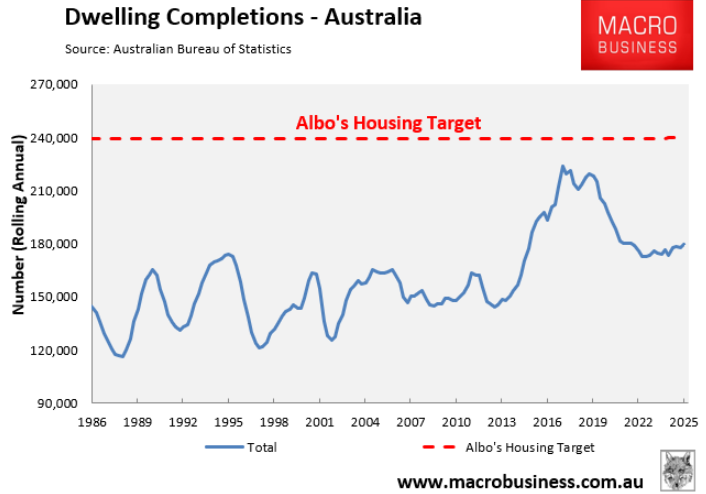
It now takes longer and costs more doing the very same thing than just 20 years ago. The Federal Government’s target of building 1.2 million homes over 5 years could most kindly be described as an aspirational target. At worst a lie. Either way, even when it comes to the simplest form on construction, our supply response is clearly lagging, and slowing. 

It's going to be interesting to watch how this growth challenge pans out. Much of our national dialogue is focused simply on population and housing. There’s quite a bit of attention also on the increasing traffic congestion experienced in our major centres. If we start to add to that obvious short falls in hospitals, schools, drinking water, corrections and any number of other things that are the direct consequence of growth, the debate could quickly go febrile.


Ross Elliot is an experienced strategist and advisor with over 35 years in urban development, infrastructure, and public policy. He currently chairs the Brisbane Lord Mayor’s Better Suburbs Initiative, is Director of not-for-profit urban research and policy organisation Suburban Futures, and takes on a number of industry engagements. This article was first published on Ross’s blog, The Pulse, and is reproduced with permission.


  •   7 January 2026
  • 10
  •      
  •   
10 Comments
Michael
January 08, 2026

Labor policy is for a big Australia, with high immigration. Labor planning for a big Australia, is bring the people in and someone else will take responsibility for building the infrastructure.

13
Robert G
January 08, 2026

Post pandemic, recent ABS stats show that in the previous 40 odd months, an average of around 1000 extra bodies arrived per day.
Where do they all live, work etc etc ?
The current infrastructure can''t cope now, so how can it be expected to cope in future with more arriving wiithout massive investment.
Who is footing the bill ?
Taxpayers of course, and a national deficit for the for decades to come.
When will this madness stop ?

13
Petet Taylor
January 08, 2026

Gun buy back in 1996 cost 500 million
Gun buy back in 2026 costs 1 billion.
Gun game is set to cost 1 million every week since 1996 while our ambulances remained ramped outside our hospitals.
A billion squandered in Gun buy back is unlikely to hinder our innovative terrorists

12
ACB
January 09, 2026

However, these extra people will be paying taxes, rates etc so the financial effect is not just the expenditure. I’d like to see a detailed cash flow analysis.

8
Robert G
January 11, 2026

I'd like to see a list of taxpayer funded benefits the new arrivals receive and the associated cash flow analysis.

2
Wildcat
January 09, 2026

More migrants means more votes for Labor, that's why it's occurring.

It's the new form of branch stacking..

8
Robert
January 08, 2026

The extra water will come from desalination. This requires a lot of electricity, which means water is going to get very expensive. Does Labor care, no of course not, they are doing just fine, great "pension" when they retire.

5
DougC
January 08, 2026

I can suggest where we could find $350B+ to fund all this and many other worthy causes - but it would require rationality and common sense in government policy; I won’t hold my breath on that one.

4
Adrian Pounsett
January 13, 2026

The above is why the government needs immigration. It keeps the economy growing. This provides more of everything. I suspect there Is not a country on earth that is not growing in population. If our population were to contract, there would eventually be empty shopping centres, empty schools, infrastructure decaying everywhere with not enough people paying taxes to keep the infrastructure in good condition, dare I say, even empty hospitals. Not a good outcome.


Leave a Comment:


RELATED ARTICLES

The evolution of our cities

An investing theme you can bet on for the next 30 years

Reality may be worse than the Intergenerational Report expects

banner

Most viewed in recent weeks

Building a lazy ETF portfolio in 2026

What are the best ways to build a simple portfolio from scratch? I’ve addressed this issue before but think it’s worth revisiting given markets and the world have since changed, throwing up new challenges and things to consider.

Meg on SMSFs: First glimpse of revised Division 296 tax

Treasury has released draft legislation for a new version of the controversial $3 million super tax. It's a significant improvement on the original proposal but there are some stings in the tail.

Ray Dalio on 2025’s real story, Trump, and what’s next

The renowned investor says 2025’s real story wasn’t AI or US stocks but the shift away from American assets and a collapse in the value of money. And he outlines how to best position portfolios for what’s ahead.

10 fearless forecasts for 2026

The predictions include dividends will outstrip growth as a source of Australian equity returns, US market performance will be underwhelming, while US government bonds will beat gold.

13 million spare bedrooms: Rethinking Australia’s housing shortfall

We don’t have a housing shortage; we have housing misallocation. This explores why so many bedrooms go unused, what’s been tried before, and five things to unlock housing capacity – no new building required.

10 things I learned about dementia and care homes from close range

My mother developed dementia before eventually dying in June last year. She was in three aged care homes before finding the right one. Here is what I learned along the way.

Latest Updates

Taxation

Is there a better way to reform the CGT discount?

The capital gains tax discount is under review, but debate should go beyond its size. Its original purpose, design flaws and distortions suggest Australia could adopt a better, more targeted approach.

Property

It's okay if house prices drop

The assumption that falling house prices are electorally fatal has shaped policy for decades. Evidence from upzoning suggests affordability can improve without reducing overall housing wealth.

Investment strategies

Investment bonds for intergenerational wealth transfer

Investment bonds can be a versatile and a tax-effective option for building wealth for longer-term investment goals. They can also be used as an estate planning tool, enabling the smooth transfer of wealth to younger generations.

Investment strategies

Why switching to income may make sense in 2026

Investors are jumpy as valuations continue to rise and income investing may provide a respite. In a challenging market for income investing AML offers their top picks.

Interviews

Retiring Schroders boss on lessons he’s learned, industry changes, and the market outlook

CEO Simon Doyle is retiring after 38 years in the finance industry. In an interview with James Gruber, he shares the three main lessons he’s learned, and where he sees opportunities and risks in markets today.

Investment strategies

How US midterm elections affect the markets

Investors may overlook the US midterms amid global events, but they could still impact markets. History shows markets react during midterm years, with increased volatility and lower returns. Will this year be any different?

Investing

Does increasing geopolitical risk lead to higher equity market returns?

Increasing geopolitical tensions has investors on edge but one study shows evidence of a war premium for equity markets.

Sponsors

Alliances

© 2026 Morningstar, Inc. All rights reserved.

Disclaimer
The data, research and opinions provided here are for information purposes; are not an offer to buy or sell a security; and are not warranted to be correct, complete or accurate. Morningstar, its affiliates, and third-party content providers are not responsible for any investment decisions, damages or losses resulting from, or related to, the data and analyses or their use. To the extent any content is general advice, it has been prepared for clients of Morningstar Australasia Pty Ltd (ABN: 95 090 665 544, AFSL: 240892), without reference to your financial objectives, situation or needs. For more information refer to our Financial Services Guide. You should consider the advice in light of these matters and if applicable, the relevant Product Disclosure Statement before making any decision to invest. Past performance does not necessarily indicate a financial product’s future performance. To obtain advice tailored to your situation, contact a professional financial adviser. Articles are current as at date of publication.
This website contains information and opinions provided by third parties. Inclusion of this information does not necessarily represent Morningstar’s positions, strategies or opinions and should not be considered an endorsement by Morningstar.