Register For Our Mailing List

Register to receive our free weekly newsletter including editorials.

Home / 669

The strange effect of the 30% minimum capital gains tax

In reference to the proposed new capital gains tax arrangements before parliament, Anthony Albanese told the House of Representatives post-budget that, “we’re moving towards the system that was in place before 1999 to tax real gains, not nominal gains.”

Except that that is not entirely true. Yes, indexing the capital cost base to inflation is being reinstalled to replace the 50% discount on realised capital gains, but the smoothing of gains over five years to alleviate the bunching effect of realising a lump sum in a single year has not been revived.

And a 30% minimum tax on real gains has been introduced that has never existed before, intended as a disincentive to investors realising gains in years of low marginal tax rates due to retirement or by design.

Although sketchy as to how the 30% minimum tax would work when announced, details of its calculation have now emerged.

In a multi-step procedure, the real capital gain is first multiplied by 30% to give the minimum capital gain tax liability. Tax liabilities are then calculated according to the current tax schedule, for both total taxable income including the gain, and for taxable income excluding the gain. If the difference is less than the minimum CGT liability determined prior, then top-up tax to that minimum applies.

A numerical example using the 2025-26 tax schedule:

A real capital gain of $50,000 is realised in a year with $40,000 of additional taxable income.

The minimum CGT liability would be 30% x $50,000 = $15,000.

Tax on the $90,000 total income would be $17,788.
[$4,288 plus 30c for each $1 over $45,000]

Tax on the $40,000 non-capital gain income would be $3,488.
[16c for each $1 over $18,200]

$17,788 - $3,488 = $14,300, which is less than the minimum CGT liability by $700.

$700 top-up tax applies. Which represents 4.7% of the total tax liability.

If however, there was no other income in the year, tax on the $50,000 gain under the tax schedule would be $5,788. Top-up tax in that instance would therefore be $9,212, or 61.4% of the total tax liability, which highlights the punitive nature of the new 30% minimum tax on gains.

Focusing on gains without other income in a tax year, top-up tax rises steeply with small gains, peaking at $9,212 for gains from $45,000 to $135,000, which coincides with the 30% marginal tax rate band. From $135,000 it begins to run down, reaching zero on a gain of $225,746, the point at which the effective tax rate on income is 30%.

In percentage terms, on a standalone gain of $45,000, top-up tax represents 68.2% of the total tax liability, running down to 22.7% at $135,000, and ultimately 0% at $225,746.
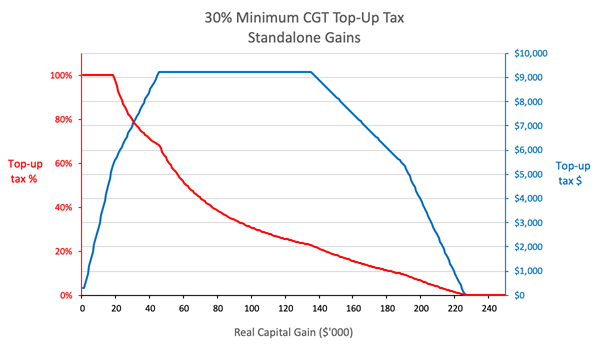
This is a strange pattern. The top-up tax starts out progressive, becomes a virtual flat tax for a $90,000 stretch to $135,000, and from that point is steeply regressive as the top-up tax slides down to $0 at $225,746 and beyond. This tax element creates a reverse-progressive situation for the mid- to upper-tax brackets where the top-up tax falls as the size of the gain increases.

And even if you consider a high-income year with a large gain, let’s say a $200,000 salary with a $250,000 real gain. The gain sits entirely within the 45% marginal tax bracket, attracting $112,500 tax. If the gain was deferred to a year of no income, tax on the gain would fall to $78,638, with no top-up tax because the 30% floor is already exceeded. The tax liability drops by about $34,000, with the effective tax rate falling to 31.5%. The incentive to defer the gain remains enormous, with the 30% minimum tax ceasing to have any effect at this level.

This doesn’t look like a system that would disincentivise those with successful investments, to cash in during years of low other income. Yet the Budget Explainer says that the policy "reduces the benefit of taxpayers deferring capital gains realisation to years where their marginal tax rates are low."

It is a system with a virtual separate capital gains tax schedule superimposed on the ordinary income tax schedule. It takes the 0% and 16% bands and replaces them with 30%. The 30% band is untouched, but then inexplicably, the 37% band drops down to 30%, and even the 45% band drops to 30% for standalone gains between $190,000 and $225,746, before reverting back to 45% beyond that.

When the minimum tax was announced without calculation detail, I had assumed that logically, it would be applied by simply replacing the 0% and 16% brackets with 30% exclusively for capital gains. That would mean a flat 30% for the first $135,000, then leave the 37% and 45% brackets unchanged.

Such an approach would still see the top-up tax peak at $9,212 on a standalone gain of $45,000, but it would be maintained at that amount, and never run-off no matter the size of the gain. And while the size of this penalty would be insufficient to eliminate the incentive to defer larger gains, at least it would reduce that incentive. This system would:

  • avoid regressivity.
  • maintain a penalty at higher gains.
  • ensure a deterrent for deferral of gains, no matter the size.
  • simplify the application of the 30% minimum tax without the need for a clumsy multi-step procedure.

Instead though, we have a policy design that uses a flat-rate floor to fix a perceived problem with income timing strategies, but which in the end contradicts the intention of the Bill. Smaller gains suffer reduced progressivity, while larger gains continue to have a pathway to time realisations to their advantage.

Even though the tax package has now passed the Senate, the government continues to bow to pressure and make changes to the legislation. Let’s hope this contentious 30% CGT floor is also under consideration for a rewrite.


Tony Dillon is a freelance writer and former actuary. This article is general information and does not consider the circumstances of any investor.


  •   1 July 2026
  • 25
  •      
  •   
25 Comments
Peter
July 02, 2026

You are funny Richard. I don't see anything wrong with any of Dillon's examples.

1
Angry
July 02, 2026

+1 agree, this 30% minimum on CGT is not good, and needs to be reviewed. In our family, we have people who would be unfairly targeted (examples 1 and 3). Neither own houses and are saving for that, and the CGT minimum is vindictive.

GeorgeB
July 02, 2026

Its a shameless cash grab by a government that is both financially and morally bankrupt while being dressed up as a lifeline to first home buyers and likely to end in tears for all concerned but especially long term renters.

18
TMac
July 02, 2026

Lies lies and more lies, these changes are nothing more than a tax grab to pay for their record spending

18
Nicholas O'Connor
July 02, 2026

this is just further proof that the legislation was rushed by people with no investment or commercial experience, and no regard for non-political consequences.
Let's now hope for early political consequences which demand a re-write of the whole budget tax package by persons qualified to do so.

16
Colin Randell
July 02, 2026

Clearly the 30% CGTis an attack on self funded retirees whose assets are slightly above the threshold for a Centrelink pension. This cohort are constantly referred to as "wealthy investors" but many of them have incomes not far above the pension level. Then if they need to sell assets (often accumulated over a lifetime of working and paying tax) to help pay for cost of living increases any capital gain attracts 30% tax thus eliminating the tax free threshold and the 16c tax bracket.
And this is after being promised prior to the last election that there would be no changes. "My word is my bond" comes to mind

9
Phillip Stewart
July 02, 2026

Richard

Nothing further on the CGT comments.

However I struggle a bit with your comment "the real source of tax abuse, being discretionary trusts,". I am OK with the trust being a taxing point, (at a flat 30%) but not creating a refundable credit in the hands of the recipient beneficiary is mischievous - at best - and could potentially target the demographics you refer to in your examples. As has been well publicised, the company franking credit system allows for refunds of tax already paid at the corporate level. The tax on discretionary trusts should operate the same way.

7
Nadal
July 02, 2026

What was once done in a discretionary trust, will now be done in a SMSF (only problem then is the cash needs to be untouched until preservation age).

Richard Lyon
July 02, 2026

Phillip,

The problem of the abuse of discretionary trusts is well known. It desperately needs to be fixed. A refundable credit adds complexity but doesn't change the outcome, except perhaps at the edges (such as bringing some trusts into the net that are somehow outside it at the moment).

It is hugely disappointing for those who use them properly, of course, but they are very much in the minority. Even otherwise upstanding people specifically and deliberately use them to reduce tax. Certainly, I've done so. Small scale, but still...

davidy
July 02, 2026

Does anybody in Canberra and Treasury understand how these changes work - it is simply mind boggling (actually scary) at the lack of understanding.

And how will a capital loss work ?

6
Neil
July 02, 2026

Thanks Tony, another clearly written article from you. My question is not directly arising from your article but is related.
Can anyone please tell me if the 30% minimum on CGs will apply to the CG component of distributions from managed funds and ETFs? If so, for those of us in the zero or 16% tax bracket it would seem to put these investments at a significant disadvantage compared to LICs, especially for small cap funds whose returns are mostly capital gains.

4
Peter
July 02, 2026

Best comment yet Neil. Relevant to many more people.

1
Stephen
July 02, 2026

Hi Peter, that’s correct but it’s 30% tax rate for companies with passive income over 80% of income.

I’m assuming that the company will be established for investment purposes and therefore over 80% of income will be passive income.

Trevor
July 02, 2026

Hi Neil,
Hopefully this is an unintended consequence that will be rectified?

1
Bryan
July 02, 2026

Treasury lacks the internal knowledge and experience to understand complex taxation issues. So, it has been outsourced to the likes of PWC and KPMG. We know how that has gone.

2
Jim Bonham
July 02, 2026

Thanks for the article Tony.
This adds another useful insight into the very peculiar 30% minimum CGT.

In many ways it reflects the characteristics of the entire budget, at least with regard to capital gains: poorly thought through with very limited analysis; guided more by philosophical prejudice than analysis; misleading justification (whether deliberately so, or based on ignorance); difficult to understand, with complex implications; targeting the wrong people. The list goes on.

1
Stephen
July 02, 2026

The 30% tax on capital gains and the 30% non refundable tax on discretionary trust distributions will make companies the default investment vehicle of choice.

A investment company pays 30% tax on profits but that tax creates a refundable franking credit that can be streamed over time to shareholders when they are in low tax brackets.

If all shareholders have incomes below a marginal tax rate of 30% the tax paid by the company will be partially or fully refunded.

Peter
July 02, 2026

Stephen
Base rate companies pay tax at 25%.

James #
July 02, 2026

"If all shareholders have incomes below a marginal tax rate of 30% the tax paid by the company will be partially or fully refunded."

If Labor get another term there is every chance they'll have another crack at franking credits. The changes to negative gearing and CGT were all part of Shorten's (Labor Caucus) agenda. Franking credits are unfinished business. They've learnt from their mistake of taking contentious changes to an election. I'm sure the Greens will support such a change in The Senate.

The attack on self funded retirees, aspiration and wealth continues.

Perhaps the most egregious change is Labor's mindset that income from work and income from capital should be taxed the same. They should not. All other countries recognise this to encourage investment and acknowledge that the money invested to earn income is after tax income and is at risk of partial or full loss.

3
Fabio
July 02, 2026

Tony I'm shocked at how this minimum 30% minimum tax rate on CGs will be calculated.

Can you please advise where the government /treasury has explained their methodology? It seems ill-considered so just wondering if this is still a work in process.

Tony Dillon
July 02, 2026

Hi Fabio. The methodology can be found in the following link to the Explanatory Memorandum of the Treasury Laws Amendment (Tax Reform No. 1) Bill.

It is a seven-step process outlined at section 1.180

https://parlinfo.aph.gov.au/parlInfo/search/display/display.w3p;query=Id%3A%22legislation%2Fems%2Fr7493_ems_a90ad43e-17d7-4cd3-859b-84ac4e6f3dea%22

D Ramsay
July 02, 2026

Colin has hit an extremely important point.
..."many of them have incomes not far above the pension level. Then if they need to sell assets (often accumulated over a lifetime of working and paying tax) to help pay for cost of living increases any capital gain attracts 30% tax thus eliminating the tax free threshold and the 16c tax bracket."

Chalmers said explicitly on TV - "a flat 30% on all cgt will stop people from waiting to dispose of assets until their income is low" .....
Oh der ... brainiac treasurer...the reason we hold assets into our older years is so that we can sell them (i.e. draw down money to live on stupid) to support ourselves. We are not all on $100K - $200K+ pensions paid by the tax payer like you pollies are

Doug
July 02, 2026

Tony, thanks for your insights about the implementation of this indeed strange tax. Is the minimum 30% tax considered for each realised asset sale or the combined gains from all sales? For instance is the tax on selling 10 different shares each enjoying say a gain of $20,000 the same as say selling one single large share (or property) with a $200,000 gain? From your great chart, it looks like there isn't much additional "top up" tax on a $200,000 gain (maybe $1000) but there is a larger $5,000 top up on a small $20,000 gain you wouldn't want to pay 10x.

Tony Dillon
July 02, 2026

Hi Doug. Great question. One's tax liability is determined on an aggregated, annual basis. So ten $20k individual gains would be treated the same as a single $200k gain, if all were realised in the same year.

If however, you were to realise the $20k gains in different years (no other income), say across ten years, then yes, top-up tax would amount to 10 x $5,712 = $57,120 which would be 95.2% of the total tax paid across the ten years of $60,000. Without the 30% minimum, a total of only $2,880 would be paid over the ten years.


Leave a Comment:

RELATED ARTICLES

Budget tax changes only scratch the surface. Here are 4 reforms Australia needs next

What might the Tax White Paper say on imputation and CGT?

Is the government being honest with us about its business CGT changes?

banner

Most viewed in recent weeks

How to minimise tax with a will

Inheritance tax implications in Australia may surprise some, as poor estate planning without proper wills or trusts can lead to costly tax bills and delays for beneficiaries.

Testamentary trusts post-budget: Estate planning, tax reform and the ‘death tax’ debate

Proposed Budget changes to taxation are casting new uncertainty over testamentary trusts, prompting closer scrutiny of estate planning structures and the real implications of reforms still taking shape.

Meg on SMSFs: The CGT changes don’t impact super but what about Div 296 tax decisions?

New CGT rules could tip the scales in the super vs non-super debate. For those facing the Division 296 tax, the case for withdrawing has gotten more complex. A "comparison rate" tool may help assess decisions.

High quality businesses are on sale

Beneath the dominance of the ASX's largest stocks, much of the market has been left behind. High-quality companies are now trading at levels rarely seen, offering opportunities for investors willing to look deeper.

The investment mistake killing your returns

Retail investors face an increasingly complex product environment, but simplicity may be the most overlooked advantage in building a portfolio you can actually live with.

Welcome to Firstlinks Edition 667 with weekend update

The downfall of the giant and three lessons for investors.

  • 18 June 2026

Latest Updates

SMSF strategies

Meg on SMSFs: How wide is the ban on LRBAs?

The government's recent deal with the Greens has put SMSF property borrowing on the chopping block. The change raises tricky questions about timing, exceptions and what SMSFs will still be able to buy.

Shares

Why Australian shares are falling behind the world

Australia’s market boasts a long record of outperformance, but recent results tell a different story. Is the ASX’s lagging performance a temporary setback or evidence that structural forces will keep global markets ahead?

Taxation

The strange effect of the 30% minimum capital gains tax

The 30% minimum tax on capital gains sits at the heart of the budget's proposed reforms. Yet the mechanics reveal anomalies that introduce unexpected distortions that raise questions about its design.

Shares

The next phase of Australian equity leadership

For years, banks have powered Australian sharemarket returns. But changing economic conditions, stretched valuations and global trends suggest the next generation of winners may not be found in familiar domestic sectors.

Economy

Global market growth hinges on Iran War and AI rollout

Global growth is facing mounting pressure from war, higher oil prices, inflation and trade tensions. But a wave of AI-related investment may prove powerful enough to support economic activity and reshape the outlook for markets.

Retirement

The retirees who can't spend

Why do so many retirees pass away with their wealth intact? Conventional wisdom blames pension rules for the reluctance to spend, but a case study from New Zealand shows that the answer may not be as predictable.

Investment strategies

Here’s my investment philosophy. What’s yours?

Investors often hear they need an “investment philosophy,” yet few know what that really means. Beneath the jargon sits a simple idea: a handful of core beliefs that shape every financial decision, for better or worse.

Sponsors

Alliances

© 2026 Morningstar, Inc. All rights reserved.

Disclaimer
The data, research and opinions provided here are for information purposes; are not an offer to buy or sell a security; and are not warranted to be correct, complete or accurate. Morningstar, its affiliates, and third-party content providers are not responsible for any investment decisions, damages or losses resulting from, or related to, the data and analyses or their use. To the extent any content is general advice, it has been prepared for clients of Morningstar Australasia Pty Ltd (ABN: 95 090 665 544, AFSL: 240892), without reference to your financial objectives, situation or needs. For more information refer to our Financial Services Guide. You should consider the advice in light of these matters and if applicable, the relevant Product Disclosure Statement before making any decision to invest. Past performance does not necessarily indicate a financial product’s future performance. To obtain advice tailored to your situation, contact a professional financial adviser. Articles are current as at date of publication.
This website contains information and opinions provided by third parties. Inclusion of this information does not necessarily represent Morningstar’s positions, strategies or opinions and should not be considered an endorsement by Morningstar.