Register For Our Mailing List

Register to receive our free weekly newsletter including editorials.

Lessons for investors from unconventional monetary policy

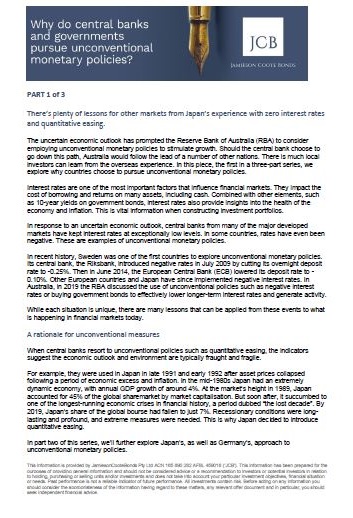
This whitepaper brings together JCB's three-part series exploring the effect of unconventional monetary policies on economies and financial markets.

Part 1 - Why do central banks and governments pursue unconventional monetary policies?

In this piece, the first in a three-part series, we explore why countries choose to pursue unconventional monetary policies.

Part 2 - Unconventional monetary policy: Japan and Germany’s experience

The second part explores the backdrop to the decision by these countries to embark on zero and negative interest rates and quantitative easing.

Part 3 - Lessons for investors from unconventional monetary policy

The final piece looks at the impact unconventional monetary policies have had on different asset classes, with a special focus on sovereign bonds.

Read more...
  •   5 March 2020
  •      
  •   


Leave a Comment:

banner

Most viewed in recent weeks

How cutting the CGT discount could help rebalance housing market

A more rational taxation system that supports home ownership but discourages asset speculation could provide greater financial support to first home buyers.

Is there a better way to reform the CGT discount?

The capital gains tax discount is under review, but debate should go beyond its size. Its original purpose, design flaws and distortions suggest Australia could adopt a better, more targeted approach.

Want your loved ones to inherit your super? You can’t afford to skip this one step

One in five Australians die before retirement and most have not set up their super properly so their loved ones can benefit from all their hard work and savings. 

Welcome to Firstlinks Edition 648 with weekend update

This is my last edition as Editor of Firstlinks. I’m moving onto a new role though the newsletter will remain in good hands until my permanent replacement is found.

  • 5 February 2026

Super is catching up, but ageing is a triple-threat

An ageing Australia is shifting the superannuation system’s focus from accumulation to the lifecycle of retirement. While these pressures have been anticipated for decades, they are now converging at scale and driving widespread industry change.

Meg on SMSFs: Last word on Div 296 for a while

The best way to deal with the incoming Division 296 tax on superannuation is likely doing nothing. Earnings will be taxed regardless of where the money sits, so here are some important considerations.

Latest Updates

Taxation

3 ways to defuse intergenerational anger

With the upcoming budget increasingly likely to include bold proposals to alter the tax code I’ve outlined three incremental steps with fewer unintended consequences.

Economy

Why an extended US-Iran war will punish mortgage holders

The impact of the Iran War is far more than expensive petrol. Higher oil prices have secondary inflationary impacts that reverberate throughout the economy which could be bad news for Australians with mortgages.

Infrastructure

Don’t forget the yield

Global Listed Infrastructure dividends are forecast to grow 5-6% p.a over the next two years. After a hiatus, share buybacks are back on the agenda and will play an integral role in shareholder returns.

Iran war hands politicians free ticket to blame oil prices for inflation

Past oil shocks offer lessons for investors dealing with the fallout from the Iran War and the ongoing impact on inflation.

Economy

Japan 2026: A new PM heralds a new golden age?

Former Australian Prime Minister, Paul Keating, once said "When you change the government, you change the country." We're about to see whether that holds true in Japan.

Investment strategies

Why are central banks moving from US Treasuries to gold?

Central banks now hold more gold reserves than US Treasuries, signalling a shift in safe-haven asset strategy and portfolio diversification as geopolitical risks increase.

Strategy

Has global human wellbeing peaked? What the data reveals

Historically economic progress is measured by GDP growth but there is an increasing body of work that explores quantitative measures of wellbeing.

Sponsors

Alliances

© 2026 Morningstar, Inc. All rights reserved.

Disclaimer
The data, research and opinions provided here are for information purposes; are not an offer to buy or sell a security; and are not warranted to be correct, complete or accurate. Morningstar, its affiliates, and third-party content providers are not responsible for any investment decisions, damages or losses resulting from, or related to, the data and analyses or their use. To the extent any content is general advice, it has been prepared for clients of Morningstar Australasia Pty Ltd (ABN: 95 090 665 544, AFSL: 240892), without reference to your financial objectives, situation or needs. For more information refer to our Financial Services Guide. You should consider the advice in light of these matters and if applicable, the relevant Product Disclosure Statement before making any decision to invest. Past performance does not necessarily indicate a financial product’s future performance. To obtain advice tailored to your situation, contact a professional financial adviser. Articles are current as at date of publication.
This website contains information and opinions provided by third parties. Inclusion of this information does not necessarily represent Morningstar’s positions, strategies or opinions and should not be considered an endorsement by Morningstar.