Register For Our Mailing List

Register to receive our free weekly newsletter including editorials.

Home / 680

Welcome to Firstlinks Edition 680

  •   17 September 2026
  •      
  •   

Australians appear to be far more pessimistic about retirement before they get there, than after they arrive.

The latest findings from Vanguard reveal that retirees were considerably more likely to express positive sentiment toward retirement than working-age Australians. In some respects, retirement may turn out better than many people fear.

The report suggests this might reflect the advantages many existing retirees enjoy, such as greater accumulated savings, lower levels of debt and clearer retirement plans. That is hardly surprising, but is this gap is misplaced pessimism or a genuine structural shift?

Higher expectations

Working-age Australians increasingly believe retirement will require exceptionally high income levels, exceeding $90,000 per year for a household among younger cohorts. Meanwhile, today's retirees report far lower income needs. For context, the ASFA Retirement Standard estimates the cost of a comfortable retirement as $55,923 per year, or around $1,071 a week. 
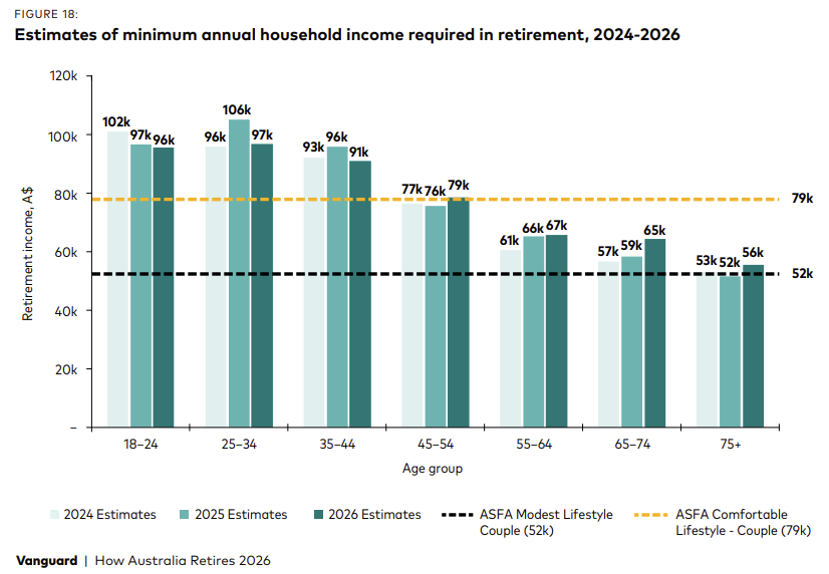
One could argue that social perceptions of retirement have shifted from achieving financial security to achieving something closer to financial abundance. Though I don’t believe the story is simply one of unrealistic expectations.

The role of housing debt

To some extent, younger Australians may be justified in their concerns. Around 61% of respondents identified having little or no debt as an important contributor to retirement confidence. But many younger Australians are unlikely to have the same starting position as current retirees.

Where previous generations viewed retirement as a period free from major financial obligations, younger Australians increasingly expect those obligations to follow them into retirement itself. To me, this is the more consequential notion buried in the survey.

For decades, Australia's retirement system has rested on the implicit assumption that retirees own their homes outright, but this appears to be increasingly fragile.

Nearly half of Gen Z respondents and over a third of Millennials expect to retire with a mortgage. Many also expect to continue paying down debt during retirement or to use superannuation to extinguish it. If these expectations prove correct, it will represent a profound change in the way retirement is funded and experienced.
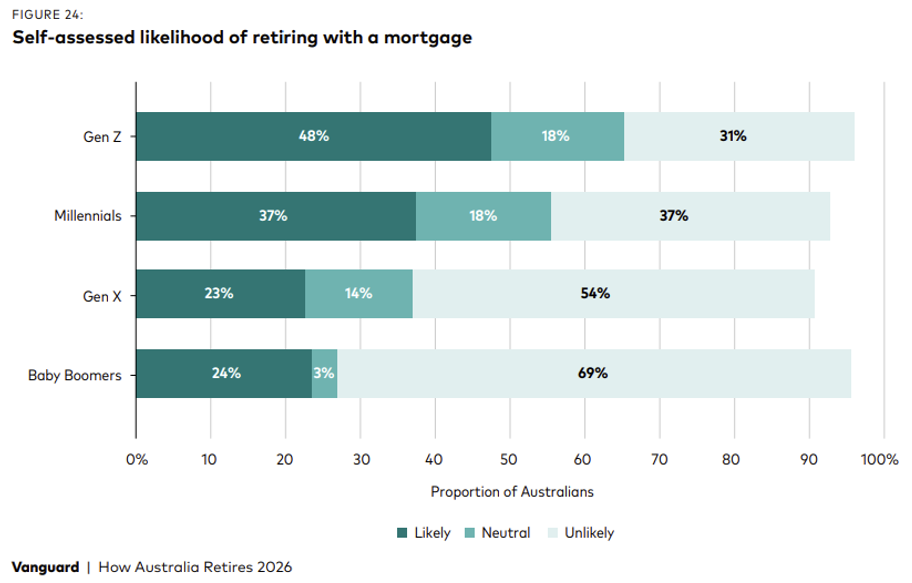
Among those who believe they will retire with a mortgage, almost 40% expect to use their super to pay off that debt as part of their transition into retirement.

This may seem perfectly rational as eliminating debt before or at the beginning of retirement can dramatically improve cash flow and financial security. Yet it also highlights a shift in the role of superannuation itself. A vehicle for generating income may increasingly become a way to repair household balance sheets.

More broadly, it raises questions about how retirement adequacy should be measured. Two retirees with identical balances can face vastly different realities if one owns their home outright while the other is still servicing debt.

There is also a wider policy implication. For years, the assumption has been that compulsory super would lessen dependence on the Age Pension. Yet if a growing share of retirement savings is diverted toward mortgage repayment, the outcome may be more complex than anticipated.

While converting superannuation into home equity may improve Age Pension eligibility, it also leaves retirees with less capital available to generate income. Either way, the assumptions underpinning much of our retirement planning warrant a closer look.

Simonelle Mody

Also in this week's edition...

Testamentary trusts have survived the trust tax. Rachael Rofe is back to reveal a hidden technical detail that could still force many families to rethink wills

Shani Jayamanne models how the recent tax changes complicate the task of rebalacing your portfolio

Ashley Owen shares a chart that reveals how population growth is masking Australia's productivity problem

Despite eyewatering returns from mega-caps, Robert M. Almeida and Ross Cartwright discuss why tomorrow’s winners may not be today’s index leaders

Sometimes the important information in an earnings result isn't the number itself. Jarrad Stuart explains why an earnings beat might reveal about future returns

Michael Hallinan details a rarely discussed detail buried in SMSF structures could dramatically change who wears the cost when something goes wrong.

Buying global shares means making a bet on both the companies and on the Australian dollar. Trevor Schmid shows how the second bet cost investors 8.5% in the last financial year. 

Curated by Simonelle Mody and Leisa Bell

A full PDF version of this week’s newsletter articles will be loaded into this editorial on our website by midday.

Latest updates

PDF version of Firstlinks Newsletter (coming soon)

Monthly Gold ETF Flows from World Gold Council

Monthly Bond and Hybrid updates from ASX

Monthly Investment Products update from ASX

Listed Investment Company (LIC) Indicative NTA Report from Bell Potter

ASX Listed Bond and Hybrid rate sheet from NAB/nabtrade

Plus updates and announcements on the Sponsor Noticeboard on our website


  •   17 September 2026
  •      
  •   


Leave a Comment:

banner

Most viewed in recent weeks

Will you run out of money in retirement?

Fear of running out has become a defining retirement anxiety. Why do some retirees die with substantial wealth while others deplete their nest egg? Evidence suggests the answer is more complicated than we think. 

Why spending more in early retirement can improve lifetime income

Conventional wisdom encourages retirees to preserve superannuation. But if those likely to qualify for the Age Pension later in life spend a little more today, it may deliver higher lifetime income and a more stable retirement.

The investment that sidesteps the new tax traps

Tax rules have changed, but many investors are still using yesterday’s strategies. Insurance bonds may offer advantages for those seeking greater control, tax efficiency and certainty about their wealth.

Testamentary trusts have secured the CGT exemption

Treasury’s latest CGT reform draft delivers a win for testamentary trusts and deceased estates, exempting estate-derived gains from the 30% floor. However, questions on death and divorce rollovers remain unresolved.

Meg on SMSFs: What do we think about reversionary pensions these days?

Reversionary pensions have long been a staple of SMSF estate planning, but are they still the best option? Meg Heffron revisits a once-clear favourite and asks whether changing super rules have shifted the balance.

Welcome to Firstlinks Edition 674 with weekend update

What begins as appetite, grows into excess and ultimately ends in spectacle. Millions of investors just discovered this the hard way.

  • 6 August 2026

Latest Updates

Planning

Testamentary trusts survived the trust tax. The drafting battle has just begun.

The fight over testamentary trusts looked settled. Then the draft legislation arrived. Hidden in a technical detail is a question that could force many families to rethink wills they thought were already future-proof.

Investment strategies

The new capital gains tax trap for your portfolio

Investors have long accepted one portfolio rule without much question. A major tax shift could change that calculation entirely, forcing difficult trade-offs between risk, discipline and an overlooked cost lurking beneath.

Economy

Population growth masks Australia’s productivity problem

For years, investors have benefited from a seemingly reliable growth story. But recent national accounts raise uncomfortable questions about what has really been driving Australia’s economy and whether that can continue unchecked.

Investment strategies

Why tomorrow’s winners may not be today’s index leaders

The stocks that built retirement balances over the past decade now dominate many portfolios. The new challenge is whether these companies can continue meeting the increasingly high expectations embedded in today's share prices.

Investing

What earnings surprises reveal about future returns

Sometimes the most important information in an earnings result isn't the number itself. It's the possibility that the market's assumptions have been fundamentally wrong and future earnings may look very different.

SMSF strategies

Individual SMSF Trusteeship directly liable for ATO fines

A rarely discussed detail buried in SMSF structures could dramatically change who wears the cost when something goes wrong. With penalties rising, a decision many dismissed as administrative may deserve a second look.

Investment strategies

The currency bet you didn’t know you made

Buying global shares means making two bets: on the companies and on the Australian dollar. Most investors consciously choose only the first. Last financial year, the second bet cost 8.5% in returns for many investors.

Sponsors

Alliances

  • ASA-Logo-RGB-ActiveGreen-web.png

© 2026 Morningstar, Inc. All rights reserved.

Disclaimer
The data, research and opinions provided here are for information purposes; are not an offer to buy or sell a security; and are not warranted to be correct, complete or accurate. Morningstar, its affiliates, and third-party content providers are not responsible for any investment decisions, damages or losses resulting from, or related to, the data and analyses or their use. To the extent any content is general advice, it has been prepared for clients of Morningstar Australasia Pty Ltd (ABN: 95 090 665 544, AFSL: 240892), without reference to your financial objectives, situation or needs. For more information refer to our Financial Services Guide. You should consider the advice in light of these matters and if applicable, the relevant Product Disclosure Statement before making any decision to invest. Past performance does not necessarily indicate a financial product’s future performance. To obtain advice tailored to your situation, contact a professional financial adviser. Articles are current as at date of publication.
This website contains information and opinions provided by third parties. Inclusion of this information does not necessarily represent Morningstar’s positions, strategies or opinions and should not be considered an endorsement by Morningstar.