Tax is one of the few subjects capable of producing near-universal dissatisfaction.
For all the heat generated by ongoing debates, Australians actually appear relatively united on the outcomes they value, though considerably less on how those outcomes should be funded.
Per Capita's Tax Survey tracks community attitudes towards taxation and public spending over time. One important caveat is that these results were collated before the May 2026 Federal Budget, so they shouldn't be interpreted as a verdict on the latest reforms, but rather, a snapshot of the period immediately beforehand.
A nation in the mirror
One of the more enduring findings in the survey relates to self-perception. Nearly half of the respondents continue to describe Australia as a high-tax, big-government country and this has remained relatively stable for over a decade. The consistency of this view is arguably more interesting than the result itself.
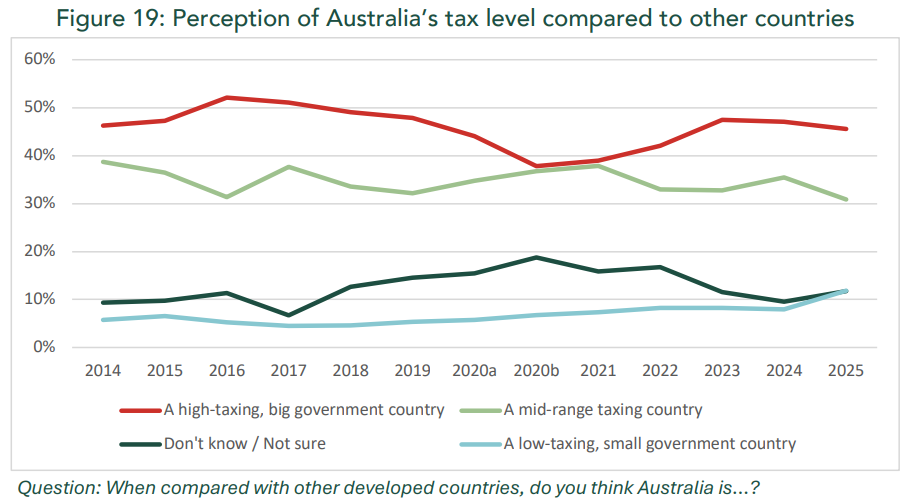
Multiple governments have come and gone during the survey period, while tax rates and fiscal settings having repeatedly shifted. Yet our perception of Australia as a heavily taxed nation has barely moved.
Though the proportion of respondents identifying Australia as a middle-of-the-road tax country has fallen, both the low-tax and ‘unsure’ categories have modestly grown. Instead of converging towards a common understanding, it seems there is a broader range of competing narratives at play.
At the same time, the survey paints a far more positive picture of attitudes towards public services than one might expect. Australians continue to report reasonably high levels of confidence in the quality, accessibility, value for money and usefulness of public services. These ratings have eased from their pandemic-era peak, but remain stronger than they were a decade ago.
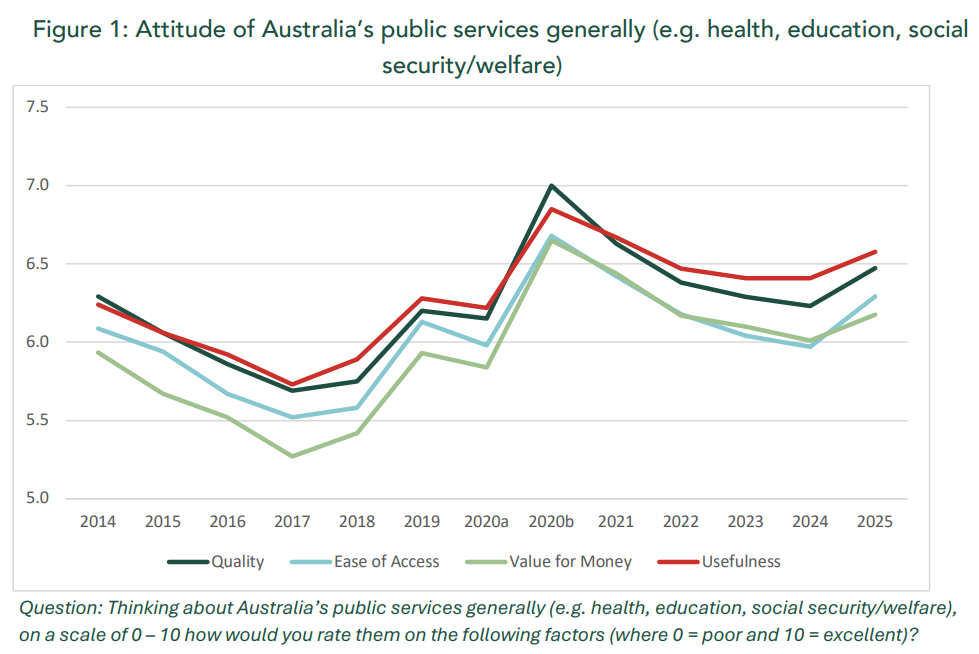
Given public debate often operates on the assumption that confidence in institutions has collapsed, this finding surprised me. It also perhaps explains another seemingly paradoxical result. Most respondents believe governments should spend more on public services, particularly health and education.
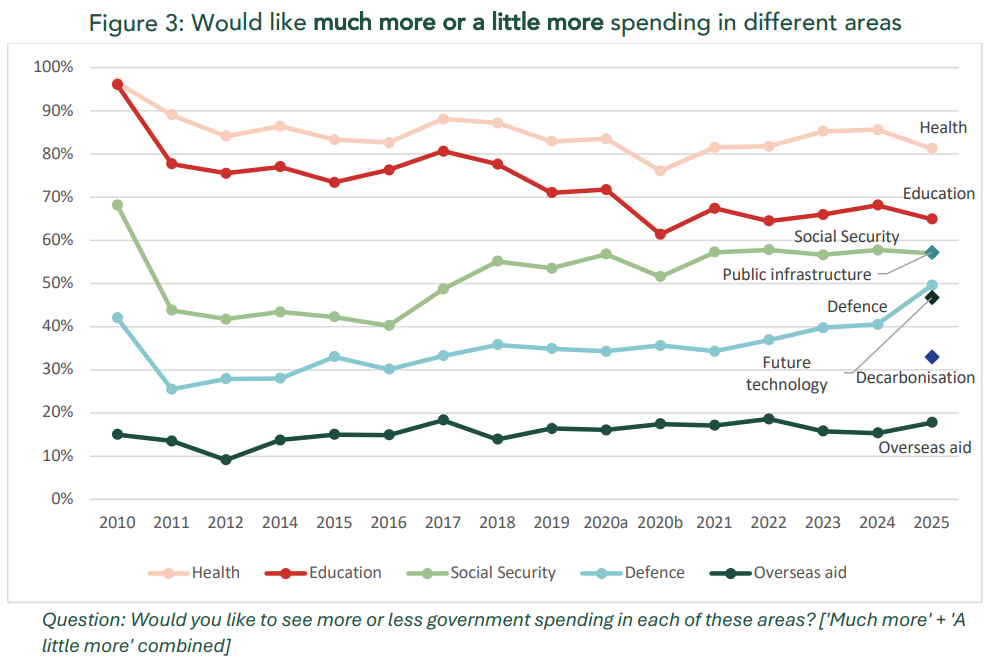
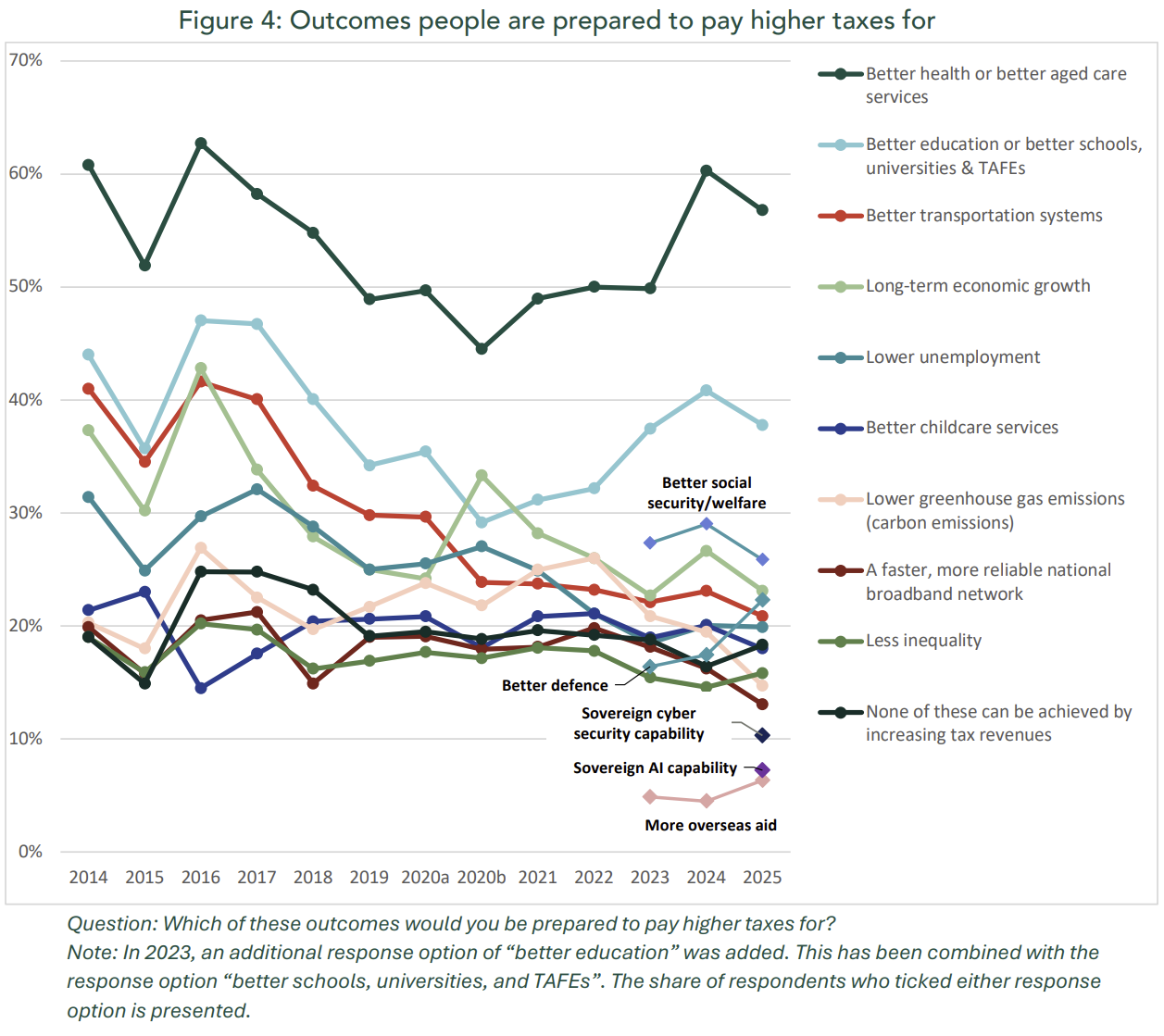
However, when the question shifts from spending in the abstract to individual contributions, people's enthusiasm naturally becomes selective.
On the surface, it seems that we're willing to pay more when the outcome is tangible and immediate. Health services, aged care and education continue to attract the strongest support. By contrast, the willingness to pay more for decarbonisation, sovereign AI capability and other less direct outcomes remains comparatively low.
I'll play devil's advocate and suggest that doesn't necessarily reflect a reluctance to contribute. Rather, there is a strong desire to see clearer connection between the cost and its outcome. The further an expense or objective moves from the everyday experience, the harder it becomes to persuade people to pay for it.
Who should foot the bill?
This willingness to support public spending while remaining cautious also appears in the survey's findings on revenue raising.
A crackdown on corporate tax avoidance remains the most popular option. Higher tax rates on top income earners also continues to attract support. Measures such as negative gearing and capital gains tax reforms, which have since moved from debate to policy, attracted only moderate support in the survey.
There is an old tendency in public policy for agreement to diminish in proportion to specificity. Agreement is often easiest at the level of principle, but once pen is put to paper, that consensus is difficult to sustain.
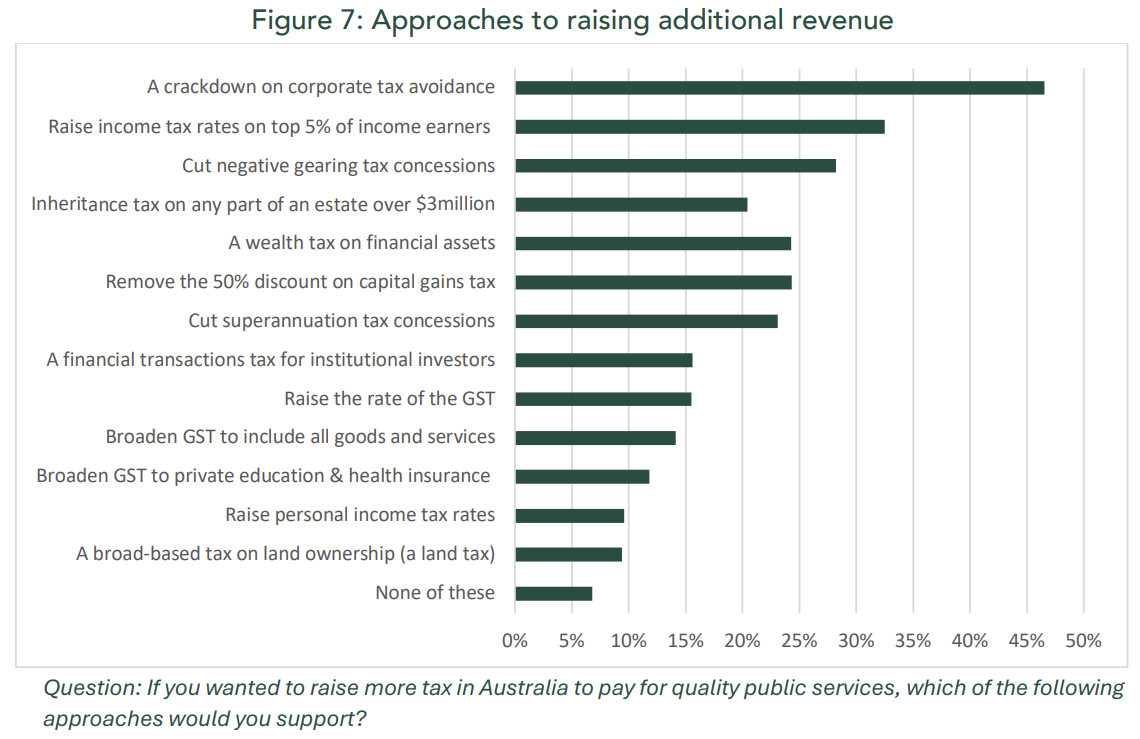
Whether one agrees with these policy positions or not, they suggest many Australians place considerable weight on perceived fairness. The survey indicates a preference for targeted measures aimed at those seen as better placed to contribute, rather than approaches that distribute the burden more evenly across the population.
Retirement income funding
Australia is often described as one of the world's great compulsory savings systems. The Super Guarantee now sits at 12%, but debate continues about whether the system will ultimately provide adequate income for retirees.
Some believe individuals should aspire to save more, while a similar number argue that the Age Pension should play a larger role. Others see the answer in further strengthening superannuation itself through concessions.
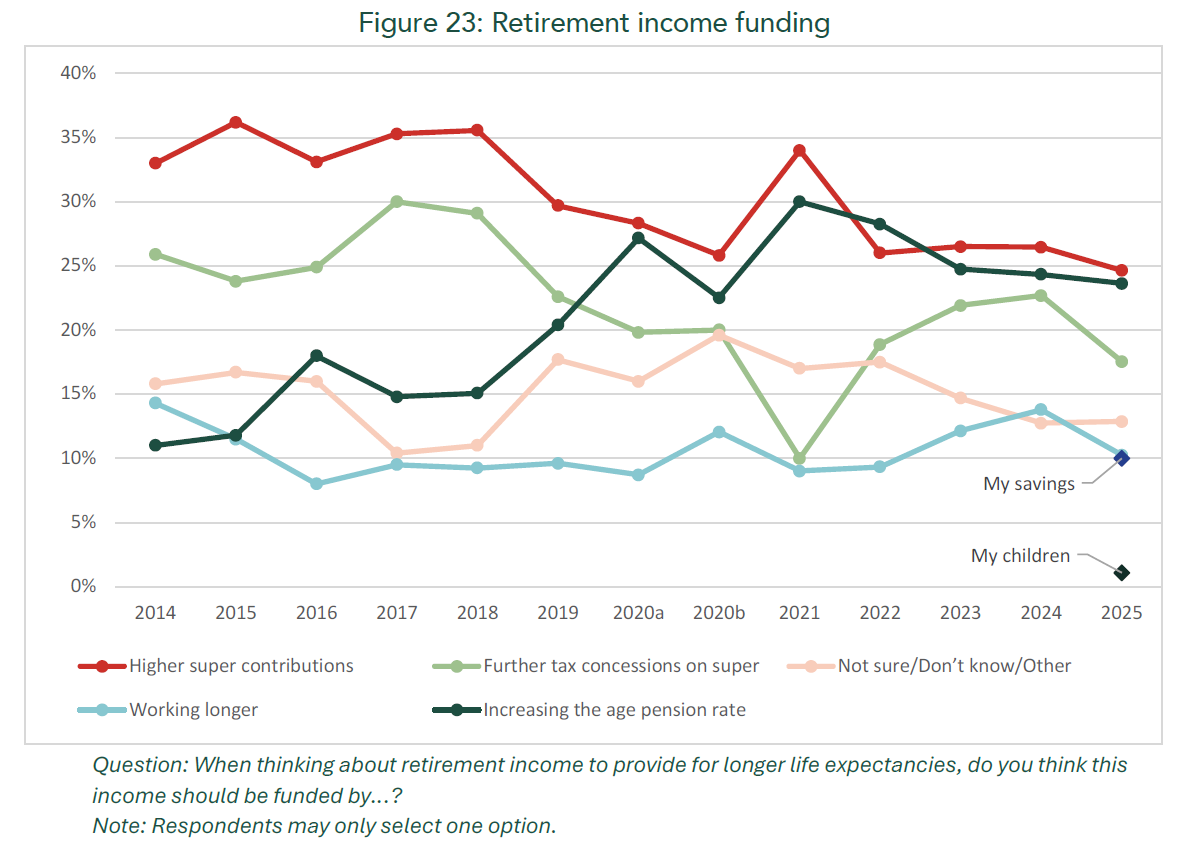
Despite decades of discussion about self-reliance, retirement continues to be viewed as a collective challenge.
We may disagree on the mechanism, but there remains a broad expectation that longevity risk and income security should not rest solely on the shoulders of individuals. That is perhaps unsurprising. If an increasing number of people reach retirement age without adequate resources, the consequences are ultimately endured more broadly through taxation. In that sense, retirement policy occupies an unusual space where we must balance personal responsibility with the recognition that the consequences rarely stop at the individual.
Simonelle Mody
Also in this week's edition...
Politicians are fighting over access to super, but Ron Bird argues they may be ignoring three key structural failings that cost Australians more than we realise.
Why do some families preserve wealth for generations while others struggle? Peter Roach explores this phenomenon in the great wealth transfer myth.
The demise of bank hybrids leave investors with a problem. Kanish Chugh asks what comes next, and are the obvious replacements enough?
After a recent trip to the US, Emma Fisher shares the latest market themes emerging out of the technology sector and how company moats are being reshaped.
Warren Buffett's departure marks the end of an era. Jason Phol discusses whether Berkshire's success can continue without the man responsible for much of it.
Jeremy Duffield and Mikhail Walden evaluate whether the 4% retirement withdrawal rule has been lost in translation.
For more than a decade, investors lived through an era of near-zero interest rates. Michael Collins believes this was not without side effects.
Curated by Simonelle Mody and Leisa Bell
Latest updates
PDF version of Firstlinks Newsletter
Monthly Investment Podcast by UniSuper
Listed Investment Company (LIC) Indicative NTA Report from Bell Potter
Plus updates and announcements on the Sponsor Noticeboard on our website