Few subjects attract more contradictory social conventions than money.
We're often told that it shouldn't matter and that the topic is incredibly gauche to discuss openly.
Yet we observe financial media is often littered with rich lists, millionaire investor profiles and tales of eye-watering fortunes that have been amassed or squandered. Many devour these stories with a compulsive desire to understand how one person arrives somewhere another does not.
Admittedly, I am no stranger to this enthusiasm. But I'm reluctant to dismiss it as merely a form of financial voyeurism. I suspect what many find most interesting has less to do with the numbers and more with the path that produced it.
The natural assumption is that if someone has accumulated substantial wealth, there must be something to learn from them. Perhaps they are simply better investors. I wonder whether that link is as intuitive as it first appears.
Surprisingly, there are relatively few studies that directly examine the investment outcomes of households with substantial assets. An interesting one that I came across was Asset Allocation and Returns in the Portfolios of the Wealthy (2023) by Cynthia Balloch and Julian Richers.
Through analysing 180,000 portfolios from 2016 - 2022, the authors found a positive relationship between wealth and investment outcomes, where performance tended to improve at the higher end of the distribution. Wealthier households achieved both higher raw and risk-adjusted returns.
On the surface, the finding appears to confirm the intuition that the wealthy are simply superior investors. However, that may be an overly simplistic conclusion. The same research paper also uncovered an interesting finding about the changes in portfolio composition as wealth increased.
Asset allocation differences
Balloch and Richers found that wealthier households allocated a greater proportion of their capital to alternative assets like private equity, venture capital and hedge funds. While listed assets remained a key component of portfolios, they increasingly gained exposure to opportunities that are often unavailable to the average retail investor.
This complicates the idea that wealth leaves behind an easily replicable blueprint.
If stronger returns stem partly from opportunities that are inaccessible to most investors, then studying the wealthy becomes a more nuanced exercise. We may be observing not only better investment decisions, but a different set of opportunities altogether.
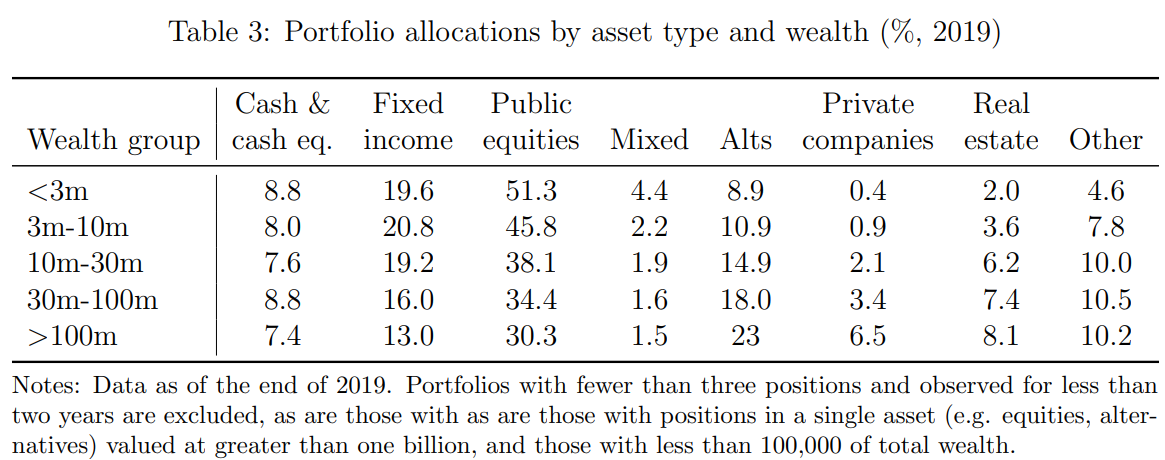
Naturally, higher allocations to private market assets can make return comparisons difficult and shift risk-adjusted metrics.
The authors' analysis tried to account for this through calculating counterfactual returns, in which all private equity and venture capital returns were replaced with the value-weighted market return in each month. In plain terms, they tested whether the result still held when private market returns were substituted with public market returns.
They still found that wealthier households continued to outperform even after adjusting for differences in private market returns. I believe that suggests something else may be at work.
The causation argument
When we observe a wealthy investor generating strong returns, it’s natural to assume the wealth is evidence of skill. But we run the risk of confusing correlation with causation. Some of the relationship might actually run in the opposite direction.
An individual with a $5 million portfolio experiences volatility differently from somebody trying to build financial security with a five-figure account balance. An affluent investor can likely tolerate extended periods of underperformance, spread costs across a larger asset base and pay for advice when needed.
Investing is often presented as an intellectual exercise but most of us know it is also an emotional one. Wealth doesn’t just change a portfolio but also the conditions under which decisions are made. This creates a structural advantage that has little to do with investment selection.
It is entirely possible that some become wealthy because they’re unusually disciplined, patient or simply have superior investing skill. It is also possible that once they’ve accumulated wealth, those same qualities become easier to maintain.
Concluding thoughts
This is a classic chicken-and-egg dilemma that I am reluctant to draw a definite conclusion upon.
Do wealthy investors outperform because wealth makes aspects of investing easier? Or does investing become easier because the habits required to accumulate wealth have already been learnt? I suppose both explanations could be true.
I am curious where readers stand.
Over your investing lifetime, what do you believe has contributed most to successful outcomes? And when we look at 'successful' investors, are we observing the causes of wealth or merely its consequences?
Simonelle Mody
Also in this week's edition...
Kaye Fallick interviews Bill Kelty, one of the key figures behind Australia’s super system, to debate whether we may be asking too much of a retirement savings system.
Marc Jocum explains why rising yields have put bonds back into business, however, the new challenge for investors is deciding whether they're still being adequately rewarded for risk.
Retirees, advisers and super funds all talk about the bucket strategy as if it refers to one thing. Craig Sankey doesn't agree, and argues that the differences can be significant.
Investment temptations are hard to resist. The team from Schroders outlines what 'The Odyssey' can teach us about valuation discipline.
Market concentration has been a growing source of concern in recent years. Jan-Carl Plagge explores whether that means more risk for investors.
Health goals, new friendships and lingering questions about identity. Dr Joanne Earl is back to share insights from her eight months in retirement.
Australia's economic problems are hardly a secret, but is the stock market as exposed as we think? Dion Hershan believes economic stagnation might be ok at this point.
Curated by Simonelle Mody and Leisa Bell
Latest updates
PDF version of Firstlinks Newsletter
Listed Investment Company (LIC) Indicative NTA Report from Bell Potter
Plus updates and announcements on the Sponsor Noticeboard on our website