When I was in my first year of university, I pulled up to an ATM to make a withdrawal. A man and his son were ahead of me in line and the kid turned to his father and asked if I was James Bond. This might be the high point of my life. I’ve been on this earth for a little more than 16,600 days. That was the first, only, and likely last time I have ever been confused with anyone as remotely as cool as James Bond. My most frequent celebrity comparison is to Kermit the Frog from listeners to our podcast.
Some context is probably needed. I had borrowed my dad’s car, a BMW Z3, that featured in the Bond movie that was out at the time. I was wearing a tux because I was invited to an anachronistic social function in NY. I didn’t have the heart to tell the kid that everything he saw was an illusion. If he saw me sleeping in my tux at the end of a long night of ‘socialising’, the illusion would have quickly worn off.
Being rich is also an illusion. We judge people by what we see and not their actual circumstances. That is hidden away within the prevailing social custom to not talk about money. Many of us hide our actual circumstances from ourselves. It is far easier than facing the truth. This focus on perception has consequences to achieving the real goals that so many of us strive for – financial security and financial independence.
What is rich?
The official definition of where individuals fall on the spectrum of working, middle and upper classes uses income as the metric to divide the population. The top 10% of earners are considered upper class with the bottom 50% working class. The middle class falls in-between.
In 2022 the median income in Australia was $65,000 a year according to the Australian Bureau of Statistics. Anyone making less than this amount would be considered working class. Anyone making more than $137,000 falls in the top 10% which is considered upper class. To reach the top 1% of income earners in Australia requires a salary of $253,000.
When Australians are asked where they would self-classify themselves there are significant differences. Researchers from ANU asked Australians in 2023 if they considered themselves working, middle or upper class. Around 43% of survey respondents considered themselves as working class and 56% middle class. That leaves 1.4% that self-classified as upper class.
There are also surveys on how we perceive others. According to a Dacxi survey 40% of Australians consider the upper class as those that earn more than an after-tax income of $150,000 annually. 33% apply a net worth lens to the definition and classify the upper class as those with a net worth of over $1 million. It should come as no surprise in housing obsessed Australia that 25% of respondents say the upper class are those that own their home outright.
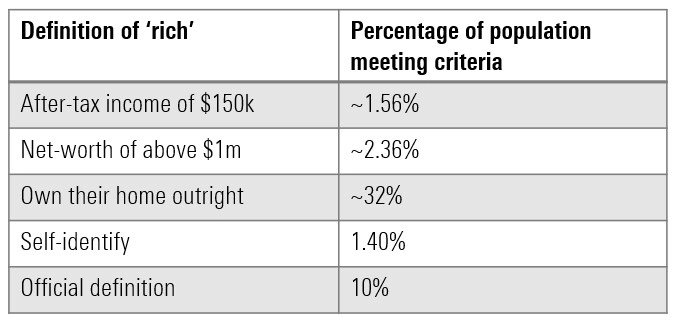
There are several inferences that we can make from this conflicting information. The first is that far more Australians consider other people ‘rich’ than see themselves as ‘rich’. This makes sense because an ambiguous term like ‘rich’ is simply a point of comparison to peers. Somebody living in a $10 million home that is neighbours with someone in a $15 million home may feel middle class in comparison.
The second is that the definitions of rich are so disparate that many people can significantly exceed one category while not qualifying in another. A retiree with tax-free retirement savings of $2 million who owns their own home outright meets the definition in two categories but may have an after-tax income well below the $150,000 threshold.
Finally, using terms like net worth or income doesn’t provide any context into the actual life that someone leads. Living in different parts of the country costs different amounts of money. A salary may not feel high in Sydney or Melbourne but could be a windfall in regional Australia. Different debt levels and lifestyle choices mean people with a high net worth and high income could be barely making ends meet. Basing a definition of ‘rich’ on fluctuating asset levels also may have little bearing on day-to-day life. If your house value fluctuated plus or minus 10% it may make a significant difference to your net worth. But would your day-to-day life be any different?
Implications on how you invest
The fact that so few Australians consider themselves ‘rich’ compared to the actual data and the official and unofficial definitions exposes the folly of investing to ‘get rich’. Like Sisyphus perpetually pushing a boulder up the hill there is no end to the journey. As Bud Fox says to Gordon Gekko in Wall Street, “When does it all end? How many yachts can you water ski behind?”
To feel successful at anything means setting concrete and incremental goals that induce a feeling of accomplishment as each is met. And that feeling of accomplishment of meeting an incremental goal is important because that is what keeps us going. The secret to successful investing is patience, discipline and consistency. And we need to acknowledge that is hard. We need to find a way to persevere.
Building wealth is a means to an end. The point is to improve our lives. Being the richest person in the cemetery holds little appeal. When I first started my career, my goal was to build a small emergency fund. Looking back on it now my modest goal seems contrite. I pay more for an international flight than I was trying to save. But achieving that goal improved my life. It reduced my financial stress levels. I may not have felt rich but I did feel more financially secure. And that feeling of security is far more important than meeting an ambiguous definition of ‘rich’.
Final thoughts
The second definition of rich in the Oxford Dictionary is “existing in plentiful quantities, abundant”. This definition has nothing to do with money. The example sentence is “the rich flora and fauna of the forest”. Maybe this is a better way of thinking about things. Don’t aim to be rich. Aim for a rich life – whatever that means for you.
The eye-rolling is almost palpable when I tell people that their financial goals shouldn’t be having the most money possible or getting rich. But the whole point of defining goals is to help you achieve them. How can you come up with a plan and strategy to achieve an ambiguous goal? How can you persist in trying to achieve it when there is no destination?
The paradox of the goal setting process is that if you do it correctly you are far more likely to end up with the most money possible than blindly thrashing around the emotional roller coaster of the share market. Want to get your finances on track? Think about your definition of a rich life. Come up with a five-year plan and concrete goals to progress along that journey. Your future self will thank you.
What is your definition of a rich life? Email me at [email protected]. Any emails sent to [email protected] are unlikely to reach me.
Mark LaMonica, CFA, is Director of Personal Finance at Morningstar Australia.