Register For Our Mailing List

Register to receive our free weekly newsletter including editorials.

Home / 681

How the typical Australian Family could save $844,350 in taxes

If you think a testamentary trust is only for the wealthy, think again. A testamentary discretionary trust (TDT) does not make an inheritance tax-free, but what it can do, is change who is taxed on the income that the inheritance produces. Over a generation or two, that difference can potentially be worth hundreds of thousands and in some cases, millions of dollars.

Taxation matters

Ordinarily, under Division 6AA of the Income Tax Assessment Act 1936, minors can be subject to significantly higher tax rates on passive or trust income. However, qualifying income derived through a testamentary trust can be treated as excepted trust income, allowing the minor beneficiary to access ordinary individual tax rates.

Importantly, this concession is generally confined to income derived from property that came from a deceased estate, together with qualifying accumulations and replacement property that can be traced back to that estate.

This means assets cannot simply be injected into a testamentary trust after the fact to obtain the tax concession. The relevant trust assets must genuinely originate from the deceased estate and remain sufficiently identifiable and traceable back to that estate.

For the 2026–27 financial year, the ordinary Australian resident tax-free threshold remains $18,200. In addition, the maximum Low Income Tax Offset is $700. This means that, broadly speaking, a resident beneficiary with no other taxable income may be able to receive approximately $22,866 of taxable income before actually paying income tax.

The beneficiaries who may fall within this category commonly include minor children and other beneficiaries who have little or no other taxable income.

Where a beneficiary already earns income from employment or another source, the position is different because the trust distribution is added to their existing taxable income and taxed at their applicable marginal tax rate.

This is where the flexibility of a testamentary discretionary trust becomes important. Rather than all of the investment income being taxed in the hands of one adult beneficiary, the trustee may have the ability subject to the terms of the trust and the tax legislation, to distribute income across a wider group of beneficiaries.

To demonstrate how this can work in practice, we are going to look at the typical Australian family scenario and with this in mind, explore the size of the estate, the income generated by the inheritance, the beneficiaries’ existing incomes and the number of beneficiaries available.

Assumptions used in the modelling

For the typical Australian family, we assume a 4% annual income return on the inheritance capital after death.

In simple terms, a $1,000,000 testamentary trust would therefore produce approximately $40,000 of taxable investment income each year.

For the purposes of this example, we have also assumed that the relevant estate assets are capable of generating that return. This may involve assets being liquidated, invested, sold or otherwise restructured following the administration of the estate.

Superannuation has been included in some of the modelling only where it is validly directed to the deceased's legal personal representative and ultimately forms part of the estate available under the will.

Superannuation does not automatically form part of a deceased estate. Appropriate superannuation death benefit planning is therefore required if the intention is for those funds to ultimately flow through the estate and into a testamentary discretionary trust.

The figures used are based on the 2026–27 income tax year and are illustrative only, specifically, they exclude the Medicare levy, capital gains tax, franking credits, superannuation death benefit tax, accounting fees and other taxation or administration costs.

The long-term

To give you a practical insight, which most are reluctant to forecast, we have extrapolated the annual savings over a period of 30 years to demonstrate the potential long-term effect and tax savings via use of a testamentary trust.

In the tables below, we share the typical Australian family, their inheritance and asset base, income-earning capacities, number of children and grandchildren and general estate planning needs.

In this scenario, we compare the potential trust capital, the assumed taxable income generated by that capital, the beneficiaries available for distributions and the potential difference in tax payable.

The most important point to understand is that the value of a testamentary discretionary trust is not determined simply by the size of the estate.

It is the combination of:

  • the size of the inheritance;
  • the amount of income the inheritance produces;
  • the existing taxable income of the beneficiaries; and
  • the number of lower-income beneficiaries, including minors, who may potentially receive distributions.

The typical Australian family

The couple has approximately $2.4 million of combined wealth, assuming the $1 million of superannuation is ultimately available to the estate structure.

If that capital generates approximately 4% per annum, the family has around $96,000 of investment income every year.

If the inheritance is simply divided equally between their two adult children — a teacher earning $75,000 and a musician earning $65,000 — each child effectively receives another $48,000 of taxable investment income on top of their existing salary.
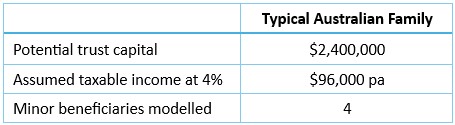
On our modelling assumptions, that additional income results in approximately $28,825 of additional income tax each year across the two children.

Now compare that with the testamentary discretionary trust structure.

We can assume there are four minor grandchildren available as beneficiaries. If the $96,000 of annual trust income were distributed equally, each grandchild would receive approximately $24,000. Based on the assumptions used in this example, the income tax payable would be only around $170 per child, or approximately $680 collectively.

That produces an illustrative annual tax saving of approximately $28,145.
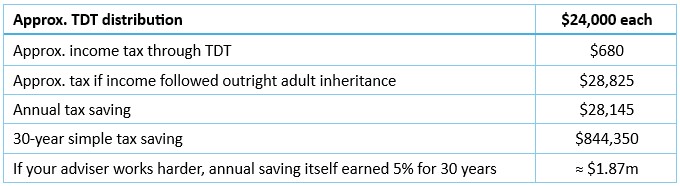
Extrapolated over, say, 30 years, without allowing for changes to tax rates, investment returns, beneficiary circumstances or the time value of money, that equates to approximately $844,350 in potential tax savings.

For this typical Australian family, a testamentary discretionary trust is therefore not simply a strategy reserved for extremely wealthy families.

It can provide a mechanism for using investment income to contribute towards expenses such as education, school fees, extracurricular activities, healthcare and other costs for the next generation, while potentially preserving considerably more wealth within the family over time.

The real power is not that the inheritance itself becomes tax-free.

The power is in the ability to control how the income generated by that inheritance is distributed and taxed over many years and potentially across multiple generations.

Ultimately, the financial benefits of a testamentary trust cannot be realised if and until the death of the will maker. Tax benefits will be determined based on the individual and their circumstances at the time of death of the will maker and subject to the valid terms of the will maker’s will.


Abbey John is the Principal Lawyer at Estates Now. Her work focuses on estate planning, wills, testamentary trusts, probate and deceased estate administration, helping individuals and families navigate succession, asset protection and intergenerational wealth matters.


  •   23 September 2026
  • 9
  •      
  •   
9 Comments
Harry
September 28, 2026

Nicely put Malcolm. The 30year crystal ball at your place sounds about as good as mine. Let's not forget offspring not getting along. Won't the lawyers have fun unravelling it all. Any tax benefits will vanish in a heartbeat. Yes, I too have these, having been talked into it by a lawyer along with thousands upon thousands of dollars to set them up! A famous estate lawyer in the US died and his own will was awaited with high expectation. In it were words to the effect of " I leave everything to my wife! The end".

OldbutSane
September 24, 2026

This article would have been much more useful if it had identified a "break even" point where to cost of setting up, running and closing down one or multiple testamentary trusts was compared to the savings. I can't imagine that you would get the accounting/tax work done for less than $5000pa each (let alone financial advice fees) and you would need a separate TT for each child too.

4
lyn
September 27, 2026

Unless squillions, above $ example I'd not bother. From my experience, though not of course for all cases, it becomes over many subsequent years onerous, messy & maybe expensive. I kept some of the historic paperwork and invoices.
Would like to share story re my family of a TT albeit in UK but similar principle, originating in 1957 on death of grandfather until death of my mother 2002. 3 daughters beneficiaries, estate of family home with lifetime use condition his 2 sisters (went on 22yrs), commercial & residential properties, 100yr old business to be disposed of as mother wanted to be free at last, many leasehold land lots on which homes owned by the residents but they not own land beneath which is common in UK with special disposal rules when landlease ends which many did even AFTER mother's death so some costs continued until I sold leases to residing principals.
I grew up learning all this at dinner table as burden of admin fell to mother the only sister with children, had business head as she only sibling in the business for 30yrs as other 2 boarding school and university education but she was expected to join business, heard arguments amongst them about repairs/running costs for their aunts, rental property repairs,legal & accounting costs etc as other 2 only saw diminishing income but they never did inspections re repairs, renovations etc as Mum on the spot(she took me) as sisters a long journey & no knowledge, making for difficult times/resentment tho they rose above it at family occasions & holidays together. Mum gentle but firm disliking the many years of discord all because of a TT. Before that they were fun together. It blighted her life, I watched her sadness re her sisters.
Over the years as expenses rose, a property sold here & there to offset shortfalls so after 45yrs only leasehold land left of which her share carried into her Will. Both sisters always blamed Mum for diminished income neither ever being in any business nor with then - current knowledge local trading/rental conditions.
Oddly, shares ex early 1900's left to each sister not part of trust assets. They thrived, I hold 2/3 of. Gives pride 3 generations kept those in tack so long.
Wished to give other side of a TT within which there is also the tale of a direct bequest. You can tell which was easier, cheaper, free of angst & fruitful and how the passage of 45yrs can change/unknown future conditions for both sides of the coin.
I with Barry's comment above, let beneficiaries have it to manage for pleasure of building more wealth, then pay the income tax and be grateful if they don't lose it! After what I witnessed would only consider Trust with regret --- if saw crack in a relationship to protect 3 generations' wealth for the 4th & 5th. Hope the story was not boring for fellow readers.

2
Justin
September 24, 2026

Fundamentally disingenuous and almost click bait.

The broad based assumptions and flow through pattern is not humanly valid. Please account for relative time frames to match your financial outcomes.

Great ideas but not in almost any way achievable.

1
Barry
September 26, 2026

Section 100A still applies, so you cannot give the money to the grandkids and then claw any of it back. So the effective tax rate is actually 100%, not 0%, because you lose all of that money distributed to the grandkids. If you were going to gift that money to the grandkids anyway, then this is fine, but if you wanted to use that money for your own wealth building, then you would be better off paying 47% tax and keeping it for your wealth building and compounding.

1
Owen
September 27, 2026

Barry, I am not sure what you mean "use that money for your own wealth building"; to create the Testamentary Trust you have to be deceased.
The pros and cons of gifting money to your grandchildren when you remain alive is not what the article is about.

Neil
September 25, 2026

Why compare the tax payable by 2 people to that paid by 4? Of course the total income split between 2 people with attract higher tax.
I thought the purpose of the article might be to demonstrate the benefits of testamentary trusts, not of splitting inheritances between more people. But that point is taken and valuable if the purpose of the leaving an inheritance is to minimise tax.
Just pay the tax on all your sources of income and stop whining about it.

Jack
September 27, 2026

You cannot leave an asset in your will to your grandchildren under the age of 18, because they are too young to own anything. So you have to leave the asset to your adult children, and as the new owners of the asset, they are then liable for the tax on the income earned by that asset. That additional income may push them into a higher tax bracket.
If a child under the age of 18, earns investment income such as bank interest, they pay 0% tax up $416, 66% tax from $417 to $1307 and 45% on amounts above $1307.

If your will leaves your assets to a testamentary trust, the trust owns the asset, not the adults, and the income tax is paid by the beneficiaries. If a child under the age of 18 is a beneficiary of a testamentary trust, they are taxed at adult rates. They pay 0% tax up to $22,850 and 15% up to $45,000. More beneficiaries allow the trust income to be spread more widely and thus reduce the overall tax.

Testamentary trusts are ideal for making provision for the health and education of grandchildren and great-grandchildren, especially if they are orphaned.

2
 

Leave a Comment:

RELATED ARTICLES

Most estate planning for tax is inadequate

Testamentary trusts survived the trust tax. The drafting battle has just begun.

How to minimise tax with a will

banner

Most viewed in recent weeks

Why spending more in early retirement can improve lifetime income

Conventional wisdom encourages retirees to preserve superannuation. But if those likely to qualify for the Age Pension later in life spend a little more today, it may deliver higher lifetime income and a more stable retirement.

It’s time for LICs to die

A high-profile dividend cut and a prominent fund manager’s apology have reignited a long-running debate. If investors can access similar exposures more cheaply and efficiently elsewhere, what exactly is keeping LICs alive?

Testamentary trusts survived the trust tax. The drafting battle has just begun.

The fight over testamentary trusts looked settled. Then the draft legislation arrived. Hidden in a technical detail is a question that could force many families to rethink wills they thought were already future-proof.

Is it time to bail on Australian stocks?

For generations, Australian investors have backed banks, miners and dividends. But has that loyalty come at a cost? A look at the numbers raises an uncomfortable question about where future returns will come from.

The new capital gains tax trap for your portfolio

Investors have long accepted one portfolio rule without much question. A major tax shift could change that calculation entirely, forcing difficult trade-offs between risk, discipline and an overlooked cost lurking beneath.

How the typical Australian Family could save $844,350 in taxes

The value of a testamentary trust is not determined by wealth alone. Depending on circumstances, it can reduce the tax burden on inherited income, create efficiencies and help build intergenerational wealth.

Latest Updates

Fixed interest

Higher yields are creating opportunities in global bonds

Bond markets are adjusting to a new reality, but not in the ways investors expect. With markets repricing and capital competing for attention, investors may need to rethink where resilience and opportunity lie. 

Economy

Are we in a recession?

What if the warning signs are already everywhere? From supermarket aisles to company failures, investors are being bombarded with recession signals. But most face a different risk that can be just as dangerous for portfolios. 

SMSF strategies

Meg on SMSFs - Division 296 actuarial certificates

The tax bill might be yours, but the event that caused it may not be. A key Division 296 calculation can sometimes attribute earnings in ways that many SMSF trustees won't instinctively expect or fully appreciate.

Property

The first impact of negative gearing reform is not the tax bill

Negative gearing changes formally begin in 2027, but the first consequences may already be here. A subtle shift is quietly influencing who can borrow, how much they can access and which property strategies still stack up.

Economy

The oil market is running out of easy answers

The biggest threat to markets may not be what investors are watching. The numbers have stopped adding up and supply is harder to measure, with forecasts becoming simple guesses. A more fragile reality is being masked.

Investment strategies

The state of investor knowledge in Australia

Australians are investing more than ever, yet a surprising divide is emerging between those building wealth effectively and those making costly mistakes. Surprisingly, the gap has little to do with income, age or starting capital.

Taxation

Complexity and capital gains

A case study shows that the ‘30% minimum CGT’ is a poorly conceived tax that adds significant complexity to an already over-complex system. A less complicated model would create a much fairer progressive tax scale.

Sponsors

Alliances

  • ASA-Logo-RGB-ActiveGreen-web.png

© 2026 Morningstar, Inc. All rights reserved.

Disclaimer
The data, research and opinions provided here are for information purposes; are not an offer to buy or sell a security; and are not warranted to be correct, complete or accurate. Morningstar, its affiliates, and third-party content providers are not responsible for any investment decisions, damages or losses resulting from, or related to, the data and analyses or their use. To the extent any content is general advice, it has been prepared for clients of Morningstar Australasia Pty Ltd (ABN: 95 090 665 544, AFSL: 240892), without reference to your financial objectives, situation or needs. For more information refer to our Financial Services Guide. You should consider the advice in light of these matters and if applicable, the relevant Product Disclosure Statement before making any decision to invest. Past performance does not necessarily indicate a financial product’s future performance. To obtain advice tailored to your situation, contact a professional financial adviser. Articles are current as at date of publication.
This website contains information and opinions provided by third parties. Inclusion of this information does not necessarily represent Morningstar’s positions, strategies or opinions and should not be considered an endorsement by Morningstar.