Blockchain has the power to change the nature of corporations. It is critical that every investor understands this new technology and its implications. For the first time in history, assets can be transferred peer-to-peer without an intermediary, using an internet of value.
The potential of the second era of the internet
The second era of the digital revolution is here, and it has the potential to change everything about the way we interact around the world. The technology behind this new revolution is called ‘blockchain’ – the underlying technology behind cryptocurrencies like bitcoin and ether. Using cryptography, some clever code and collaboration, blockchain creates a decentralised network with trust built into the system.
The ‘double-spend' problem
For the past few decades the digital revolution has been defined by the ‘internet of information’, which has democratised the way we communicate around the world. It enables low-cost, massive peer-to-peer communication where everyone is an active participant. However, when I send an email on that internet of information, I am in fact sending ‘a copy’ of that email. That system works well for information, but not for things with some sort of underlying value, which depends on scarcity. Things like money, stocks, bonds, votes, carbon credits, data, intellectual property and art cannot be reproduced infinitely if we hope to maintain their value. If someone can infinitely copy the $100 they just sent somewhere, that $100 suddenly has no value. This is called the 'double-spend' problem.
Usually, when we want to exchange things of value online, we depend on an intermediary to establish trust – intermediaries like banks, governments, or social media companies. These intermediaries are able to ensure that when someone transfers $100, they don’t still have that $100 in their bank account. This has worked, but it has some major problems. It’s a centralised system, putting far too much power and personal data in the hands of a few. It can also be hacked, and increasingly it is. All of the computer systems in all of our financial institutions can be hacked. Most importantly, it distributes the wealth created by the digital revolution of the past 20 years asymmetrically, leaving far too many people behind.
The solution
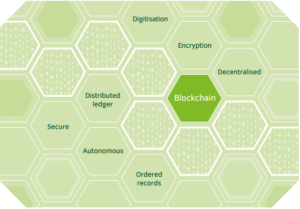
Blockchain presents a solution. It's a vast, distributed ledger with thousands of computers working to verify transactions. As a decentralised system, it can’t be hacked, and it enables you to bypass the complex network of intermediaries currently needed to verify transactions. For the first time in history people can trust each other without an intermediary. Blockchain allows people to manage, use, and interact with assets peer-to-peer. This new internet of value will be owned by investors, so rather than a bubble there is a case to be made that this is the biggest investment opportunity in history.
What is blockchain and how does it work?
Blockchain is an incorruptible digital ledger of economic transactions that can be programmed to record not just financial transactions but virtually everything of value. Each unit of value is represented by transactions recorded in a blockchain, which leverages the resources of a large peer-to-peer network to verify and approve each transaction. The main differentiating features of blockchain relative to traditional ledgers of transactions are:
- Decentralised: it runs on computers provided by volunteers around the world with no central database to hack.
- Public: anyone can view it at any time because it resides on the network, not within a single institution charged with auditing transactions and keeping records.
- Encrypted: it uses heavy-duty encryption involving public and private keys (rather like the two-key system to access a safety deposit box) to maintain virtual security.
Broadly, the steps in any blockchain process are:
- Any transfer request is broadcast out to a global network of millions of computers each using the highest level of security.
- At regular intervals, the programme creates a block that contains all of the transactions in that period. In the case of bitcoin, it is every 10 minutes.
- All around the world there are a group of people called ‘miners’ who compete to validate the transactions in the block. The first miner to validate the block gets paid part of the crypto currency from that blockchain.
- Importantly, that block gets connected to the previous block to create a chain of blocks and it is sealed with a digital wax seal. The structure permanently time-stamps and stores exchanges of value. If the block can’t be validated it will not be connected and is referred to as an ‘orphan block’.
- Records cannot be altered retroactively without the alteration of all subsequent blocks and the collusion of the network. Therefore, to hack a new validated block you would need to hack the entire chain simultaneously, not just on one computer but across millions of computers with each of the computers using the highest level of cryptography.
What is the potential impact?
With blockchain, trust is built into the network, which is why in our book Blockchain Revolution, Alex Tapscott and I refer to it as the ‘trust protocol’. This trust protocol has enormous implications and opportunities for business. Here are three real-world examples:
Global payment systems
The global payment system, for instance, can finally be brought into the 21st century. Right now, it can take days or even weeks to bypass the complex, inefficient network of intermediaries set up to move money from one party to another internationally. These intermediaries also take a significant cut, which is especially harmful for remittances. When looking at the process of immigrants sending money back to their country of birth, the implications of reduced transaction costs would mean more money in the hands of local people and improved local economies in emerging markets.
Verifying land titles
Blockchain has the potential to ensure the largesse of the digital age is distributed more equitably. The famous Peruvian economist Hernando de Soto pointed to land titles as one of the key points of failure for economic development in the Global South. There is as much as $9 trillion in capital yet to be used because of tenuous land titles, meaning that the people who own those farms, businesses, or homes can’t borrow against them to improve their lives.
As an immutable public ledger with a single version of the truth, blockchain enables us to establish a secure link between an individual and their land. This increased governance, and therefore security, may also have a significant impact on the appetite for foreign investors to invest in emerging markets.
Data protection
Blockchain also has the capacity to assure that citizens are able to exercise more sovereignty over their data. A person’s digital identity – currently controlled by large digital conglomerates who amalgamate and sell that data – could be stored in a digital ‘black box,’ secured on a blockchain.
The investor perspective
These are just a few of the potential opportunities for blockchain, and there are already companies working to capture these opportunities today. The most successful companies in this second era of the digital age will be those that have the willingness and ability to harness the power of blockchain, directly or indirectly. The most successful investors will be those that can identify the impact of blockchain on their investee companies.
Don Tapscott, CEO of The Tapscott Group, is one of the world’s leading authorities on the impact of technology on business and society. He has authored over 15 books. This document was commissioned by Insight Investment and is not investment advice.
Insight Investment is a sponsor of Cuffelinks. For more articles and papers from Insight, please click here.