Register For Our Mailing List

Register to receive our free weekly newsletter including editorials.

Home / 657

Little‑known government scheme can help retirees tap into $3 trillion of housing wealth

For many Australians, most of their retirement wealth is tied up in their home. A simple, well-designed program to tap into those trillions in home equity could help boost their retirement incomes.

Such a program exists. However, it remains little known and underused.

The federal government’s Home Equity Access Scheme (HEAS) allows older Australians to access their housing wealth. It is open to Australian residents aged 67 or older who own real estate in Australia, regardless of whether they receive the age pension.

Similar to a reverse mortgage with a bank or specialist lender, the scheme lets older Australians supplement their retirement income through a federal government loan, secured against the equity in their home or other Australian real estate.

Yet government data shows just 18,691 people are currently taking part in the scheme, a relatively low take-up.

A recent report from Deloitte estimates reverse mortgages are used to access only about 1% of the A$3 trillion value of housing wealth owned by Australians aged 60 and over.

So, why isn’t the government scheme more popular?

How does the scheme work?

Retirees can ‘top up’ any pension payment they receive up to a maximum of 150% of the maximum pension rate. People who do not receive the age pension (self-funded retirees) can receive up to the same maximum.

Participants can choose to receive:

  • fortnightly payments, or
  • a lump sum advance.

Compound interest is charged on the loan and accumulates over the life of the loan. This is the key difference from standard mortgage loans: people are not required to make regular repayments or interest payments (voluntary repayments can be made at any time).

The interest rate on the scheme is currently 3.95% and has been unchanged since January 2022. This is below the Reserve Bank’s official cash rate of 4.1% and well below commercial reverse mortgages, making it relatively cheap compared with other options.

It was previously known as the Pension Loans Scheme and was introduced in 1985 alongside the pension assets test.

Since 2019, the government has made several changes to the scheme to make it more attractive and expand eligibility. In 2022, lump sum advances were introduced.

A “no negative equity guarantee” was also introduced, meaning participants will never have to repay more than their home is worth, even if house prices fall.

How the scheme stacks up against private lenders

The government scheme shares many similarities with reverse mortgages offered by some banks and specialist lenders.

In both cases, the payments received are added to a loan that increases over time with interest. The loan is usually repaid when the home is sold, or from the estate after the borrower dies.

Voluntary repayments can be made at any time, but are not required.

Both commercial reverse mortgages and the government scheme offer regular or lump-sum payments, and include protections such as the no negative equity guarantee.

The payments have no impact on age pension payments if the loan is taken as a regular income stream to spend on living expenses or non-assessable assets.

The main differences are:

  • under the government scheme, the payments are capped at 150% of the maximum age pension rate, whereas the commercial reverse mortgages can offer higher borrowing amounts.
  • but banks and specialist lenders charge a higher interest rate on reverse mortgages, currently 8–9% per year, due to higher risks and market-based pricing.

Why such a low take-up rate?

Government data on its scheme shows the average loan amount was about $35,700 in December 2025. Of those taking part, 74% received the full age pension, 17% received a part pension, and 5% were self-funded retirees.
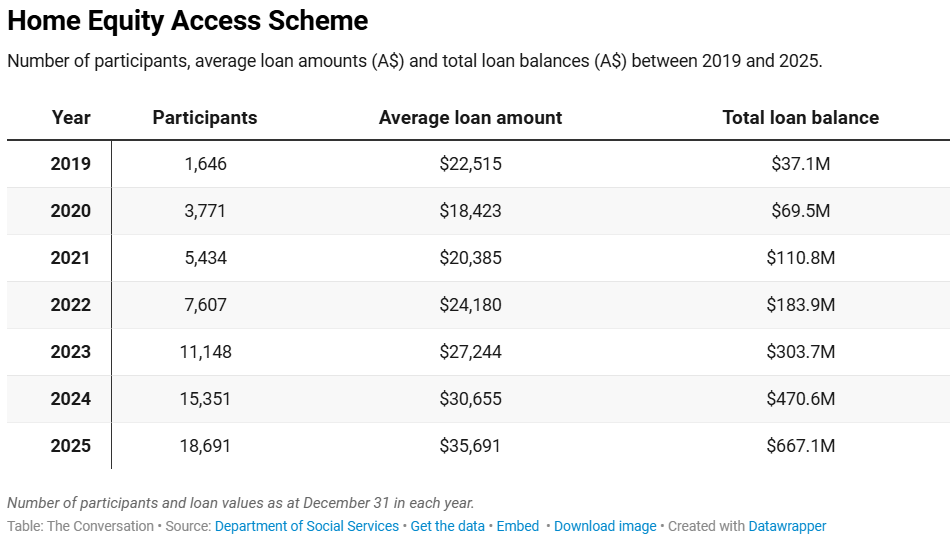
But with only 18,691 people taking part, take-up is still low.

As a government program, the scheme is not widely advertised. So it is good to see more superannuation funds providing their members with information about the scheme.

Some financial advisers may be unsure whether they can advise on the scheme. In January 2023, the Australian Securities and Investments Commission (ASIC) clarified that financial advisers can provide advice on the government scheme without needing an Australian Credit Licence.

Behavioural factors, such as debt aversion and a preference to leave the home as an inheritance, may also explain the low take-up rate. The loan will be repaid out of the sale of the home, meaning proceeds from the sale will be reduced.

However, in our research, we argue that accessing housing wealth can allow families to bring forward bequests and reduce the uncertainty around the timing of inheritances.

Another barrier may be the perceived complexity of the scheme, particularly for retirees with limited financial literacy.

While the rules can seem complex, applications are handled through Services Australia and can be completed online via the MyGov portal, using a standard Centrelink claim process.

The home equity access scheme allows older Australians to access an affordable government loan to supplement their retirement income. It can help retirees who are “asset rich, but income poor” to improve their financial wellbeing, while allowing them to remain at home and in their communities.The Conversation


Katja Hanewald, Associate Professor in Risk & Actuarial Studies, UNSW Sydney. This article is republished from The Conversation under a Creative Commons license. Read the original article.


  •   8 April 2026
  • 11
  •      
  •   
11 Comments
JunMac
April 12, 2026

I still have a mortgage and at 71 yrs old, im forced to work to pay it off and looking after my wife with alzheimers at home.

Can i avail of this to payoff my mortgage, payoff my car loan, and repairs to our home?

7
Dudley
April 09, 2026


"interest rate on the scheme is currently 3.95% and has been unchanged since January 2022":

https://guides.dss.gov.au/social-security-guide/3/4/5/45#

Date of effect Interest rate
1 January 2022 to present 3.95%
1 January 2020 to 31 December 2021 4.50%
25 December 1997 to 31 December 2019 5.25%
20 March 1997 to 24 December 1997 6.25%
10 July 1996 to 19 March 1997 7.90%
1985 to 10 July 1996 10%

Commonwealth Home Equity Access Scheme (HEAS) payments are capital and not taxable.

Marginal tax rate is 28%+ if couple's income exceeds SAPTO tax free threshold of 2 * $31,887 due to SAPTO rebate roll off or 25% if passive income bearing assets are parked in a small entity company.

If couple want to save (not spend), HEAS payments accumulate as capital which produces a taxable income once the SAPTO tax free threshold is breached or capital is parked in company.

If capital is invested in Government Guaranteed savings accounts (at ~5%), what are the risks where the HEAS loan interest rate exceeds savings rates?

Can reverse mort-gage be reversed by paying back loan principal?
Free money, risk free?

5
Dudley
April 09, 2026


Google: "Can Commonwealth Home Equity Access Scheme reverse mortgage be reversed by paying off loan capital?"

'You can repay the loan you get under the Home Equity Access Scheme in part or full at any time.'
https://www.servicesaustralia.gov.au/repay-your-loan-under-home-equity-access-scheme?context=22546

Free money, risk free, would increase the HEAS uptake rate.

2
Dudley
April 10, 2026


'Calculating the maximum HEAS loan':
https://guides.dss.gov.au/social-security-guide/3/4/5/30

Google: 'What is the HEAS Maximum Loan Amount (MLA) for a 67 year old with a home valued at $2,000,000?'
= 2000000 / 10000 * 2740
= $548,000

'Age component amount' is an exponential function of age; at age 67:
= 197.384616877968 * EXP(1) ^ (0.0392448729484611 * 67)
= $2,736.84

HEAS Maximum Loan Amount (MLA) for a $2,000,000 home of a 67 year old:
= 2000000 / 10000 * (197.384616877968 * EXP(1) ^ (0.0392448729484611 * 67))
= $547,369


Lyn
April 10, 2026

Dudley, your table of rate and dates interesting. Unchanged since 1/1/22 @ 3.95%.but can hardly see not being increased soon as deeming rate recently increased to 3.25% on bal. above 64,500 to 697,000 limit. Part-pensioners close to upper limit need do maths carefully if choose such scheme for lump sum and spend it fast, so don't breach limit for loss of a part- pension.

Dudley
April 10, 2026


"pensioners close to upper limit":

Those who HEAS loans puts near to the full Age Pension seem most needing to "do maths carefully"?

Your situation Homeowner Non-homeowner
Single $321,500 $579,500
A couple, combined $481,500 $739,500

The mort-gage has no affect on Age Pension payments but the accumulated HEAS capital in excess of the full Age Pension threshold does.

The advantage of not spending the HEAS loan principal is saving the difference between earnings on loan capital deposited in Government Guaranteed ADI deposits and the HEAS mort-gage interest payments, and having the capital readily available to repay the HEAS principal, such as when mort-gage interest rate is greater then the deposit rate.

Peter
April 11, 2026

I am surprised by the assessment that the scheme is not popular. I believe the data shows an explosive rate of take-up since the changes in 2019 which opened the HEAS up to anyone who was pension age. However the rate of people signing up for the scheme is obviously much lower than the rate at which aggregate borrowings against the scheme increase. When someone signs up for the HEAS, they will be assigned a Maximum Loan Amount, which is a limit on their aggregate allowed borrowing calculated from their age and the amount of equity in their home, but their actual borrowings on day one are typically zero. So ten thousand people could sign up for the scheme today and have no immediate impact on the total amount of borrowing. But the scheme is popular enough that, last time I spoke with Centrelink’s Financial Information Service, they were quoting leads times of at least 8 weeks, from application to final processing.

The fact that the rate has remained unchanged at 3.95% since January 2022, despite 13 increases in the cash rate in the subsequent two years, tells me that the government wants people to tapping into their home equity. Likewise, the change made in 2022 to allow the scheme to provide a very modest lump sum advance (50% of the annual pension amount) was, I suspect, an attempt by the Govt to try and re-ignite consumer spending in the midst of the Covid pandemic. Whether or not you agree that the HEAS should be allowed to move away from the fortnightly “drip-feed” supplement that the scheme was originally envisaged to provide, the HEAS seems here to stay.

I believe Rachel Lane has alluded to the HEAS as being a possible way to square the aged care funding circle in one of her various articles on the subject. So the challenge for politicians to consider might be to see how the rules around HEAS withdrawals can be modified from their present form to facilitate this.

2
Lyn
April 10, 2026

Katja,
Interesting article but 'non-assessable assets' ought be singular as only 'non-assessable' in my thoughts is the home. Your ref to bringing forward timing of some inheritance, needs approach with care if lump sum gifted by part-pensioner via this method, say to adult child re help for home deposit, because surely gifting rules will apply to part-pensioner? If close to upper limit, such gifting may perhaps negate just a very small part-pension to nil pension. As your figures show 17% part-pensioners participated, it needs to come with a warning!

Andrew
April 11, 2026

Surely the comparison is simply drawing on offset mortgage against an IP or shares (possible margin call but likely lower leverage). this is then tax deductible. so the equivalent borrowing rate is 3.95%/(1-avg rate). For those on 0% is a no-brainer, but if rate is 30% this is 5.7% which is similar to market currently ?

Dudley
April 11, 2026


"Surely the comparison is":

The largest risk of profiting from a Government Guaranteed bank deposit interest minus a government guaranteed mort-gage interest is theft of the deposit.

IP and shares have additional risks.


Leave a Comment:

RELATED ARTICLES

The growing debt burden of retiring Australians

Retiring debt-free may not be the best strategy

Why empty nesters won’t downsize

banner

Most viewed in recent weeks

Indexation implications – key changes to 2026/27 super thresholds

Stay on top of the latest changes to superannuation rates and thresholds for 2026, including increases to transfer balance cap, concessional contributions cap, and non-concessional contributions cap.

The refinery problem: A different kind of energy crisis in 2026

The Strait of Hormuz closure due to US-Iran conflict severely disrupted global energy supply chains. While various emergency measures mitigated the crude impact, the refined product market faces unprecedented stress.

The missing 30%: how LIC returns are understated, and why it matters

The perceived underperformance of LICs compared to ETFs is due to existing comparison data excluding crucial information, highlighting the need for proper assessment and transparent reporting.

Little‑known government scheme can help retirees tap into $3 trillion of housing wealth

The Home Equity Access Scheme in Australia allows older homeowners to tap into their home equity for retirement income, yet remains underused due to lack of awareness and its perceived complexity.

Origins of the mislabeled capital gains tax ‘discount’

Debate over the CGT discount is intensifying amid concerns about intergenerational equity and housing affordability. This analysis shows that the 'discount' does not necessarily favor property investors.

Div 296 may mean your estate pays tax on assets your beneficiaries never receive

The new super tax, applying from 1 July, introduces more than just a higher rate on large balances. It brings into focus a misalignment between where wealth sits and where the tax on that wealth ultimately falls.

Latest Updates

The ultimate superannuation EOFY checklist 2026

Here is a checklist of 28 important issues you should address before June 30 to ensure your SMSF or other super fund is in order and that you are making the most of the strategies available.

Retirement

Two months into retirement

A retirement researcher's take on retirement and her focus on each of her six resource buckets to stay engaged during the transition and beyond.

Superannuation

Markets have always delivered for super fund members. What if they don’t?

What happens if market resilience in the face of ongoing geopolitical tensions ends? Potential decade-long market weakness shows the need for contingency planning.

Retirement

We tend to spend less in retirement …

Studies show that a drop in expenditure during retirement leads to a happier retirement. But when costs ramp up again later in life, it's a guaranteed income that makes spending more hurt less.

Shares

Can you value a share just using dividends?

A cow for her milk, a stock for her dividends. Investors are too quick to dismiss this valuation technique. 

Property

The 25-year property trust default is being questioned

The 33% CGT discount rate being floated isn’t random. It sits at the structural break-even between trust and company for the multi-property cohort. That’s driving the conversation we’re hearing now.

Investment strategies

Are active managers bringing a knife to a gunfight?

How passive investing has permanently changed market structure — and why sophisticated tools are now the price of survival.

Sponsors

Alliances

© 2026 Morningstar, Inc. All rights reserved.

Disclaimer
The data, research and opinions provided here are for information purposes; are not an offer to buy or sell a security; and are not warranted to be correct, complete or accurate. Morningstar, its affiliates, and third-party content providers are not responsible for any investment decisions, damages or losses resulting from, or related to, the data and analyses or their use. To the extent any content is general advice, it has been prepared for clients of Morningstar Australasia Pty Ltd (ABN: 95 090 665 544, AFSL: 240892), without reference to your financial objectives, situation or needs. For more information refer to our Financial Services Guide. You should consider the advice in light of these matters and if applicable, the relevant Product Disclosure Statement before making any decision to invest. Past performance does not necessarily indicate a financial product’s future performance. To obtain advice tailored to your situation, contact a professional financial adviser. Articles are current as at date of publication.
This website contains information and opinions provided by third parties. Inclusion of this information does not necessarily represent Morningstar’s positions, strategies or opinions and should not be considered an endorsement by Morningstar.